If you’re trying to handle customer support in Slack or Microsoft Teams, you know how quickly it can spiral into chaos. What starts as a great way to talk directly with your users often becomes a messy firehose of questions, follow-ups, and conversations that just slip through the cracks.
Tools like Commslayer popped up to fix this, but if you’re reading this, you’ve probably hit a wall with it. Maybe it’s too rigid, the pricing feels mismatched for your needs, or it just can’t connect to all the different places your team’s knowledge is actually stored.
I've been in that exact spot. That's why I decided to dive in and properly test the most popular Commslayer alternatives out there. I was looking for something that could tame the chaos without making us switch our entire helpdesk or spend a few months on a painful migration. This is my hands-on comparison of the top tools I found, so you can pick the right one for your team without having to sit through a dozen sales demos.
What are Commslayer alternatives?
Basically, they're AI-powered tools that help you manage and automate customer support inside chat apps like Slack and Microsoft Teams. The whole point is to turn those messy, endless chat threads into a support channel that you can actually manage and measure.
Think of it as a smart layer that sits on top of your chat tool. It can figure out what a user is asking and then do something about it. Usually, they can:
-
Turn chats into tickets: They can automatically grab a message, turn it into a trackable support ticket, and send it to the right person so nothing gets lost.
-
Give instant AI answers: They use AI to recognize common questions and answer them on the spot, handling the easy, repetitive stuff so your team doesn't have to.
-
Connect to your company's brain: They can plug into your knowledge sources, whether that’s a polished help center, a Confluence space, or a folder of Google Docs.
-
Show you what's actually going on: They give you analytics on how many questions you’re getting, how fast you’re solving them, and what people are asking about most.
Why even look for Commslayer alternatives?
If you're on the hunt for a new tool, it’s probably because you’re dealing with some common headaches. These tools are meant to make your life easier, but sometimes they just introduce a new set of problems. Here are a few reasons you might be ready for a switch:
-
It can’t connect to your real knowledge: Your team’s info isn't just in a neat and tidy help center. It’s spread across Google Docs, Notion pages, and buried in old support tickets. Some tools can’t tap into these different sources, leaving their AI with limited context.
-
The automation is too basic: The AI might just be good at simple Q&A. But what if you need it to look up an order status or check account details? If the AI can’t do more than spit out a pre-written answer, it’s not much more than a basic FAQ page.
-
You want a flexible setup: Some names in this space offer chat AI as part of a giant, all-in-one platform. This can be fantastic for teams wanting a unified system, but others might prefer to keep their existing niche tools and just add an AI layer.
-
The pricing is hard to forecast: Nothing’s worse than a surprise bill. It is important to find pricing models that are predictable as your team grows so you can manage your budget effectively.
How I evaluated the top Commslayer alternatives
To get past all the marketing hype, I judged every tool on a few simple things that actually matter to a support team.
-
Could I set it up myself?: Was it something I could get going quickly, or did I need to block out my calendar for a month? I was looking for tools that were accessible.
-
Did it play nice with others?: Could it connect to industry leaders like Zendesk or other systems like Freshdesk, or was it trying to keep me in a single ecosystem?
-
How smart was the AI, really?: Could it understand context, perform actions, and know when to pass a conversation to a human?
-
Could it find our information?: How well did it tap into the places where our knowledge actually lives? I wanted something that could learn from wikis, docs, and past support conversations.
-
Was the pricing clear?: I looked for simple, predictable pricing that makes sense for a growing business.
A quick comparison of the top Commslayer alternatives
Here’s a bird's-eye view of how the top contenders measure up.
| Tool | Best For | Key Feature | Works with Existing Helpdesk? | Pricing Model |
|---|---|---|---|---|
| eesel AI | Teams that want to enhance their existing tools | Risk-free simulation & broad knowledge source integration | Yes (Zendesk, Freshdesk, etc.) | Flat rate (by interaction volume) |
| Zendesk | Large enterprises needing a powerful, scalable suite | Deep ticketing features & marketplace | Integrated (includes its own helpdesk) | Per-seat, tiered plans |
| Freshdesk | Mid-market teams looking for a user-friendly suite | Freddy AI capabilities | Integrated (includes its own helpdesk) | Per-seat, feature-based tiers |
| Capacity | Teams focused heavily on AI-driven process automation | AI-powered workflows and automations | Yes (via integrations) | Contact Sales |
The 4 best Commslayer alternatives in 2026
After spending a good amount of time with each platform, here’s my detailed breakdown.
1. eesel AI
eesel AI acts like a smart layer that plugs into the helpdesk, chat tools, and knowledge sources you're already using. It doesn't force you to replace your entire setup; it just makes your current tools smarter. This is a fantastic option for teams who like their helpdesk but want to add powerful AI without a long migration process.
Pros:
-
You can go live in minutes: The setup is straightforward and self-serve. You connect your helpdesk and knowledge sources with a few clicks. I got it up and running in a test environment in less than 10 minutes.
-
It connects to everything: eesel AI can pull in knowledge from your help center, past tickets, Confluence, Google Docs, Notion, and more.
-
You can test it before you launch: Its simulation mode is helpful. You can run the AI on your past tickets to see how it would have responded, giving you a forecast of performance before a single customer talks to it.
-
The pricing is transparent: It’s a flat rate based on how many AI interactions you have per month, which helps keep costs predictable even if your team size changes.
Cons:
- It’s a focused AI layer, so it doesn't have its own ticketing system. For many, that's a benefit, but if you need a brand-new helpdesk, you'll want to use it alongside a platform like Zendesk.
Pricing: eesel AI’s plans are $0.40 per ticket handled, pay as you go, with no platform fee, no seats, and no cap on the number of bots you build.
2. Zendesk
As the gold standard in the customer service world, Zendesk offers a massive and powerful suite of tools that scales with you. Its AI agents are built right into the platform, making it a reliable fit for teams that need to handle large ticket volumes and sophisticated workflows.
Pros:
-
Its ticketing system is incredibly robust and is trusted by thousands of leading companies worldwide.
-
It has a massive marketplace of apps and integrations, allowing you to customize your support environment extensively.
-
The AI is deeply integrated and can be trained on your Zendesk help center articles and other data you have inside the platform for a unified experience.
Cons:
-
As a comprehensive platform, Zendesk provides a unified environment where all your tools work in harmony, which means it is most effective when used as your primary helpdesk.
-
The knowledge base is deeply integrated with the ticketing system, ensuring a seamless flow of information, though some might find the interface tailored toward those who want an all-in-one experience.
-
Zendesk offers tiered plans designed to scale alongside your business growth, providing enterprise-grade value for teams that need high-level reliability.
Pricing: AI features come with Zendesk’s Suite plans, starting at $55 per agent/month (billed annually) for the Suite Team plan.
3. Freshdesk
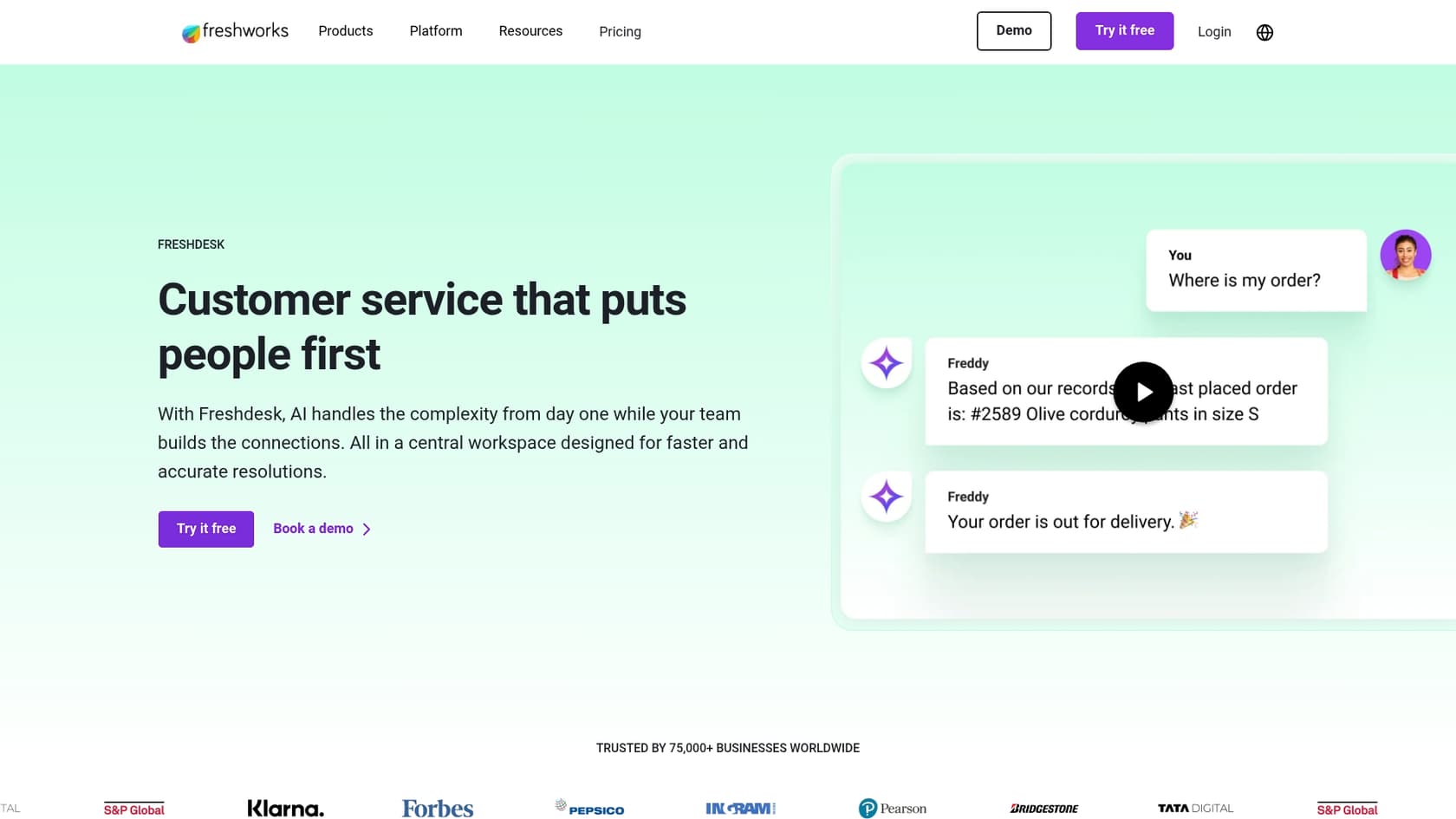
Freshdesk is a user-friendly and capable all-in-one support platform. Its AI, "Freddy AI," gives you a bunch of tools for automation and helping out agents. It’s a solid pick for small to medium-sized businesses that want a full solution that’s easy to get started with.
Pros:
-
The interface is clean and simple, making it easy for agents to learn the ropes.
-
Freddy AI is helpful for generating replies, summarizing tickets, and automating workflows.
-
The pricing is competitive, especially for smaller teams looking for a combined helpdesk and AI solution.
Cons:
-
Just like other integrated suites, you adopt the whole platform to get the full benefits of the AI features.
-
Some AI agent sessions are sold in packs, so you'll want to monitor your usage to stay within your planned budget.
Pricing: The Pro plan, which has AI features, is $49 per agent/month (billed annually). Additional costs for certain AI sessions may apply.
4. Capacity
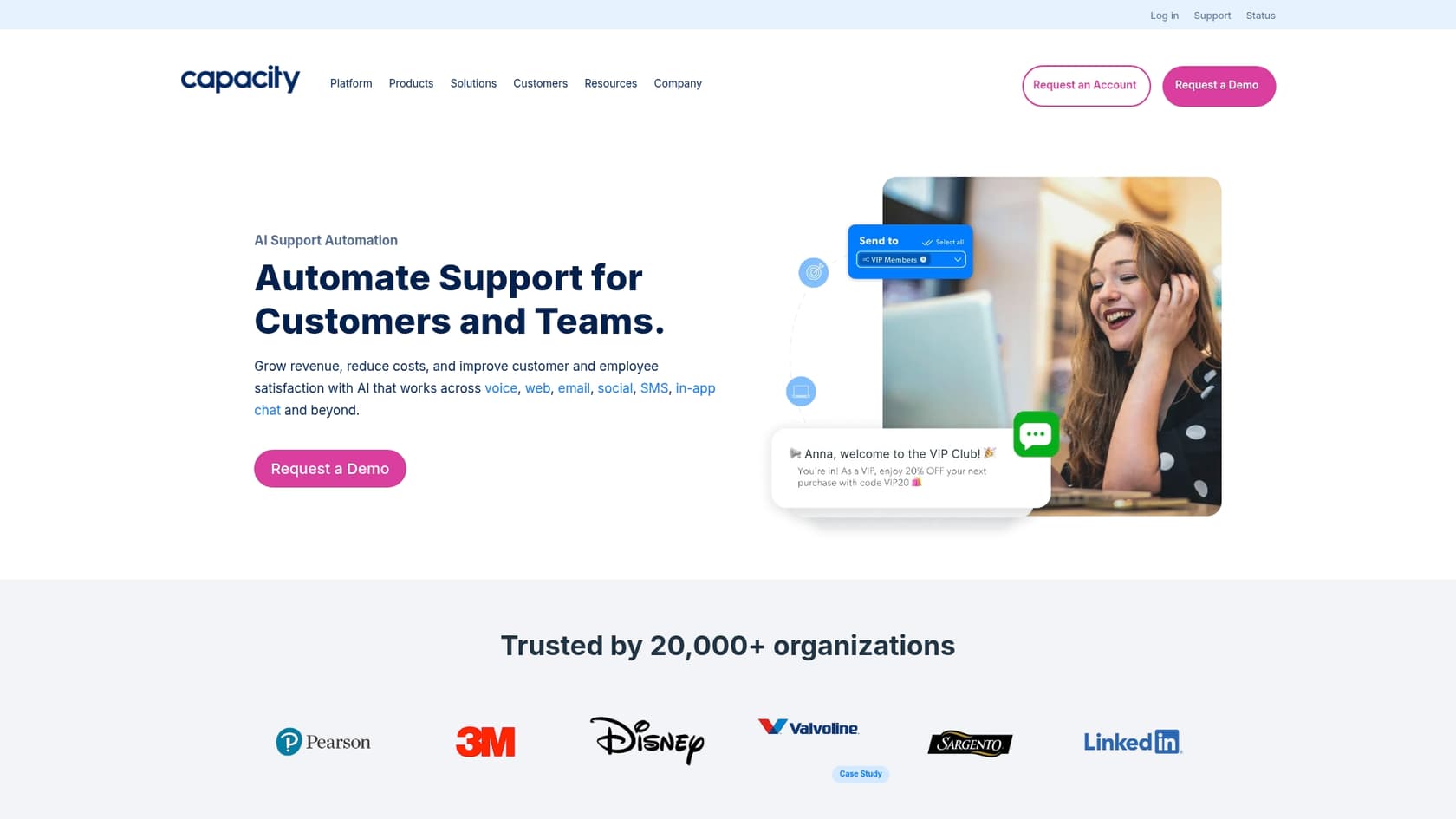
Capacity is an AI-first platform built specifically to answer questions and automate tasks. It’s focused on creating a source of truth by pulling your company's knowledge into one place and making it available through chatbots and internal search.
Pros:
-
Because it’s focused on AI, you can build sophisticated, multi-step automated workflows.
-
It's designed to connect to various business apps, which helps pull information together.
-
It can be used for both external customer support and internal employee help.
Cons:
-
It is more of an automation engine than a ready-to-go helpdesk, so you might spend more time configuring it to your team's specific process.
-
The pricing is not public, so you’ll need to schedule a consultation to understand how it fits into your budget.
Pricing: Capacity uses custom pricing. You’ll have to talk to their sales team to find out what it would cost for your organization.
How to choose the right Commslayer alternative
Picking the right tool really comes down to answering three quick questions.
Look at your current tools
Do you like your current helpdesk and just want to make it smarter? If you're happy with Zendesk, Freshdesk, or another tool but just want better automation, then an AI layer like eesel AI is a perfect choice. It enhances what you already have.
If you’re ready for a complete fresh start with an industry leader, a powerful suite like Zendesk is a proven way to go.
Identify your knowledge sources
If your team's most useful information is scattered across Google Docs, Confluence, and Slack threads, you need a tool that can connect those dots. eesel AI stands out here because it's built to pull in and make sense of knowledge from many different places.
Consider your budget
If you need predictable costs, look for a platform with clear pricing. eesel AI’s interaction-based model helps you plan your spend. For larger teams, Zendesk's tiered plans provide the stability and high-end features that justify an enterprise-level investment.
The future of Commslayer alternatives is connection, not replacement
The best support tools don't require you to tear down everything you've already built. They plug in seamlessly, connect to your existing systems, and make them better. Whether you choose an all-in-one powerhouse like Zendesk or a complementary AI layer, the goal is a more flexible, connected approach.
An AI layer makes a lot of sense if you want to keep the helpdesk your team already knows, while adding powerful automation on top. It's about finding the right balance for your specific needs.
Ready to see how AI can improve your existing helpdesk? Try eesel AI for free and see how it works with your own support tickets in just a few minutes.
Frequently asked questions
I'm feeling overwhelmed by my current support setup: why should I specifically look into Commslayer alternatives?
Many users seek Commslayer alternatives because their current tools might not connect to all knowledge sources, offer only basic automation, or come with complex pricing. These alternatives aim to tame support chaos in chat apps by automating tasks and providing instant AI answers. They prevent conversations from slipping through the cracks and free up your team for more complex issues.
What's the main difference between an "AI layer" and an "all-in-one suite" when evaluating Commslayer alternatives?
An AI layer, like eesel AI, plugs into your existing helpdesk and knowledge sources to make them smarter without replacing them. An all-in-one suite, such as Zendesk, is a complete system that provides a robust, enterprise-grade environment for your entire support operation. Industry leaders like Zendesk offer a highly reliable and deep feature set for growing teams.
How do these Commslayer alternatives typically connect to all the different places my company's knowledge is stored?
The best Commslayer alternatives, particularly AI layers like eesel AI, are designed to integrate with diverse knowledge sources. They can pull information from help centers, past tickets, Confluence, Google Docs, Notion, and more. This ensures their AI learns from where your information actually lives, providing comprehensive and accurate answers.
What kind of pricing models should I expect to see among Commslayer alternatives, and which ones are most predictable?
You'll encounter flat rates based on interaction volume (like eesel AI, which is highly predictable) and per-seat models that scale with your team size (Zendesk, Freshdesk). Zendesk, for instance, offers tiered plans that allow companies to select the best fit for their specific team size and needs. The blog recommends looking for clear pricing to avoid surprise bills.
Can Commslayer alternatives only be used for external customer support, or can they also help with internal team questions?
While primarily discussed for external customer support, some Commslayer alternatives, like Capacity, are designed to be used for both external customer support and internal employee help. They aim to consolidate company knowledge and make it accessible through chatbots and internal search.
I want to get started quickly: how easy is it to set up most Commslayer alternatives?
Setup time varies significantly among Commslayer alternatives. AI layers like eesel AI emphasize self-serve setup and can be live in minutes by connecting existing helpdesks and knowledge sources with a few clicks. Established suites like Zendesk provide a comprehensive platform that powers some of the world's largest companies, ensuring stability and extensive marketplace support as you grow.