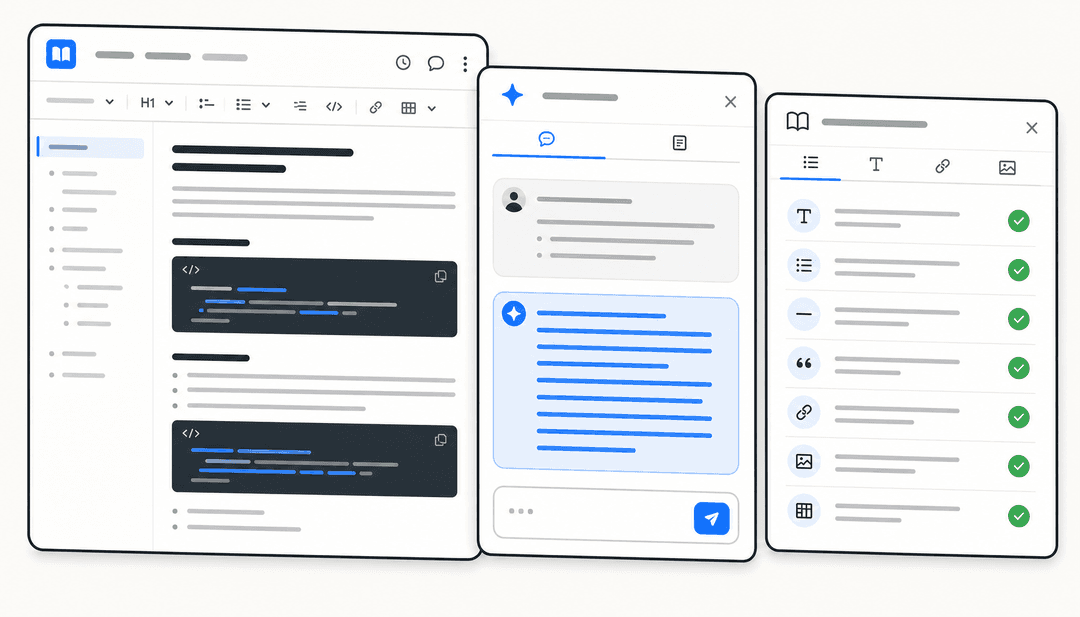
I’ve spent more hours than I can count staring at a blinking cursor, trying to wrestle a mountain of engineering notes, Slack threads, and half-finished spec documents into a user guide that actually makes sense. If you're a technical writer, you know the feeling. The pressure is always on to be accurate, clear, and fast, but the information you need is scattered across a dozen different places. It’s a constant battle against chaos.
Lately, though, I’ve found a pretty solid ally: AI. And I don't mean some robot that's coming for my job. I'm talking about smart tools that act as a co-pilot, handling the tedious, time-sucking parts of the process so I can focus on what I’m actually good at, things like strategy, information architecture, and creating a great user experience.
After trying out a ton of different applications, I’ve put together a no-fluff list of the 7 best AI tools for technical writers in 2025. These are the ones that actually make a difference, helping you write better and faster, with a lot less of that classic tech-writer friction.
What are AI tools for technical writers?
These aren't just generic chatbots you'd ask for a dinner recipe. We're talking about specialized applications designed to tackle the unique headaches of technical communication. They're built to help you where you need it most.
Their main jobs break down into a few key areas:
-
Digging up information for you: Imagine an assistant that can instantly read all your company's internal wikis, code repositories, and engineering docs, then give you a straight answer to a complex question.
-
Getting that first draft on the page: These tools can create solid first drafts of procedures, API documentation, or release notes by using your source material as a foundation. It’s a huge head start.
-
Polishing your writing and keeping it consistent: This is more than a simple spell-check. It’s about ensuring clarity, maintaining a consistent tone, and making sure every document sticks to your team’s style guide.
-
Creating visuals that actually help: Good documentation needs good visuals. These tools can help generate diagrams, annotate screenshots, and create other visual aids that make complex ideas easier to understand.
How I picked the top AI tools for technical writers
To make this list genuinely useful, I didn't just pick the most popular names. I judged each tool based on what actually matters in a technical writer's day-to-day grind. Here's my checklist:
-
Does it solve a real problem? I looked for tools that address a real, nagging issue for technical writers, whether it’s research, drafting, editing, or creating visuals. No novelties allowed.
-
How painful is it to set up? The best tools slot right into your existing workflow, connecting with platforms like Confluence or Google Docs without giving you a massive headache.
-
Can you trust what it says? This is a big one. The tool has to base its answers and drafts on the source material you provide to avoid making stuff up (what the pros call "hallucinations").
-
Does it play well with others? Documentation is a team sport. I looked for tools that make it easy to handle reviews, feedback, and shared workflows.
-
Is it worth the money? The price had to be fair for the efficiency boost it provides. The return on investment had to be clear.
A quick comparison of the best AI tools for technical writers in 2025
Here’s a quick look at my top picks. We'll dive into the details next, but this should give you a sense of where each tool shines.
| Tool | Primary Use Case | Best For | Starting Price |
|---|---|---|---|
| eesel AI | Knowledge Unification & Research | Teams needing a single source of truth for accurate documentation | $299/mo (500 credits) |
| Grammarly | Editing & Style Consistency | Individual writers and teams focused on polishing prose | $12/mo (Pro) |
| Claude | Long-Context Drafting & Summarization | Creating long-form drafts from extensive source documents | Free tier available |
| Acrolinx | Enterprise Content Governance | Large, regulated organizations needing strict terminology and style control | Custom (Enterprise) |
| oXygen AI Assistant | Structured XML/DITA Authoring | Writers working in a formal, component-based documentation environment | Add-on to oXygen license |
| Canva | AI-Powered Visuals & Diagrams | Creating high-quality visual aids and annotated screenshots quickly | Free tier available |
| Paligo | Component Content Management | Teams managing complex, reusable content with built-in AI assistance | Custom (CCMS) |
The 7 best AI tools for technical writers in 2025
Alright, let's get into the nitty-gritty of what makes each of these tools worth a look.
1. eesel AI
Let’s be real, the biggest bottleneck in technical writing isn't the writing itself, it's finding the correct, up-to-date information. It’s buried in engineering specs, scattered across Slack channels, and hidden in old support tickets. The "AI Internal Chat" from eesel AI is designed to solve exactly this problem. It acts as a foundation for all your documentation work by creating a single, searchable source of truth.
You connect it to all your company's knowledge sources, things like Confluence, Google Docs, Jira, and even past tickets. Once it's set up (which takes minutes, not months), you can ask it plain-English questions like, "What are the API rate limits for the new billing endpoint?" and get an instant, accurate answer with the sources cited. This is a huge relief, saving you hours of digging for information and bugging engineers.
Why it's on the list: It tackles the "garbage in, garbage out" problem head-on. By making sure your source information is accurate before you start writing, it improves the quality of everything that follows. Its radically self-serve setup, where you can go live without ever talking to a salesperson, is a huge breath of fresh air in the B2B software world.
Pros:
-
You can set it up yourself in just a few minutes.
-
It brings together dozens of scattered knowledge sources into one conversational chat interface.
-
It bases every answer on your company's private data, which means the accuracy is incredibly high.
Cons:
- It’s mainly a knowledge and research tool, not a standalone long-form document generator. You'd use its verified answers to feed a drafter like Claude.
Pricing: eesel AI's pricing is refreshingly transparent: fixed monthly credit plans, with no per-seat fees.
-
Free: 100 credits to try everything, no card needed.
-
Teammate: From $299/month for 500 credits (up to 5,000 credits for $1,899), with every integration, AI-powered ticket triage, skills, and unlimited agents and seats. A ticket or chat is 1 credit.
-
Larger volumes: More than 5,000 credits, plus add-ons like SSO and data residency, through sales.
2. Grammarly
Once you have your facts straight, it's time to write. Grammarly is the go-to tool for polishing your prose. It’s way more than a spell-checker. It provides smart, real-time feedback on grammar, clarity, conciseness, and tone, helping you turn technical jargon into easy-to-understand content.
Why it's on the list: Its integrations are practically invisible. Whether you're writing in Google Docs, a web browser, or another app, Grammarly is right there with you. The ability for teams to create a custom style guide is fantastic for keeping documentation consistent, no matter who is writing it.
Pros:
-
Gives you instant, actionable feedback as you type.
-
Works with almost every app and browser you use.
-
Customizable style guides help keep the whole team on the same page.
Cons:
-
Its suggestions can sometimes be a bit generic and might not always fit a highly technical context.
-
It can occasionally slow down web-based applications.
Pricing: Grammarly offers a few tiers:
-
Free: Catches basic spelling, grammar, and punctuation mistakes.
-
Pro: Starts at $12/month (billed annually). Adds sentence rewrites, tone adjustment, plagiarism detection, and 1 style guide.
-
Enterprise: Custom pricing. Adds unlimited style guides, admin controls, and enterprise security.
3. Claude
Claude's superpower is its ability to handle massive amounts of text. As a technical writer, you’re often handed a 50-page design document or a long transcript of an engineering meeting and told to "make a guide out of this." With Claude, you can upload the entire file and ask it to summarize the key points, pull out all the procedural steps, or even generate a complete first draft.
Why it's on the list: Its huge context window is a perfect match for the dense, in-depth source material that technical writers deal with every day. It saves a ton of time on that initial processing and drafting phase.
Pros:
-
Excellent at summarizing very long documents accurately.
-
Generates well-structured, long-form drafts that give you a great starting point.
-
The conversational interface is intuitive and easy to use.
Cons:
- Like any large language model, you need to fact-check it carefully. It can invent details if its source material is ambiguous.
Pricing: Claude has a simple pricing structure:
-
Free: A generous free tier for everyday use.
-
Pro: $20/month ($17/month if billed annually) for significantly more usage, access to the latest models, and priority access.
-
Max: From $100/month for 5-20x more usage than Pro, ideal for heavy-duty tasks.
4. Acrolinx
If you work in a large, regulated industry like finance or healthcare, Acrolinx (which now operates as Markup AI) is the heavyweight champion of content governance. This platform goes way beyond style suggestions. It ensures that every piece of content strictly follows complex rules around terminology, brand voice, and legal or regulatory compliance.
Why it's on the list: For big organizations where brand voice and legal precision are everything, Acrolinx is the industry standard. It's built to manage content complexity at a massive scale.
Pros:
-
Incredibly powerful for enforcing consistency across a global team.
-
Connects with a wide range of authoring tools and content management systems.
-
Gives you detailed analytics on content quality and compliance.
Cons:
-
It’s a serious investment in both time and money for setup and configuration.
-
Definitely overkill for smaller teams or startups.
-
Pricing isn't public, which means you have to go through a lengthy sales process to get a quote.
Pricing: Acrolinx offers custom pricing and requires a sales consultation. This usually means it's a solution tailored for large enterprise budgets.
5. oXygen AI Positron Assistant
This one is for a specific but crucial group of technical writers: those who live in the world of structured authoring with XML and DITA. The AI Positron Assistant is an add-on for the popular oXygen XML Editor. It's designed to help generate, rework, and validate structured content directly within the editor, so it understands the unique constraints of topic-based authoring.
Why it's on the list: It’s a purpose-built AI tool for a highly specialized field. Instead of trying to force a general-purpose AI to understand DITA, this tool is native to the environment where structured content gets made.
Pros:
-
Deeply integrated into the oXygen ecosystem, making it a natural fit for existing workflows.
-
Understands the rules of structured content, helping to automate DITA-specific tasks.
-
Can speed up the creation and validation of complex XML documents.
Cons:
- It's only useful if you're already an oXygen user and committed to a DITA/XML workflow.
Pricing: The AI Positron Assistant isn't a standalone product but is included in the Enterprise (AI-ready) licenses for oXygen's tools. For example, a single user license for the "Oxygen XML Editor Enterprise (AI-ready)" is $1,465 and includes a 1-year Support & Maintenance Pack (SMP).
6. Canva
Let's be honest, a wall of text is a user's worst nightmare. Great technical documentation relies on clear visuals. Canva's suite of AI tools, called Magic Studio, gives writers who aren't graphic designers the power to create professional-looking diagrams, flowcharts, and annotated screenshots in minutes.
Why it's on the list: Visuals are essential for clarity, and Canva's AI features make creating them incredibly easy. You can turn a boring bulleted list of steps into a clean flowchart with a single click.
Pros:
-
Extremely user-friendly with a very gentle learning curve.
-
A massive library of templates and assets to get you started.
-
AI features can generate visuals directly from text prompts.
Cons:
- It's not a specialized technical diagramming tool like Visio or Lucidchart, so it might lack some advanced features needed for highly complex schematics.
Pricing: Canva's pricing is very approachable:
-
Free: A surprisingly robust free tier that's enough for many users.
-
Pro: Starts at US$144/year for one person. Unlocks premium templates, more AI features, and brand kits.
-
Business: Starts at US$250/year per person. Adds more collaboration and brand management tools.
7. Paligo
Paligo is a top-tier Component Content Management System (CCMS) designed for topic-based authoring and content reuse. It has been steadily adding AI features directly into its platform. This means that while you're writing a reusable content "component," Paligo's AI assistant can help you improve, simplify, or summarize it on the spot.
Why it's on the list: It shows where documentation is headed, a future where AI isn't a separate tool but an integrated part of the entire content lifecycle, from authoring to publishing.
Pros:
-
Extremely powerful for managing content at scale with single-sourcing and reuse.
-
The integrated AI makes the authoring workflow more efficient.
-
Excellent collaboration and review features for large teams.
Cons:
- A full CCMS is a major strategic decision and a significant investment. It's not for teams that don't already have a mature content reuse strategy.
Pricing: Paligo's pricing now lists a Business plan starting at $15,000/year (2 authors, 2 languages), with custom Enterprise pricing. AI-powered Nexus Answers is a separate add-on starting at $6,000/year.
Practical tips for getting started with AI tools for technical writers
Okay, that's a lot of tools. Feeling a bit overwhelmed? Don't be. You don't need to adopt all of them at once. Here’s how to start smart:
-
First, focus on research, not drafting. The biggest mistake you can make is asking an AI to write about a topic it knows nothing about. Before you generate a single word, use a tool like eesel AI to gather and verify your source information. This stops you from creating beautifully written but factually incorrect content.
-
Let AI build the skeleton. Instead of staring at a blank page, ask an AI to create a high-level outline or table of contents. This helps organize your thoughts and gives you a clear roadmap to follow.
-
Talk to the AI and guide it. Don't just accept the first thing the AI gives you. Instead of "write about our new feature," try something more specific like, "Explain our new data export feature to a non-technical user. Focus on the top three benefits. Use simple language and provide a step-by-step list for how to use it."
-
Remember, you're still the expert. Treat AI-generated content like a first draft from a very fast, very eager junior writer. You are still the one in charge. Your job is to review it for accuracy, add necessary context, and make sure it matches your company's voice.
AI tools for technical writers are your new co-pilot, not your replacement
The takeaway here isn't that AI is coming for your job. It's here to take away the worst parts of your job. These tools are exceptionally good at handling the repetitive, time-consuming tasks that get in the way of deep thinking, like hunting for information, formatting documents, and writing rough drafts. This frees you up to focus on the things that truly require a human touch: understanding user needs, structuring information logically, and ensuring every piece of documentation is clear, accurate, and genuinely helpful.
Your expertise, judgment, and strategic thinking are more valuable than ever. AI is just the power tool that helps you apply them more effectively.
Ready to build your documentation on a foundation of truth? Stop wasting time hunting for information across a dozen apps. Try eesel AI to unify your knowledge and give your writers the accurate answers they need, instantly. You can set up your AI knowledge assistant in minutes.
Frequently asked questions
What exactly are AI tools for technical writers, and how do they benefit us?
AI tools for technical writers are specialized applications designed to automate tedious tasks such as information gathering, drafting, and editing. They help improve accuracy, consistency, and speed in your documentation process, allowing writers to focus on higher-level strategic work.
I'm worried about "hallucinations." How can I ensure the accuracy of content generated by AI tools for technical writers?
What's the best way for a beginner to get started with using AI tools for technical writers?
Start by focusing on research and information gathering rather than immediate drafting. Use tools like eesel AI to verify facts first, then allow AI to generate outlines or first drafts, always remembering that you remain the expert.
Will using AI tools for technical writers eventually replace my job?
Not at all. AI tools for technical writers are designed to be co-pilots, handling the repetitive and time-consuming aspects of the job. They free you up to focus on critical human tasks like understanding user needs, strategic information architecture, and ensuring empathy in documentation.
How do AI tools for technical writers integrate with existing documentation workflows and platforms?
Many AI tools for technical writers are designed for seamless integration with platforms like Google Docs, Confluence, and internal wikis. Tools like Grammarly work across applications, while specialized CCMS systems like Paligo integrate AI directly into the content lifecycle.
Are there different types of AI tools for technical writers, and which ones should I prioritize first?
Yes, there are different types of AI tools for research (e.g., eesel AI), drafting (e.g., Claude), editing (e.g., Grammarly), visuals (e.g., Canva), and content governance (e.g., Acrolinx). Prioritize tools that address your biggest workflow bottlenecks, starting with accurate information gathering.