Real-world AI in customer service examples: A practical guide for 2025

Kenneth Pangan
Written by

Kenneth Pangan

Reviewed by

Katelin Teen

Last edited December 14, 2025

Expert Verified

Real-world AI in customer service examples: A practical guide for 2025

Let's be real, customer expectations are through the roof, and your support team is likely feeling the heat. Between the constant flood of tickets, repeating the same answers, and trying to keep a smile on, it’s a recipe for burnout. The old way of doing things just isn't cutting it anymore.

And that’s where AI comes into the picture. Forget the sci-fi stuff about robots taking over. The reality of AI in customer service is much more practical: it’s about giving your human team superpowers. It helps them deliver faster, smarter, and more personal support than they ever could on their own.

In this guide, we're cutting through the noise to show you some practical, AI in customer service examples. We’ll check out how top platforms are using AI for everything from self-service to agent support. And here's a little secret: the best AI tools don't make you throw out your current helpdesk. They work with the tools you already know and love, making the whole process a lot less painful.

What is AI in customer service?

So, what are we really talking about? At its core, AI in customer service is just using smart technology, like machine learning and natural language processing, to help your team solve customer problems better and faster.

Let's quickly unpack those terms without getting too technical. As the infographic below illustrates, these two technologies work together to understand and learn from customer interactions.

  • Machine Learning (ML): Think of this as the AI’s brain. It learns from all your past support tickets and help articles. Just like a new team member gets better with experience, the AI gets smarter and more accurate over time.

  • Natural Language Processing (NLP): This is what lets the computer understand how humans actually talk (or type). It figures out what a customer really means, even if their grammar isn't perfect or they use slang.

![An infographic showing the relationship between Machine Learning and Natural Language Processing, which are core components of the AI in customer service examples discussed.::]([infographic] , A visual explaining how Machine Learning (ML) analyzes past data to find patterns, and how Natural Language Processing (NLP) interprets human language. The two concepts are shown working together to power AI customer support.)

The goal isn't just to automate for the sake of it. It’s about making life better for everyone. Customers get quick, correct answers whenever they need them. Your agents get to skip the boring, repetitive tasks and spend their brainpower on the tricky problems where a human touch is essential.

Key components seen in modern AI in customer service examples

Most companies lean on AI to improve their support in three main areas. Let’s look at some real examples for each.

1. AI for customer self-service and ticket deflection

This is all about giving customers the power to help themselves. By instantly answering common questions, you can lighten the load on your agents and deflect a ton of tickets before they ever reach the queue.

Example 1: AI agents and chatbots

Think of these as your digital front-line crew. They’re on the clock 24/7, ready to give instant answers on things like order status, return policies, or billing questions. You can find them on websites, in apps, or even handling emails.

For example, leading AI agents can handle up to 57% of common questions on their own across chat, email, and social media. Over at Freshdesk, their Freddy AI Agent comes with "Agentic Workflows" for specific industries like ecommerce, so it can manage a whole process like a product return from start to finish.

Example 2: AI-powered knowledge bases

AI is also making help centers a lot smarter. Instead of making customers scroll through pages of articles, AI can guess what they're looking for and bring the most relevant info to the top. Zendesk's AI-powered Knowledge Base is a great example of this. It also flags unsuccessful searches for your support managers, pointing out gaps in your content so you can make your help center better over time.

The catch with some of these tools

While these platforms are powerful, some of them have a sting in the tail: unpredictable pricing. Some platforms, for instance, charge a fee for every single time an AI agent solves an issue. That can feel like you're being punished for doing well. Others, like Freshdesk, use confusing "session packs" that make it tough to budget your costs.

This is where a solution like eesel's AI Chatbot comes in with a different approach. It's designed for predictable pricing and total control. You can set it up in minutes, point it to your existing knowledge sources (like your help center or even a Shopify catalog), and it runs on a clear, usage-based plan with no hidden per-resolution fees. You get the benefits of automation without the bill shock.

A gif of the eesel AI Chatbot providing an instant answer, demonstrating one of the key AI in customer service examples for ticket deflection.

2. Agent assistance and productivity

In this role, AI is more like a copilot for your human agents. It helps them answer tickets faster, more accurately, and always in your brand's voice. It’s about making your team’s job easier, not replacing them.

Example 3: AI-drafted replies and summaries

This feature is a massive time-saver. When a ticket comes in, the AI can read it and draft a full, on-point reply. Your agent just has to give it a quick once-over, maybe tweak a word or two, and hit send. It can also create summaries of long, rambling conversations, which is super helpful for getting up to speed or passing a ticket to another team.

Salesforce's Agentforce has a feature called Service Replies that does exactly that, generating responses from past cases and your knowledge base. In the same vein, some AI copilot features allow agents to rephrase replies, change the tone, or summarize chats with a single click.

Example 4: Real-time knowledge surfacing

Instead of forcing agents to jump between tabs looking for the right help article, AI can pop up relevant info right when they need it. Zendesk's Copilot offers this kind of proactive help, suggesting knowledge base articles and macros related to the conversation. Everything the agent needs is right at their fingertips.

The problem with walled gardens

The main drawback with these native AI tools is that they can be pricey and tend to create information silos. The Salesforce Agentforce for Service add-on is a steep $125 per user each month, and Zendesk Copilot will run you an extra $50 per agent per month. Even worse, they're often blind to all the useful information hiding outside their own platform, in places like your Confluence, Google Docs, or Slack.

eesel's AI Copilot is built differently to solve both problems. It’s platform-agnostic, so it plugs right into the helpdesk you’re already using, whether that’s Zendesk, Freshdesk, or another support platform. More importantly, it connects to over 100 sources to draft its replies, pulling from your internal wikis and chat tools too. This way, you avoid getting locked into one vendor and can tap into all your company's knowledge, not just a tiny piece of it.

An animated gif of the eesel AI Copilot suggesting a reply within a support ticket interface, showcasing practical AI in customer service examples for agent productivity.

3. AI for back-end operations and triage

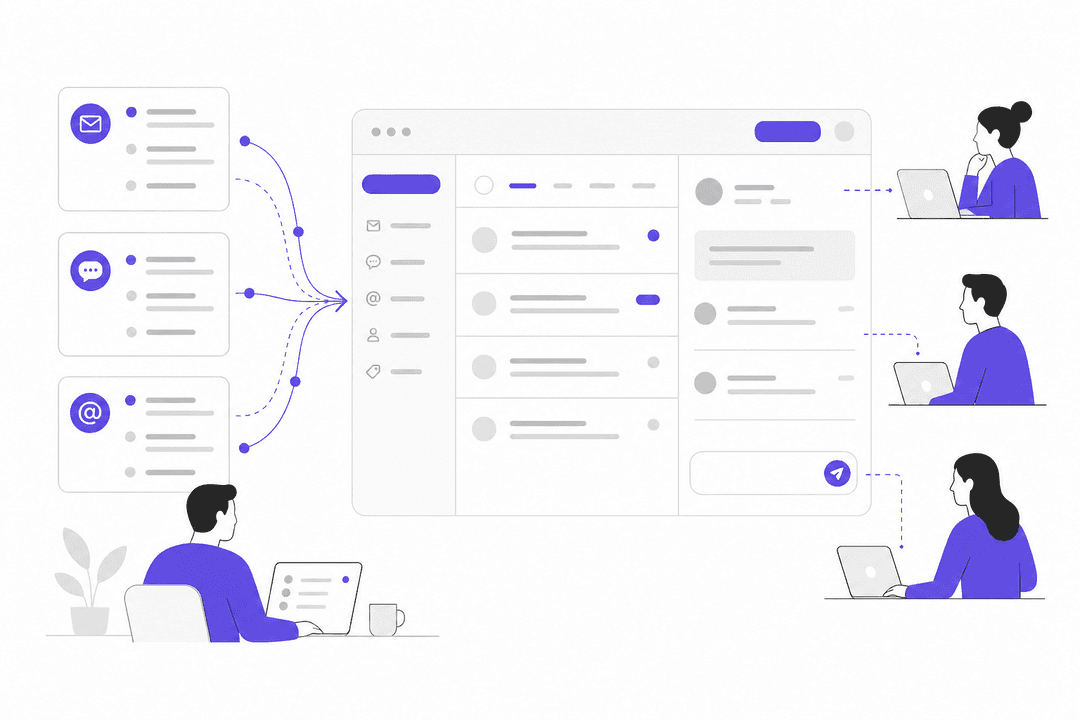
This is the behind-the-scenes work that AI can automate to keep your support operations running smoothly. It's all about sorting, tagging, and routing tickets to make sure they land in the right place, right away.

Example 5: Automated ticket routing and triage

Instead of a person manually reading and assigning every single ticket, AI can do it in a flash. It scans the ticket, understands what the customer needs (is it a billing question? A bug report?), and sends it to the right agent or team automatically.

Zendesk's Intelligent Triage can figure out a ticket's intent, sentiment, and language to route it. Kustomer goes a bit further with Skills-Based Routing which matches customers with agents who have specific skills, like being fluent in Spanish or knowing a certain product inside and out.

Example 6: Sentiment analysis and proactive insights

AI can also get a read on a customer's mood. Are they frustrated? Confused? Happy? This helps teams prioritize angry customers before a situation gets worse. On a bigger scale, AI can spot trends, like a sudden flood of tickets about a new feature, and give managers a heads-up so they can tackle the problem proactively.

Freshdesk's Freddy AI Insights is a good example here. It keeps an eye on key metrics and sends alerts about unusual activity, like a drop in customer satisfaction scores or a surge in tickets about a certain topic. If an urgent, negative ticket comes in, it can go straight to a senior team member. A simple billing question can go to finance. It's all about getting the right eyes on the right problem, fast.

Why setup can be a headache

The issue is that building these smart workflows can get complicated, fast. Both Zendesk and Freshdesk require admins to build and manage a complex web of rules and triggers. Kustomer's workflow builder is more visual, but it can still get pretty technical if you want to do anything advanced (developer.kustomer.com).

eesel's AI Triage offers a powerful but much simpler option. It’s designed to be completely self-serve, letting support leads set up rules for tagging, routing, and closing tickets without having to write any code.

The best part? It has a simulation feature that lets you test your rules on past tickets. You can see exactly how they’ll work and what their impact will be before you flip the switch.

A diagram illustrating the simple workflow for simulating triage rules before deployment, a key feature in modern AI in customer service examples.

A detailed comparison of AI customer service platforms

Picking the right tool comes down to your team’s budget, what software you're already using, and what you need AI to do. Here’s a quick side-by-side look at the big players.

FeatureZendesk AISalesforce AgentforceFreshdesk Freddy AIeesel AI
Key FeaturesAI Agents, Copilot, Intelligent Triage, Knowledge Base AI.Service Replies, Summaries, Case Classification, Voice AI.Freddy AI Agent, Copilot, Insights, Auto Triage.AI Agent, AI Copilot, AI Triage, AI Chatbot, Internal Chat.
Knowledge SourcesZendesk, Salesforce, Freshdesk, Web crawler.Primarily Salesforce ecosystem (Knowledge, Cases).Solution articles, URLs, Files (PDF, docx), Custom Q&As.100+ sources (Helpdesks, Google Docs, Confluence, Slack, etc.)
Pricing ModelPer-seat add-ons.Copilot: $50/agent/mo. (link)Per-seat add-ons or usage-based.Agentforce for Service: $125/user/mo. (link)Per-seat plan + add-ons.AI Agent: Session packs ($100/100 sessions). (link)**Transparent, usage-based plans.**Starts at $299/mo. No per-resolution fees. (link)
Setup & FlexibilityIntegrated, but can be a complex setup.Locked into the Salesforce ecosystem.Integrated, but requires configuration for each feature.Platform-agnostic, self-serve setup in minutes. Plugs into your existing helpdesk.

AI in customer service examples and your next steps

As these AI in customer service examples show, the technology really shines when it’s helping your team, not just getting rid of tickets. Success really boils down to three things: giving customers an easy way to help themselves, giving agents powerful tools to do their jobs better, and making sure everything behind the scenes runs smoothly.

The best way to get started is to find one repetitive, high-volume task in your workflow and think about how AI could help. The right tool should make this easy, affordable, and risk-free to try.

Curious to see how AI would perform with your actual setup, without signing up for a long and costly project? Start a free 7-day trial of eesel and run a simulation on your past tickets. You can predict your automation rate and ROI in just a few minutes.

Frequently asked questions

AI boosts efficiency by automating repetitive tasks like answering common questions and triaging tickets, freeing up human agents. It also provides agents with real-time knowledge and drafted replies, enabling them to resolve complex issues faster. This ultimately reduces response times and increases overall agent productivity.

For customers, AI offers 24/7 instant support and more personalized interactions through quick access to relevant information. For agents, it reduces burnout by handling mundane tasks, allows them to focus on challenging problems, and enhances job satisfaction with better tools.

Absolutely. While some enterprise solutions can be costly, there are flexible, usage-based AI options, like eesel, designed to be accessible for businesses of all sizes. These solutions focus on predictable pricing without hidden per-resolution fees, making AI more budget-friendly.

The blog emphasizes that AI's role is to empower human agents, not replace them. AI handles repetitive tasks and acts as a copilot, allowing agents to focus on complex, empathetic, and strategic customer interactions where a human touch is essential.

Many modern AI solutions, especially those designed to be platform-agnostic, can be set up in minutes by connecting to your existing helpdesk and knowledge sources. You can often see a measurable impact on ticket deflection and agent productivity within weeks of deployment.

AI learns from your existing support data, including past tickets, help articles, internal wikis, and chat logs. It uses this information to understand common questions, customer intent, and your company's specific knowledge base to provide accurate responses and assistance.

Share this post

Kenneth undefined

Article by

Kenneth Pangan

Writer and marketer for over ten years, Kenneth Pangan splits his time between history, politics, and art with plenty of interruptions from his dogs demanding attention.