

What an AI chatbot for telecom actually is
I work the support queue every day, so let me start with the thing that trips people up: there are two very different products wearing the same "chatbot" label.
The old kind is a rule-based chatbot: a scripted decision tree with buttons and canned replies. "Press 1 for billing, press 2 for technical support." It works right up until a subscriber phrases their problem in a way the script didn't anticipate, then it dead-ends into "I didn't understand that" and dumps them back to the start. Telecom customers, who are usually already annoyed that their data ran out or their bill jumped, hate it, and it's a big part of why telco CSAT sits near the bottom of every industry ranking.
The new kind is an AI customer service chatbot built on a large language model. It reads what the subscriber actually meant, finds the answer in your knowledge, and writes a reply in plain language. It can explain why this month's bill is higher, walk someone through activating an eSIM, or confirm whether there's a known outage on their tower, without a human touching it. That's the difference between deflection and resolution, and for telecom support at scale it's the whole ballgame.
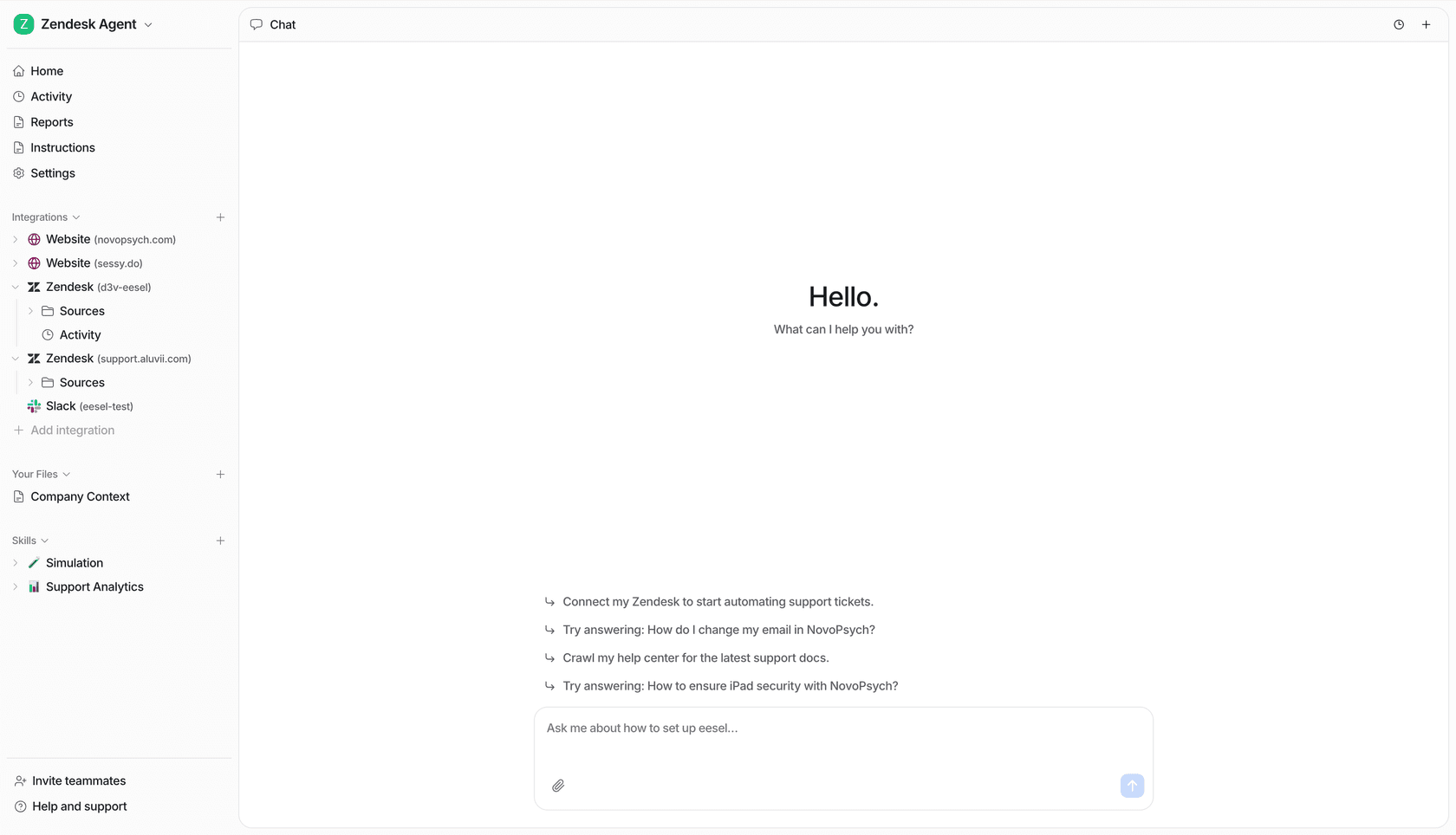
If you want to see the range of what these can do, my roundup of AI chatbot examples has concrete ones, and common chatbot problems covers where the older generation still trips up.
Why telecom support is its own kind of hard
Telecom support isn't retail support with more towers. A few things make it distinctly brutal, and they're exactly the things an AI chatbot is good or bad at depending on how you set it up.
The volume is enormous and painfully repetitive. A carrier can field the same "why is my bill higher this month" or "how much data do I have left" question tens of thousands of times a month. That repetition is what makes tier-1 deflection such a clean fit for AI, and it's why picking the right customer service metrics matters, most of that volume never needed a human in the first place.
Demand is spiky. A tower goes down, a new plan launches, or a billing cycle rolls over, and your queue triples in an hour. Human staffing can't flex that fast, so wait times blow out exactly when subscribers are most frustrated. An AI chatbot answers the same status question thousands of times in parallel without the queue growing, which is the single most useful thing it does for a telco.
The answer often lives in a system, not a doc. A lot of telecom questions ("what's my balance", "when does my contract end") need live account data, not just a help article. The chatbots worth using can pull from your connected systems and knowledge base together, so an AI knowledge base chatbot that only reads static FAQs is the floor here, not the ceiling.
The stakes are churn. Telecom is a switching market. A clumsy cancellation flow or a wrong answer about an early-termination fee doesn't just annoy someone, it loses the account. That's why the escalation logic below matters more here than almost anywhere else.
I heard the honest version of this fear from a support manager who wanted AI to take real load off the queue but was nervous about accuracy:
"The AI will never be able to answer 100% of the questions, but if it tries and just answers 'sorry I don't know this,' I cannot go and check all my 7,000 tickets to see if the AI actually made a good answer. I need an AI who is only handling the tickets that it's confident to handle and all the other ones, leave them alone."
That's the right instinct, and it's the whole design principle for doing this safely.
How an AI chatbot resolves a telecom ticket
Under the hood, a modern support bot runs the same loop every time, and it's worth understanding because it's where accuracy comes from.
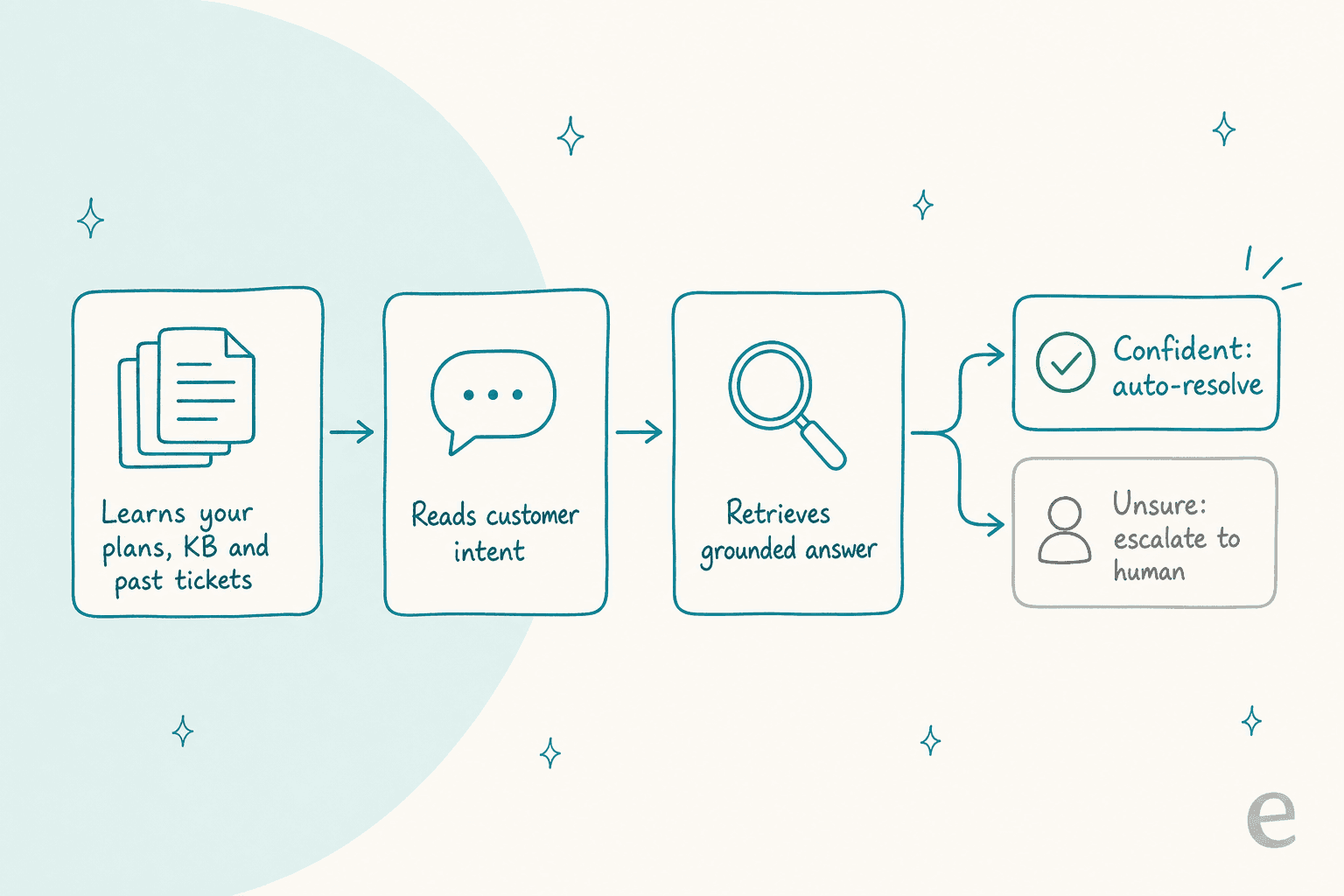
- It learns your knowledge first. Before it answers anything, it ingests your help center, plan and pricing docs, past tickets, and connected tools. Good tools turn years of ticket history into usable knowledge on day one, so it already sounds like your team and knows your plan names.
- It reads the subscriber's actual intent. Not keywords, meaning. "My data's gone already and it's the 10th" and "why did I get throttled" route to the same answer.
- It retrieves the answer from your knowledge, not from the open internet. This is what keeps it grounded in your plans and your coverage instead of a plausible-sounding guess.
- It checks its own confidence. If it's sure, it resolves the ticket. If it isn't, it hands off to a human. That single decision is what separates a trustworthy bot from a liability.
This is also where a conversational AI assistant earns its keep over a scripted flow: every step adapts to the specific subscriber instead of forcing them down a fixed menu. If you want the deeper mechanics, my guide to the benefits of conversational AI goes further.
What to automate, and what to leave to a human
The single biggest mistake is aiming for 100% automation. You don't want that, and neither do your subscribers. The goal is to let the AI clear the repetitive volume so your humans get their time back for the tickets that actually need a person, especially the ones where an account is on the line.
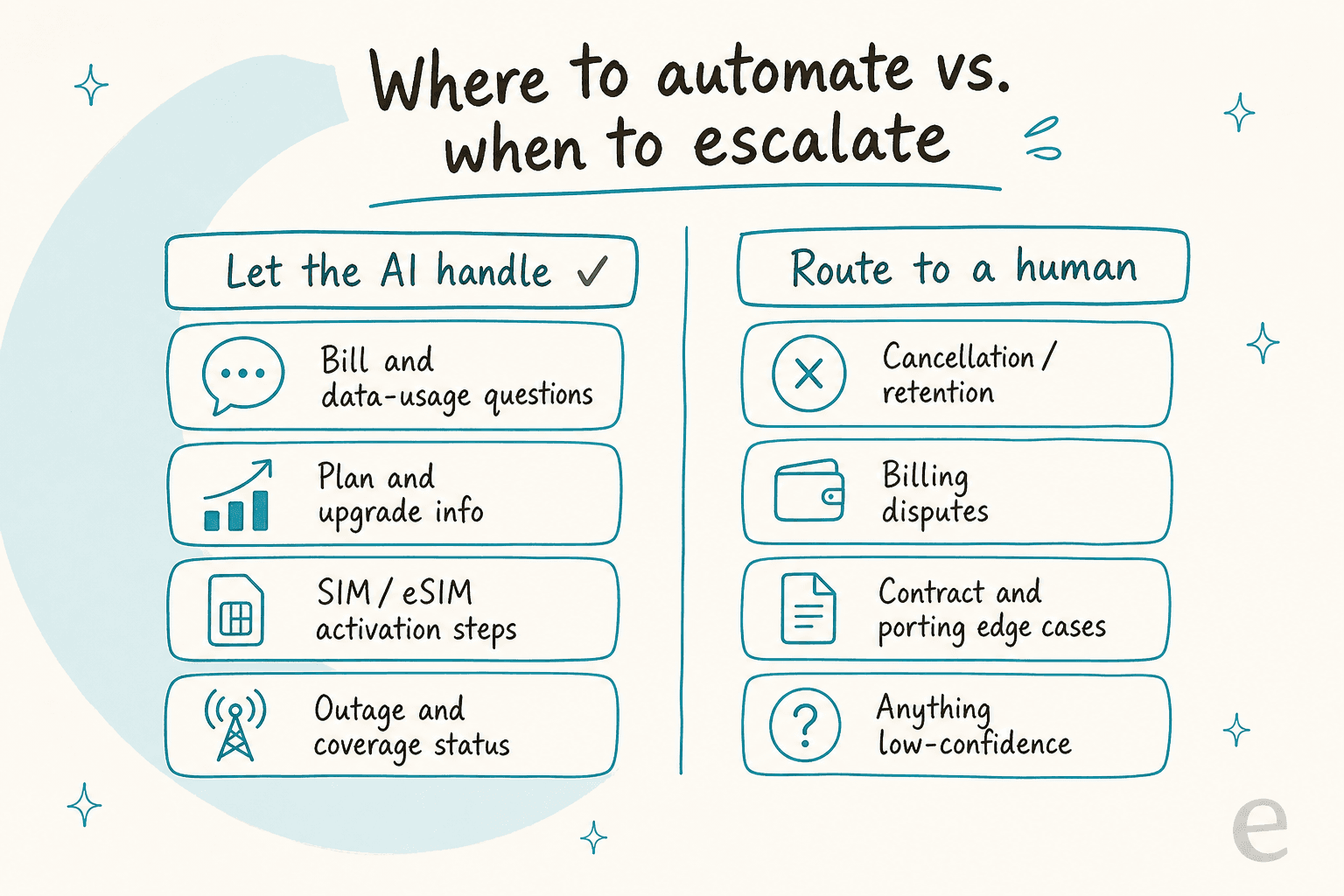
Here's a rough split that holds up for most telecom teams:
| Ticket type | Best handled by | Why |
|---|---|---|
| Bill explanations | AI | High volume, answer lives in billing data |
| Data usage and throttling | AI | Repetitive, single correct answer |
| SIM / eSIM activation | AI | Well-documented, step-by-step |
| Outage and coverage status | AI | Same answer, needed at massive scale |
| Plan and upgrade questions | AI | Pulls from your plan docs |
| Cancellation and retention | Human | Account at risk, needs judgement |
| Billing disputes and credits | Human | Needs authority and empathy |
| Number porting edge cases | Human (AI triages) | Regulated, but AI can tag and route |
| Anything low-confidence | Human | Never guess at a subscriber's bill |
The mechanism that makes this safe is AI escalation: the bot decides, per ticket, whether it's confident enough to answer. Low confidence means it drafts a reply for an agent to approve instead of sending it, or routes the whole ticket to a human. You get the volume relief without the "the bot quoted the wrong cancellation fee" horror story.
Meeting subscribers on the channels they actually use
Telecom support doesn't happen in one place. Some subscribers open the app, some reply to an SMS, plenty message on WhatsApp, and a big share still call. A chatbot only pays off if it covers where your subscribers already are, so the same trained AI should answer in the app chat, over SMS, and increasingly on voice too.
The key thing is that it's one trained brain behind all of them. You don't want a separate FAQ bot for the website and a different scripted flow for WhatsApp, both going stale on their own schedule. Train once on your knowledge, deploy across channels, and every fix improves every surface at once.
Rolling it out without breaking trust
The fastest way to lose faith in an AI chatbot, and to torch subscriber trust, is to switch it on for every customer at once and hope. Do it the boring, safe way instead.
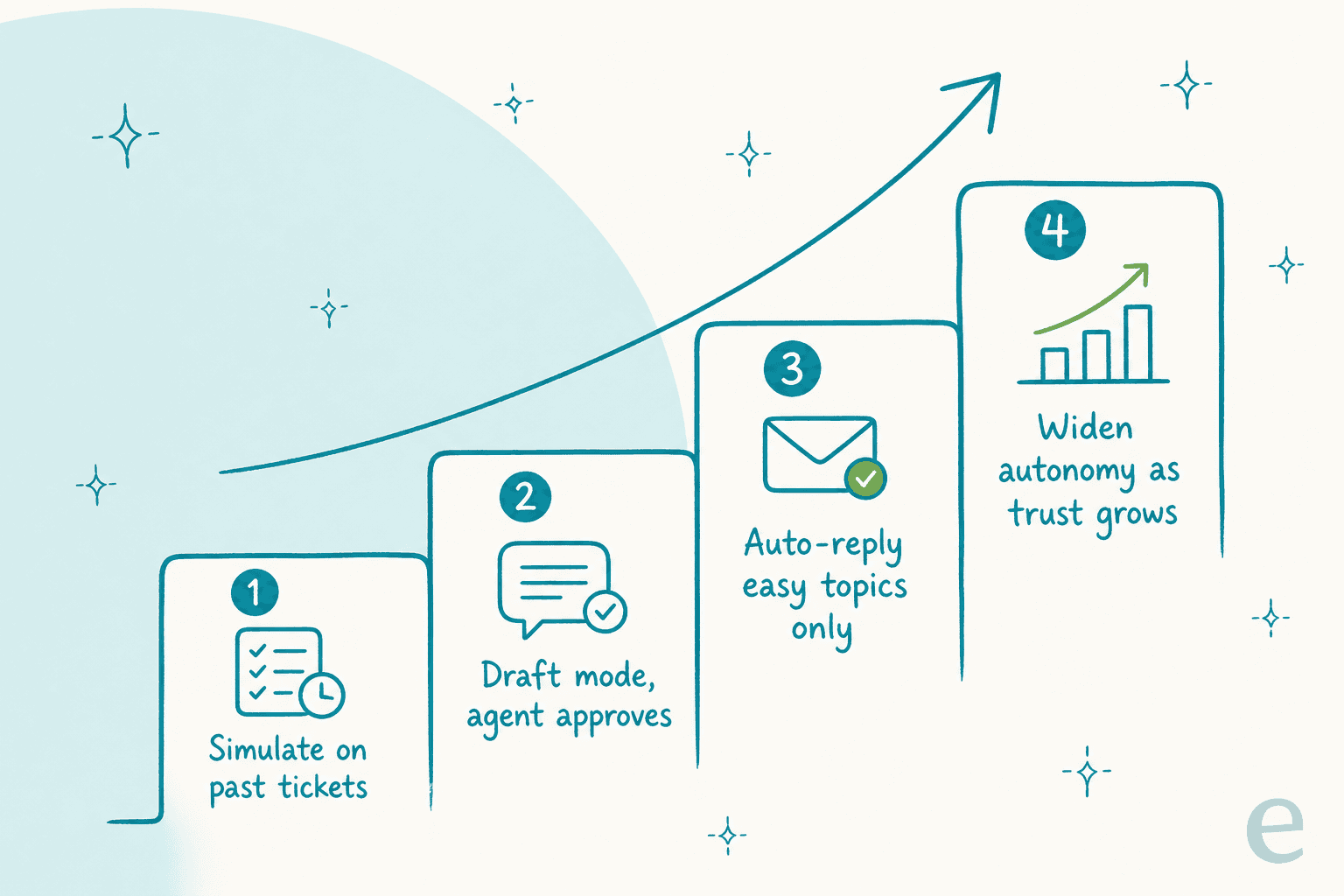
- Simulate on past tickets first. Before a single subscriber sees a reply, run the AI against thousands of your historical tickets and read what it would have said. eesel AI's simulation mode reports coverage by topic, so you can see exactly where it's strong (activation, usage) and where it's guessing (disputes).
- Start in draft mode. Let it write replies your agents approve before sending. Every correction teaches it, and your team builds trust by watching it get things right on real tickets.
- Auto-reply to easy topics only. Turn on full autonomy for the safe, high-volume categories (usage checks, outage status, activation steps) and keep everything else supervised.
- Widen autonomy as trust grows. As the numbers hold, hand it more. This is the opposite of the flip-a-switch approach, and it's why it sticks.
This gradual model is also how you dodge the classic AI chatbot problems, most of them come from over-automating before the tool has earned it. It's the same lesson we've relearned the hard way running AI on live queues for years: we've watched a confident-sounding bot quietly give wrong answers, which is exactly why every rollout now starts in simulation against real ticket history.
What it costs, and why the model matters
Sticker price is the wrong thing to compare. The pricing model is what actually decides your bill, and at telecom volumes the difference is huge.
Per-seat tools charge for every support agent on the plan, whether or not they touch the AI, which punishes you for having a big team. Per-resolution pricing scales with actual work done, but the bill is hard to forecast. eesel AI is one fixed monthly price: from $299/month for 500 credits (1 credit per ticket or chat, however long), no per-seat fees, no platform fee, and tickets your humans handle don't use credits. It's worth pressuring any vendor here: some per-resolution models bill you more the better the AI performs, and a fixed monthly plan keeps your bill steady even when an outage spikes volume.
Here's what that looks like across plan sizes (telecom teams with bigger volumes get custom pricing):
| Tickets per month | Monthly cost (Teammate plan) |
|---|---|
| 500 | $299 |
| 1,000 | $499 |
| 2,500 | $999 |
| 5,000 | $1,899 |
| More than 5,000 | Talk to us |
Compare that to the cost of a human agent handling the same tier-1 load at telco volumes, and the math tends to make itself. If you're still weighing options, my list of support automation platforms lays out the field.
Try eesel for telecom customer support
If you're running telecom support and drowning in the same bill, usage, and activation questions, this is exactly what eesel AI is built for. It plugs into the helpdesk you already use (Zendesk, Freshdesk, HubSpot, Front, and 100+ others), learns from your existing docs and ticket history in minutes, and resolves tier-1 tickets in 80+ languages without you writing a single flow.
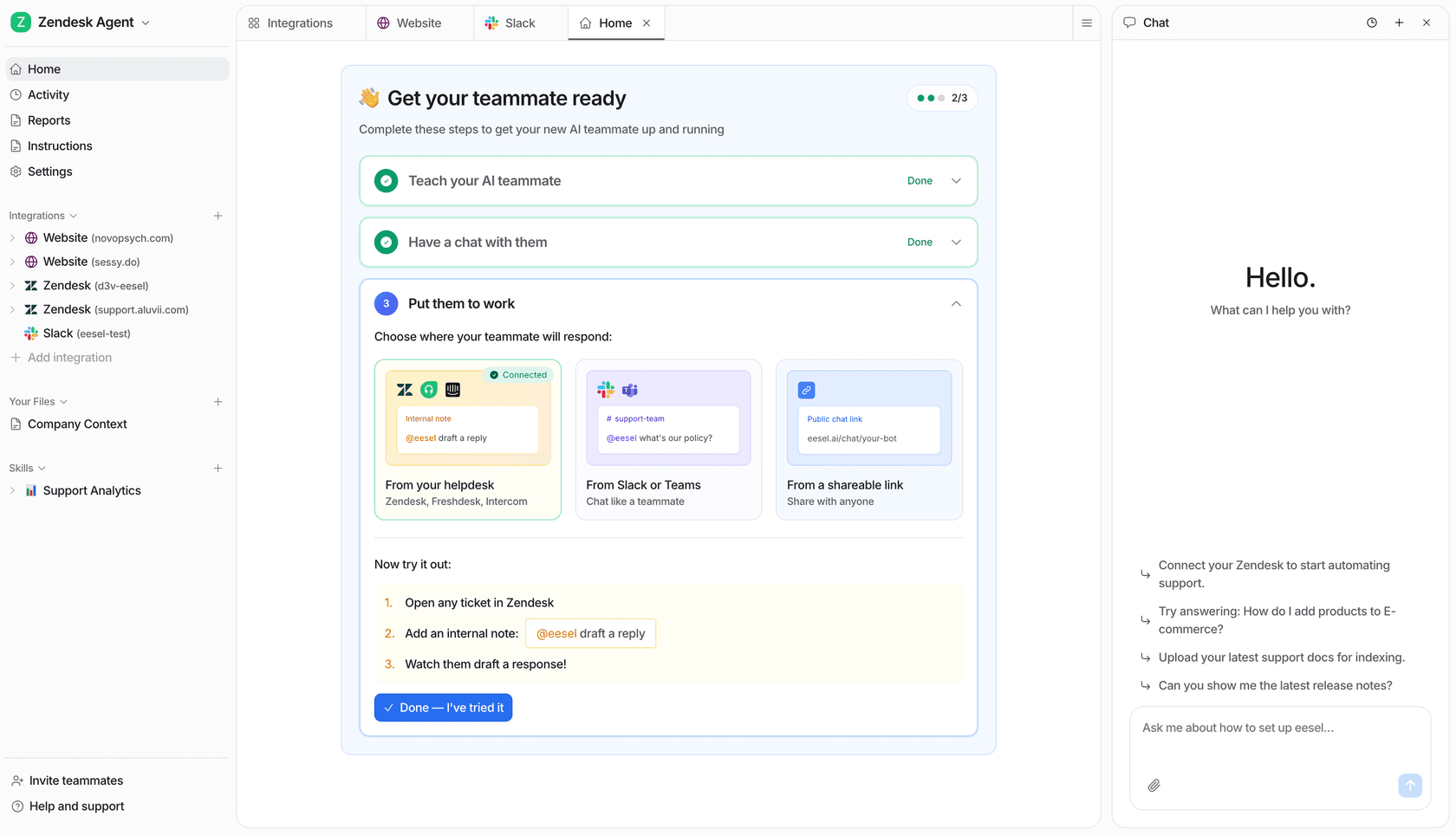
The part support teams tend to like most: you can simulate it against your past tickets before it ever touches a live subscriber, then widen its autonomy at your own pace with confidence-based escalation catching anything it's unsure about. Across 8,000+ customers, eesel resolves up to 65% of conversations automatically. It's free to start with 100 credits and no card, so you can run a simulation and see your own numbers before committing.