
How to tell a good chatbot idea from a gimmick
I spend my days on eesel's support queue, which means I see the gap between chatbot ideas that sound clever in a planning doc and the ones that actually reduce load once they meet real customers. The clever-sounding ones almost always fail the same way: they try to be a personality, or a "concierge for everything," and end up confidently wrong on the questions that mattered.
The ideas that work are narrower and more boring, and they pass three checks:
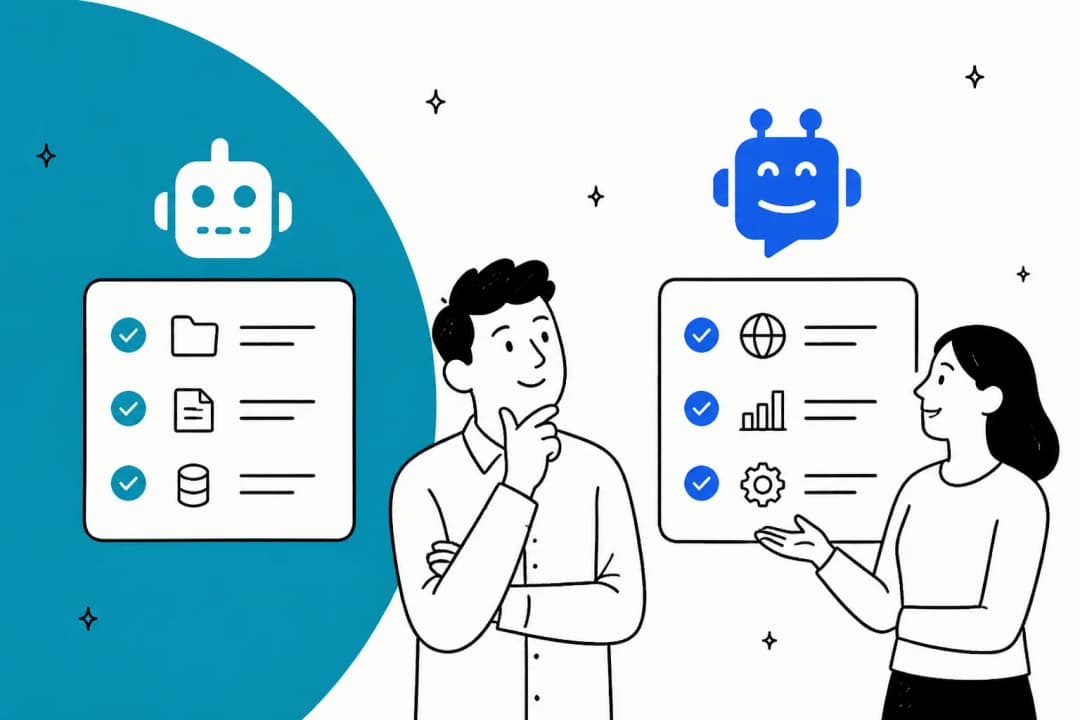
- It maps to a ticket type you already get a lot. If you cannot point at a folder of real tickets the bot would have handled, it is a solution looking for a problem. The best first chatbot idea is hiding in your own ticket volume.
- It can take an action, not just answer. Answering "where is my order" is table stakes; actually pulling the tracking number is the point. This is the line between a customer service chatbot and an FAQ widget.
- It knows when to stop. The scariest bots are the confident ones. A good chatbot idea has a clear "I'm not sure, here's a human" path built in from day one, which is why so many teams get burned when their AI chatbot answers incorrectly.
That last point is the whole game. Here is the loop every one of these ideas should follow, whether it is deflecting a shipping question or routing an IT ticket:
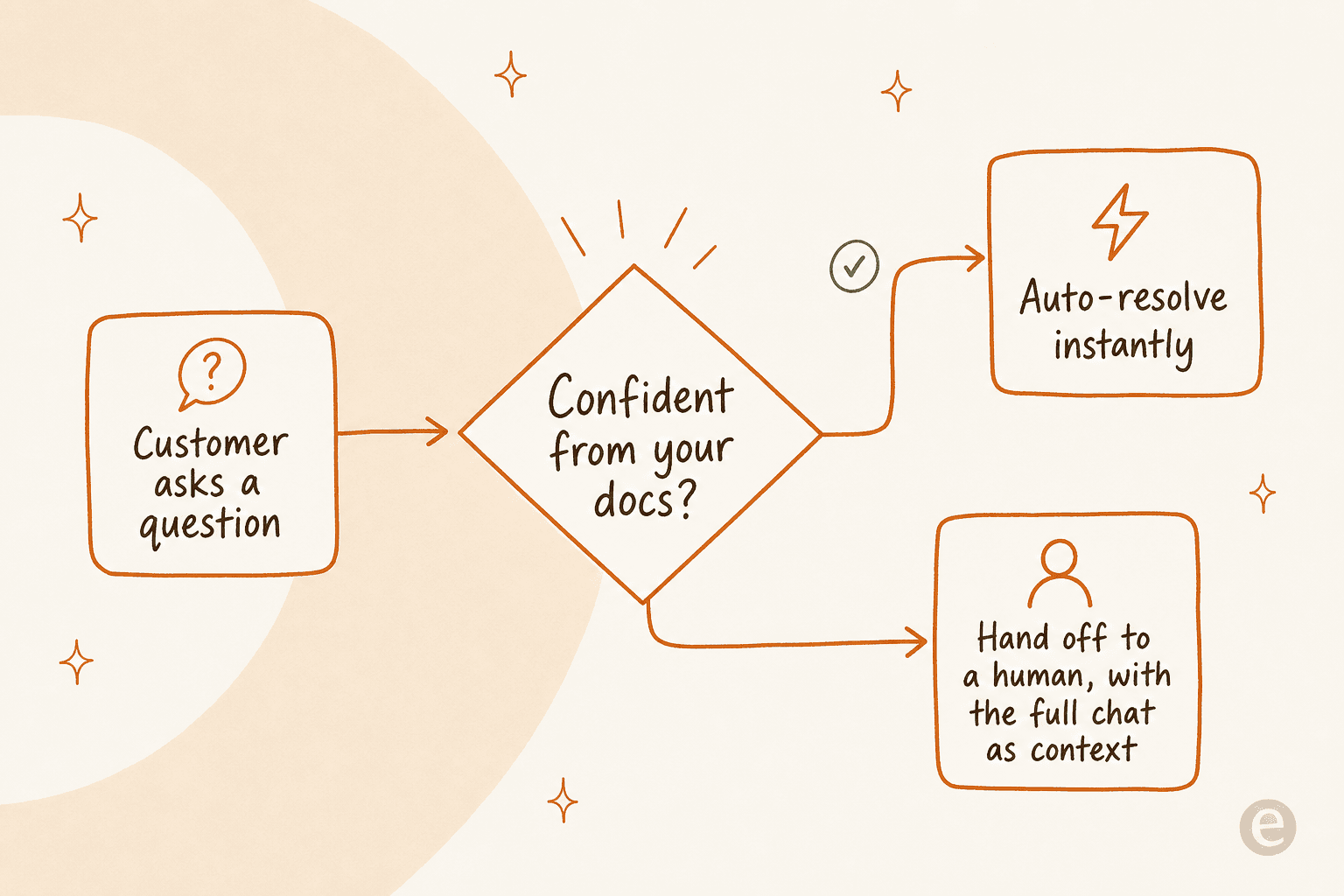
The reason to obsess over the handoff: it is what lets you aim high on volume without fear. When a bot only answers what it is confident about and quietly passes the rest along, you can point it at your biggest ticket category and let it clear the bulk while your team keeps the hard 27%.
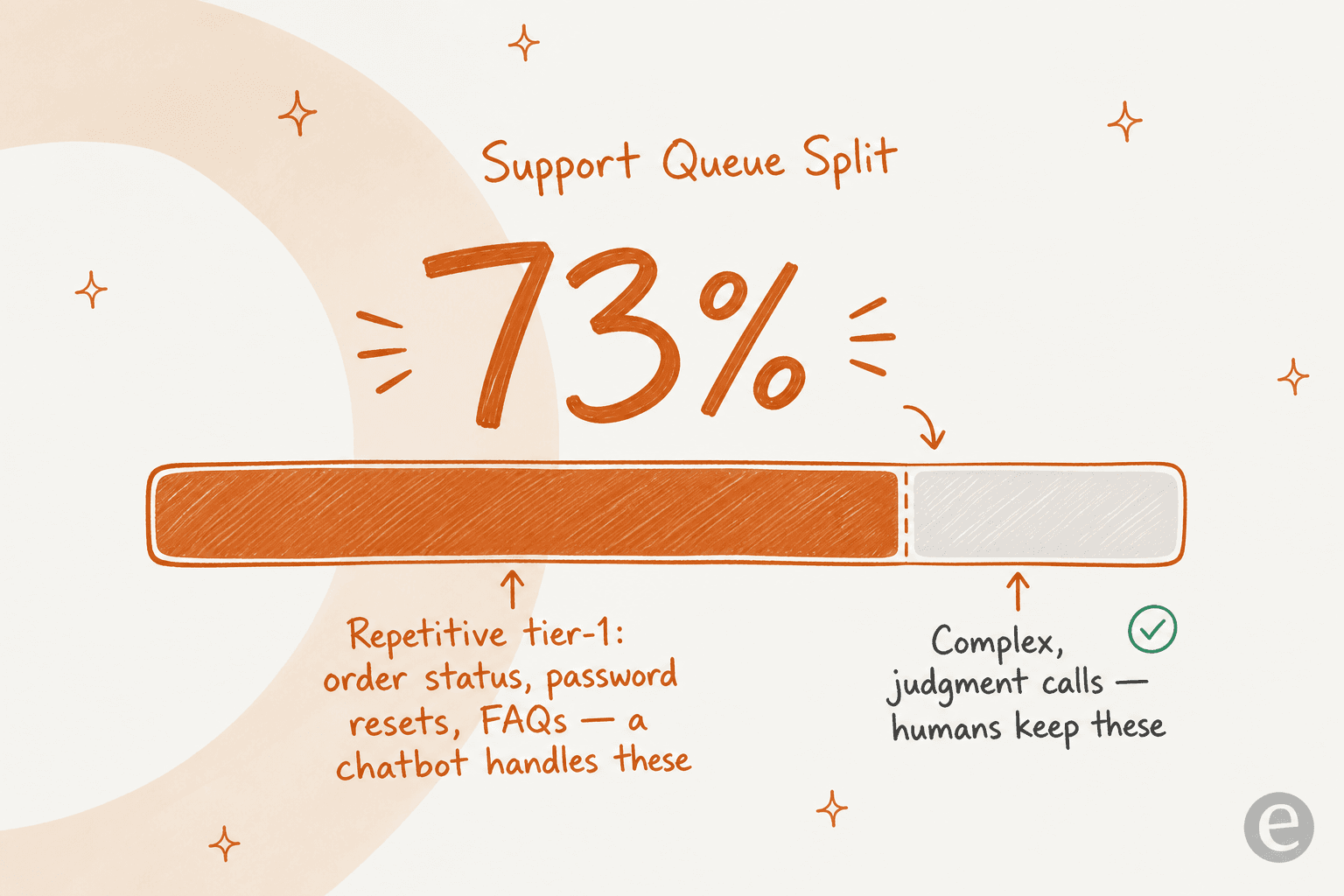
That 73% is not a hypothetical. On eesel's own deployments I have watched a bot clear that share of a team's tier-1 requests inside the first month, which sounds wild until you realize how much of any support queue is the same handful of questions asked a thousand ways. The trick is picking the right handful, so let's get into the actual ideas.
The three families of chatbot ideas
Before the list, a map. Most people picture "a chatbot" as one thing, a widget on the website. But chatbot ideas split along two axes: who they serve (your customers vs. your own team), and what they do (answer questions vs. take actions). Almost every team starts in the top-left corner and never explores the rest, which is where the untapped wins are.
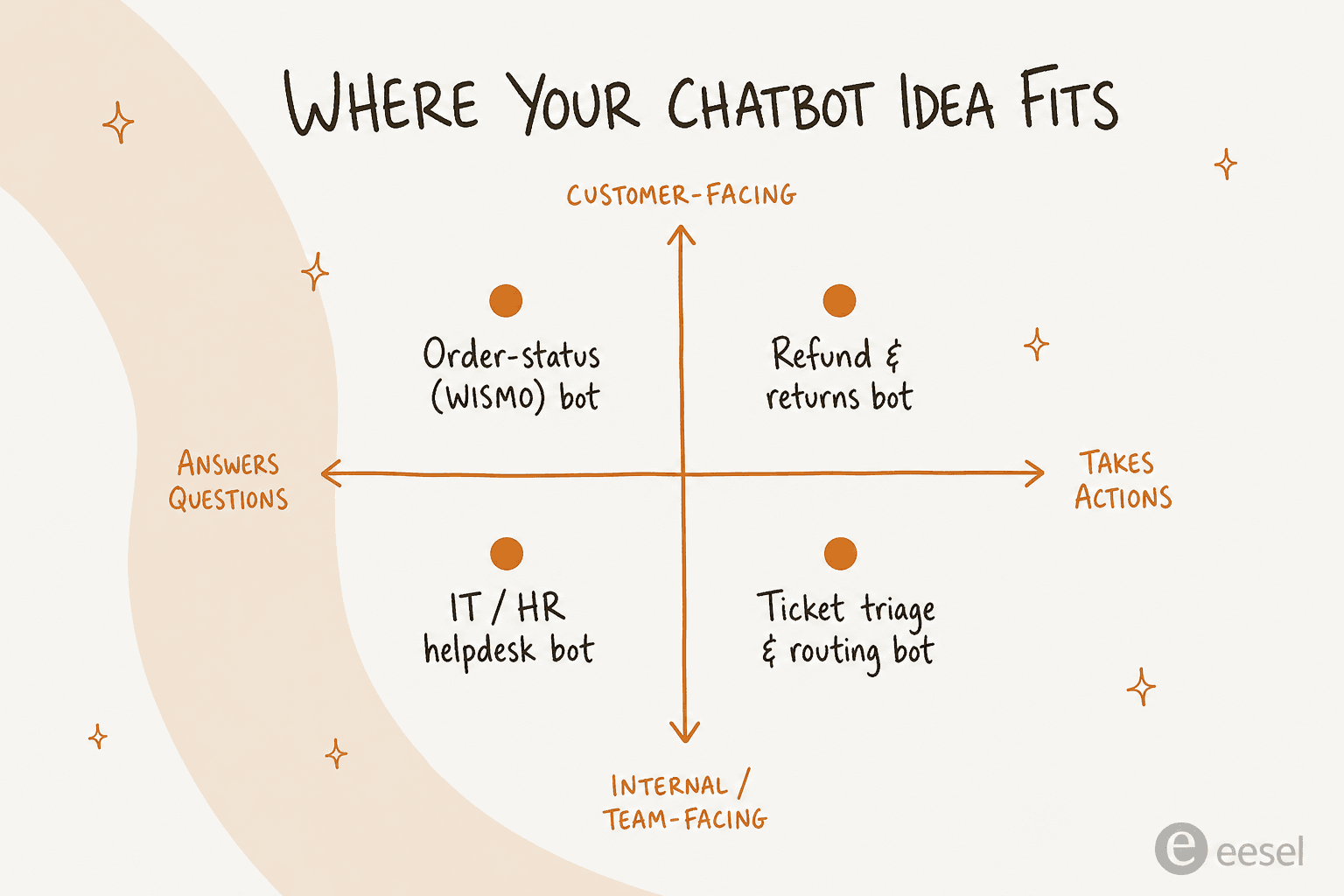
The 17 ideas below walk across that whole map.
Customer-facing chatbot ideas
These are the bots your customers talk to directly, usually in a chat bubble, help center, or messaging channel. Best for: deflecting the repetitive front-line questions before they ever become a ticket.
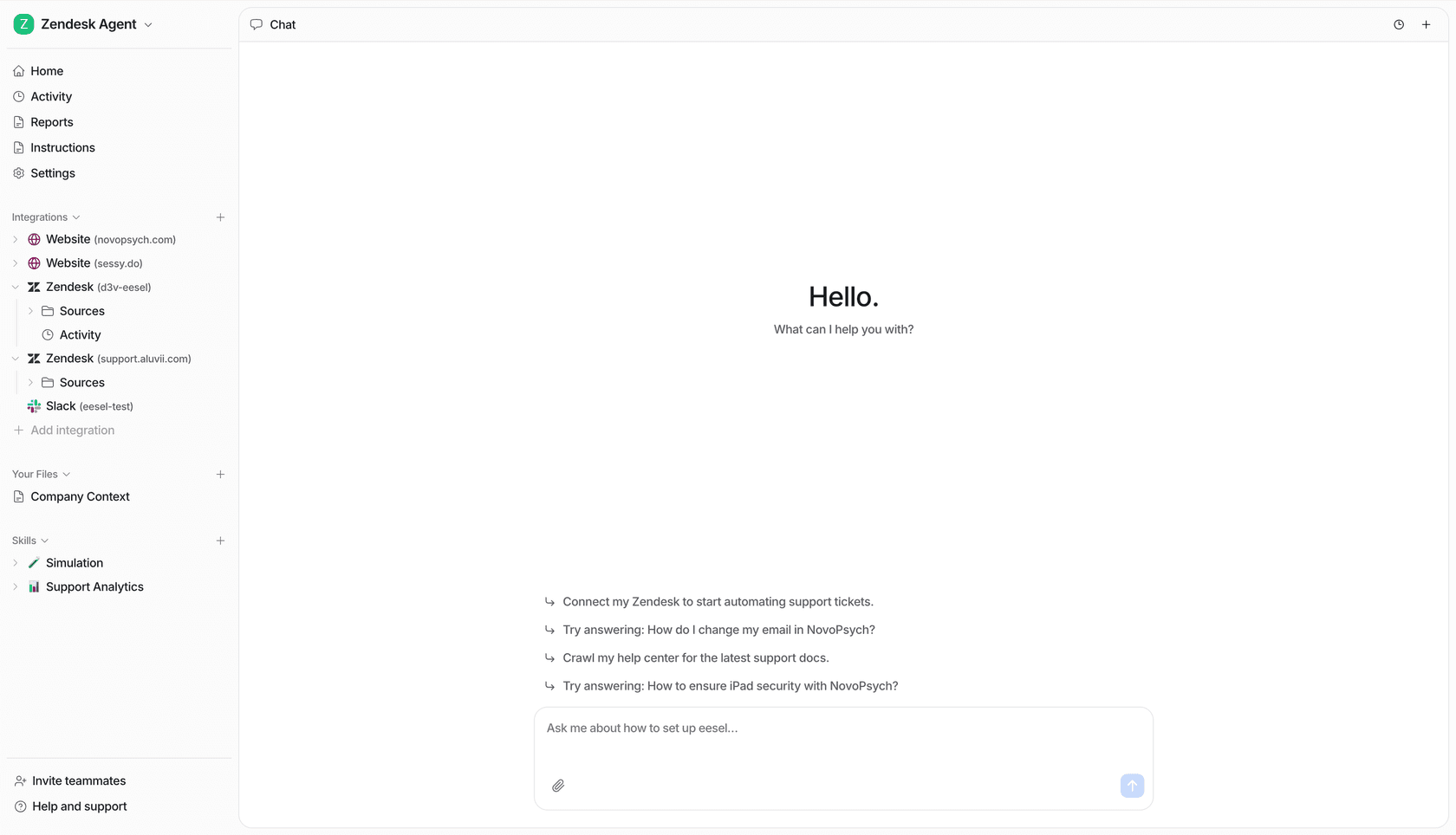
1. The order-status (WISMO) bot. "Where is my order" is the single most repeated ecommerce question, and it is pure deflection gold because the answer already exists in your store data. A bot that connects to Shopify order data and returns a live tracking status can clear a huge chunk of your inbox on its own. This is the idea I would build first for any ecommerce team, see our deeper guide on AI for order tracking.
2. The refund and returns bot. One step past answering: actually starting the return. A bot handling refund requests can check the policy, confirm eligibility, and kick off the return flow, escalating only the edge cases. This is where "chatbot" stops meaning "FAQ" and starts meaning "does the work."
3. The subscription and cancellation bot. Pausing a plan, swapping a delivery date, or handling a cancellation with a retention offer are high-volume and high-emotion. A bot that handles the mechanical part instantly (and hands the genuinely upset customers to a person) protects both your queue and your churn rate.
4. The FAQ deflection bot. The classic, but done properly it trains on your actual help center rather than a hand-written script, so it answers in your voice and stays current. This is the backbone of live-chat deflection, and the one most teams already have in some form.
5. The proactive / outage bot. Instead of waiting to be asked, this bot fires a message when it detects a known issue ("we're aware of the checkout delay, here's the status"). It turns a spike of angry tickets into a single proactive note. Underused, and one of the highest-leverage chatbot ideas for any team with occasional incidents.
6. The multilingual support bot. If you sell across borders, a bot that answers in the customer's language from the same knowledge base is a genuine unlock. One German ferry operator on eesel named theirs "CaptAIn," greeting passengers with "Moin!" and handling everything from timetable questions to ticket inquiries in German, on the same setup an English-speaking team would use:
"We named our AI bot CaptAIn, it greets our customers with 'Moin!' and handles everything from timetable questions to ticket inquiries. It has become an essential part of how we serve our passengers."
a German ferry and transport operator running a branded, German-language AI chatbot for timetable and ticket inquiries
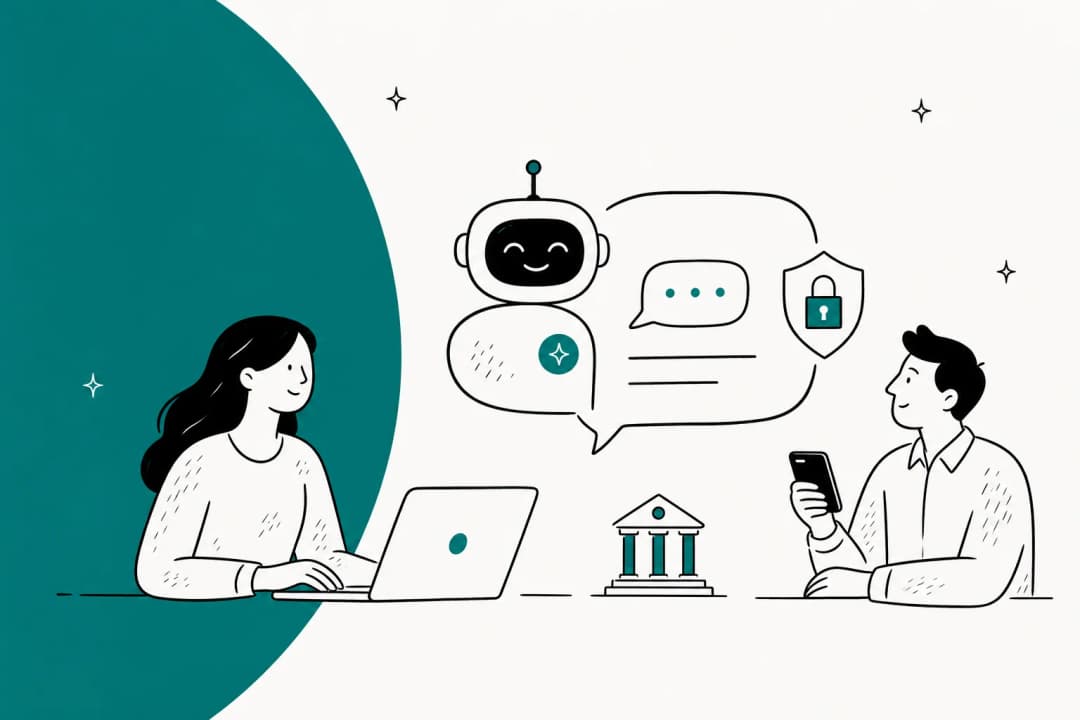
7. The self-service portal bot with citations. For complex or regulated products, a bot that answers and shows its sources lets customers trust the answer. As one head of support at a German software vendor put it, their customers "can easily find large amounts of complex information on our portal, including sources." Citations are what make a bot credible when the stakes are real.
8. The website lead-qualification bot. Not every chatbot idea is for support. A bot on your pricing page that answers pre-sales questions and books a demo for the qualified ones is a conversion tool wearing a support-bot costume.
Here is a real deflect-then-handover in the wild, from an SEO tool's website chat: the bot answered two documentation questions ("how do I delete keywords," "how do I delete search engines"), then the instant the user asked "can I talk to a human?" it handed straight over. That is the loop working exactly as designed, no arguing, no dead ends.
Internal / employee chatbot ideas
The whole bottom half of the map, bots pointed at your own team, is where most companies have done nothing. These are usually the easiest to launch because your employees are more forgiving testers than your customers. Best for: cutting the internal-request load on IT, HR, and ops.
9. The IT helpdesk bot. Password resets, system access requests, and basic troubleshooting are the internal equivalent of WISMO, endless, repetitive, and rules-based. An IT service desk bot living in Slack or Teams can resolve most of them before a human ever sees the ticket.
10. The HR / onboarding bot. "How much PTO do I have," "how do I submit an expense," and every new-hire onboarding question follow the same script every quarter. A bot trained on your HR docs answers instantly and privately, which employees often prefer to asking a person.
11. The internal knowledge-search bot. For any team drowning in scattered docs, a bot that searches across your wiki, past tickets, and chat history at once is a force multiplier. Point it at Confluence, Notion, or Google Drive and it becomes the single front door to knowledge that used to require knowing who to ask.
12. The payroll / finance question bot. Payroll inquiries and expense questions are sensitive, repetitive, and policy-driven, a perfect fit for a bot that pulls from the finance handbook and escalates anything it is not certain about.
One medtech team I've seen stood up exactly this kind of internal-plus-external setup: an embedded website chat widget backed by their Confluence knowledge base, escalating to Jira Service Management when it hit something it could not resolve, and they tuned the tone from tester feedback before it ever touched a real customer. That "back it with your real knowledge, wire up the escalation, test it first" pattern is the whole playbook.
Agent-assist chatbot ideas (the ones customers never see)
The most underrated family. These bots do not talk to anyone directly, they make your human agents faster. Best for: teams who are not ready to let a bot reply on its own but want the speed anyway.
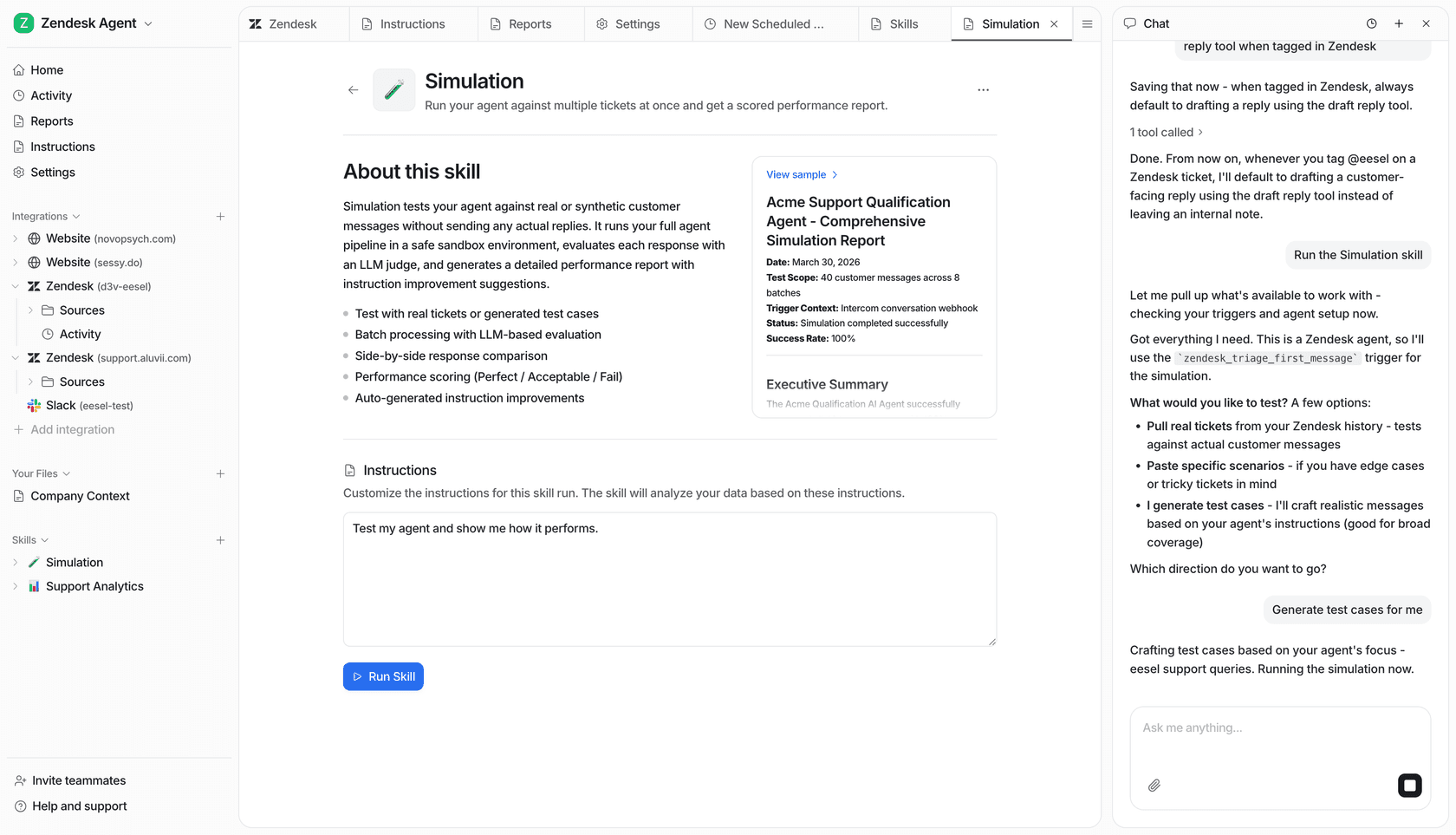
13. The draft-reply copilot. Instead of auto-sending, the bot writes a suggested reply and leaves it for the agent to approve, edit, or send. This is the AI copilot for customer service model, and it is the gentlest possible on-ramp: all the speed, none of the "what if it says something wrong" risk, because a human is still the last step.
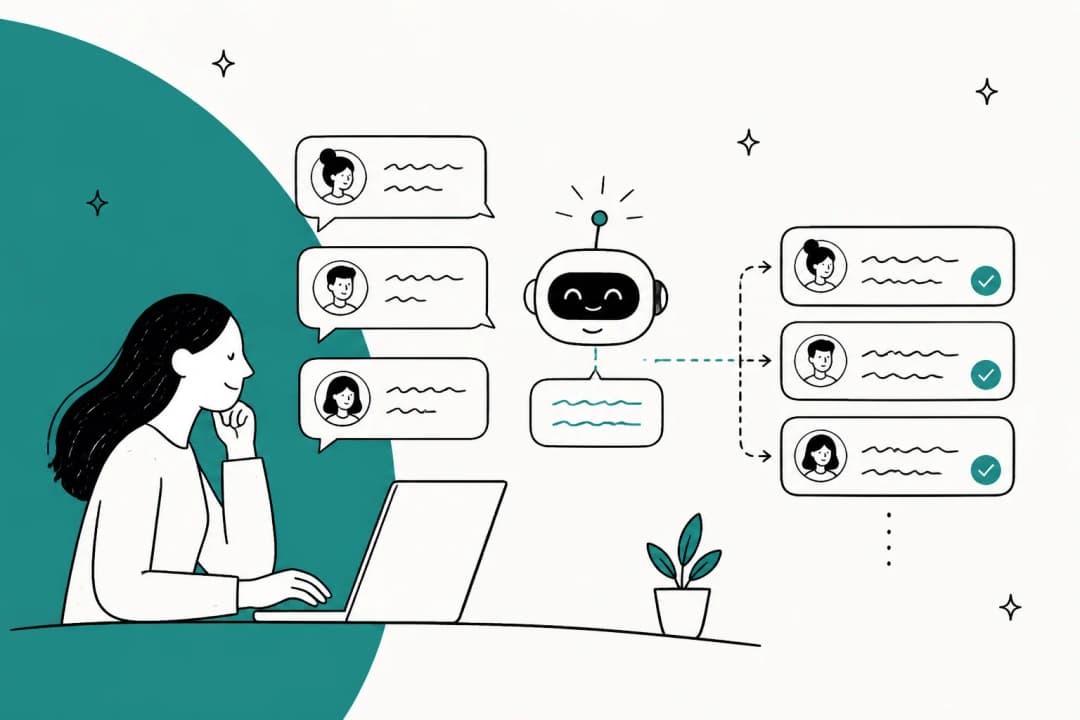
14. The triage and routing bot. A bot that reads every incoming ticket, tags it, sets priority, and routes it to the right queue. Unglamorous and enormously valuable, especially for bug-report triage and any team where tickets currently land in one big undifferentiated pile.
15. The ticket-summarization bot. For long email threads or escalations, a bot that writes a two-line summary at the top saves every agent who touches that ticket from re-reading the whole history. Small feature, disproportionate time savings.
16. The QA and coaching bot. A bot that reviews a sample of closed tickets against your quality rubric and flags the ones a manager should look at. It turns support QA from a manual spot-check into full coverage.
17. The knowledge-gap bot. The cleverest of the bunch: a bot that notices the questions it couldn't answer, and drafts new help-center articles to fill those gaps. One bilingual B2B SaaS team I've seen wanted exactly this, an AI that cross-references their user guide, Slack, internal KB, and past tickets, and then auto-drafts new articles from the gaps it finds. Your bot getting better at its own job over time is the dream.
A quick map of which idea fits which team
If you are staring at 17 ideas wondering where to point first, this is the shortcut:
| Chatbot idea | Best for | What it deflects | Effort to launch |
|---|---|---|---|
| Order-status (WISMO) bot | Ecommerce / DTC | "Where is my order" | Low |
| Refund & returns bot | Ecommerce / subscriptions | Return requests | Medium |
| FAQ deflection bot | Any team | Repeated how-tos | Low |
| Multilingual bot | Cross-border teams | All of the above, in more languages | Low |
| IT helpdesk bot | Internal IT | Password / access tickets | Low |
| HR / onboarding bot | People teams | Policy & onboarding questions | Low |
| Draft-reply copilot | Cautious teams | Nothing (assists humans) | Very low |
| Triage & routing bot | High-volume queues | Manual sorting | Low |
| Knowledge-gap bot | Docs-heavy teams | Future tickets | Medium |
If you only take one thing from this table: the draft-reply copilot and the FAQ bot are the safest first steps, and the WISMO bot is the highest-volume win for anyone selling physical products.
Which chatbot idea should you build first?
The right first idea depends on your team more than on the tech. Walk this quick decision tree:
The mistakes that kill a chatbot idea
I have watched enough launches to know the failure modes are always the same handful:
- Trying to boil the ocean. A bot aimed at "all support" answers everything at 60%. A bot aimed at order status answers that at 95%. Narrow wins. Ship one idea, prove it, then expand, the teams that try to launch a do-everything AI chatbot in one go are the ones who quietly turn it off two months later.
- No handoff plan. If the bot cannot cleanly escalate, every question it cannot answer becomes a frustrated customer. The handoff is not a nice-to-have, it is the feature.
- Testing on live customers. The riskiest way to launch is to point a fresh bot at your real inbox and hope. The teams that do it well simulate the bot against their own historical tickets first, so they know the resolution rate and can see exactly where it would have gone wrong before a customer ever sees it.
- Scripting instead of training. A decision-tree bot with hand-written rules is out of date the day your product changes. A bot that trains on your live docs and past tickets stays current on its own.
That third point is the one I would underline twice. A support manager at a bus-tracking service put the goal about as plainly as anyone:
"create an application that will be able to handle 60% of the incoming zendesk tickets and know when to pull a real person in for better analysis and resolution."
a support manager at a bus-tracking service running 200-250 tickets a month on Zendesk
"Handle the volume, and know when to pull a real person in." That is every good chatbot idea in one sentence.
Try eesel for your first chatbot idea
Most of the 17 ideas above share the same three requirements: the bot has to train on your real knowledge, take actions in your tools, and hand off cleanly. That is exactly what eesel is built to do. You point its AI agent at your help docs, past tickets, and tools like Zendesk, Gorgias, Freshdesk, Slack, or Confluence, and it works out of the box, no new workflows for your team to learn.

The differentiator that matters most for these ideas: you can simulate the bot on thousands of your own historical tickets before it goes live, so you know its real resolution rate and exactly where it would have escalated, instead of finding out on a live customer. Pick one idea from the list, point eesel at the right knowledge, and you can have it answering by the afternoon. It is free to try.
The best chatbot idea is not the cleverest one, it is the one that clears the question your team is tired of answering. Find that question, build the narrow bot that owns it, and let the handoff catch everything else.
Frequently Asked Questions
What are some good chatbot ideas for a customer support team?
What is the best chatbot idea to start with?
What can a customer service chatbot actually do beyond answering FAQs?
Are AI chatbots worth it for small support teams?
How do I build a support chatbot without coding?


Article by
Riellvriany Indriawan
Riell is a designer and writer at eesel AI with about two years of experience researching CX platforms, AI chatbots, and helpdesk software. She combines her design background with a sharp eye for how these tools actually look and feel in practice — making her comparisons unusually visual and user-focused.