If you're running an ecommerce store, you’ve probably figured out that just "having a chatbot" isn't the magic fix some people claim it is. The real power isn't in the bot itself, but in what it can actually do. A poorly equipped bot is often more frustrating than no bot at all, but one with the right skills can become your best sales and support agent.
This article breaks down the seven capabilities that directly boost your sales and keep customers coming back. We dug into what top-performing ecommerce brands are doing right now to turn their chatbots from simple FAQ machines into smart, revenue-generating assistants.
What are the 7 must-have chatbot capabilities for high converting ecommerce (and why they matter)?
Chatbot capabilities are just the specific jobs a bot can do that lead to real results, like making more sales or cutting down on support tickets. This is a huge leap from the clunky, rule-based bots from a few years ago that followed rigid scripts and usually hit a dead end.
Today’s AI agents can understand what a customer is saying, learn from past chats, and connect with your other business tools to give genuinely helpful answers. The right set of capabilities turns a chatbot from a passive Q&A tool into a 24/7 sales and support assistant that actually helps your business grow. With shoppers now expecting instant and personalized help, these capabilities are no longer a nice-to-have; they're essential.
How we picked these must-have chatbot capabilities
To cut through the hype, we focused on features that deliver results you can actually measure. Everything on this list was chosen based on four simple questions:
-
Does it increase sales? Does this feature help bring back lost sales or guide people toward making a purchase?
-
Does it make customers happier? Does it solve problems quickly, answer questions accurately, and leave people feeling good about your brand?
-
Does it make life easier? Can it handle repetitive tasks and grow with your business without needing a huge team to manage it?
-
Does it play well with others? How easily does it connect with the tools you already use, like Shopify, Gorgias, and Zendesk?
A quick comparison of the must-have chatbot capabilities
Here’s a quick look at the capabilities we’re about to cover. This table sums up what each one does and what to look for when you're choosing a platform.
| Capability | Key Function | Impact on Sales | What to Look For |
|---|---|---|---|
| Unified Knowledge | Answers questions using all your info (docs, past tickets, help center). | High | Connects to many sources (not just a help center) and learns from old chats. |
| Personalized Recommendations | Suggests products based on what a customer is doing right now. | Very High | Integrates with Shopify/BigCommerce; uses AI to see browsing history. |
| Proactive Cart Recovery | Catches users who are about to leave their cart and offers help. | Very High | Triggers based on user behavior and offers help in real-time. |
| Automated Order Management | Gives instant "Where is my order?" (WISMO) updates 24/7. | Medium | Connects directly to your ecommerce platform for live data. |
| Seamless Human Handoff | Smartly passes complex issues to a human agent. | High | Gives you control over when to escalate and sends the full chat history. |
| Omnichannel Integration | Works everywhere: your site, social media, and help desk. | High | Simple integrations with tools you already use like Zendesk. |
| Actionable Analytics | Gives you insights to improve your bot and your help docs. | Medium | Has a test mode, reports on knowledge gaps, and tracks ROI. |
The 7 must-have chatbot capabilities for high converting ecommerce in 2025
Alright, let's get into the seven capabilities that make all the difference. Think of these less as individual features and more as key ingredients for building a smarter, more profitable online store.
1. Unify all your knowledge for instant, consistent answers
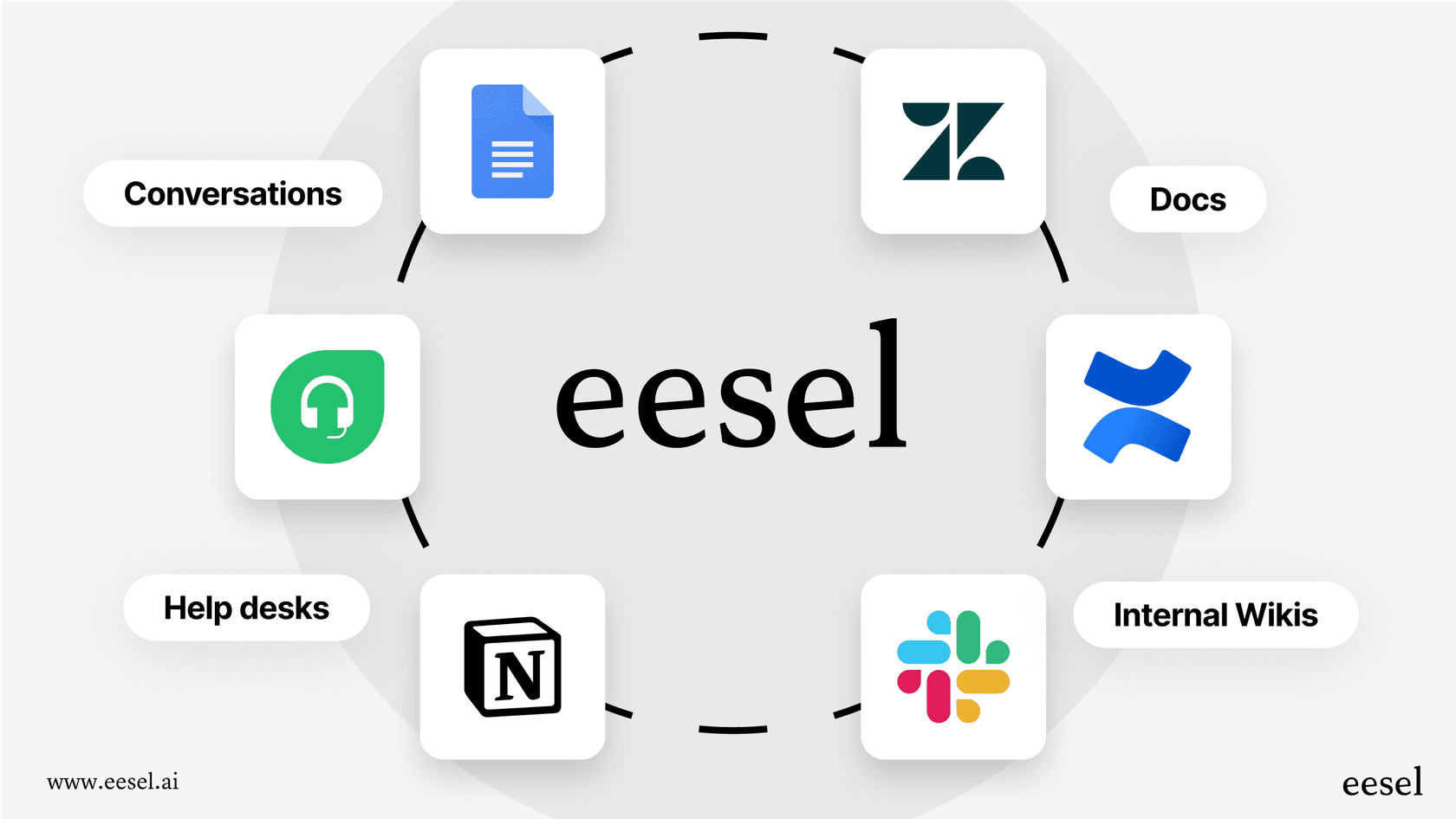
Let's be honest, nothing kills a sale faster than a chatbot that says "I don't know" or gives the wrong answer. This capability lets a chatbot learn from all of your company's information, not just a single help center. We're talking past support tickets, internal wikis like Confluence or Notion, random Google Docs, and your entire Shopify product catalog.
When your bot has access to everything, customers get consistent, accurate info whether they're asking about a return policy buried in a doc or a product detail on your website. This builds trust and gets rid of the friction that makes people leave. This is where a tool like eesel AI really helps, by connecting to over 100 sources with simple integrations. It can even train on your team's past conversations in Zendesk or Gorgias to automatically pick up your brand's unique voice.
2. Offer personalized product recommendations and support
This is about using AI to act like a great in-store sales associate. The chatbot analyzes a customer's real-time behavior (like pages they've viewed or items in their cart) and past purchases to suggest things they'll actually like.
Instead of a generic response, the bot can say, "I see you're looking at our winter jackets. Since you've bought hiking gear before, you might also like these waterproof boots." This kind of personal touch can increase the average order value and makes customers feel like you actually get them. Some platforms, like eesel AI, can connect directly to your ecommerce backend like Shopify or BigCommerce to pull this real-time data, allowing its AI Chatbot to provide surprisingly relevant recommendations.
3. Proactively recover abandoned carts
A great chatbot doesn't just sit around waiting for questions. It can tell when a user is about to leave the checkout page and proactively pop up to ask if they need help.
Cart abandonment is a massive source of lost revenue for online stores. A proactive chatbot can answer a last-minute question about shipping, offer a small discount to close the deal, or help with a tricky payment issue. This is way more effective than an email that shows up hours after the customer has already moved on. With a tool like eesel AI, you can set up custom prompts for cart abandonment that tap into your unified knowledge to answer questions instantly.
4. Provide 24/7 automated order management (WISMO)
"Where is my order?" (WISMO) questions are the bread and butter of ecommerce support. Automating them means you can give customers instant, accurate answers any time of day, without needing a human.
This frees up your team to focus on complex sales questions that actually bring in money. It also gives customers the instant gratification they expect, which improves their experience after the purchase and makes them more likely to shop with you again. With modern tools, this is surprisingly easy to set up. For example, eesel AI lets you create a simple flow where the bot asks for an order number and looks up the status in your system, all inside the help desk you already use, like Zendesk or Freshdesk.
graph TD A[Customer asks "Where is my order?"] --> B{Chatbot requests order number}; B --> C[Customer provides order number]; C --> D{Chatbot connects to ecommerce platform API}; D --> E[Chatbot retrieves real-time order status]; E --> F[Chatbot provides instant update to customer];
5. Seamlessly hand off to human agents when needed
Sometimes, a bot just can't solve the problem. A smart chatbot knows when to quit and smoothly pass the conversation to a human. The key here is "smoothly", the agent gets the full context of the conversation so the customer never has to repeat themselves.
We’ve all been on the other side of a terrible handoff, and it's incredibly frustrating. Getting it right turns a potential complaint into a positive interaction that builds loyalty. This is where having full control matters. Some platforms, including eesel AI, let you decide exactly which types of questions get automated and which go straight to a person. You can start small, automating just one or two topics, and expand from there as you get more comfortable.
6. Integrate across all your channels and tools
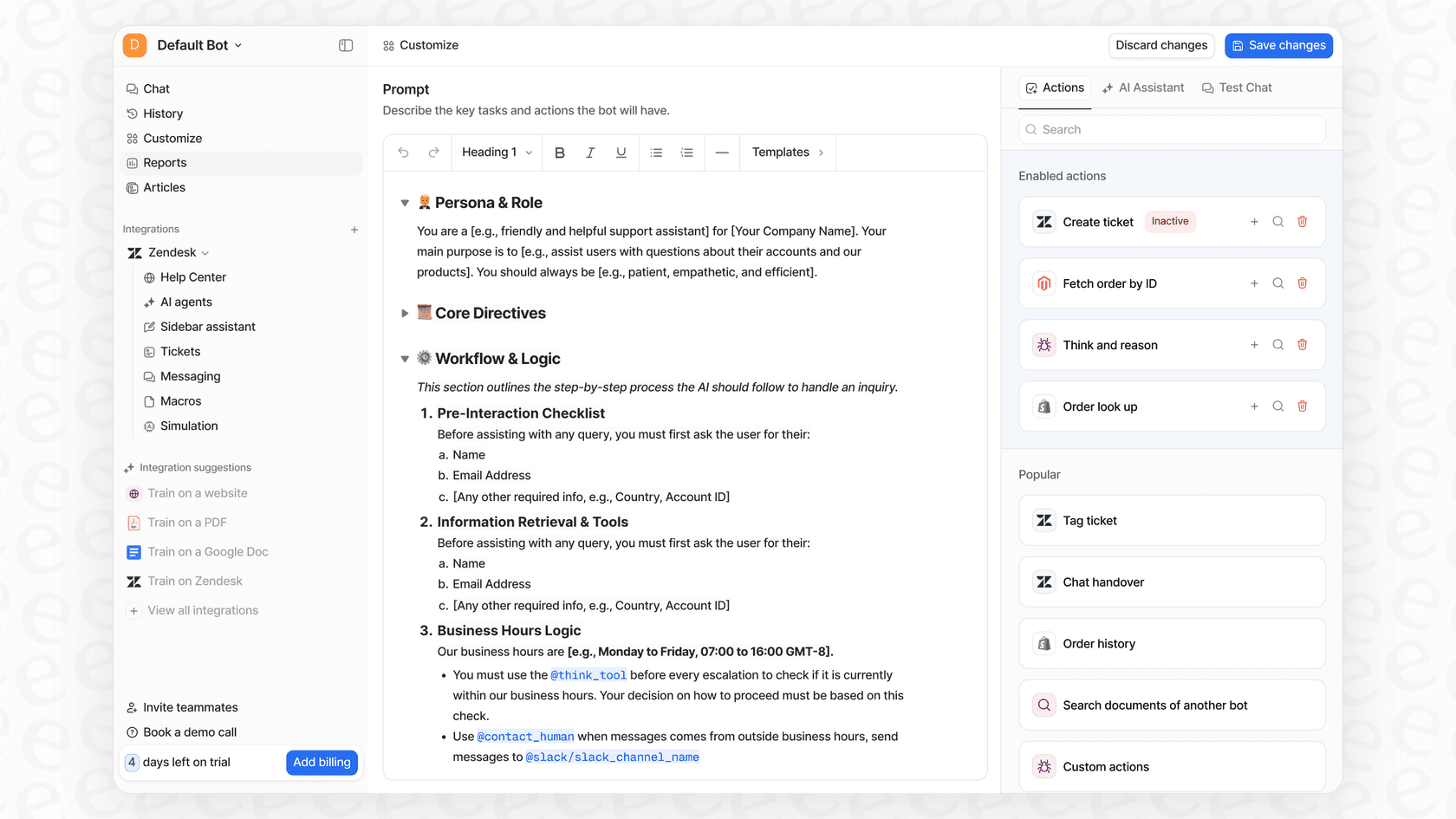
Your customers don't care about channels; they just want to talk to your brand wherever is most convenient for them. Your chatbot should provide the same smart experience everywhere, whether someone is on your website, messaging you on Instagram, or using the chat widget in your help desk.
A unified chatbot makes sure the conversation and context can follow the customer from one place to another, and that your answers are consistent everywhere. The best way to do this is with a tool that has deep, one-click integrations. For example, eesel AI connects easily with help desks like Intercom, chat tools like Slack, and all your knowledge sources. This lets you deploy one smart AI "brain" across all your customer touchpoints in minutes, not months.
7. Provide actionable analytics and a risk-free way to test
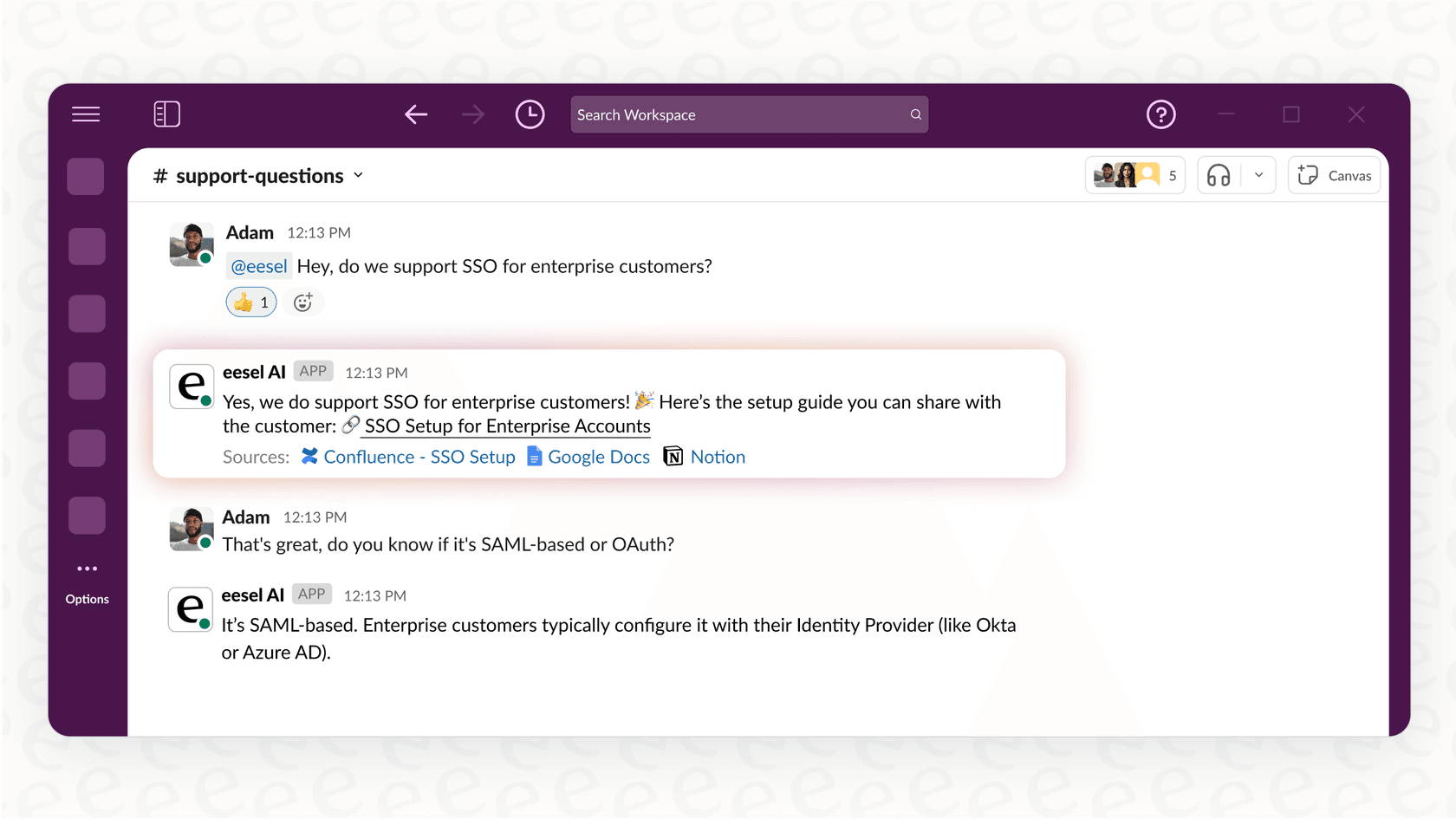
A good chatbot platform should do more than just give you simple stats. It should show you what to do next to improve. Most importantly, it should let you test how well it works before it ever talks to a real customer.
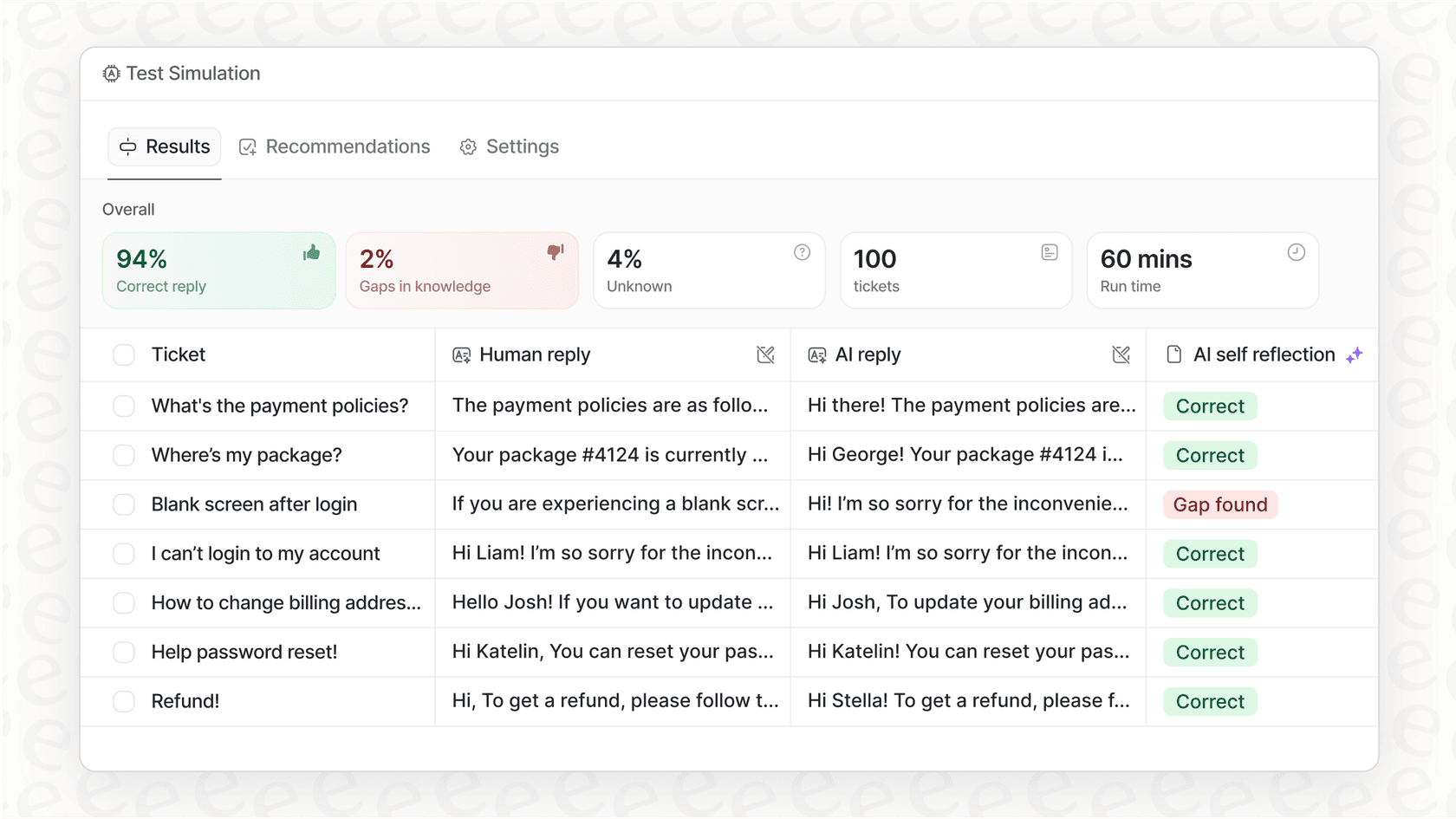
You need data to make smart decisions. Knowing which questions your bot is struggling with helps you fill gaps in your help docs, and being able to see a potential ROI makes it much easier to justify the investment. This is a huge differentiator for eesel AI. Its simulation mode lets you test the AI on thousands of your past support tickets to see exactly how it would have performed and calculate potential savings before you ever go live. It also points out gaps in your knowledge base, turning data into a clear action plan. Being able to test-drive a bot like this is something you just don't see with most other tools.
A practical guide to choosing a chatbot with the right capabilities
Ready to pick a tool? Here’s a simple checklist to help you decide.
-
Figure out your main goal first. Are you trying to drive more sales with recommendations, or are you trying to free up your support team by deflecting tickets? Pick a tool that’s strong in the area you care about most.
-
Look for a self-serve setup. Be careful with platforms that force you into long sales calls and demos just to see the product. Tools like eesel AI that let you sign up and start building in minutes are usually a sign of a more modern, user-friendly approach.
-
Insist on a simulation feature. Don't go in blind. Ask providers how you can test their AI on your actual data before you launch. A good simulation is a must-have for making a confident, risk-free choice.
-
Check the pricing model carefully. Watch out for "per-resolution" pricing, which can lead to surprisingly high bills that penalize you for being successful. For instance, some platforms charge $0.99 for every AI resolution on top of their monthly seat fees. Gorgias also charges around $0.90 per automated resolution in addition to its ticket-based plans. These costs add up fast. Look for transparent, flat-rate plans so you know exactly what you're paying.
-
Make sure it works with your other tools. The chatbot has to connect smoothly with your help desk, ecommerce platform, and knowledge sources without becoming a huge IT project.
Ready to upgrade your ecommerce chatbot?
As you can see, the right chatbot capabilities can turn your customer service from a cost center into a growth engine. By offering personalized, 24/7 help, you can build the kind of loyalty that turns first-time buyers into lifelong fans.
eesel AI was designed to make all seven of these capabilities easy to set up and totally risk-free to try. It’s the simplest way to add a smart, conversion-focused AI agent to your ecommerce store.
Ready to see how it works? Start your free trial to build your first bot in a few minutes, or book a demo to see how it performs with your own data.

Frequently asked questions
These capabilities are specific, advanced functions that help your chatbot go beyond basic FAQs to actively drive sales and improve customer satisfaction. They matter because modern shoppers expect instant, personalized assistance, and these capabilities deliver exactly that, turning your bot into a revenue-generating assistant.
You should check if your bot offers features like unified knowledge access, personalized product recommendations, proactive cart recovery, 24/7 automated order management, seamless human handoff, omnichannel integration, and actionable analytics. If it's missing several of these, it's likely not fully equipped for high conversion.
You can expect increased sales through better engagement and cart recovery, higher customer satisfaction due to instant and accurate support, and greater efficiency by automating routine tasks. The actionable analytics will also help you continuously refine your strategy for improved ROI.
Modern chatbot platforms are designed for seamless integration with popular ecommerce systems like Shopify and your help desk tools like Zendesk. Look for solutions offering one-click integrations and a self-serve setup to ensure a smooth, quick implementation process.
If your main goal is sales, prioritize Personalized Recommendations and Proactive Cart Recovery. These capabilities directly engage customers with relevant offers and intervene to prevent abandoned purchases, significantly boosting your conversion rates.
Start by defining your main goal, then look for platforms with a self-serve setup and, crucially, a simulation feature to test the bot with your data before going live. This allows for risk-free adjustments and helps build confidence in its performance.
Be wary of "per-resolution" pricing models, as these can lead to unexpectedly high costs that penalize successful automation. Instead, look for transparent, flat-rate plans that allow you to budget effectively and understand your expenses upfront.
Share this article

Article by
Stevia Putri
Stevia Putri is a marketing generalist at eesel AI, where she helps turn powerful AI tools into stories that resonate. She’s driven by curiosity, clarity, and the human side of technology.