Distributing support tickets fairly among your team sounds simple until you're actually doing it. One agent ends up with twenty tickets while another has five. Someone cherry-picks the easy ones. Your supervisor spends half their day manually assigning work instead of managing the team.
Round robin ticket assignment exists to solve exactly this problem. It's a method for automatically distributing incoming tickets to agents in a rotating cycle, ensuring everyone gets an equal share over time.
In this guide, we'll walk through how to set up round robin assignment in Zendesk, covering both the native omnichannel routing features and popular third-party apps that extend those capabilities. We'll also look at when round robin makes sense, and when you might want to consider a more intelligent approach.
What is round robin ticket assignment?
Round robin assignment is straightforward: each new ticket goes to the next agent in a predefined list, cycling back to the start once everyone has received one. Think of it like dealing cards at a poker table, everyone gets one before anyone gets a second.
Teams use round robin for a few key reasons:
- Fair distribution: Prevents ticket hoarding and ensures workloads stay balanced
- Reduced cherry-picking: Agents can't skip difficult tickets and grab easy ones from a shared queue
- Less manual work: Supervisors don't need to spend time assigning tickets individually
- Predictable capacity: You know roughly how many tickets each agent will handle
That said, round robin isn't always the right choice. It treats every ticket the same, whether it's a simple password reset or a complex billing dispute. It also doesn't account for agent expertise. A Spanish-speaking customer might get routed to an agent who doesn't speak Spanish simply because it was their turn.
For teams with straightforward, relatively uniform tickets, round robin works well. For teams handling complex, varied issues, you might need something smarter. We'll cover that later.
Native Zendesk round robin routing
Zendesk includes round robin functionality through its omnichannel routing feature. This is available on all Zendesk Suite plans (Team, Growth, Professional, Enterprise, and Enterprise Plus) as well as Support plans (Team, Professional, or Enterprise).
How it works
Zendesk's round robin method assigns tickets based on the last time each available agent received work for that specific channel (email, messaging, or calls). The agent who has gone longest without an assignment gets the next ticket.
The system considers these events as assignments:
- Any ticket assignment, whether manual or automatic
- A call or messaging ticket being offered to an agent
- A reopened ticket being assigned
Requirements and setup
To use omnichannel routing, you need:
- Agent Workspace activated on your account
- If you have a Chat subscription, native messaging or Sunshine Conversations must be activated
- For email tickets: an auto-routing tag to identify which tickets should be routed
- For group-based routing: tickets must have a group assigned
Here's the short version of the setup process:
- In Admin Center, go to Objects and rules > Omnichannel routing > Routing configuration
- Click "Turn on omnichannel routing"
- Enter an auto-routing tag for email tickets
- Create custom queues (Professional+) or set up group-based routing
- Create ticket triggers to assign groups and add the auto-routing tag
- Save your configuration
Limitations to know about
Native round robin has some constraints worth considering:
- Existing tickets won't be routed: Only tickets created or updated after you enable omnichannel routing get assigned automatically
- All agents start offline: When you first turn it on, every agent is set to offline and needs to set a new status
- Limited customization: You can't easily set different rules for different ticket types without upgrading to custom queues (Professional+)
- No queue limiting: The native feature doesn't let you cap how many tickets an agent can receive, it just keeps cycling
For smaller teams with simple needs, these limitations might not matter. For larger or more complex operations, you'll probably want to look at third-party apps.
Third-party round robin apps for Zendesk
Several apps in the Zendesk Marketplace extend round robin functionality with features the native option lacks. Here are the main ones worth considering.
Round Robin App
The Round Robin App is the most established option, having assigned over 393 million tickets since 2016. It's used by companies like Stanford, Berkeley, Expedia, Zillow, and The Home Depot.
Key features:
- Round robin assignment with queue limiting (cap how many tickets each agent gets)
- Skills-based routing using tags
- Work schedule management for different time zones
- Agent self-availability controls
- Same-requester assignment (keeps one customer's tickets with the same agent)
- Alternate/backup agents for when primary agents are unavailable
Pricing: Free tier available, with paid plans offering more features. They offer a 30-day free trial with Enterprise features enabled.
Customer results:
- thredUP reported a 15% increase in agent productivity and 20% decrease in first response time
- DonorsChoose saw specialists hit daily goals 50% more often with an 11% overall capacity increase
The main downside is that it's a separate system from Zendesk, so there's some setup complexity when connecting the two.
Playlist Routing
Playlist Routing costs $9 per agent per month and offers a 14-day free trial. You can find it in the Zendesk Marketplace.
Key features:
- Round robin and skills-based routing
- Integration with Zendesk Schedules for time-based routing
- Agent capacity limits
- Real-time routing for WhatsApp and social messaging
- Agent availability reporting
- "Playlist button" pull assignment (agents request tickets rather than receiving them automatically)
- Sound notifications for ticket assignments
- Automatic idle detection
The pull assignment feature is particularly interesting. Instead of pushing tickets to agents, agents click a button when they're ready for the next ticket. This eliminates collision (two agents grabbing the same ticket) and gives agents more control over their workflow.
Knots Round Robin
Knots Round Robin takes a simpler approach, building on top of Zendesk's native triggers and tags rather than creating a separate system. You can find it in the Zendesk Marketplace.

Key features:
- Trigger-based assignment using Zendesk tags
- Customizable rules based on agent groups, availability, or ticket properties
- Native Zendesk integration (no external system to manage)
- Dashboard for monitoring and adjusting rules
This option works well for teams that want round robin functionality without adding another platform to manage. The trade-off is fewer advanced features when compared to Round Robin App or Playlist.
Setting up round robin in Zendesk: Step-by-step
Let's walk through setup for both native and third-party options.
Option 1: Native omnichannel routing
What you'll need:
- Admin access to your Zendesk account
- Agent Workspace enabled
- A plan that supports omnichannel routing (all Suite plans, or Support Team+)
Step 1: Enable omnichannel routing
In Admin Center, navigate to Objects and rules > Omnichannel routing > Routing configuration. Click "Turn on omnichannel routing." If your account was created before December 5, 2024, you will need to explicitly enable it. Newer accounts have it on by default.
Step 2: Configure your auto-routing tag
Enter a tag like "auto_route" that will identify which email tickets should be routed. This tag gets added via triggers (which we'll set up next).
Step 3: Set up routing triggers
Create a trigger that:
- Matches the tickets you want to route (by channel, organization, or other conditions)
- Assigns a group
- Adds your auto-routing tag (for email tickets)
Step 4: Configure agent statuses
Be sure your agents understand the unified status system. When omnichannel routing is turned on, all agents start as offline and need to set their status to Online, Away, or another available status.
Step 5: Test with sample tickets
Create a few test tickets and verify they get assigned to agents in round robin fashion. Check the routing configuration page to see assignment activity.
Option 2: Round Robin App setup
What you'll need:
- A Zendesk account with API access enabled
- Admin credentials (or agent credentials with specific permissions)
- A Google account for authentication
Step 1: Install from the Zendesk Marketplace
Find "Round Robin" in the Zendesk Apps Marketplace and install it.
Step 2: Register and connect
Go to roundrobin-assignment.com and register with your Google account. In the Settings page, enter your Zendesk subdomain, username, and API token (created in Zendesk Admin Center > Apps and integrations > Zendesk API).
Step 3: Select active agents
In the Agents table, set the "Active" field to "On" and "Availability" to "Available" for agents who should receive tickets.
Step 4: Create queues
Link queues to your existing Zendesk views. Set the run interval (how often the app checks for new tickets) and enable the queue.
Step 5: Configure limits and rules (optional)
Set ticket limits per agent, configure skills-based routing rules, and set up work schedules if needed.
Choosing the right approach for your team
Here's a quick breakdown to help you decide:
| Approach | Best for | Key advantage | Main limitation |
|---|---|---|---|
| Native Zendesk | Small teams (1-10 agents) with simple needs | Included in your plan | No queue limiting, limited customization |
| Round Robin App | Medium to large teams needing advanced features | 393M+ tickets assigned, extensive features | Separate system to manage |
| Playlist | Teams wanting pull assignment | Agents control their workload | $9/agent/month adds up |
| Knots | Teams wanting simple trigger-based routing | Native Zendesk integration | Fewer advanced features |
Go with native Zendesk if: You're a small team, your tickets are fairly uniform, and you don't need complex routing rules.
Go with Round Robin App if: You need queue limiting, skills-based routing, work schedules, or same-requester assignment.
Go with Playlist if: You want agents to pull tickets rather than having them pushed, or you need real-time WhatsApp routing.
Go with Knots if: You want to keep everything in Zendesk and don't need the advanced features of the other apps.
Going beyond round robin with intelligent routing
Round robin solves the distribution problem, but it doesn't solve the matching problem. It treats every ticket the same and every agent the same, which isn't how support actually works.
A billing question should probably go to your billing specialists. A technical issue should go to someone with the right technical skills. A VIP customer's ticket should be flagged and prioritized. Round robin can't do any of that.
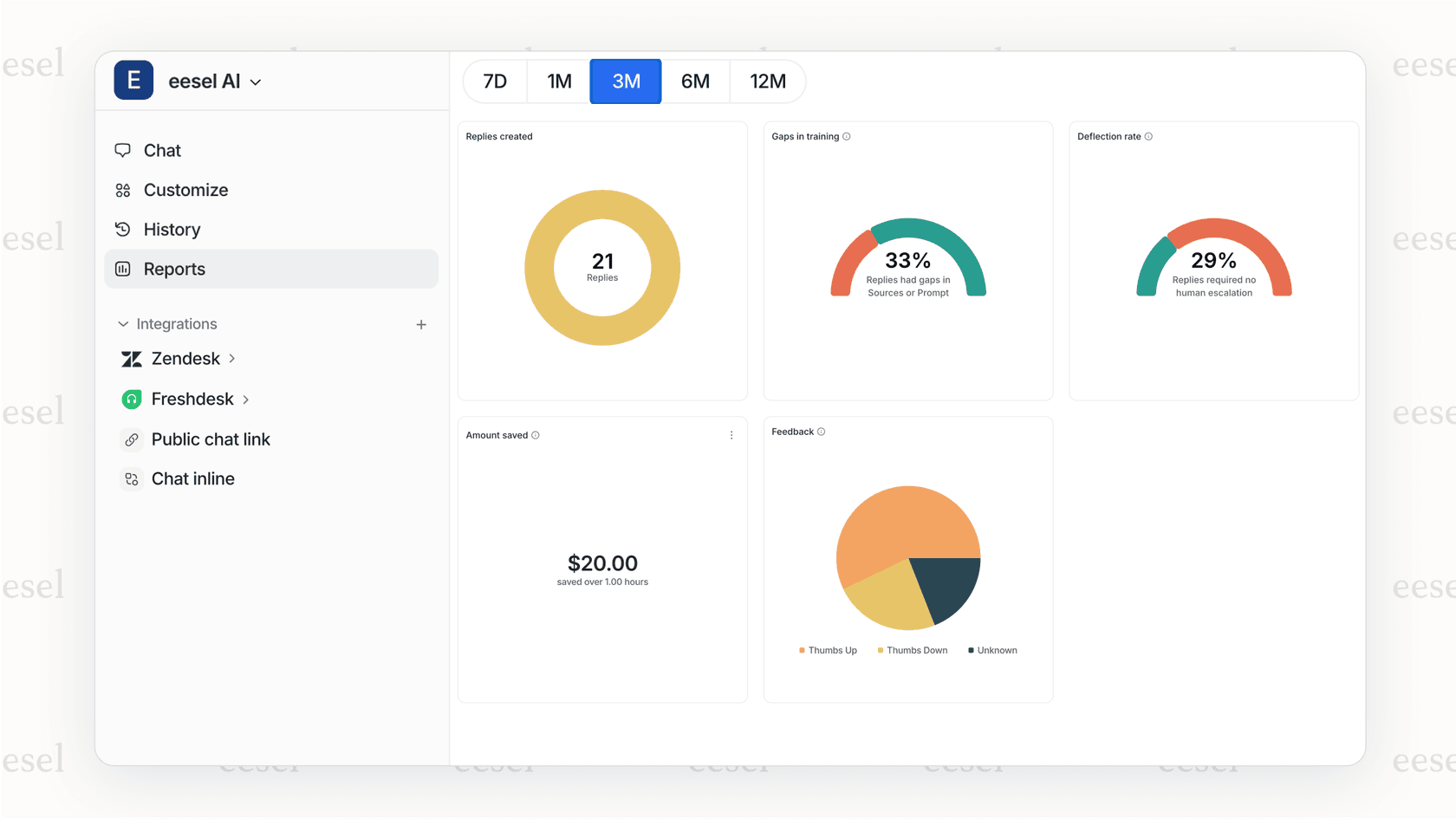
This is where eesel AI comes in. Instead of rotating tickets through agents in a fixed cycle, our AI analyzes the content of each ticket and routes it to the agent best equipped to handle it.

Here's how it works:
- Content analysis: AI reads and understands what the customer is asking
- Agent matching: Routes based on agent expertise, past performance on similar issues, and current workload
- Automatic escalation: Complex or sensitive issues get flagged and routed to senior agents automatically
- Continuous learning: The system improves over time as it learns which agent resolutions lead to the best outcomes
For teams dealing with varied, complex tickets, intelligent routing often outperforms round robin. Agents spend less time on issues outside their expertise, customers get faster resolutions from better-matched agents, and supervisors spend less time manually reassigning misrouted tickets.
If you're interested in exploring this approach, you can learn more about eesel AI for Zendesk or check out our AI triage capabilities for automatic ticket tagging and routing.