Not every support ticket can be resolved by your frontline team. Sometimes a customer needs to speak with a manager: maybe they're requesting a policy exception, they're frustrated with their experience, or they're a VIP who expects white-glove treatment. Without a clear process, these requests create confusion, delay resolutions, and frustrate both customers and agents.
This guide walks you through setting up a manager escalation workflow in Zendesk. You'll learn when to escalate, how to build automation rules that route tickets to the right people, and get email templates your team can use immediately. We'll also look at how AI can handle escalations more intelligently than rules-based systems.
When to escalate tickets to managers
Escalating to a manager is different from escalating to a technical specialist. Understanding this distinction helps your team route tickets correctly the first time.
Hierarchical escalation (to managers) happens when a customer needs someone with higher authority. This includes:
- Policy exceptions (refunds outside the window, account adjustments)
- Billing disputes requiring approval
- Customers explicitly requesting "a manager"
- Escalating complaints from high-value accounts
- Situations where the customer has lost trust in the frontline agent
Functional escalation (to specialists) happens when the issue requires different expertise:
- Technical bugs that need engineering input
- Complex product questions requiring deep knowledge
- Issues requiring access to specialized tools or systems
The key difference? Hierarchical escalation is about authority and customer perception. Functional escalation is about knowledge and capabilities.
Over-escalation hurts everyone. It overwhelms managers, trains customers to demand supervisors as a shortcut, and prevents your team from developing problem-solving skills. Set clear criteria and stick to them.
Setting up your Zendesk escalation to manager workflow
Here's how to build a workflow that automatically escalates tickets to managers based on time, priority, or custom conditions.
Step 1: Create your escalation group
Start by creating a dedicated group for escalated tickets. This makes it easy to track escalations and ensures the right people get notified.
Navigate to Admin Center → People → Groups and click "Add group." Name it something clear like "Manager Escalations" or "Tier 2 - Management." Assign the managers and team leads who should handle these tickets.
Keep this group small. Its purpose is to flag tickets visually and enable targeted notifications. You can have as few as one senior agent if that person manages all escalations.
Step 2: Build the escalation automation
Automations in Zendesk run every hour and check for time-based conditions. This is perfect for catching tickets that have been sitting too long.
Navigate to Admin Center → Objects and rules → Business rules → Automations and click "Add automation."
Set these conditions:
- Ticket: Status → Is → Open
- Ticket: Hours since requester update → Greater than → [your threshold, e.g., 4]
- Ticket: Priority → Is → High (or Urgent)
- Ticket: Tags → Contains none of the following → "escalated_to_manager"
Set these actions:
- Add tag → "escalated_to_manager"
- Group → "Manager Escalations"
- Add internal note → "This ticket has been automatically escalated to management due to [reason]"
The nullification tag ("escalated_to_manager") prevents the automation from running repeatedly on the same ticket. Without it, Zendesk would move the ticket to the escalation group every hour.
Step 3: Create the notification trigger
Triggers fire immediately when a ticket is created or updated. Use a trigger to notify managers the moment a ticket gets escalated.
Navigate to Admin Center → Objects and rules → Business rules → Triggers and click "Add trigger."
Set these conditions:
- Ticket: Group → Changed to → "Manager Escalations"
- Ticket: Tags → Contains at least one of the following → "escalated_to_manager"
Set these actions:
- Email group → "Manager Escalations"
- Optionally: Add CC to specific managers
- Optionally: Set priority to Urgent
Test this workflow before going live. Create a test ticket, let it sit for your threshold time, and verify the automation moves it and the trigger sends notifications.
For more advanced SLA-based escalation workflows, check out our guide on Zendesk escalation automations by SLA.
Escalation email templates for managers
When escalating to a manager, context is everything. The receiving agent needs to understand the situation without re-reading the entire ticket thread.
Template 1: Standard escalation
Subject: Escalated: [Ticket #] - [Brief description]
Hi [Manager name],
This ticket requires manager attention:
Customer: [Name] ([Account tier if applicable]) Issue: [One-sentence summary] History: [2-3 bullet points of what's been tried] Why escalating: [Specific reason - policy exception, customer request, etc.] Suggested next step: [Your recommendation]
Link: [Zendesk ticket URL]
Thanks, [Agent name]
Template 2: Urgent escalation for VIP customers
Subject: URGENT - VIP Escalation: [Ticket #]
[Manager name],
VIP customer [Name] needs immediate attention. They've been waiting [X hours] for resolution on [issue].
Account value: $[Amount] ARR Sentiment: Frustrated/Neutral/Satisfied but persistent Business impact: [If applicable]
Please prioritize this ticket.
[Link]
Template 3: Customer-requested escalation
Subject: Customer-Requested Escalation: [Ticket #]
Hi [Manager],
[Customer name] has requested to speak with a manager regarding [issue].
Customer's specific concern: [Quote their request if helpful] What we've offered: [Summary of attempted resolutions] Customer's response: [Why they're unsatisfied]
They expect a response within [timeframe if mentioned].
[Link]
Every escalation should include: customer context, what's been tried, why it's escalating now, and what you think should happen next.
Best practices for manager escalations
A poorly managed escalation process creates more problems than it solves. Here's how to keep yours effective.
Set clear escalation criteria. Document exactly when agents should escalate and when they should keep working. Ambiguity leads to inconsistent customer experiences.
Use SLA policies to drive timing. Connect your escalation automation to SLA targets. If your first reply SLA is 4 hours, set your escalation threshold at 3 hours to give managers time to respond.
Document everything in internal notes. The escalation tag tells you a ticket was escalated. Internal notes tell you why. This context is invaluable for training and process improvement.
Monitor escalation rates. If 50% of tickets are escalating, your thresholds are too aggressive. If none are escalating, your SLAs might be too lenient. Aim for a small, actionable percentage (typically 5-15% for most teams).
Train agents on when not to escalate. Sometimes the right answer is "no," even if the customer wants a manager. Empower your team to make decisions and stick to them.
Keep customers informed. Automated escalations shouldn't be invisible. Use triggers to send updates like "Your ticket has been escalated to our senior team for faster resolution."
Automating intelligent escalations with eesel AI
Native Zendesk escalation rules work, but they've got limitations. They rely on simple conditions like time elapsed or priority level. They can't understand context, read ticket sentiment, or learn from past escalations.
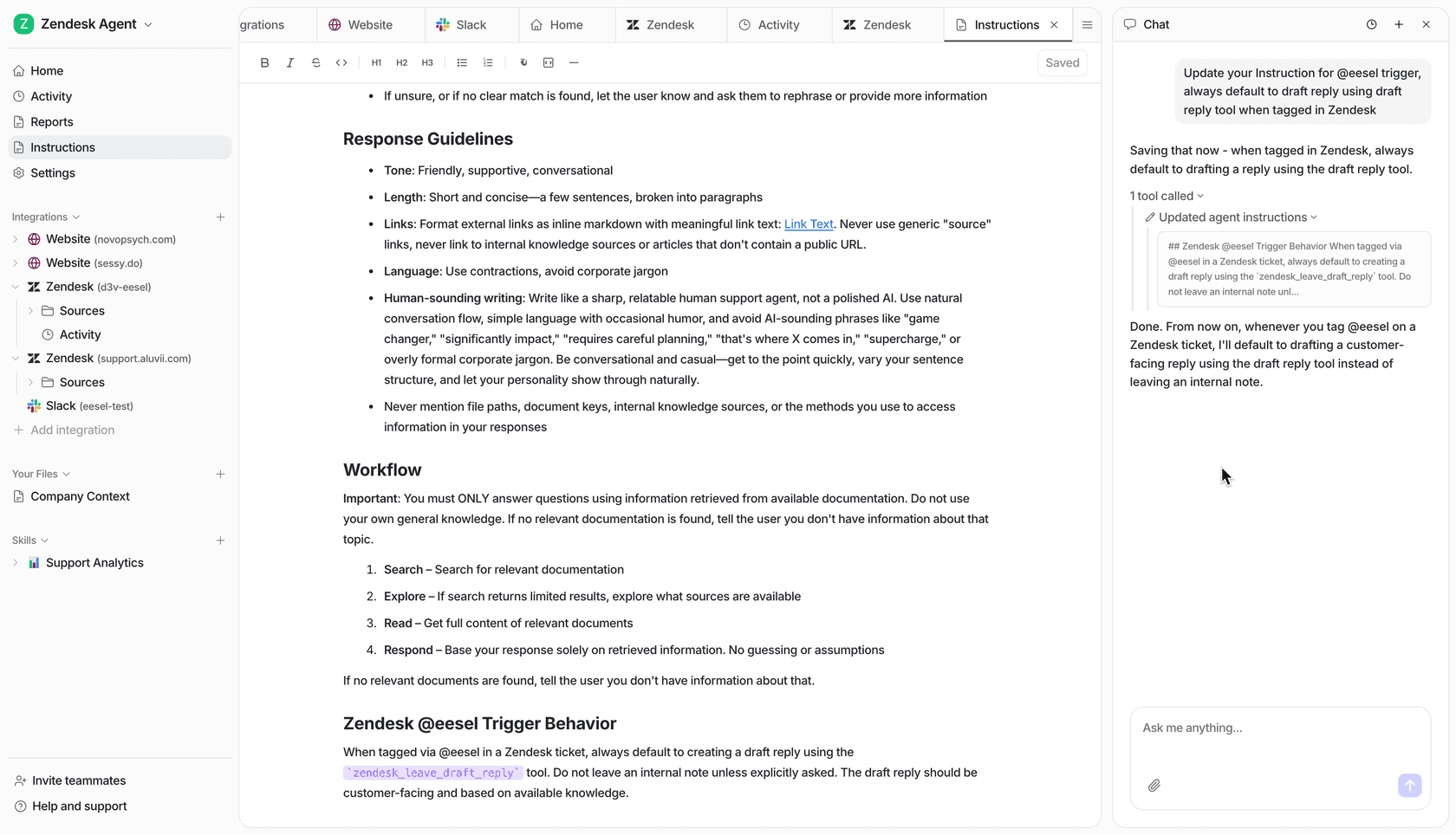
We approach this differently. Instead of building complex automation rules, you hire an AI teammate that learns your escalation policies in plain English.
Here's how it works: You connect our AI to your help desk and tell it your rules. "Escalate billing disputes over $1,000 to the Finance team immediately." "If a VIP customer's ticket hasn't been replied to in 30 minutes, notify the account manager." Our AI Agent handles the monitoring and escalation automatically.
Before going live, you can simulate our AI on thousands of past tickets to verify it understands your rules correctly. Once live, it learns from corrections. If an escalation wasn't needed, tell us and we'll adjust.
Our AI handles up to 81% of tickets autonomously in mature deployments, escalating only what you define. The AI Triage product tags, routes, and prioritizes tickets based on content, not just time elapsed.
For teams already using Zendesk, our Zendesk integration works alongside your existing setup. You don't need to replace anything just invite eesel to your team and start defining smarter escalation rules.
Measuring escalation effectiveness
You can't improve what you don't measure. Track these metrics to keep your escalation process healthy.
Escalation rate: The percentage of tickets that get escalated. Industry benchmarks vary, but 5-15% is typical for most support teams. Higher than that suggests your frontline needs more training or authority. Lower than that might mean issues aren't being caught.
Time to manager response: How long between escalation and the manager's first reply. This should be significantly shorter than your standard first reply time.
Resolution time for escalated tickets: Escalated tickets naturally take longer to resolve, but track the trend. If resolution times are increasing, your escalation criteria might need adjustment.
Re-escalation rate: How often a ticket escalated to a manager gets escalated again (to a director, for example). High re-escalation rates suggest your first-level managers need more authority or training.
Use Zendesk Explore to build dashboards tracking these metrics. Review them monthly and adjust your thresholds as your team and product evolve.
Streamline your Zendesk escalation to manager workflow today
Setting up manager escalations in Zendesk takes some initial configuration, but the payoff is worth it. Your customers get faster resolution for complex issues. Your agents know exactly when and how to escalate. Your managers get clear context instead of surprise tickets.
Start with the three-step workflow: create your escalation group, build the automation, and set up the notification trigger. Use the email templates to ensure consistent communication. Then monitor your metrics and refine over time.
If you're tired of wrestling with Zendesk workarounds and want to see how AI can handle escalations more intelligently, try eesel AI or book a demo to see it in action on your actual ticket history. Our AI learns your business from your past tickets, macros, and help center. It understands context, not just timestamps.
The best escalation process is the one your team actually uses. Keep it simple, document it clearly, and review it regularly.