
Service level agreements (SLAs) are the backbone of any serious support operation. They set clear expectations with customers and give your team measurable targets. But here's the catch: what happens when a ticket is about to breach its SLA? Ideally, you'd want an automatic escalation to alert the right people before the deadline passes. Unfortunately, Zendesk doesn't make this straightforward.
If you've searched for "Zendesk escalation automations by SLA," you've probably discovered the same gap everyone else has. Zendesk can notify you when an SLA is breached, but it cannot natively trigger an automation based on "X minutes before breach." This is one of the most requested features in the Zendesk community, with hundreds of upvotes on the official feature request.
The good news? There are workarounds. Some are native to Zendesk, others use third-party tools. We'll walk through each method so you can choose what works best for your team. And if you're looking for a solution that handles escalations more intelligently, we'll show you how we approach this at eesel AI.
Understanding Zendesk's SLA automation limitations
Let's clarify what Zendesk can and cannot do with SLA-based automations.
Zendesk offers two types of business rules: triggers and automations. Triggers fire immediately when a ticket is created or updated. Automations run hourly and can act on time-based conditions. But neither can directly trigger based on specific SLA target breaches.
The confusion often stems from a condition called "Hours since last SLA breach." This sounds promising, but it only tells you how much time has passed after an SLA was already breached. It cannot tell you "this ticket will breach in 30 minutes."
Why does this matter? Because reactive notifications (after a breach) don't give your team time to intervene. Proactive escalations (before a breach) let you reassign, notify, or take action while there's still time to meet the commitment.
The official feature request for SLA-based automation triggers has been active for years. Zendesk's response has been consistent: use the available workarounds. So that's what we'll cover.
We take a different approach at eesel. Rather than wrestling with time-based automation triggers, our AI teammate learns your escalation rules in plain English. You simply tell it things like "escalate tickets from Enterprise customers if they haven't been replied to in 2 hours" and it handles the rest. No complex workflows needed.
Prerequisites for SLA escalation automations
Before setting up any escalation workflow, make sure you have the following:
Zendesk plan requirements
- Zendesk Suite Professional ($115/agent/month) or higher for SLA policies
- Zendesk Suite Enterprise ($169/agent/month) for Group SLAs
- Support Team plan ($19/agent/month) has automations and triggers but no SLA features
Permissions and knowledge
- Admin access to Zendesk (only admins can create business rules)
- Understanding of the difference between triggers and automations
- Familiarity with your team's escalation matrix (who should be notified when)
Optional integrations
- Slack workspace (for notification channels)
- PagerDuty account (for on-call escalation)
- n8n account (for advanced workflows, from $20/month)
Test everything in a sandbox environment first. Zendesk offers sandbox environments on Enterprise plans, or you can create a test view to monitor automation effects before rolling out to your main queue.
Method 1: Group-based escalation workflow
This is the most reliable native workaround. Instead of triggering on "SLA about to breach," we use a combination of automations and triggers to move tickets into an escalation group when time conditions are met.
Step 1: Create SLA policies
First, set up the SLA policies you want to enforce.
Navigate to Admin Center → Objects and rules → Business rules → Service level agreements. Click "Create policy" and define your targets.
Key decisions you'll need to make:
- Which metrics to track (First Reply Time, Next Reply Time, or Resolution Time)
- Target times for each priority level (Urgent, High, Normal, Low)
- Business hours vs Calendar hours

Business hours only count during your set schedule. Calendar hours count 24/7. Most teams use business hours for First Reply Time and calendar hours for Resolution Time, but this depends on your customer commitments.
Once your SLA policies are active, Zendesk will start tracking targets on matching tickets. You can see SLA badges in ticket views and individual ticket pages.
Step 2: Create the "Breached SLAs" group
Next, create a dedicated group for escalated tickets.
Go to Admin Center → People → Groups and click "Add group." Name it something clear like "Breached SLAs" or "Escalations - SLA Risk." Assign agents who handle escalated issues. These should be your senior support staff or team leads.
The group doesn't need many members. Its purpose is to flag tickets visually and enable trigger-based notifications. You can have as few as one agent in this group if that person manages all escalations.
Step 3: Set up the automation
Now create the automation that moves tickets into your escalation group.
Navigate to Admin Center → Objects and rules → Business rules → Automations. Click "Add automation."
Conditions to set:
- "Hours since requester update" is greater than X (set this based on your risk threshold)
- Status is Open (don't escalate Pending or On-hold tickets)
- Ticket is not in "Breached SLAs" group (prevents re-running)
Actions to take:
- Add tag "sla_breach_risk" (for tracking)
- Change group to "Breached SLAs"
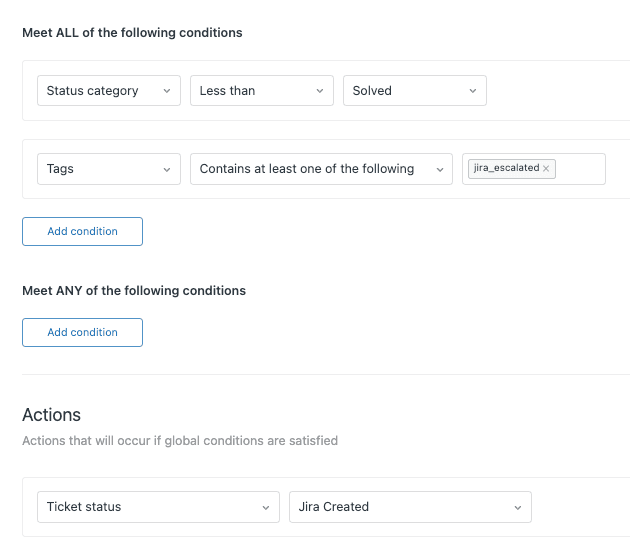
This automation runs every hour. When it finds tickets matching your conditions, it moves them to the escalation group. The limitation? You're using "hours since update" as a proxy for "approaching SLA breach," which isn't exact. But it's the closest you can get with native Zendesk tools.
Step 4: Create the trigger for notifications
Finally, set up a trigger to notify people when tickets enter the escalation group.
Go to Admin Center → Objects and rules → Business rules → Triggers. Click "Add trigger."
Conditions:
- Group changed to "Breached SLAs"
- Tags contains "sla_breach_risk"
Actions:
- Email group "Breached SLAs" (notifies assigned agents)
- Optionally: Notify target (Slack webhook or PagerDuty)
- Add internal note: "This ticket has been escalated due to approaching SLA breach"
Test this workflow thoroughly. Create a test ticket, let it sit, and verify the automation moves it and the trigger sends notifications. Adjust the "hours since update" threshold until it catches tickets at the right moment.
Method 2: Proactive SLA monitoring with n8n
For teams needing more precise control, n8n offers a powerful alternative. n8n is a workflow automation platform that can poll the Zendesk API hourly, calculate exact SLA percentages, and trigger notifications at precise thresholds.
Here's how it works:
The workflow runs every hour. It fetches all open tickets from Zendesk via the API, including their created_at and sla_due timestamps. For each ticket, it calculates the percentage of SLA time elapsed using this formula: percentElapsed = (1 - remaining/total) × 100.
At 75% elapsed, it sends a warning to your Slack channel. At 90% elapsed, it updates the ticket priority to "High" in Zendesk and alerts the team for immediate action. All events are logged to Google Sheets for compliance reporting.
n8n's hosted plans start at $20/month for 2,500 executions. Each execution counts as one full workflow run, regardless of how many tickets it processes. For most support teams, this means you can monitor hundreds of tickets hourly on the Starter plan.
The main advantage over native Zendesk workarounds? Precision. You get notified at exactly 75% and 90% of SLA elapsed, not "sometime after X hours." The trade-off is complexity. You need to set up and maintain the workflow, manage API credentials, and monitor the n8n instance.
Choose this method if:
- You have dedicated ops or technical staff
- SLA precision is critical to your business
- You need audit logs for compliance
Stick with native Zendesk workarounds if:
- You prefer simplicity over precision
- You don't have technical resources
- Hourly granularity is sufficient
Using Group SLAs for internal escalation tracking
If you're on Zendesk Enterprise ($169/agent/month), you have access to Group SLAs. These measure internal team accountability, also known as Operational Level Agreements (OLAs).
While standard SLAs track commitments to customers, Group SLAs track how long tickets sit with internal teams. They measure Group Ownership Time: the time from when a ticket is assigned to a group until it's reassigned or solved.

Group SLAs are useful for multi-department workflows. For example:
- IT teams tracking how long tickets stay with the infrastructure team
- Finance teams measuring approval turnaround times
- Product teams monitoring how long escalations sit with engineering
Setting up Group SLAs is similar to standard SLAs. Navigate to Admin Center → Objects and rules → Business rules → Service level agreements, then select the "Group SLAs" tab. Create a policy, select the target groups, and set ownership time targets.
Important limitations:
- Group SLAs cannot distinguish between assignment and escalation. They simply measure time with the group.
- They reset when tickets are reassigned. If a ticket moves from Team A to Team B and back to Team A, Team A gets a fresh ownership timer.
- They don't trigger automations. You still need the group-based workaround described earlier for notifications.
Group SLAs work best for post-hoc reporting and accountability, not real-time escalation triggers.
Third-party solutions and integrations
Several third-party tools can fill Zendesk's SLA escalation gaps. Here's a comparison:
| Solution | Approach | Pricing | Best for |
|---|---|---|---|
| SweetHawk Suite | Native Zendesk apps | $12/agent/month | Teams wanting native Zendesk functionality |
| n8n workflows | API-based automation | $20-800/month | Technical teams needing custom logic |
| PagerDuty | On-call escalation | $25-49/user/month | Teams with on-call rotations |
| eesel AI | AI-driven escalation rules | From $299/mo (500 credits) | Teams wanting intelligent, plain-English rules |
SweetHawk Suite
SweetHawk makes the most popular Zendesk apps for workflow automation. Their Timers app ($2/agent/month) and full SweetHawk Suite ($12/agent/month) add enhanced SLA enforcement directly inside Zendesk.
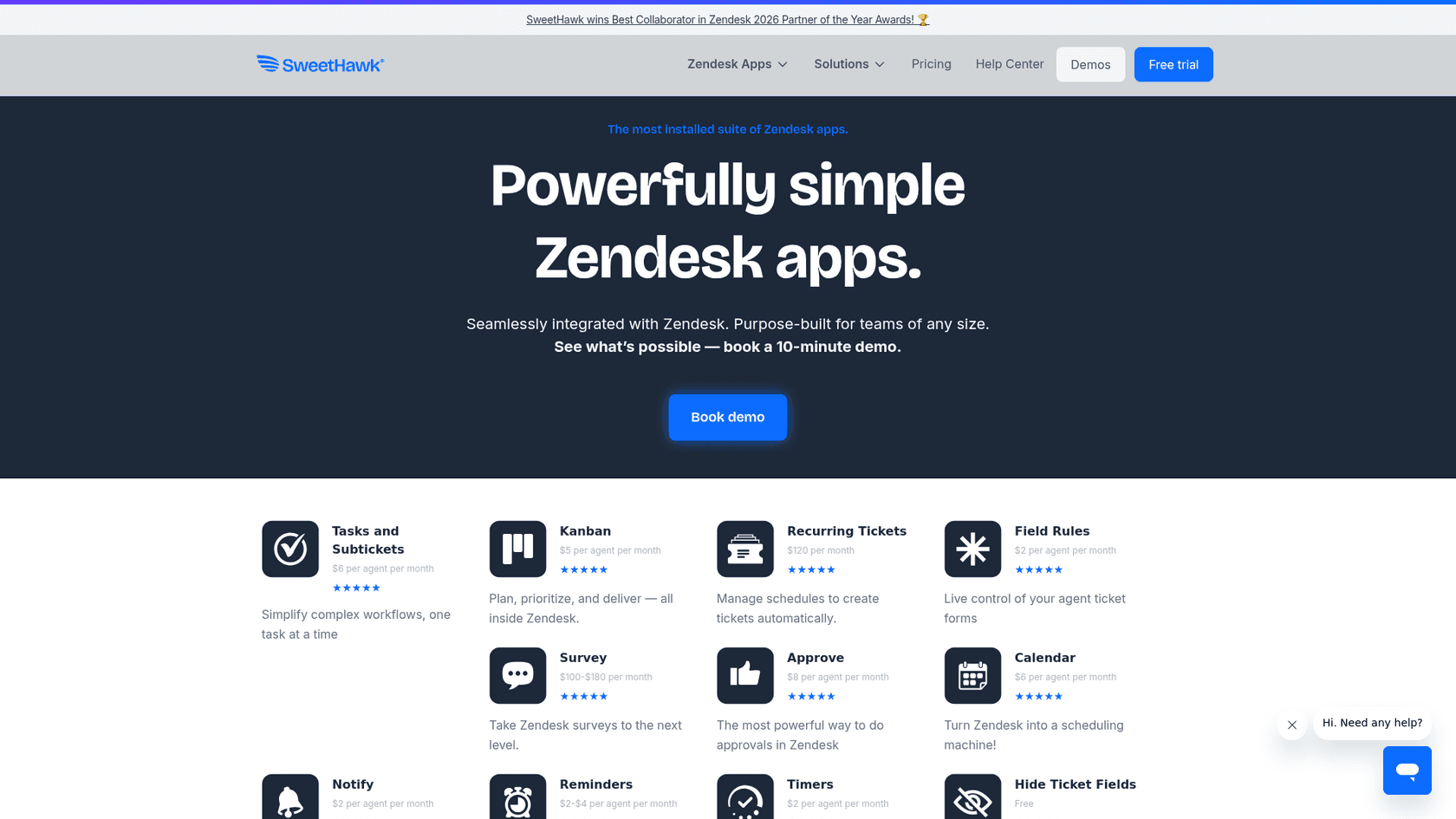
Unlike native Zendesk, SweetHawk apps can create more sophisticated time-based rules. They're built exclusively for Zendesk, so setup takes minutes and the interface feels native. SweetHawk is trusted by 12,000+ organizations including Amazon, eBay, and Twilio.
PagerDuty integration
If your escalation process involves waking up on-call engineers, PagerDuty integrates directly with Zendesk. When tickets breach SLA or meet certain conditions, PagerDuty can page the on-call team via phone, SMS, or push notification.
PagerDuty plans start at $25/user/month for the Professional tier, which includes Slack and Microsoft Teams integration, external status pages, and basic automation. The Business tier ($49/user/month) adds custom fields, advanced workflows, and ServiceNow integration.
eesel AI
We think about escalations differently. Instead of building complex automation rules, you hire an AI teammate that learns your escalation policies in plain English.

Here's how it works: You connect our AI to your help desk and tell it your rules. "Escalate billing disputes over $1,000 to the Finance team immediately." "If a VIP customer's ticket hasn't been replied to in 30 minutes, notify the account manager." Our AI handles the monitoring and escalation automatically.
Before going live, you can simulate our AI on thousands of past tickets to verify it understands your rules correctly. Once live, it learns from corrections. If an escalation wasn't needed, tell us and we'll adjust.
Our AI Agent handles up to 81% of tickets autonomously in mature deployments, escalating only what you define. The AI Triage product tags, routes, and prioritizes tickets based on content, not just time elapsed.
| Method | Setup complexity | Precision | Best for |
|---|---|---|---|
| Native Zendesk workaround | Low | Medium | Simple escalation needs |
| n8n workflows | High | High | Technical teams with dev resources |
| SweetHawk apps | Low | High | Zendesk-native experience |
| PagerDuty | Medium | High | On-call incident management |
| eesel AI | Low | Very High | Intelligent, rule-based escalation |
Best practices for SLA escalation management
Regardless of which method you choose, follow these practices to keep your escalations effective:
Set realistic SLA targets before automating. If your team consistently misses SLAs, escalating more aggressively won't help. Fix the root cause first.
Use SLA-based views for manual monitoring. Create views sorted by "Next SLA breach" ascending. Agents can see at-risk tickets at a glance, even without automation.
Test in sandbox first. Zendesk Enterprise includes sandbox environments. Test your automation logic there before affecting real tickets.
Document your escalation matrix. Write down who gets notified when, and for which ticket types. This prevents confusion and ensures coverage during vacations or turnover.
Monitor escalation rates. If 50% of tickets are escalating, your thresholds are too aggressive. If none are escalating, your SLAs might be too lenient. Aim for a small, actionable percentage.
Keep customers informed. Automated escalations shouldn't be invisible. Use triggers to send updates like "Your ticket has been escalated to our senior team for faster resolution."
Review and adjust quarterly. SLA needs change as your team and product evolve. Schedule quarterly reviews of your policies and automation rules.
Build smarter escalation workflows with AI
Zendesk's native limitations around SLA-based automations are well-known and well-documented. The workarounds we've covered (group-based workflows, n8n integrations, Group SLAs, and third-party apps) each solve part of the problem, but they all require trade-offs between simplicity and precision.
We believe escalation management should be simpler. Instead of configuring complex workflows, you should be able to define escalation rules the same way you'd explain them to a new team member: in plain English.
With our AI, you can:
- Define escalation rules naturally: "Always escalate tickets from Enterprise customers after 2 hours"
- Simulate on past tickets before going live to verify the rules work
- Start with AI drafting responses for review, then level up to full autonomous handling
- Handle routine tickets end-to-end, escalating only what truly needs human attention
Our approach isn't about adding another layer of automation. It's about bringing intelligence to your escalation process. Our AI learns your business from your past tickets, macros, and help center. It understands context, not just timestamps.
If you're tired of wrestling with Zendesk workarounds and want to see how AI can handle escalations more intelligently, try eesel AI or book a demo to see it in action on your actual ticket history. Check out our guide on AI agent for helpdesk for more on intelligent ticket management, or read about Zendesk AI agent escalations to learn more about smarter escalation workflows.


