Disclosure: This article is published by eesel AI, a competitor of ServiceNow and Zendesk. We encourage you to read ServiceNow's own materials and Zendesk's own materials for their perspective.
Choosing between ServiceNow AI and Zendesk AI means choosing between two different philosophies about what enterprise AI is supposed to do. ServiceNow built its name as the backbone of enterprise IT operations and has progressively layered AI across those workflows. Zendesk bet on customer service as a distinct discipline and built AI that works out of the box for support teams.
Both products are mature. Both have serious enterprise customers. The question isn't which one is better in the abstract. It's which one fits what you're actually trying to build.
What is ServiceNow AI?
ServiceNow describes itself as "AI control tower" for business reinvention, a platform that unites data, AI, workflows, and security across every department (source). 85% of Fortune 500 companies use ServiceNow, with a 98% renewal rate and over 95 billion workflows running on the platform.
ServiceNow's AI capabilities fall under three main products.
Now Assist is ServiceNow's generative AI layer, covering summarization, reply drafting, code generation, and AI-powered search across ITSM, HR, CRM, and other product lines. The underlying models are a mix of ServiceNow's own domain-specific LLMs and third-party options including Azure OpenAI, IBM WatsonX, and Google Gemini.
AI Agents are autonomous agents that "act autonomously to get work done." They draw from knowledge articles, incidents, CMDB, and external systems via Workflow Data Fabric. The AI Agent Studio lets teams build and customize agents using natural language, and the AI Agent Orchestrator handles coordination when multiple agents collaborate on a complex workflow.
Virtual Agent is ServiceNow's conversational chatbot product, with multi-turn conversations, Slack and Teams integrations, and live-agent handoff built in.
In February 2026, ServiceNow launched its Autonomous Workforce line, adding "AI Specialists" with defined roles, including an L1 Service Desk AI Specialist that autonomously resolves IT requests using enterprise knowledge bases and historical incident data.
What is Zendesk AI?
Zendesk serves over 100,000 companies and positions its product as the "Resolution Platform": AI agents resolve interactions autonomously, Copilot helps human agents work faster, and both run on a unified ticketing and omnichannel stack. In March 2026, Zendesk acquired Forethought, folding a leading agentic AI startup into the lineup under the name "Forethought AI agents by Zendesk."
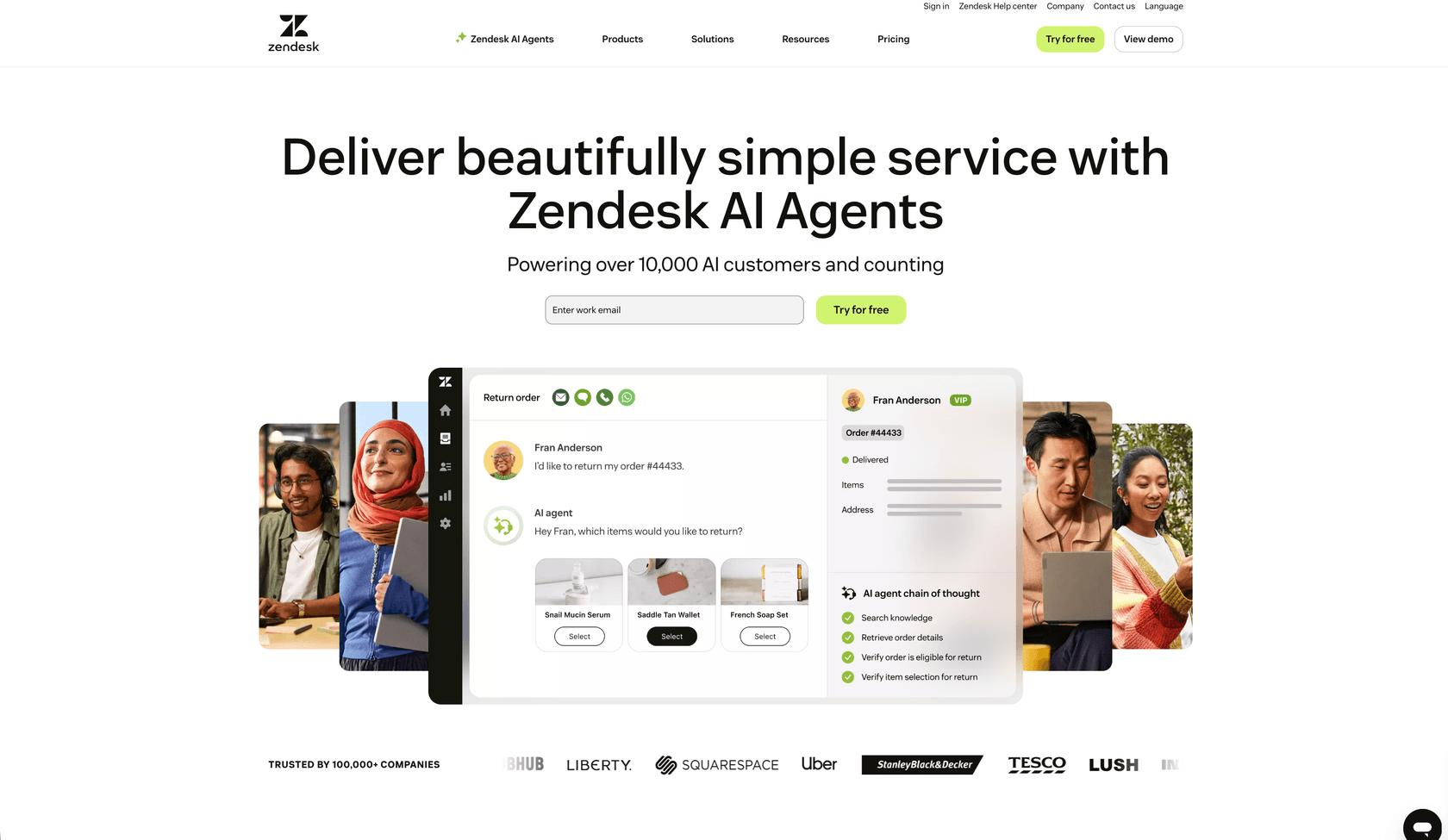
Zendesk AI Agents are autonomous agents pre-trained on 18 billion real customer interactions. They support 80+ languages and are built to handle the full resolution cycle across email, chat, messaging, and voice. Zendesk publishes a progression for what AI agents can achieve: 30% automation from basic knowledge connections, scaling to 80%+ automation when running across untapped channels and regions.
Zendesk Copilot assists human agents in real time, drafting replies, surfacing intent and sentiment, and suggesting next-best actions. Customer-reported outcomes include 82% productivity gains, 76% time savings, and 65% less busy work.
ServiceNow AI vs Zendesk AI: key differences
| Aspect | ServiceNow AI | Zendesk AI |
|---|---|---|
| Primary focus | Enterprise workflow automation | Customer service and support |
| AI approach | Build custom agents | Pre-trained AI ready to deploy |
| Best for | Large enterprises with complex IT needs | Teams wanting quick AI deployment |
| Setup complexity | Requires implementation and configuration | Works out of the box |
| Pricing model | Custom enterprise quotes | Transparent, tiered pricing |
| G2 rating | 4.4/5 (1,270 reviews) | 4.3/5 (6,816 reviews) |
The core difference: ServiceNow AI is a platform you build on. Zendesk AI is a solution you turn on.
ServiceNow AI features and capabilities
ServiceNow's AI Agent Studio lets teams build agents tailored to specific workflows using natural language prompts or visual tools. Pre-built agents are also available through the AI Agent Marketplace.
The AI Agent Orchestrator handles something most platforms leave unaddressed: coordination between agents. When multiple AI agents handle different parts of a complex workflow, the Orchestrator manages handoffs and keeps the overall goal on track.
The AI Agent Fabric is a protocol layer that lets ServiceNow agents communicate with third-party AI agents via the Agent2Agent (A2A) protocol and pull context from external tools via the Model Context Protocol (MCP).
ITSM, ServiceNow's helpdesk product, is sold in three tiers: Foundation, Advanced, and Prime. Each tier now bundles a Moveworks-for-ITSM SKU at the matching level, per the ITSM pricing page. AI Agents for ITSM is a Prime-tier feature.
What reviewers say: 1,270 reviews, 4.4/5 on G2, with praise for workflow automation and centralized IT management. The most-cited concern is specific: "AI features can feel limited unless properly configured and licensed." Top "cons" tags: Learning Curve (72), Expensive (60), Complexity (56).
Strengths:
- Custom agent development via AI Agent Studio
- Multi-agent orchestration across complex workflows
- Deep integration with enterprise systems and ITSM processes
- AI Control Tower for governance across all AI deployments
- Strong interoperability via AI Agent Fabric (MCP, A2A)
- Enterprise security and compliance built in
Limitations:
- Requires significant implementation effort; no self-serve path
- Pricing not publicly disclosed; contact ServiceNow for a quote
- Steeper learning curve than ready-to-deploy alternatives
- AI features can underdeliver without proper configuration and licensing
Zendesk AI features and capabilities
Zendesk AI Agents come in two tiers. The Essential tier is included in all Suite plans and covers email and messaging channels, generative replies, a customizable agent persona, and basic escalation and data capture. The Advanced tier (priced via "Talk to Sales" with no public price) adds the full AI agent builder, integrations and actions for calling APIs and taking steps in third-party systems, reasoning controls, and advanced language support.
This split matters: Essential alone is closer to a knowledge-grounded FAQ bot. Action-taking, multi-step autonomous resolution requires the Advanced tier.
The Forethought acquisition in March 2026 adds a third path: Forethought AI agents run either inside Zendesk or on top of other helpdesks, bringing additional agentic AI depth to the lineup.
Zendesk Copilot integrates with third-party systems like Shopify and Jira, drafts replies from your knowledge base and macros, and surfaces relevant ticket insights in real time. G2 reports an overall AI agent performance score of 96 (30 points above average), with 100% correct escalation rate and 96% response accuracy.
Real customer outcomes from the AI Agents page: Hello Sugar reached a 66% automation rate and $14k in monthly savings. Lush reported $434k in annual savings with 93% CSAT. UrbanStems hit a 39% automated resolution rate and $100K savings in three months.
"Centralized ticketing, omnichannel support, automation, and reporting are the best things about Zendesk's customer service. It puts conversations from email, chat, phone, and social media all in one place, which helps teams stay organized and respond faster."
Strengths:
- Pre-trained on 18 billion interactions; no training needed
- Quick to deploy at the Essential tier
- 80+ languages with automatic switching
- Transparent, tiered pricing
- Strong Copilot for human agent assistance
- Broad marketplace with 1,800+ apps
Limitations:
- Less customization than a build-your-own platform
- Advanced AI agents (action-taking, multi-step) require a paid add-on without a public price
- Copilot is a separate add-on at $50/agent/month on top of plan costs
ServiceNow AI vs Zendesk AI: pricing comparison
ServiceNow pricing
ServiceNow does not publish dollar pricing on any public-facing page. The ITSM pricing page lists three named tiers (Foundation, Advanced, and Prime) with feature breakdowns, but every plan ends with a "Get Custom Quote" call to action. The AI Control Tower page says "Contact Us for Pricing." Pricing is not publicly listed; contact ServiceNow for a quote.
Third-party consultancies publish estimates: Unthread and RedressCompliance both cite ITSM ranges of $70-$200 per fulfiller per month. These figures are not published by ServiceNow and should be treated as third-party estimates only.
Zendesk pricing
Zendesk publishes its full plan ladder at zendesk.com/pricing:
| Plan | Annual (per agent/month) | Monthly (per agent/month) | AI agents | Automated resolutions/agent/month |
|---|---|---|---|---|
| Suite Team | $55 | $69 | Essential | 5 |
| Suite Professional | $115 | $149 | Essential | 10 |
| Suite Enterprise | $169 | $219 | Essential | 15 |
| Suite + Copilot Professional | $155 | - | Essential + unlimited Copilot | 10 |
| Suite + Copilot Enterprise | $209 | - | Essential + unlimited Copilot | 15 |
Copilot add-on: $50 per agent per month (available on Professional and Enterprise plans)
Advanced AI agents: Priced via "Talk to Sales", no public price
Additional automated resolutions: $1.50 per AR (committed upfront) or $2 per AR (pay-as-you-go) for volume beyond the included allowance
Zendesk also offers a 14-day free trial. ServiceNow does not.
When to choose ServiceNow AI
ServiceNow AI makes sense when:
- You are already running on the ServiceNow ecosystem
- You need custom AI agents built for complex, unique workflows rather than standard customer service patterns
- ITSM is your primary use case
- You have the internal resources for implementation and ongoing management
- Enterprise security, compliance, and multi-department AI governance are non-negotiable requirements
- You want to orchestrate multiple AI agents across different systems and departments
ServiceNow rewards organizations that can invest the time and internal expertise to build exactly what they need.
When to choose Zendesk AI
Zendesk AI is the better fit when:
- You want AI working this week, not in months
- Customer service is your primary focus, not internal IT workflows
- You need support across multiple channels and languages without complex configuration
- Transparent pricing matters for budgeting and procurement
- Your team wants AI that assists human agents and handles straightforward tickets, with a clear upgrade path to full autonomy
- You want to start at a smaller scale and expand as you see results
Zendesk rewards teams that want proven AI without the complexity of platform engineering.
A third option: eesel AI
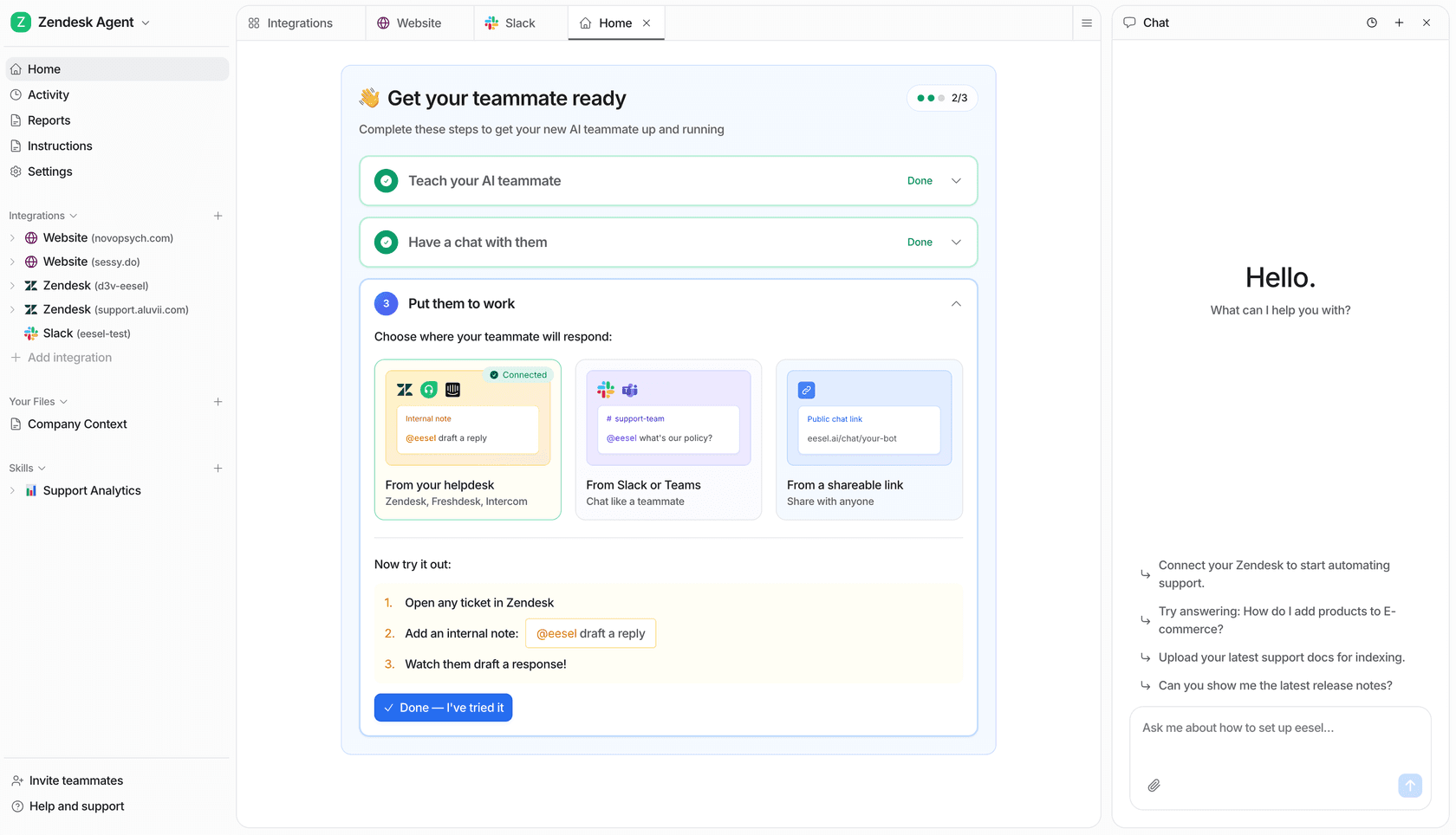
ServiceNow and Zendesk both layer AI on top of platforms built before AI was central to customer service. eesel AI takes a different approach: it sits as an AI agent layer on top of your existing helpdesk, not a replacement for it.
Connect eesel to your helpdesk (Zendesk, Freshdesk, Gorgias, and 100+ others) and it learns from your past tickets, help center, and connected documents without manual training. Before going live, run eesel against thousands of past tickets in simulation mode to see exactly how it would respond and measure expected resolution rates. Escalation rules are defined in plain English: "If the refund request is over 30 days, politely decline and offer store credit." No code needed.
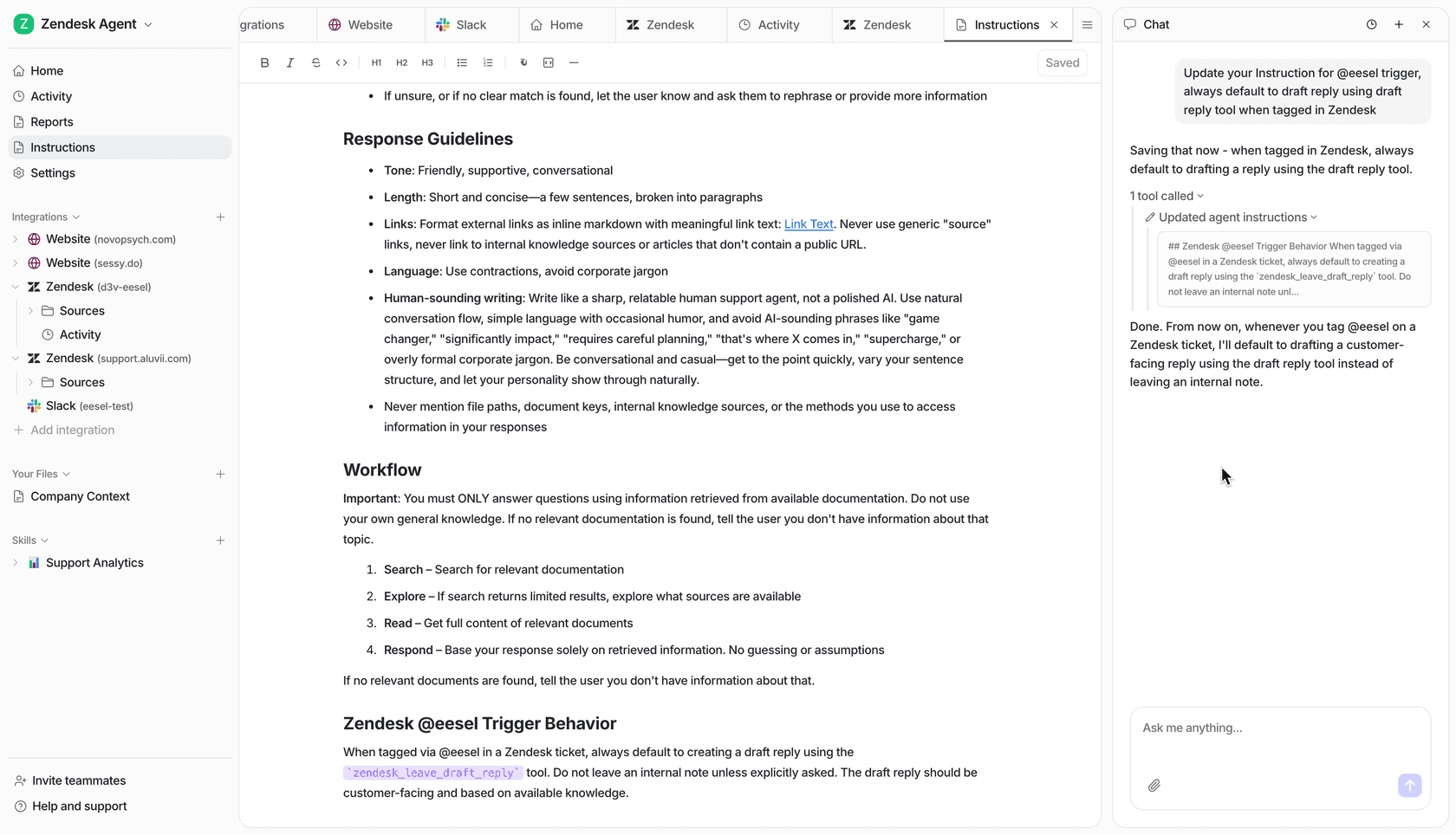
Pricing: eesel uses task-based pricing: $0.40 per regular task (support tickets, chat sessions) and $4.00 per heavy task. There's no platform fee and no per-seat charge. Sign up with $50 in free credits, no credit card required. An enterprise add-on at $1,000/month adds a dedicated solutions engineer, SSO, and HIPAA compliance.
Mature eesel deployments report up to 81% autonomous resolution, with a typical payback period under two months.