
Choosing the right AI-powered customer service platform can feel overwhelming. Two names keep coming up: Salesforce Agentforce and Zendesk AI. Both promise to change how you handle support, but they take fundamentally different approaches.
We'll break down what each platform actually offers, how they compare on pricing and implementation, and which one makes sense for your team.
What is Salesforce Agentforce?
Salesforce Agentforce is an autonomous AI agent platform built on top of Salesforce's existing Einstein AI infrastructure. Think of it as a system for creating intelligent agents that can reason, act, and collaborate independently to handle business tasks across sales, service, marketing, and commerce.
The platform centers around the Atlas Reasoning Engine, which breaks down complex prompts into smaller tasks, evaluates progress at each step, and proposes action plans. You can customize agents using the low-code Agent Builder, or build entirely new ones using Flows, Prompts, Apex code, and MuleSoft APIs.
Salesforce offers several pre-built agent types: Service Agents for handling support issues, Sales Development Reps for engaging prospects 24/7, Sales Coaches for training teams, and specialized agents for merchandising, buyer assistance, and campaign optimization.
What's important to remember is that Agentforce is designed for enterprises already invested in the Salesforce ecosystem. It integrates deeply with Salesforce CRM, Data 360, and Slack, creating a unified platform where AI agents work alongside your existing workflows.
What is Zendesk AI?
Zendesk AI takes a different approach. Rather than building a platform for creating custom AI agents, Zendesk offers pre-trained AI capabilities designed to work out of the box for customer service teams.
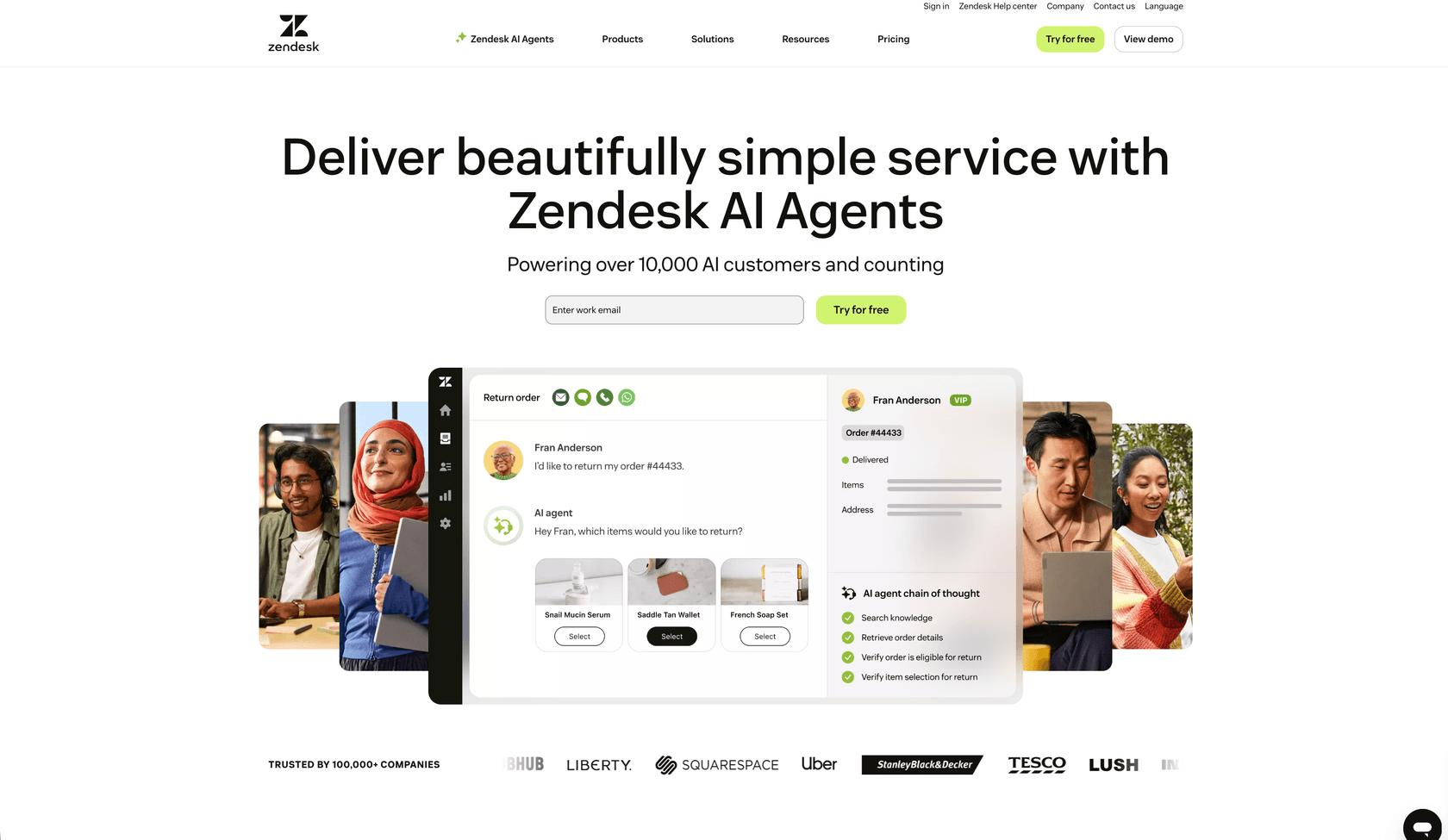
The system is trained on 18+ billion real service interactions, which means it understands customer intent, sentiment, and common issue patterns from day one. No configuration wizards. No training uploads. You connect it to your help desk and it starts learning your specific business context immediately.
Zendesk's AI suite includes autonomous AI agents that can resolve up to 80% of interactions across any channel, an Answer Bot for self-service, Copilot for real-time agent assistance, Intelligent Triage for automatic ticket categorization, and Generative Replies that draft responses based on your knowledge base.
The platform is purpose-built for customer service. While Salesforce adapted their CRM for service use cases, Zendesk built their entire platform around support workflows from the ground up.
AI capabilities comparison
Salesforce Agentforce AI features
Salesforce emphasizes customization and control. The Atlas Reasoning Engine provides sophisticated task decomposition, allowing agents to handle multi-step processes autonomously. The Agentforce Script feature combines deterministic workflows with flexible LLM reasoning, giving you both precision and adaptability.
Key capabilities include:
- Autonomous AI agents that reason, act, and collaborate across departments
- Einstein AI platform with predictive analytics and custom model development
- Agentforce Voice for AI-powered phone, web, and mobile interactions
- Cross-department AI covering sales, marketing, service, and commerce
- Real-time case classification and intelligent routing
- Einstein Trust Layer with dynamic grounding, zero data retention, and toxicity detection
The trade-off? You need technical expertise to unlock the full potential. Salesforce implementations often require dedicated admins, developers, and external consultants.
Zendesk AI features
Zendesk prioritizes immediate value. The AI agents work from day one with no training required because they're already trained on nearly two decades of support interactions.
Key capabilities include:
- Pre-trained AI agents with up to 80% autonomous resolution rates
- Answer Bot for instant self-service from your knowledge base
- Intelligent Triage that categorizes tickets by intent automatically
- Copilot providing real-time suggested replies and action execution
- Sentiment Analysis detecting frustration and flagging at-risk customers
- Generative Replies drafting responses grounded in your help center content
The platform also includes native tools many teams need separately: Quality Assurance for evaluating agent performance, Workforce Management for forecasting and scheduling, and comprehensive analytics with 200+ pre-built reports.
Key differences in approach
The fundamental difference is customization-first versus ready-to-use. Salesforce gives you building blocks to create exactly what you need, assuming you have the technical resources. Zendesk gives you a complete solution that works immediately, assuming your needs fit their established patterns.
Salesforce's approach works well when you have complex, unique workflows that span multiple departments. Zendesk's approach works well when you want to improve customer service quickly without engineering overhead.
Performance data reflects this. Salesforce reports a 58% AI success rate for single-turn interactions and 35% for multi-turn conversations. Zendesk claims up to 80% autonomous resolution rates with 66% one-touch resolution and 92% reduction in email handle time.
Pricing and total cost of ownership
Zendesk pricing
Zendesk uses a per-agent pricing model with annual billing (monthly available at higher rates).
| Plan | Annual Price (per agent/month) | Monthly Price | Key Features |
|---|---|---|---|
| Support Team | $19 | $25 | Email/ticketing, basic automations, 1000+ integrations |
| Suite Team | $55 | $69 | Essential AI agents, generative replies, 1 help center, messaging, phone |
| Suite Professional | $115 | $149 | Advanced AI, 5 help centers, Copilot writing tools, skills-based routing, HIPAA |
| Suite Enterprise | Custom (sales) | Custom (sales) | 300 help centers, approval workflows, sandbox, custom roles, audit logs |
Add-ons include:
| Add-on | Price |
|---|---|
| Advanced AI Agents | Contact Sales |
| Copilot | $50/agent/month |
| Quality Assurance | $35/agent/month |
| Workforce Management | $25/agent/month |
| Advanced Data Privacy | $50/agent/month |
| Contact Center | $50/agent/month |
Zendesk also uses resolution-based pricing for AI. Each plan includes 5-15 automated resolutions per agent per month. Beyond that, committed resolutions cost $1.50 each, or $2 each on pay-as-you-go.
Salesforce pricing
Salesforce offers multiple pricing structures including per-user licensing and Flex Credits for consumption-based products.
| Plan | Price (per user/month) | Key Features |
|---|---|---|
| Starter Suite | $25 | Simple CRM suite, lead/account management, email marketing |
| Pro Suite | $100 | Enhanced chat, customization, sales quoting, forecasting |
| Enterprise | $175 | AI for customer service, self-service help centers, workflow automation |
| Unlimited | $350 | Salesforce Knowledge, premier success plan, full sandbox |
| Agentforce 1 Service | $550 | Full AI suite, AI for employees, Tableau Next, 1M Flex Credits |
Note that every Salesforce customer can get started with Agentforce for free through Salesforce Foundations. However, the true cost extends beyond the subscription. Salesforce implementations typically require significant professional services, dedicated admin headcount, and third-party tools for full functionality.
Salesforce has raised prices recently: a 6% increase in August 2025 for Enterprise and Unlimited editions, following a 9% increase in July 2023.
Hidden costs to consider
When evaluating either platform, factor in:
- Implementation and consulting fees Salesforce projects often span months or years with external consultants
- Admin headcount requirements Salesforce typically needs dedicated administrators
- Training and onboarding time Complex platforms require more extensive training
- Third-party integrations and add-ons Native tools in one platform may require paid add-ons in another
Bottom line? Zendesk's total cost is more predictable. Salesforce's costs can escalate significantly depending on implementation complexity.
Implementation and time to value
Zendesk implementation
Zendesk emphasizes fast deployment. The typical setup takes 4-6 weeks, and 90% of customers deliver value in under 8 weeks according to their data. The process is largely self-guided with minimal technical expertise required.
Native QA and Workforce Management tools are included, so you don't need to integrate separate systems for quality monitoring or scheduling. The unified platform means AI, ticketing, and reporting work together without complex configuration.
Salesforce implementation
Salesforce implementations are more involved. Complex setups often span months or years, particularly when deploying AI capabilities. Agentforce requires Data 360 configuration for proper AI deployment, which adds implementation overhead.
Most organizations need dedicated admins and often hire external consultants for initial setup and ongoing optimization. The technical expertise requirements are significantly higher than Zendesk.
User feedback on setup experience
Reviewers on TrustRadius and G2 consistently highlight this difference. Zendesk users praise the straightforward setup and intuitive interface. Salesforce users acknowledge the learning curve but appreciate the depth of customization available once configured.
The pattern is clear: Zendesk gets you running faster. Salesforce gives you more control once you're running.
Ideal use cases and recommendations
When to choose Zendesk
Zendesk fits best when:
- You run a small to mid-sized team prioritizing ease of use
- You need fast time-to-value (weeks, not months)
- Your focus is purely on customer service (not full CRM)
- You have limited technical resources
- You prefer predictable, per-agent pricing
Companies like UrbanStems achieved 39% automated resolution and $100K savings in three months. Lush hit 60% first contact resolution with $434K annual savings. These results come from Zendesk's out-of-the-box AI capabilities.
When to choose Salesforce
Salesforce makes sense when:
- You're a large enterprise with complex, custom workflows
- You're already using Salesforce CRM and want tight integration
- You need AI across multiple departments (sales, marketing, service, commerce)
- You have dedicated technical teams for implementation and management
- You need advanced predictive analytics beyond standard reporting
The platform excels when customer service is part of a broader customer journey that spans sales, marketing, and post-purchase support.
Alternative to consider: eesel AI
There's a middle ground worth considering. While Salesforce offers maximum customization and Zendesk offers maximum simplicity, some teams want AI capabilities without the complexity of Salesforce or the limitations of Zendesk's fixed workflows.
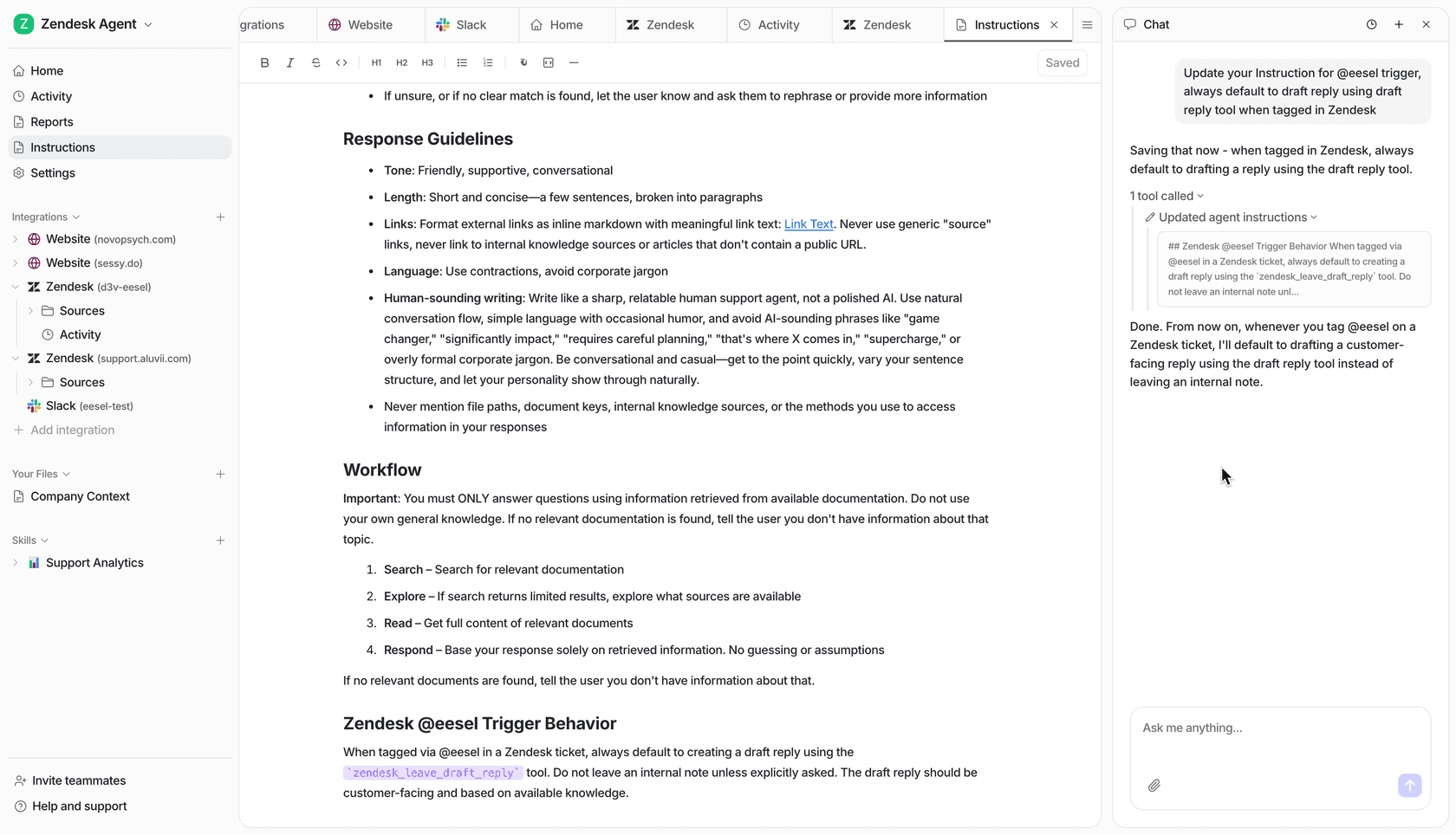
eesel AI approaches this differently. Instead of configuring workflows, you "hire" eesel as an AI teammate. It learns your business from existing help desk data (past tickets, help center articles, macros) in minutes rather than weeks. You start with oversight (drafts for review) and level up to full autonomy as eesel proves itself.
The key difference is plain-English control. You define escalation rules and behavior in natural language: "If the refund request is over 30 days, politely decline and offer store credit." No code, no rigid decision trees.
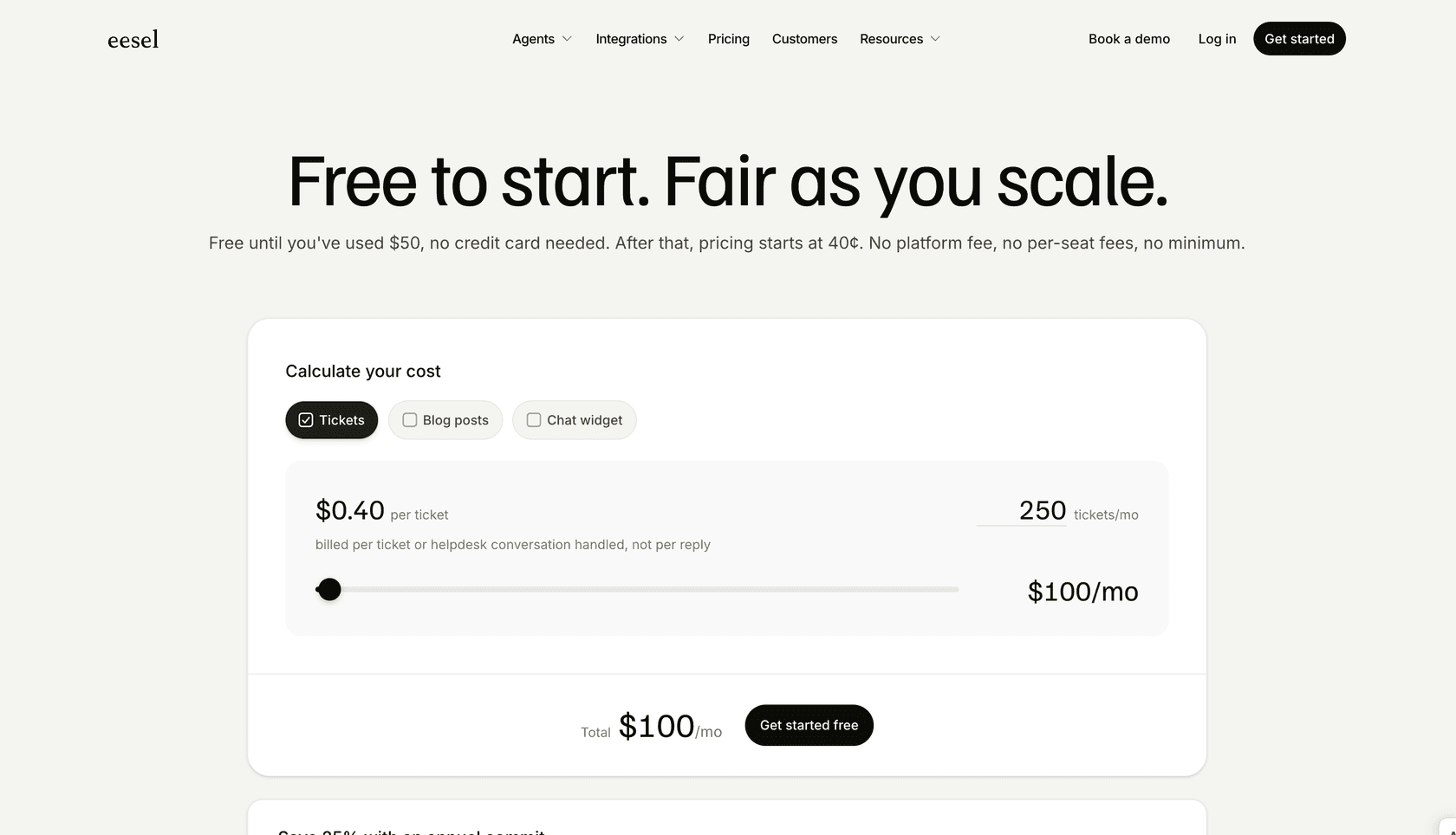
For teams wanting autonomous resolution with easier setup than Salesforce and more flexibility than Zendesk, eesel AI's pricing starts at $299/month for 500 credits (1 credit per ticket handled), with unlimited agents and no per-agent fees.
Making the right choice for your team
The "right" choice depends on your specific situation. Large enterprises with complex, multi-department needs and existing Salesforce investments will likely find Agentforce worth the implementation investment. Smaller teams wanting fast ROI with minimal technical overhead will likely prefer Zendesk AI.
Consider these questions:
- How quickly do you need to show results?
- What technical resources can you dedicate to implementation and ongoing management?
- Is customer service part of a broader CRM strategy, or a standalone function?
- Do you need deep customization, or will standard workflows serve you well?
If neither extreme fits, alternatives like eesel AI offer a balance: autonomous AI resolution with progressive rollout, plain-English configuration, and fixed monthly pricing based on credits rather than seats.
The best platform is the one your team will actually use effectively. Fancy features mean nothing if implementation stalls or the interface frustrates your agents. Start with your team's capabilities and work backward from there.