Serval vs SIIT: which AI service desk wins in 2026?

Alicia Kirana Utomo

Katelin Teen
Last edited September 22, 2026
Serval vs SIIT at a glance
| Dimension | Serval | SIIT |
|---|---|---|
| Best for | Enterprise IT replacing a legacy ITSM | Mid-market ops team (roughly 150 to 2,000 employees) |
| Category | Full-stack AI-native ITSM / ESM | Chat-native internal service desk |
| Primary channel | Slack, Teams, email, portal, phone | Slack and Microsoft Teams (both first-class), email, portal |
| Pricing | Quote-only, single platform fee | $23 / $45 / $89 per admin/mo, billed annually |
| Billable unit | Negotiated (analysts read it as seat-based) | Per admin; unlimited employees free |
| AI usage meter | None published | None on the agent; Assist has a 10-conv/week fair-use cap |
| Where AI answers come from | Connected KB + approved code workflows | Notion, Confluence, or Slab wiki only |
| Trains on past tickets | No (Catalyst uses ticket history to build workflows) | No |
| Test before go-live | Human-run guided pilot | Shadow / simulate mode for playbooks |
| Provisioning actions | Deep (IAM, MDM, JIT access, CMDB) | Deep (Okta, Google, Entra, JumpCloud, Jamf, Intune) |
| Deployment | Cloud, hybrid, or self-hosted | Cloud |
| Compliance | Enterprise ITSM posture, self-hosting option | SOC 2 Type II, GDPR |
| Reviews | New, thin third-party review base | 5.0 from 29 reviews on G2 |
| Notable backing | ~$1B valuation, $127M raised | $5M seed, 100+ customers |
What Serval is
Serval is an AI-native Enterprise Service Management platform that automates employee IT requests end to end, from onboarding and offboarding to just-in-time access, password resets, and email configuration. It positions itself bluntly as a rip-and-replace for the incumbents, "built to replace ServiceNow, JSM, and FreshService," and it can also sit on top of an existing ITSM through bi-directional sync while you migrate.
The company is young but very well funded. Founded in 2024, Serval raised a $47M Series A in October 2025 and then a $75M Series B led by Sequoia in December 2025, reaching a roughly $1B valuation on $127M total funding. The customer wall is heavy on the kind of logos that make an enterprise buyer comfortable: Ramp, Cribl, Perplexity, Together AI, plus Spotify, Fox, and Live Nation per Computerworld.
What makes Serval distinctive is not that it answers questions in chat, it is the safety architecture underneath. There are two separate agents. Catalyst is the admin-only agent that turns a plain-English description into a real, code-based workflow. The Help Desk Agent is the end-user agent that reasons over a request and resolves it using only the workflows an admin has already published. CEO Jake Stauch frames the split to TechCrunch with the nightmare it is meant to prevent: "You don't want someone to go into Slack and say, 'Hey, I want to delete all the data at the company,' and the very helpful AI agent responds, 'Great, I'll delete all the data.'"
That is worth sitting with, because it is the whole product philosophy in one line. Serval's agent cannot improvise an action against your systems. It can only call deterministic workflows that carry their own permissions and approval gates, "that aren't subject to LLM judgement." One IT lead on the site captures the day-to-day payoff:
"Zero touch tickets... has allowed me to keep my team smaller and mightier."
Serval is new enough that independent reviews are still thin. Its G2 score is 4.9 from 10 reviews, but every one is a seller-invited, incentivized review clustered in a single month, so I would read it as early enthusiasm rather than proof at scale. The more useful signal is the specific criticism buried inside those same five-star reviews, which lands on the thing any AI agent has to earn, trust:
"Often, the agent will say something is set up or configured, but it will silently fail... I'd like the agent to flag issues and suggestions before a human does."

That is a fair, familiar note, and catching exactly that kind of silent miss before it reaches an employee is what the whole safety architecture is trying to buy you.
What SIIT is
SIIT is an internal help desk that runs inside Slack and Microsoft Teams. Employees ask for things in the chat tool they already use, SIIT turns those asks into structured, tracked requests, admins work them from a web dashboard, and on the top tier AI agents both answer from the company wiki and execute the change in Okta, Google, Entra ID, or JumpCloud. It is explicitly not IT-only; the pricing FAQ says it supports HR, Finance, Legal, and Facilities too.
The company sits in a different weight class. Founded by ex-Aircall people in Paris, SIIT raised a $5M seed and serves a European-scaleup-heavy roster: Monzo, Qonto, Mistral, Doctolib, Spendesk, and Gorgias. The customer stories point squarely at small teams punching above their weight, like "How Unit Runs IT for 200 Employees With 2 People" and a claimed 160:1 admin-to-employee ratio at Monzo.
Two things stand out once you get past the marketing. First, SIIT treats Teams as a real peer to Slack, not a bolted-on skin, which is rarer than it sounds and a real reason Teams-first European companies pick it. A reviewer whose company runs on Teams says exactly that:
"Most of our company lives in Teams not Slack and finding a help desk tool that actually treats Teams as a first class citizen was harder than expected. Siit isn't a Slack tool with a Teams skin. Forms render properly inside the chat and approvals happen right in the thread."
Second, SIIT has been shipping hard on the developer surface. Its changelog shows a new Slack Agent with visible step-by-step reasoning, a full MCP server, grouped requests in the public API, and a listing in Claude's Connector Directory, all since mid-August 2026. For a mid-market tool, that is a serious agent-friendly footprint.
SIIT's reviews are unusually clean: 5.0 out of 5 from 29 reviews on G2. Read that honestly, though. A perfect score on a small, partly invite-sourced base tells you the early customers are happy and nobody is publicly unhappy, which is a real signal but not the same as proof at scale.
How they actually work: two different bets on safe AI
Here is where the comparison gets interesting, and it is the part I care about most as someone who builds this stuff. Serval and SIIT have made two different bets on how an AI agent should be allowed to touch your systems.
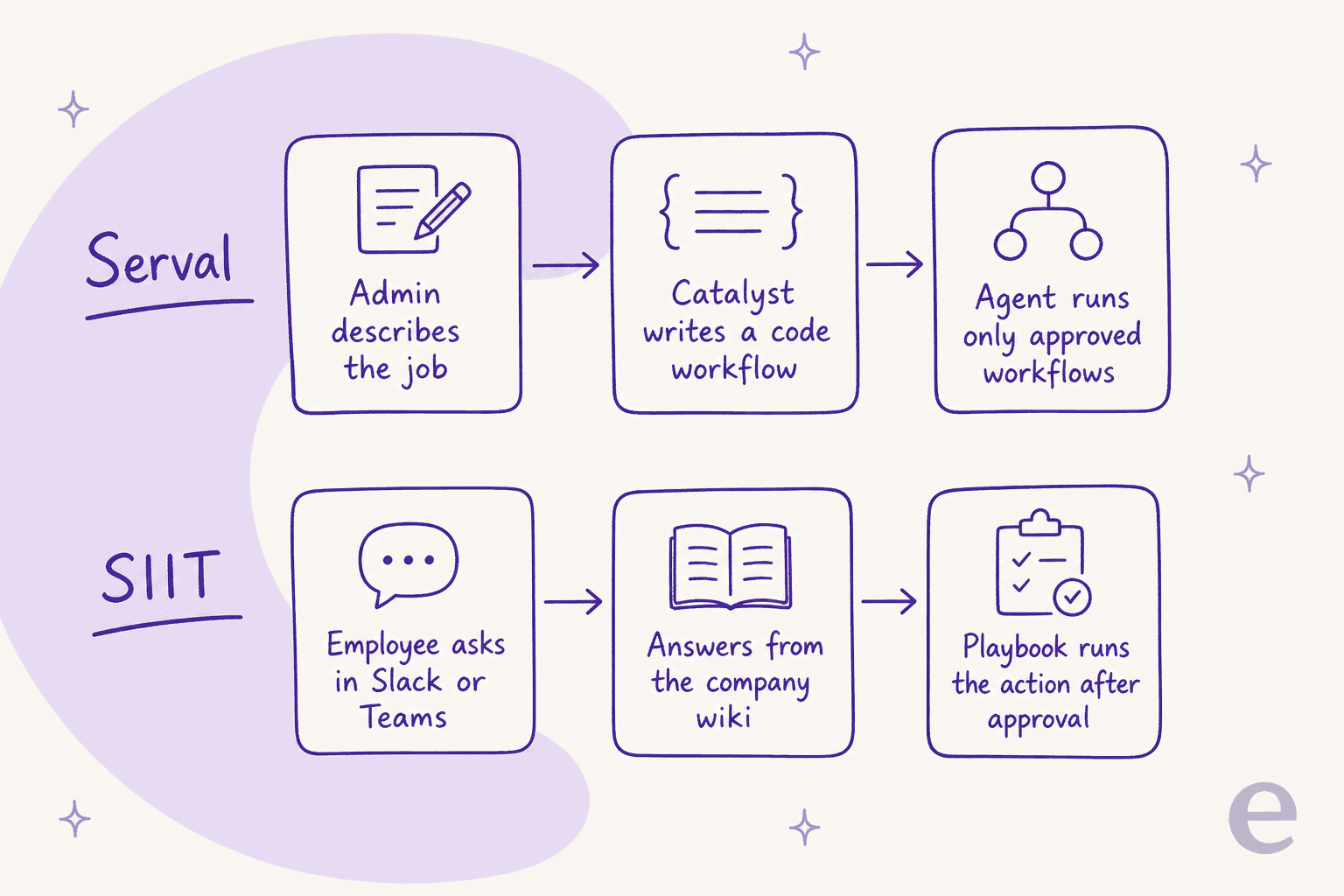
Serval's bet is determinism through code. An admin describes a job, Catalyst writes an actual code workflow for it, and the end-user agent can only ever call those published workflows. Stauch's argument to Computerworld is that "the best way to build automations is not a drag-and-drop workflow builder, but letting AI do what it does best, which is to write code." Once a workflow is built, "workflows always run the exact code you define, meaning no hallucinations or surprises." The homepage demo shows Catalyst chewing through 5,866 ServiceNow incidents from 90 days, clustering them, and proposing three concrete automations. It is a clever design, and the reason enterprise security teams warm to it.
SIIT's bet is a grounded agent plus tight guardrails. Its playbooks are written in plain natural language with a trigger and numbered steps, and actions are inserted inline (things like /okta reset password or /jumpcloud add to group). Each action runs as either auto-run or approval-required, and the AI trust model adds per-playbook autonomy levels, a kill switch, and a shadow mode that logs "what would have happened without making changes." SIIT even names its model providers, which almost nobody does: OpenAI and Mistral, with EU customers routed to EU-hosted Mistral by default.
The honest read is that both are safe by design and neither lets a raw LLM run wild against production. The difference is philosophy. Serval pushes the intelligence up front into code that an admin reviews once; SIIT keeps the agent reasoning at request time but fences it with approvals and autonomy levels. If your security team's instinct is "show me the exact code that runs," Serval speaks your language. If your instinct is "let it reason, but make me approve the sharp actions," SIIT does.
Pricing: transparent seats vs enterprise quote
This is the cleanest split in the whole comparison, and for a lot of teams it decides the question on its own.
SIIT publishes everything. All three tiers are quoted per admin, billed annually, and the meter is the agent seat, not employee headcount.
| SIIT plan | Price (per admin/mo, billed annually) | What you get |
|---|---|---|
| Essentials | $23 | Slack/Teams/email intake, service catalog, approvals, KB integrations, SSO, RBAC, SOC 2, GDPR |
| Standard | $45 | + Workflows (all trigger types), knowledge base, incidents/changes/problems, analytics, 100+ integrations |
| Pro | $89 | + AI Agents, AI Triage, monitoring, SLA management, custom reports |
| Custom | Quote | Enterprise integrations, advanced workflows, dedicated support |
The number to hold onto: SIIT is priced per admin, and "you can support unlimited employees at no extra cost." A four-admin team supporting 350 employees pays for four seats, full stop. There is also no AI usage meter on the agent: no per-resolution or per-conversation charge appears anywhere, which is still unusual in this category in 2026. The one asterisk is Assist (the config-and-docs helper), which carries a 10-conversation-per-week fair-use allowance on the lower tiers.
The catch worth naming plainly: every AI feature is Pro-only. The Triage Agent doc states it, and SLA management is stapled to the same tier. So if AI is the reason you are shopping, your real like-for-like number is $89 per admin per month, not the $23 sticker. Below that, SIIT is a competent Slack ticketing tool with no AI.
Serval, by contrast, publishes no prices at all. The pricing page sells "one platform fee, no surprises" and a demo, not a rate card. Sacra reads the model as seat-based enterprise subscription, and the commercial motion is a four-week guided pilot with a dedicated deployment engineer that ends in the "50% of your tickets automated, guaranteed" commitment. That is a strong offer for a big org, but it means you cannot know your cost, or even really evaluate the tool, without a sales conversation.
A quick worked example. Say you are a 6-admin ops team supporting 1,200 employees. On SIIT Pro that is a knowable 6 x $89 = $534/month, billed annually, with the AI included and no per-ticket surprise. On Serval, the same team is looking at a negotiated platform fee you will only see after a pilot, likely higher and structured for a larger buyer. Neither is wrong; they are priced for different customers.
Who each one is really for
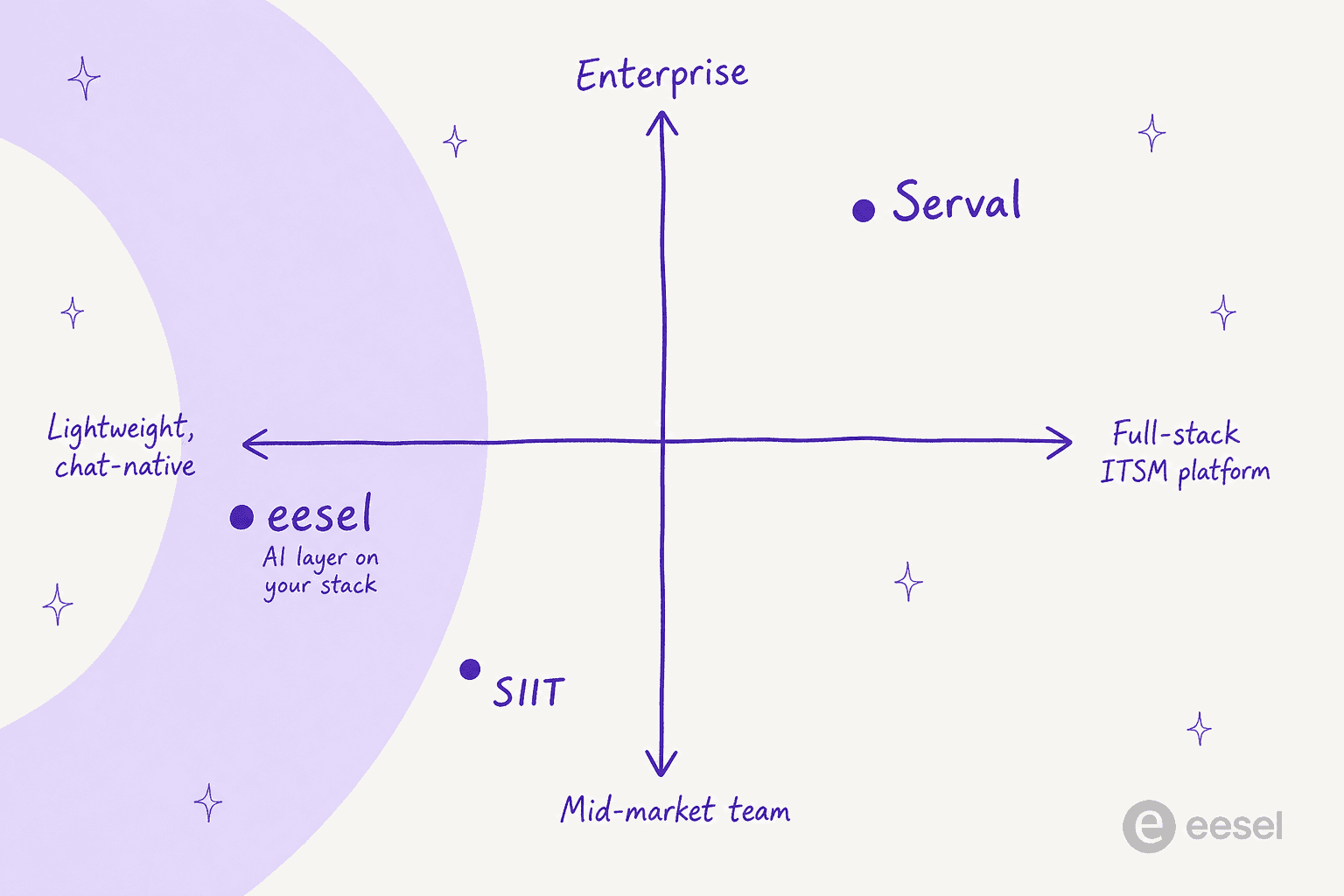
Pick Serval if you are a large IT organization that wants to actually retire ServiceNow or Jira Service Management, you have the appetite for a guided deployment, and your security team wants every automated action to be reviewable code with hard approval gates. Its CMDB, access management, self-hosting option, and enterprise logo wall are all built for that buyer. The tradeoff is that it is quote-only and sales-led, so it is a poor fit if you want to try before you talk to anyone.
Pick SIIT if you are a lean internal-ops or IT team of one to five people supporting a few hundred to a few thousand employees, you already live in Slack or Teams, your wiki is in Notion or Confluence, and you want AI at a price you can read on a webpage. It is an especially strong fit for Teams-first European companies, an underserved corner. The tradeoff is that the AI is Pro-only, your knowledge has to be in one of three wikis, and custom reporting is thin, which is the most consistent complaint in its review base:
"The reporting is decent for ticket volume but custom dashboards feel limited. I wanted to slice resolution time by department and ended up exporting to a sheet."
If you want to sanity-check which side you fall on before reading further, here is a quick decision aid.
What both leave on the table
Serval and SIIT are both strong, and I would happily recommend either to the right buyer. But there are two gaps they share, and they are the reason I would push a lot of teams to look at a different shape of tool before committing.
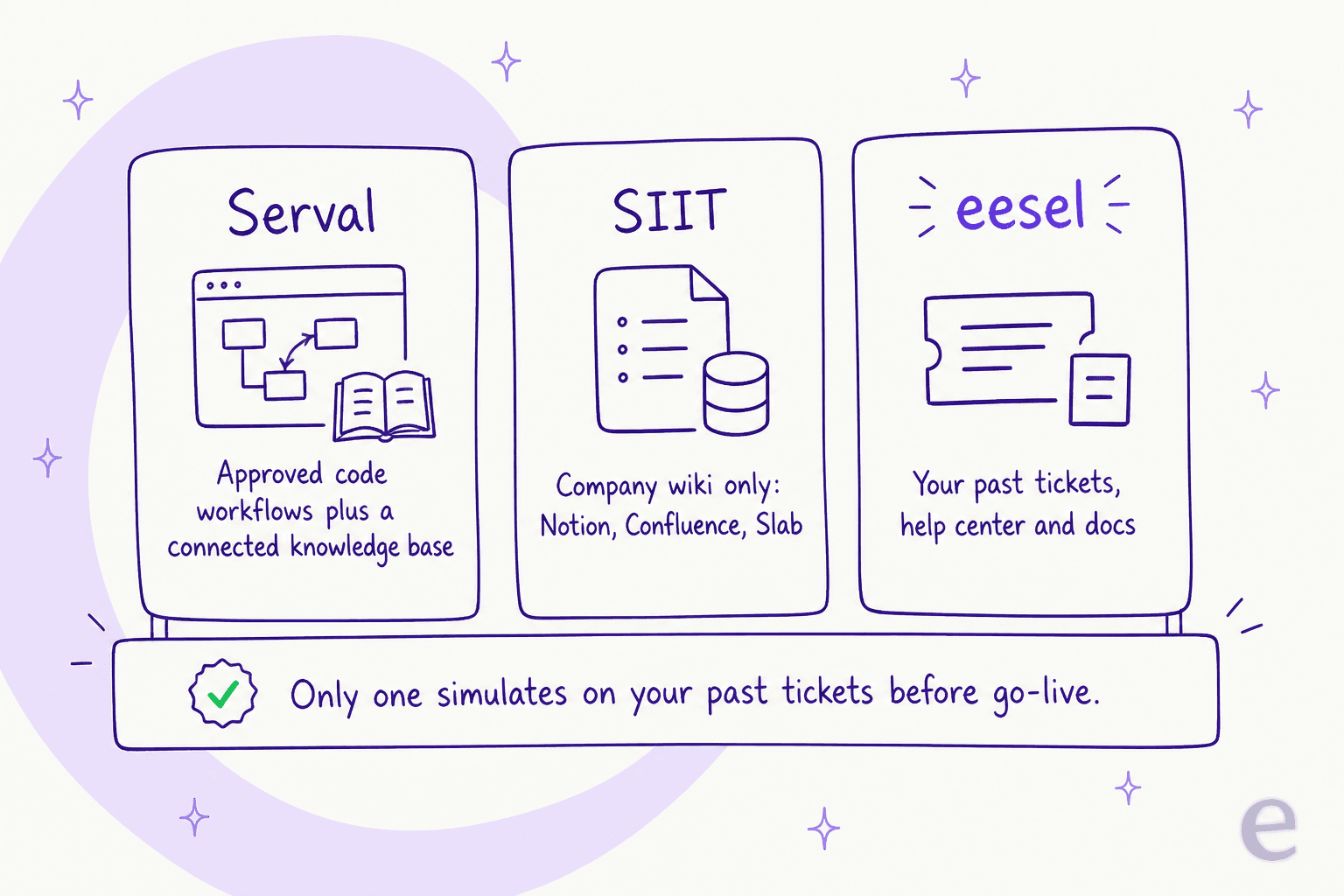
The first gap is learning from your real tickets. Neither product's employee-facing agent learns to answer from your ticket history. Serval answers from a connected knowledge base and runs approved workflows; SIIT grounds answers strictly in a Notion, Confluence, or Slab wiki and states there is no historical-ticket ingestion. That is a defensible design choice, but it means your answer quality is only ever as good as your wiki, and one SIIT reviewer's "couple of weeks of pruning old pages" is the real onboarding cost.
The second gap is testing before go-live. Serval's guided pilot is human-run. SIIT's shadow mode dry-runs the playbooks you wrote and logs what would have happened. Both are useful, but neither replays your actual historical ticket volume through the agent to show you how it would have handled real past requests. I have watched a confident-sounding bot quietly give wrong answers on a live queue, and it is exactly why, at eesel, we do not let an agent go live until it has been simulated against real historical tickets first. A dry run of a playbook you already trust answers a narrower question than "how would this have done on last month's tickets."
This is not a knock on either tool; it is just a different product bet. If those two gaps matter to you, the shortlist should probably include an AI layer, not just another service desk.
Try eesel for AI on the helpdesk you already run
If the Serval vs SIIT question is really "how do I get good AI resolving employee and customer requests without a rip-and-replace," that is the exact problem eesel is built for. Rather than adopt a new service desk, you add an AI teammate to the helpdesk and knowledge you already have.
Three differences matter for this comparison specifically. The eesel teammate trains on your past tickets, help center, and docs, so it is not limited to a hand-groomed wiki. It simulates on those historical tickets before go-live, replaying real past requests and scoring the answers against what your team actually sent, so you see the gaps before a customer does. And it is usage-based at 40 cents per ticket, with no platform fee, no per-seat cost, and no minimum, which is a very different math from per-admin seats or an enterprise platform fee. For the developer-minded, there is also an eesel CLI and MCP support, so a person, a script, or a coding agent like Claude Code can operate the same teammate the dashboard does, which sits nicely alongside the API and MCP surfaces both Serval and SIIT are now building.
To be fair about fit: if you specifically need a dedicated internal IT service desk with deep JIT-access provisioning and a CMDB, Serval and SIIT are purpose-built for that and eesel is not trying to be. But if the job is accurate, well-tested AI answers on top of your existing support stack, it is worth starting free and running a simulation on your own tickets before you commit to switching desks at all.
Frequently Asked Questions
What is the difference between Serval and SIIT?
Serval is an enterprise, AI-native ITSM platform built to replace ServiceNow, Jira Service Management, and Freshservice, sold quote-only through a guided pilot. SIIT is a mid-market IT service desk that lives in Slack and Microsoft Teams with transparent per-admin pricing. The short version of the Serval vs SIIT question: Serval is the platform swap, SIIT is the lightweight chat-native desk.
How much does Serval cost compared to SIIT?
Serval publishes no prices at all; it sells a single negotiated platform fee through a four-week pilot, so you have to book a demo to get a number. SIIT publishes three tiers: Essentials at $23, Standard at $45, and Pro at $89 per admin per month, billed annually, with unlimited employees at no extra cost. If you want to know your cost before a sales call, SIIT is the transparent one.
Do Serval or SIIT train their AI on past tickets?
Neither trains the employee-facing agent on your ticket history to learn answers. Serval answers from a connected knowledge base and runs approved workflows; SIIT grounds answers in a Notion, Confluence, or Slab wiki. If learning from real past tickets matters, an AI teammate that trains on your ticket archive is a different approach.
Is SIIT only for Slack?
No. SIIT treats Microsoft Teams as a first-class channel alongside Slack, and also supports email intake and a self-service portal. The system of record is a web dashboard, so SIIT is chat-native rather than chat-only.
Can I use an AI agent on top of my existing helpdesk instead of switching?
Yes. Where Serval and SIIT are service desks you adopt, an eesel AI teammate is designed to layer onto the helpdesk you already run, train on your past tickets and docs, and bill per ticket rather than per seat, so you can automate support without replacing your stack.


Article by
Alicia Kirana Utomo
Kira is a writer at eesel AI with a Computer Science background and over a year of hands-on experience evaluating AI-powered customer service tools. She focuses on breaking down how helpdesk platforms and AI agents actually work so that support teams can make better buying decisions.