Salesforce Service Cloud vs Zendesk AI: Which platform fits your needs

Stevia Putri
Written by

Stevia Putri

Reviewed by

Stanley Nicholas

Last edited March 13, 2026

Expert Verified

Banner image for Salesforce Service Cloud vs Zendesk AI: Which platform fits your needs

Choosing between Salesforce Service Cloud and Zendesk is a decision many businesses face when upgrading their customer support operations. Both platforms have earned their spots as industry leaders, but they take fundamentally different approaches to solving the same problem.

Salesforce built its reputation as the world's #1 CRM, with Service Cloud as one module in a vast ecosystem. Zendesk started as a help desk solution and evolved into an AI-first customer experience platform. If you're comparing these two, you're likely deciding between a comprehensive enterprise suite and a focused service solution.

This comparison breaks down what each platform offers, how their AI capabilities compare, and which one makes sense for your specific situation. We'll also look at how both platforms integrate with eesel AI for teams that want to enhance their AI capabilities.

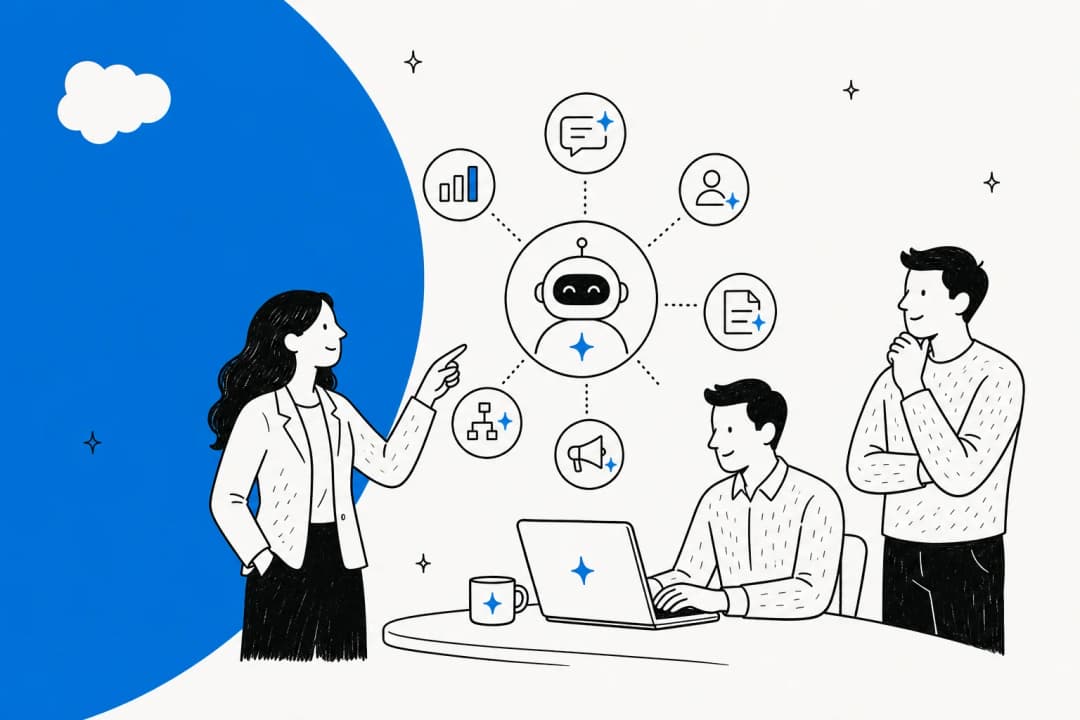
Visual comparison of Salesforce Service Cloud and Zendesk AI platform philosophies

What is Salesforce Service Cloud?

Salesforce Service Cloud is the customer service module of Salesforce's broader CRM platform. It's designed for enterprises that want to manage customer relationships across sales, marketing, commerce, and support within a single ecosystem.

The platform offers comprehensive case management, omnichannel routing, and AI capabilities through Agentforce and Einstein AI. You'll get tools for self-service portals, field service management, and deep analytics that tie into your broader Salesforce data.

Salesforce Service Cloud landing page showcasing enterprise customer service features

Service Cloud works best when you need everything connected. Customer data from Sales Cloud flows automatically into service records. Marketing interactions inform support context. For large enterprises already invested in Salesforce, this unified approach eliminates data silos and gives agents a complete view of every customer relationship.

The tradeoff? You're buying into a complex platform that requires significant setup, dedicated administrators, and often external consultants to configure properly. Implementation typically takes months, not weeks.

What is Zendesk AI?

Zendesk is a purpose-built customer experience platform that has evolved into an AI-first solution. Unlike Salesforce's broad CRM approach, Zendesk focuses exclusively on service, support, and customer experience.

The platform centers around Zendesk AI, which comes pre-trained on over 18 billion service interactions. This means the AI works effectively from day one without requiring extensive training or configuration. Key capabilities include AI agents that can resolve up to 80% of customer interactions autonomously, intelligent triage that routes tickets automatically, and a copilot feature that assists human agents with suggested replies and next steps.

Zendesk AI landing page showcasing AI-first customer experience platform

Zendesk's approach prioritizes fast time-to-value. Most teams can get up and running in days or weeks rather than months. The interface is clean and intuitive, designed specifically for support agents rather than being a modified CRM interface.

The platform serves everyone from small businesses to enterprises like Uber, Slack, and Airbnb. If your primary need is excellent customer service rather than a unified CRM, Zendesk offers a more focused solution.

AI capabilities comparison

AI has become the key differentiator between these platforms. Both offer powerful capabilities, but their philosophies differ significantly.

Salesforce Agentforce and Einstein AI

Salesforce Agentforce lets you build and customize autonomous AI agents for 24/7 customer and employee support. You can configure these agents using prompts, flows, Apex code, and APIs to match your specific business processes.

Einstein AI provides predictive capabilities like case classification, article recommendations, and next best action suggestions. The platform can analyze customer data to predict issues before they escalate and recommend solutions to agents in real time.

The strength here is flexibility. If you have unique workflows or industry-specific requirements, you can tailor the AI to match. The limitation is complexity. Getting the most from Salesforce AI requires technical expertise, dedicated admin resources, and time to train and refine the models.

Pricing reflects this enterprise focus. Agentforce 1 Service runs $550 per user per month. Einstein AI add-ons start around $75 per user per month on top of your base Service Cloud subscription.

Zendesk AI features

Zendesk AI takes the opposite approach: AI that works immediately without configuration. Their models come pre-trained on service interactions across industries, so you get intelligent automation from the moment you turn it on.

The AI agents can handle complex conversations across any channel, reasoning through problems and taking actions independently. When they need help, they escalate smoothly to human agents with full context preserved.

The copilot feature acts as a proactive assistant for your human agents. It provides insights, suggests replies, and can even execute actions with agent approval. The system learns from your knowledge base, solved tickets, and business procedures to deliver increasingly accurate assistance.

For teams that want AI assistance without the complexity, Zendesk's approach is compelling. The advanced AI add-on runs about $50 per agent per month, which is significantly less than Salesforce's AI offerings.

Key differences in AI approach

The fundamental difference is customization versus immediacy. Salesforce gives you a powerful toolkit to build exactly what you need, if you have the resources to wield it. Zendesk gives you sophisticated AI that works out of the box, with less ability to customize the underlying models.

If you've got unique requirements and technical teams, Salesforce's flexibility may justify the complexity. If you want AI benefits without a major implementation project, Zendesk's pre-trained approach delivers faster results.

Pricing comparison

Understanding the true cost of each platform requires looking beyond list prices to implementation, admin overhead, and ongoing maintenance.

Zendesk pricing

PlanPrice (annual)Key features
Support Team$19/agent/monthEmail, social ticketing, basic routing, 1000+ integrations
Suite Team$55/agent/monthAI agents (Essential), messaging, live chat, 1 help center
Suite Professional$115/agent/monthCopilot writing tools, 5 help centers, skills routing, HIPAA compliance
Suite Enterprise$169/agent/month300 help centers, sandbox, custom roles, audit logs

Zendesk also offers several add-ons:

  • Copilot: $50/agent/month
  • Advanced AI agents: Contact sales
  • Quality Assurance: $35/agent/month
  • Workforce Management: $25/agent/month

Automated resolutions (when AI resolves a ticket without human intervention) include 5-15 per agent per month depending on your plan, with overage at $1.50-$2 per resolution.

Salesforce Service Cloud pricing

PlanPrice (annual)Key features
Starter Suite$25/user/monthBasic CRM, lead management
Pro Suite$100/user/monthEnhanced chat, customization
Enterprise$175/user/monthAI for service, workflow automation
Unlimited$350/user/monthSalesforce Knowledge, premier success
Agentforce 1 Service$550/user/monthFull AI suite, Tableau, 1M Flex Credits

Salesforce primarily sells annual contracts paid in advance. Monthly billing is only available for the Starter Suite. Most enterprise deployments also require additional spending on implementation services, consulting, and dedicated administrative staff.

Total cost of ownership

Zendesk typically delivers a lower total cost of ownership. Nucleus Research found Zendesk customers experience 42% lower admin costs compared to alternatives. The platform requires minimal IT resources and most teams can self-implement.

Salesforce's TCO runs higher due to implementation complexity, ongoing admin needs, and consulting fees. However, for organizations already using Salesforce CRM, the unified platform can reduce costs compared to maintaining separate systems.

When evaluating pricing, consider your team's technical capabilities. A lower list price won't help if you'll need to hire consultants to configure the system.

Ease of use and implementation

How quickly can your team start delivering better customer experiences? The answer differs significantly between these platforms.

Zendesk: Quick setup, intuitive interface

Zendesk is built for fast deployment. Most teams can get basic functionality running in days, with full implementation typically taking weeks rather than months. According to Nucleus Research, 90% of Zendesk customers deliver value in under 8 weeks.

The interface reflects this focus on simplicity. Agents get a clean, modern workspace designed specifically for customer service. Navigation is intuitive, and most features work without extensive training.

For small to mid-sized teams without dedicated IT staff, this ease of use is a major advantage. You don't need developers or certified administrators to get value from the platform.

Salesforce: Powerful but complex

Salesforce implementations typically span months. The platform's flexibility requires significant upfront configuration to match your business processes. Most enterprise deployments involve external consultants and dedicated internal resources.

The interface is powerful but has a steeper learning curve. Agents navigate a CRM-centric experience that can feel overwhelming for pure support use cases. However, for teams that master it, the customization options are extensive.

Organizations with dedicated Salesforce administrators and developers can build highly tailored workflows. Without those resources, the complexity can become a barrier to getting full value from the platform.

Integration ecosystems

Both platforms connect with the tools you already use, though their approaches differ.

Zendesk offers over 1,000 prebuilt apps through its Marketplace, covering everything from CRM systems to communication tools. The API is robust and well-documented, making custom integrations straightforward. Native connections include Slack, Salesforce, Shopify, and major social media platforms.

Salesforce counters with over 7,000 apps on AppExchange plus the MuleSoft integration platform for connecting enterprise systems. The ecosystem is larger but can feel overwhelming. Native Slack integration (Salesforce owns Slack) provides seamless collaboration for case swarming and team coordination.

Both platforms integrate with eesel AI for teams wanting to add autonomous AI capabilities. Our AI agent works alongside your existing setup, learning from your tickets and help center to resolve issues without replacing your entire platform. eesel AI also integrates with Salesforce Service Cloud for teams using that platform.

Who should choose which platform?

The right choice depends on your specific situation, resources, and priorities.

Choose Zendesk if:

  • You need fast time-to-value with minimal setup
  • Your primary focus is customer service rather than broader CRM
  • You want AI capabilities that work immediately without extensive training
  • You prefer predictable pricing without hidden implementation costs
  • You're a small to mid-market company without dedicated IT resources
  • You value ease of use over extensive customization

Choose Salesforce Service Cloud if:

  • You're already invested in the Salesforce ecosystem
  • You need deep customization and complex workflows
  • You have dedicated IT, admin, and development resources
  • You want a unified platform connecting sales, marketing, and service
  • You're a large enterprise with complex, industry-specific requirements
  • You value flexibility over out-of-the-box functionality

eesel AI: An alternative approach to AI-powered support

While Salesforce and Zendesk offer comprehensive platforms, some teams need AI capabilities without the complexity of a full platform migration.

eesel AI works as an AI teammate that integrates with your existing help desk, whether that's Zendesk, Salesforce, or another platform. Instead of months of implementation, you can invite eesel to your team and start seeing value in minutes.

eesel AI dashboard for configuring the supervisor agent with no-code interface

Here's how eesel AI is different:

  • Minutes to onboard, not weeks: Connect eesel to your help desk and it immediately learns from your past tickets, help center articles, and macros. No manual training or configuration required.

  • Progressive rollout: Start with eesel drafting replies for agent review. As it proves itself, level up to full autonomy handling specific ticket types or working 24/7.

  • Plain-English control: Define what eesel handles and when it escalates using natural language. "Always escalate billing disputes to a human" or "If the refund request is over 30 days, politely decline and offer store credit."

  • Works with what you have: Whether you're on Zendesk, Salesforce, Freshdesk, or another platform, eesel integrates directly. No need to rip and replace your existing setup.

eesel AI pricing starts at $299 per month for up to 1,000 AI interactions, with no per-seat fees. You pay for what you use, not for every agent on your team.

Making your decision

Both Salesforce Service Cloud and Zendesk are solid choices. The question is which one fits your specific needs.

If you're already using Salesforce CRM and have the technical resources to customize extensively, Service Cloud offers a unified platform that eliminates data silos. Just budget for implementation time and ongoing admin costs.

If you want sophisticated customer service capabilities with minimal complexity, Zendesk delivers faster time-to-value and lower total cost of ownership. The AI works immediately, and your team can be productive without extensive training.

For teams that want AI-powered support without committing to either platform's full ecosystem, eesel AI offers a middle path. You get autonomous AI capabilities that learn your business and resolve tickets end-to-end, working alongside your existing tools.

Want to see how eesel AI compares? Try it free or book a demo and we'll show you how an AI teammate can transform your support operations.

Frequently Asked Questions

For most small businesses, Zendesk AI offers better value. The lower starting price ($19/agent/month vs $25/user/month), faster implementation, and minimal IT requirements make it more accessible. Salesforce Service Cloud typically requires more resources than small teams have available.
Yes, Salesforce Service Cloud uses AI through Agentforce and Einstein AI. These tools provide predictive case classification, article recommendations, and autonomous AI agents. However, getting the most from Salesforce AI requires configuration and technical expertise to set up properly.
Zendesk AI serves enterprise customers effectively, including companies like Uber, Slack, and Airbnb. The AI agents can resolve up to 80% of interactions autonomously, and the platform scales to support large teams. Some enterprises with highly complex, unique workflows may prefer Salesforce's customization options.
Yes, eesel AI integrates with both platforms. You can add eesel AI to your existing setup regardless of which platform you choose, or use eesel as a standalone solution. This lets you get AI capabilities without committing to a full platform migration.
Zendesk implementations typically take days to weeks, with 90% of customers delivering value in under 8 weeks. Salesforce Service Cloud implementations usually span months and often require external consultants. The complexity difference is significant when planning your timeline.
Zendesk AI is generally more affordable. The advanced AI add-on costs approximately $50 per agent per month, while Salesforce's Agentforce 1 Service runs $550 per user per month. For teams primarily wanting AI capabilities without extensive customization, Zendesk offers better value.

Share this post

Stevia undefined

Article by

Stevia Putri

Stevia Putri is a marketing generalist at eesel AI, where she helps turn powerful AI tools into stories that resonate. She’s driven by curiosity, clarity, and the human side of technology.