


Runway Solaris, announced August 31, 2026, is the first of what Runway calls Interface World Models. The one-line version: instead of software being built as code and then run, Solaris generates the interface itself, frame by frame, live, as you interact with it. There is no HTML, no CSS, no code underneath. The image on your screen is the application.
It is built on Runway's Gen-4.5 video model, pairs a language model (which decides what should happen) with a world model (which renders how it looks), and targets real-time interaction at 720p. In Runway's own user study, people preferred Solaris over a coded interface built by Claude Opus 5 by 61% to 24% on following instructions and 71% to 21% on behaving naturally.
The catch: it is a research preview, not a product. There is no pricing, no public API, and access is request-only. Every reaction so far is to a demo video, not hands-on use, and the sharpest skeptics are already asking two fair questions, whether streaming generation costs make it a workable business model, and whether the output can be trusted. That trust question is the one that matters most if you work in support, and it is exactly the problem an AI teammate for your helpdesk has to solve before it touches a real customer.
What Runway Solaris actually is
Here is the thing worth getting straight first, because most of the launch-day takes blur it: Solaris is not another text-to-video tool, and it is not a Lovable-style "AI writes the code for you" app builder either. It is stranger than both.
Runway, the company best known for AI video generation, describes itself now as "building foundational Real-World Intelligence that can understand, simulate and act in the world". Solaris is the first model in a new family it calls Interface World Models, and the premise it opens with is a genuine what-if: what happens when an operating system generates apps and websites as you use them?
In a normal app, a designer's idea gets translated into code, the code gets shipped, and from then on the app can only do what someone anticipated and wrote down. Runway's argument is that this translation step is lossy, it is "a lossy compression of the space of possible interactions, frozen before any user arrives." Solaris skips it. There is no intermediate representation. The model renders the interface layer directly, and "every frame is synthesized as you interact, allowing the interface to respond continuously to your actions."
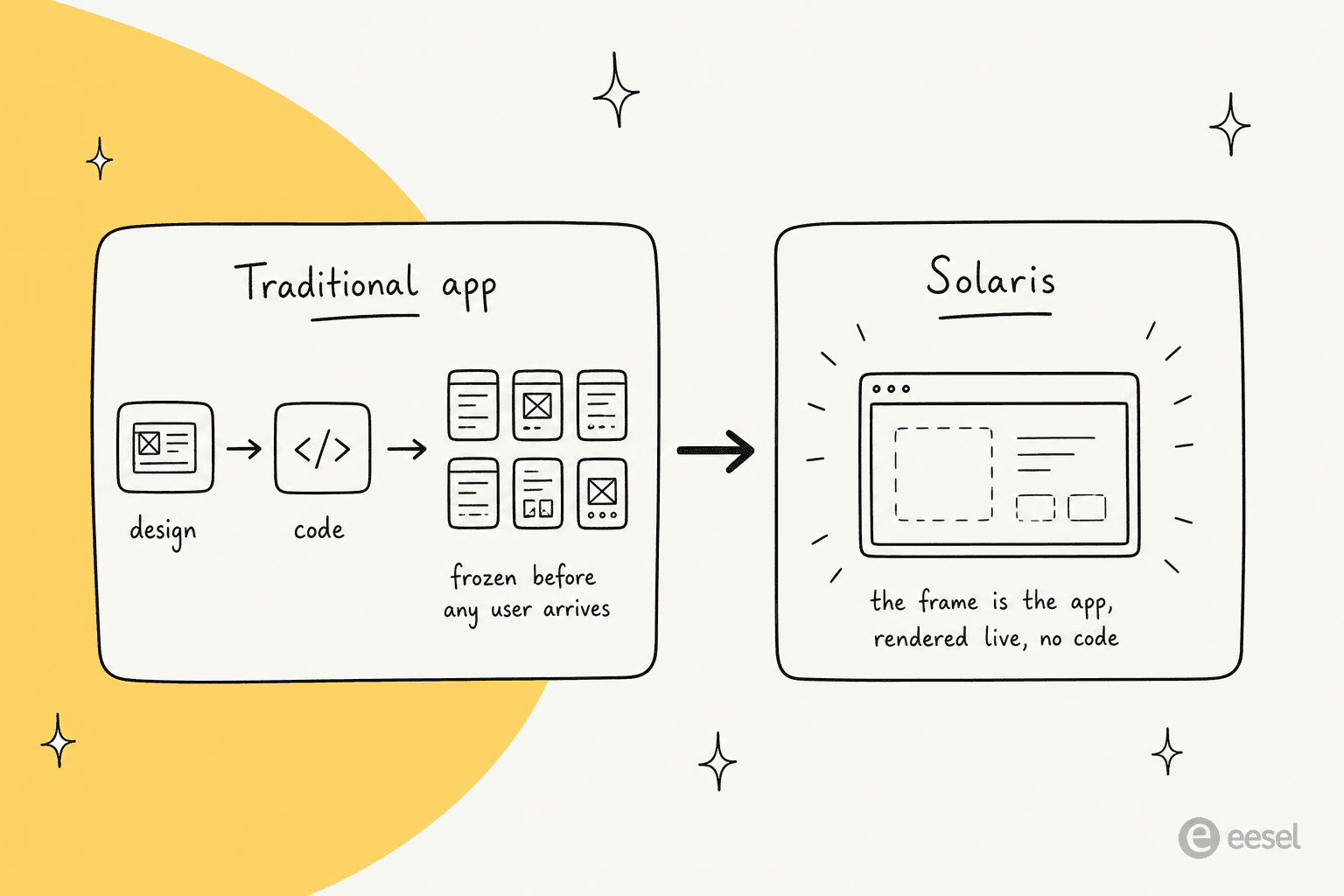
The demo examples make it concrete. A virtual clothing store where you drag a shirt onto a photo of yourself to try it on. A salad you build by dragging ingredients into a bowl. A combustion demonstration that reacts with physically plausible results. And my favourite framing from the post, "redefining the mouse", where you click a cat and its fur becomes your brush, or click a painting and you draw in its style. None of those interactions were coded. The model learned them.
If you have followed Runway's research, this is the logical next rung after GWM-1, its general world model, and it sits inside a real lineage: Gen-4, then Gen-4.5, then GWM-1, now Solaris. This is not a marketing rebrand of an old model.
How Solaris works: two models, one screen
This is the part I find most interesting, because it is a clever reuse of things that already exist rather than a mysterious new architecture.
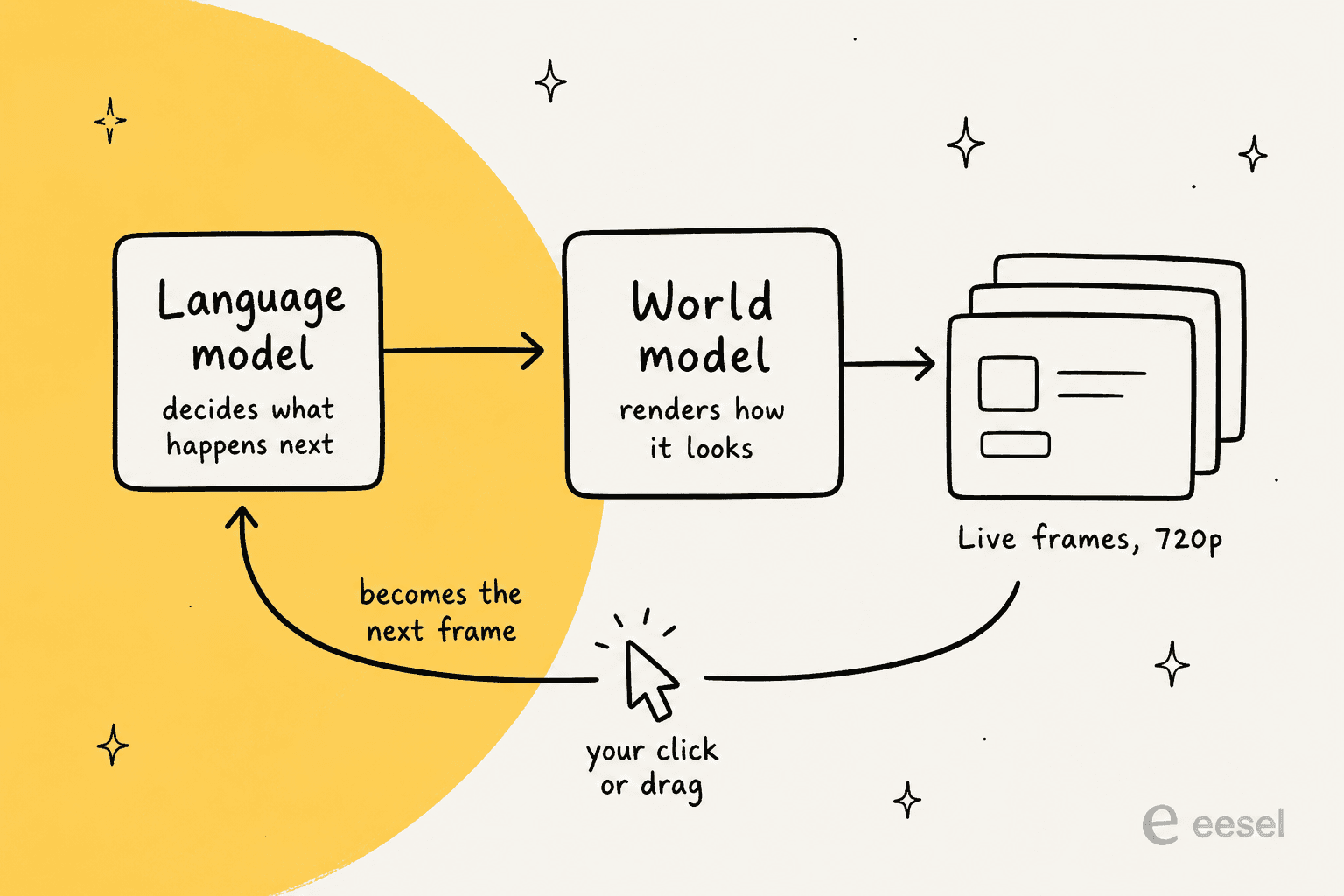
There are two models doing two jobs. A language model interprets your request, decides whether an action modifies the current scene or transitions to a new one, and produces the prompts that guide rendering. A world model, built on Gen-4.5, then generates how that behaviour actually appears. In Runway's words, "one decides what the application should do next, while the other generates how that behaviour appears."
The trick that makes it interactive rather than a pre-baked clip is how it treats your input. Clicks, drags, and edits are fed in as conditioning for the next frame, the same way text or an image would be. The model only ever sees interactions that have already happened, so it learns the relationship between an action and its visual outcome without anyone programming that relationship in.
Getting a video model to run fast enough to feel live took three moves: teaching it to generate frames autoregressively so each frame depends only on the ones before it, distilling the slow many-step denoising process down to a few steps, and then training that fast version on its own outputs so quality holds over a long session. Runway set its bar at the point where interactions "stop feeling interactive somewhere around half a second of delay," and claims the real-time work also made Solaris orders of magnitude cheaper to run than a standard video diffusion model. It is worth flagging what is not disclosed, though: no frame rate, no parameter count, no context length, no model size. We know the design targets, not the receipts.
The demo everyone is reacting to
Because Solaris shipped as a research report plus limited testing, the reaction is a demo reaction, and it splits cleanly into awe and a raised eyebrow.
On the awe side, creators who spend their days in generative tools got what Solaris is doing straight away:
"Very cool work by Runway. Feels like the best of both worlds -- fine grain control of a WYSIWYG editor with the creativity & speed of generative models."
Runway's CTO Anastasis Germanidis posted the launch thread, which drew around a thousand likes and became the center of gravity for the discussion. Over on Hacker News, one commenter called it "one of the most innovative and coolest AI model demos I've seen this year," which is a high bar in a year with no shortage of demos.
But the more useful takes are the ones poking at the seams. A designer on r/UXDesign pointed out that "show, don't tell" interaction is an old idea, researchers have written about programming by demonstration for decades, so the novelty is the rendering, not the interaction model. And the sharpest analytical question came from Hacker News, which is the one I keep coming back to:
"So, instead of inferring intent from an information-dense input (text), they do it w/ just mouse-based gestures? ... I would love to see how this holds up in practice."

That "how it holds up in practice" is doing a lot of work, and it is the right instinct. A demo video is a curated happy path. The interesting question is the tenth minute of a real session, not the first thirty seconds.
Solaris vs a coded interface: what the numbers say
Runway did not just ship a video and vibes. It ran two studies, and the numbers are the strongest part of the announcement.
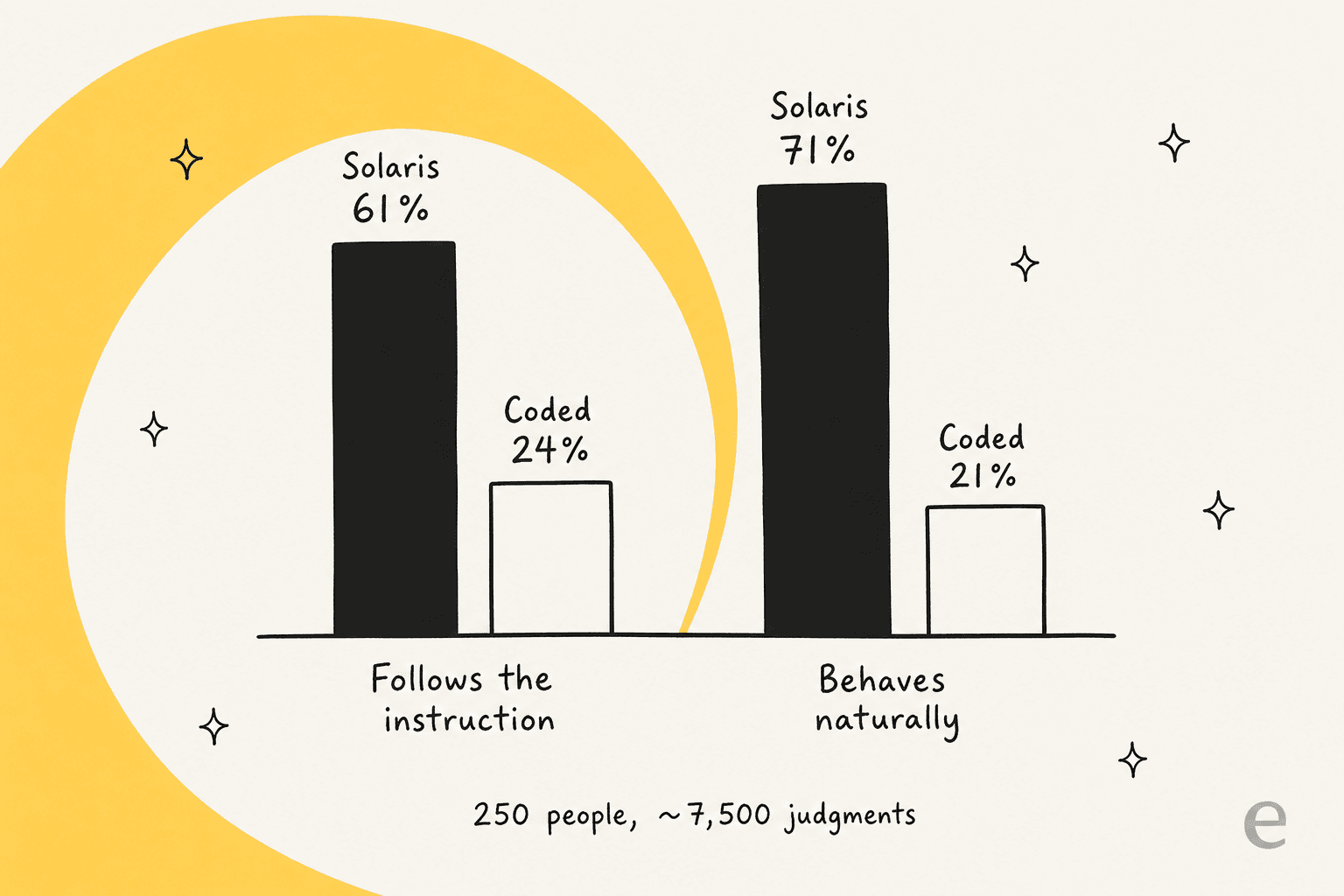
The headline study pitted Solaris against a coded interface built by Claude Opus 5, a state-of-the-art model, given the same starting image and the same interaction requests. With 250 participants and roughly 7,500 pairwise judgments, here is how it landed:
| Question | Solaris preferred | Coded interface | Equivalent |
|---|---|---|---|
| Which better follows the instruction? | 61% | 24% | 13% |
| Which behaves more naturally within the scene? | 71% | 21% | 6% |
The second study, which Runway calls "the cost of translation," is the one that explains the philosophy. It tested how faithfully multimodal models, including GPT-4o, Gemini 2.5 Pro, and Claude Fable 5, could reconstruct an interface from a single screenshot, across 30 interfaces. The finding: every model loses information in the translation, and it gets worse as the visual complexity goes up. That is Runway's whole thesis in one experiment, code is a lossy middle step, so remove it.
Two honest caveats. These are Runway's own studies, not independent benchmarks, and there is no third-party number to check them against yet. And "preferred in a pairwise demo comparison" is not the same as "reliable enough to ship," which is the gap the skeptics are circling.
Where the skeptics have a point
I want to be fair to Solaris, because it is a real piece of research and the demos are impressive. But two criticisms are strong enough that they deserve to sit right next to the hype.
The first is economics. The best critical comment I found came from r/accelerate, and it is worth reading in full:
"I like this a lot but I'm skeptical that people are going to want to pay ongoing generation costs for their app to function versus just having a coded app... if it requires your company stream dolla dolla bills directly to runway at all times to run your app I'm not seeing this as a feasible business model. Your economics would scale up with engagement, not a good situation to be in."

Runway does say the real-time work made Solaris much cheaper than standard video diffusion and that "the cost curve continues to improve." But "cheaper than generating video" is a low bar when the alternative is code that runs for essentially nothing. Cost is one of the three engineering challenges Runway names itself, alongside speed and staying coherent over a long session.
The second is trust, and this is the one Runway is most candid about. Its own limitations section says it plainly: "a convincing wrong answer is worse than no answer." A generated interface can render something that looks right but is not, a price, a product detail, a button that does not do what it appears to. Runway says keeping Solaris anchored to verified context as a session unfolds is "an active research focus," which is the polite research way of saying not solved yet. Someone on Hacker News put the practical version more bluntly, comparing it to earlier world-model demos:
"it looks cool at first but really quickly you'll start to see the gaps"
What Solaris means if you run customer support
Here is where this stops being an AI-video story and starts being relevant to anyone shipping AI to real users.
Runway floats a use case that lands directly in customer experience: a storefront that becomes a generated environment, preserving brand identity while adapting products, layouts, and recommendations per visitor in real time. That is a genuinely exciting picture of where interfaces could go. But notice that the hardest unsolved problem in Solaris, grounding the output in verified data so it does not confidently show something wrong, is the exact problem that has defined AI for support from day one.
I have spent years building AI agents for the helpdesk, and the single most important lesson is the one Runway just wrote into its own limitations section. A support bot that sounds confident and is wrong does more damage than one that says "let me get a human." It is why AI hallucinations in support are the thing you engineer against first, not last, and why we simulate every rollout against thousands of a company's real historical tickets before it answers a live customer. You do not find out in production whether the answer is grounded, you find out on tickets you already know the resolution to.
So the way I read Solaris, and models like it, is this: it is fascinating infrastructure, a new substrate for how interfaces might get generated. But infrastructure is not an employee. A model that can render anything still needs the guardrails, the grounding, and the domain context to be trusted with a specific job, and that is a different discipline from making the pixels move.
Try eesel
That is the gap eesel is built to close. Where Runway is building the model layer, eesel is the AI teammate you actually hire for a job, and today that roster is an AI helpdesk teammate and an AI blog writer. Each one arrives with the skills, integrations, and company context for its role, rather than being a raw generalist you have to wire up yourself.
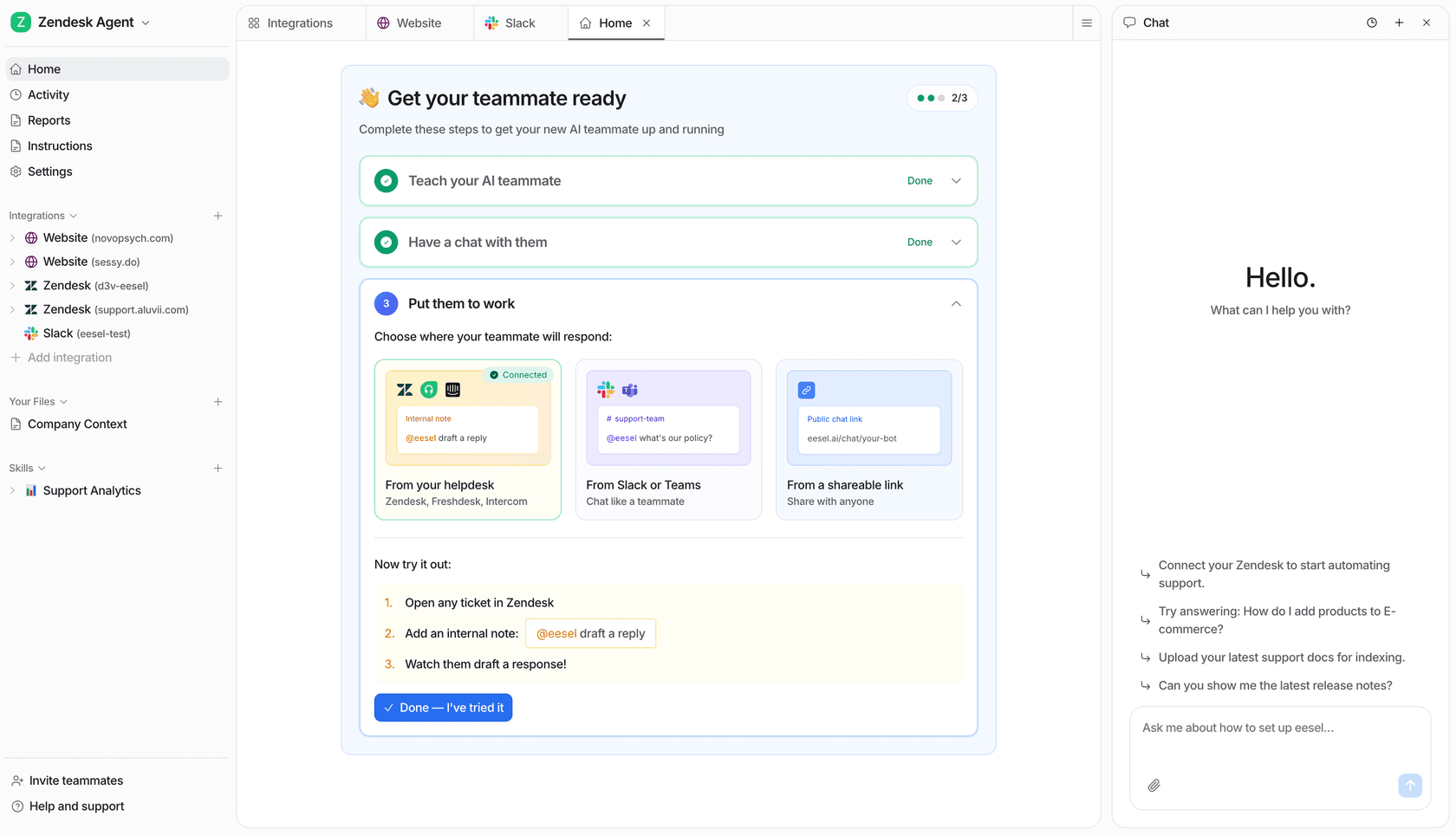
For support specifically, the helpdesk teammate plugs into the tools you already run, Zendesk, Freshdesk, Gorgias, Slack, learns from your past tickets and help center, and, crucially, lets you simulate it on real historical tickets before it ever replies to a customer. That is the trust problem Solaris is only starting to name, solved for the one job that cannot afford a convincing wrong answer. It is free to try, and you can watch it draft real answers on your own tickets in a few minutes.