

Let’s be honest. Juggling customer support tickets from email, chat, and social media feels like a never-ending game of whack-a-mole. The moment you clear one queue, another one pops up. It's draining, and it keeps your team from handling the complex problems that really need a human touch.
This is the exact problem AI customer support software is meant to solve. The promise is simple: automate the repetitive stuff, free up your team for more important work, and give your customers instant answers, any time of day.
But with so many tools out there, which ones actually live up to the hype? To find out, I rolled up my sleeves and put the 6 top options to the test. My goal was to find practical tools that deliver real results without making you tear down your whole support system and start from scratch.
Defining the best AI customer support software
Basically, AI customer support software uses artificial intelligence to read, understand, and automatically respond to customer questions. Think of it less like a robot and more like a new, incredibly efficient teammate.
These tools usually come in two main flavors:
-
AI agents: These are the bots that can fully resolve common questions on their own. Think "Where's my order?" or "How do I reset my password?" They handle the entire conversation from start to finish without needing any help.
-
AI copilots: These work alongside your human agents as an assistant. They can draft replies, summarize long ticket histories, and pull up relevant help articles, making your team faster and more consistent.
Unlike the clunky, old-school chatbots that just searched for keywords, modern AI gets the context of a conversation. It learns from your past support tickets and can even do things like tag a ticket or send it to the right person.
How we chose the best AI customer support software
When I put this list together, I focused on what actually matters to a busy support team. It’s not about flashy features nobody uses; it’s about real-world value. Here’s a visual breakdown of what I was looking for:
-
It had to work with my existing helpdesk. Let's face it, switching helpdesks is a huge, expensive pain. I prioritized tools that could plug into the platforms we already know and use, like Zendesk and Freshdesk.
-
It needed to be easy to set up. Could a manager get it running in a few minutes without needing to call in a developer? I looked for truly self-serve platforms with simple controls.
-
The pricing had to be transparent. I wanted clear pricing models. Per-agent fees feel like a penalty for growing your team, and per-resolution costs can lead to some nasty surprises on your bill. Interaction-based pricing felt the most straightforward.
-
The AI had to be genuinely smart. How well does the AI learn from a company’s own knowledge, like past tickets and help center articles? I tested how well each tool could provide accurate, on-brand answers that didn’t sound robotic.
A quick comparison of the best AI customer support software
Before we get into the details, here’s a quick side-by-side look at how the top tools compare.
| Software | Best for | Works with existing helpdesk? | Pricing model | Free trial |
|---|---|---|---|---|
| eesel AI | Automating support without replacing your helpdesk | Yes | Interaction-based | 7 days |
| Zendesk AI | Teams already using the full Zendesk suite | Yes (native) | Flexible tiered plans | 14 days |
| Freshdesk (Freddy AI) | Teams wanting a mature, all-in-one helpdesk ecosystem | Yes (native) | Flexible tiered plans | 14 days |
| Gorgias | Shopify and ecommerce businesses | Yes (native) | Ticket-based + per automation | 7 days |
| Sierra | Enterprises with dedicated engineering teams | Yes | Custom | Demo-based |
| Tidio | Small businesses wanting simple live chat & bots | Yes (limited) | Per user + per conversation | 7 days |
The 6 best AI customer support software in 2026
Here’s a deeper look at each platform, starting with my top pick for its flexibility, power, and straightforward setup.
1. eesel AI
eesel AI is built to be an intelligent layer that connects directly to your existing helpdesk (like Zendesk, Freshdesk, and Gorgias) and knowledge sources. This lets you start automating support in minutes without having to change your current setup.
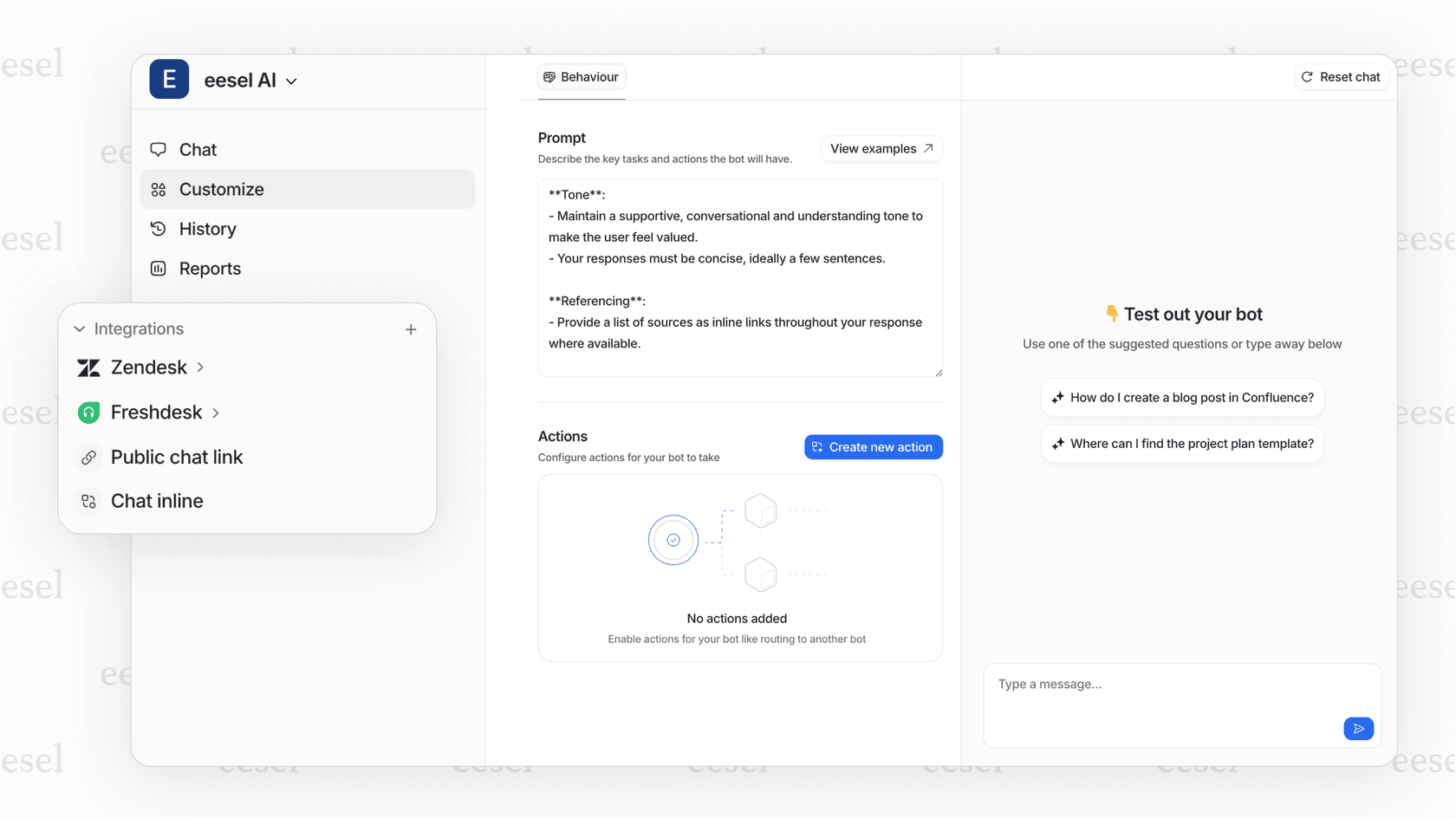
Why we picked it: It stands out because it improves your current workflow instead of forcing you into a massive migration project. It learns from your past tickets and help docs to give genuinely helpful, human-sounding answers. What really sold me was its "bulk simulate over past tickets" feature. It lets you see how the AI would have answered thousands of your real tickets before it ever talks to a live customer, so you can go live feeling confident.
-
Pros:
- Integrates smoothly with all the major helpdesks, so you can keep the tools you already like.
- You can set it up yourself in just a few minutes, no coding required.
- Clear, interaction-based pricing that won't punish you as your team grows.
-
Cons:
- It's a newer tool, so it doesn't have a native phone channel (though it works fine with helpdesks that do).
- The 7-day free trial is a bit shorter than some of the others on this list.
-
Pricing: The Team plan starts at $239/month (billed annually) for 1,000 interactions. A 7-day free trial is available.
2. Zendesk AI
Zendesk is a mature, reliable platform that powers customer service for thousands of companies. Its AI features, including those from its world-class multilingual acquisition Ultimate.ai, are integrated into its comprehensive suite.
Why we picked it: If your team is looking for a robust, enterprise-grade ecosystem, Zendesk AI is an impressive choice. It offers intelligent triage that automatically figures out a customer's intent and sentiment, an advanced AI copilot for your agents, and powerful AI agents that strengthen Zendesk's position in the market.
-
Pros:
- A trusted, scalable platform that works perfectly for teams committed to the Zendesk ecosystem.
- Powerful agent-assist tools like ticket summarization and generative replies.
- Offers specialized, pre-trained models tailored for industries like retail and finance.
-
Cons:
- Zendesk provides an all-in-one experience, so its AI is best utilized within its own industry-leading platform.
- Zendesk offers tiered plans to match different team sizes: advanced features like the Copilot add-on or "outcome-based" resolution pricing are available to help businesses align their investment with actual results.
-
Pricing: The Suite Team plan starts at $55 per agent, per month, with various scalable options for advanced AI features.
3. Freshdesk (Freddy AI)
Freshdesk's Freddy AI is a powerful and comprehensive AI suite for teams who want a proven, all-in-one platform to manage every customer interaction. Freshdesk has built an impressive ecosystem and marketplace that supports thousands of growing businesses.
Why we picked it: Freddy AI offers a wide range of strong features, like a no-code bot builder and sophisticated support for channels like WhatsApp and Instagram. It also supports over 60 languages, which is a fantastic benefit for businesses with a global customer base.
-
Pros:
- Excellent omnichannel support that connects with a vast array of messaging apps.
- The intuitive no-code bot builder makes it easy for teams to create custom chat flows.
- Offers high value with comprehensive features included in its core plans.
-
Cons:
- Freshdesk provides a unified experience, meaning its AI is optimized for those already utilizing its powerful, industry-leading helpdesk environment.
- Freshdesk offers tiered plans to match different team sizes. Features like Freddy Copilot or specific Freddy AI Agent session packs allow teams to scale their AI investment as their support needs grow.
-
Pricing: Plans with basic AI start at $15 per agent, per month, with flexible add-on options to enhance your AI capabilities.
4. Gorgias
Gorgias is a specialized choice for customer service for ecommerce brands, particularly those on Shopify. Its whole platform is designed for online sellers.
Why we picked it: The deep, native integration with Shopify is its superpower. The AI can pull up order details, process returns, create discount codes, and answer product questions using real-time data from your store. It was built from the ground up to help ecommerce stores automate support and sell more stuff.
-
Pros:
- The best out-of-the-box Shopify integration you'll find.
- The AI can handle complex ecommerce tasks like editing orders, managing refunds, and giving personalized product recommendations.
- It can turn support chats into sales by tracking revenue generated from conversations.
-
Cons:
- Because Gorgias is deeply specialized for the ecommerce sector, it is best suited for online retailers rather than SaaS or general business models.
- Gorgias offers a structured pricing approach where automated interactions are calculated to ensure teams can clearly track the efficiency and ROI of their automation investment.
-
Pricing: The Basic plan starts at $50/month for 300 tickets, with various options to enhance your setup with AI automation.
5. Sierra
Sierra is a heavy-duty AI platform built for large companies with complex, high-volume support needs, and the technical resources to match.
Why we picked it: Sierra is for teams that need fine-tuned control and have the engineers to build sophisticated AI agents. It uses a special toolkit and API to perform complex actions across all your business systems, from updating your CRM to managing a subscription.
-
Pros:
- Extremely powerful and can be set up to handle very complicated, multi-step tasks.
- Designed for enterprise-level security and scale, and trusted by major brands.
- Offers voice capabilities, so you can automate phone support.
-
Cons:
- This is not a tool you can just sign up for and use. It's for companies with strong engineering teams to set up and maintain, and even getting API access requires approval.
- The pricing isn't public, which usually means it comes with a custom, enterprise-level price tag.
-
Pricing: Custom pricing is available after you book a demo.
6. Tidio
Tidio combines live chat, chatbots, and email marketing into one simple, affordable platform. It’s a popular choice for small businesses that are just getting started.
Why we picked it: Tidio is incredibly easy to set up and has a generous free plan that lets you test the waters. Its visual chatbot builder, Flows, lets you create automated workflows without any code, which is perfect for answering basic FAQs or capturing leads on your website.
-
Pros:
- Very user-friendly and can be installed on any website in minutes.
- Affordable pricing with a free plan that includes 50 live chat conversations each month.
- Connects with tools like Zendesk and Zapier to create tickets or send data to other apps.
-
Cons:
- The AI feels more rule-based than truly conversational. It's great for pre-planned flows but struggles with questions that go off-script.
- The conversational AI agent (Lyro) is a separate add-on that starts at $32.50 per month for 50 AI conversations.
-
Pricing: A free plan is available. Paid plans start at $24.17/month.
How to choose the best AI customer support software for your team
Feeling a bit overwhelmed by the options? Don't worry. Picking the right tool really just comes down to answering three key questions.
Plug into your existing tools or start over?
Switching your helpdesk is a massive project. It disrupts your team, you risk losing old data, and it can take months to complete. Look for AI software that can work as a smart layer on top of your current setup. It will save you time, money, and a lot of headaches, letting you see results in minutes, not months. This is one of the main reasons people choose platforms like eesel AI, which works beautifully with industry leaders like Gorgias, Freshdesk, and Zendesk.
Understanding pricing models: Per agent vs. per resolution vs. per interaction?
-
Per-agent pricing (like Freshdesk and Zendesk) is a classic model that matches your team size, with specialized AI features often available as flexible add-ons or tiered options to match your budget.
-
Per-resolution pricing can align your costs with successful outcomes, though it requires careful monitoring for high-volume periods.
-
Interaction-based pricing is a transparent model where you only pay for what the AI actually does (like sending a reply), making it easy to budget and track your return on investment. This is the model that eesel AI uses. To make it clearer, here is a comparison of how each pricing model works:
Can you test the best AI customer support software on your own data first?
Letting a brand-new AI bot talk to your customers is a big step. You want to ensure it represents your brand perfectly from day one.
You should pick software that lets you test its performance on your actual past tickets before it ever speaks to a live customer. This provides confidence and gives you peace of mind that the AI is really ready to help. This simulation feature is a huge plus for tools like eesel AI.
The best AI customer support software feels less like a robot and more like your best new teammate
The best AI customer support software isn't about finding the tool with the most features. It’s about finding a balance between power, ease of use, and a price that makes sense for your business as it grows.
The goal isn't just to close tickets faster. It's about giving customers quick, accurate help so your human agents can focus on the conversations that really matter. A tool that improves the workflow you already have will always be a better investment than one that forces you to start over from scratch.
Instead of replacing your helpdesk, why not add a layer of intelligence to it? Start your free 7-day trial of eesel AI and see how much time you can save with just a few minutes of setup on top of your existing Freshdesk or other support platform.

Frequently asked questions
The best AI customer support software automates repetitive customer inquiries, freeing your human agents to handle more complex issues. It provides instant, accurate answers around the clock, improving customer satisfaction and reducing response times. This ultimately helps [manage ticket volume](https://www.eesel.ai/blog/best-ai-customer-support-software) without expanding your team.
Many top AI solutions are designed to integrate seamlessly with popular existing helpdesks like Zendesk or Freshdesk. The goal is to act as an intelligent layer on top of your current setup, allowing you to automate support in minutes without a lengthy migration process or technical heavy lifting.
Common pricing models include per-agent, per-resolution, and interaction-based. Per-agent charges increase with your team size, while per-resolution charges can be unpredictable during high volumes. Interaction-based pricing, where you pay for each AI-generated reply, is generally considered the most transparent and budget-friendly.
Modern AI customer support software learns directly from your company's unique knowledge base, including past support tickets, help center articles, and website content. This allows it to understand context and generate responses that are both accurate and consistent with your brand's specific tone of voice.
Yes, some of the best AI customer support software platforms offer features that allow you to [simulate how the AI would have responded](https://www.eesel.ai/blog/ai-customer-support-software) to thousands of your past tickets. This crucial step provides confidence in the AI's performance and accuracy before it ever interacts with a live customer.
AI agents are designed to fully resolve common customer questions independently, handling entire conversations from start to finish. AI copilots, on the other hand, assist human agents by drafting replies, summarizing ticket histories, or retrieving relevant information, making human agents more efficient.
Share this article

Article by
Kenneth Pangan
Writer and marketer for over ten years, Kenneth Pangan splits his time between history, politics, and art with plenty of interruptions from his dogs demanding attention.
