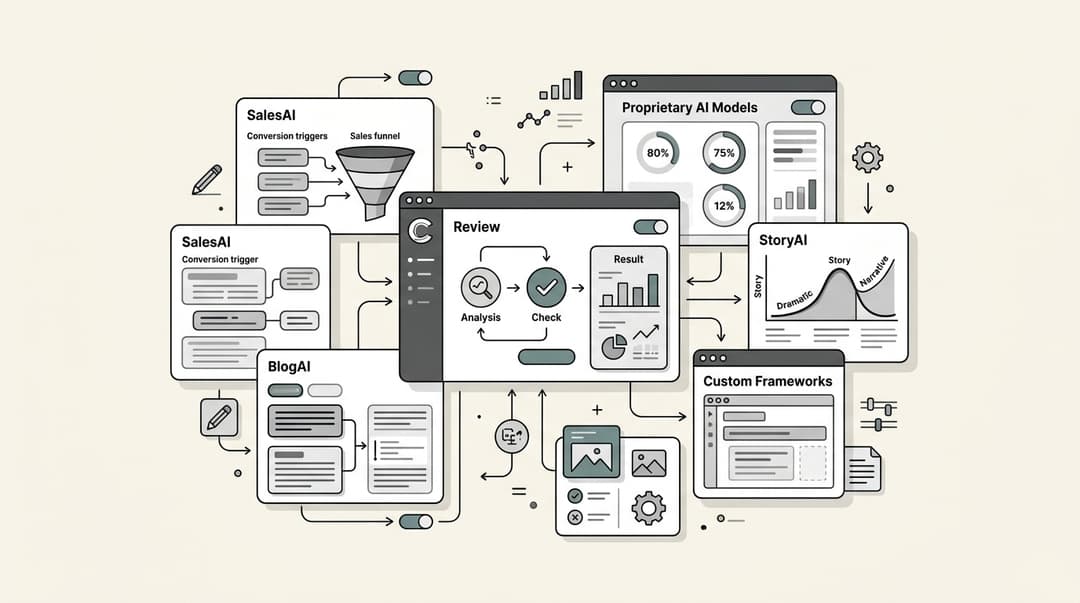
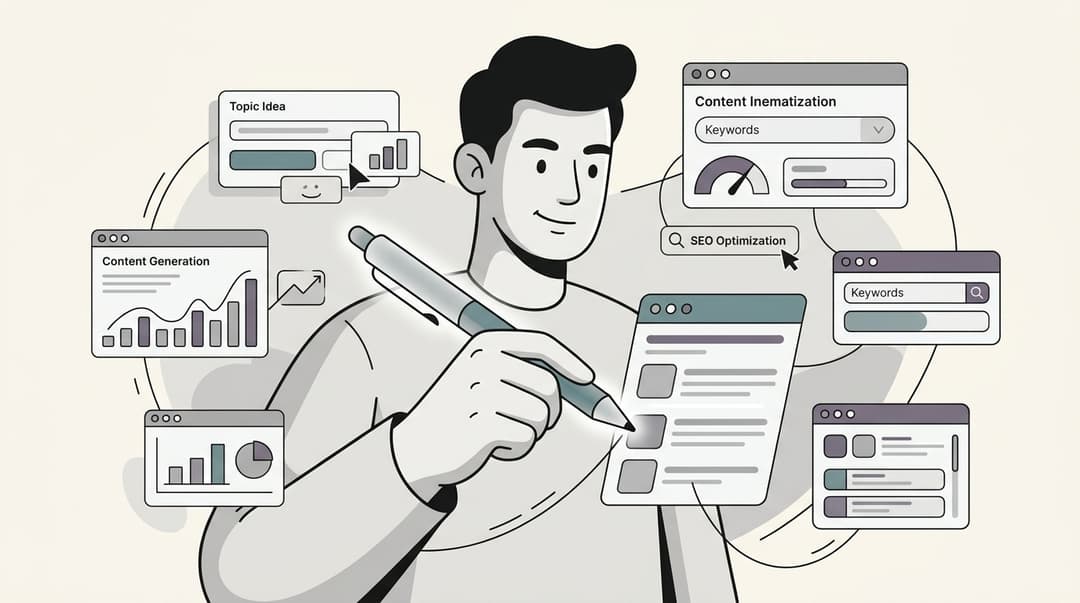
A practical guide on how to write copy that sells (without sounding like a robot)

Katelin Teen
Katelin Teen
Last edited February 1, 2026
The word "copywriting" can sound a little stuffy, can't it? It often gets described as "salesmanship in print," which brings up images of old-school ad agencies. But at its core, it's simply the engine that turns your ideas into income. It's the quiet force behind every click, sign-up, and sale.
The hard part isn't just the writing itself. It's writing copy that actually sells without coming across as pushy or, even worse, like generic AI-generated text that often misses the mark. We've all scrolled past that bland, cookie-cutter content that fails to connect with anyone.
Here is the problem. You need to understand how 'AI' writers build their content and it's goal. An 'AI' writers will simply take a search query you specify. Download the text of the top 10 results. Text mine the results and find common words. Use the most popular semantic linking profile. Write the first iteration of text and then paraphrase. There is one major flaw with all 'AI' writers however. The semantic linking profile that it uses is the same across most 'AI' articles. Google can determine this... Right know 'AI' text ranks. It won't in the next year unless you do significant editing, and I mean nearly rewrite the entire thing.

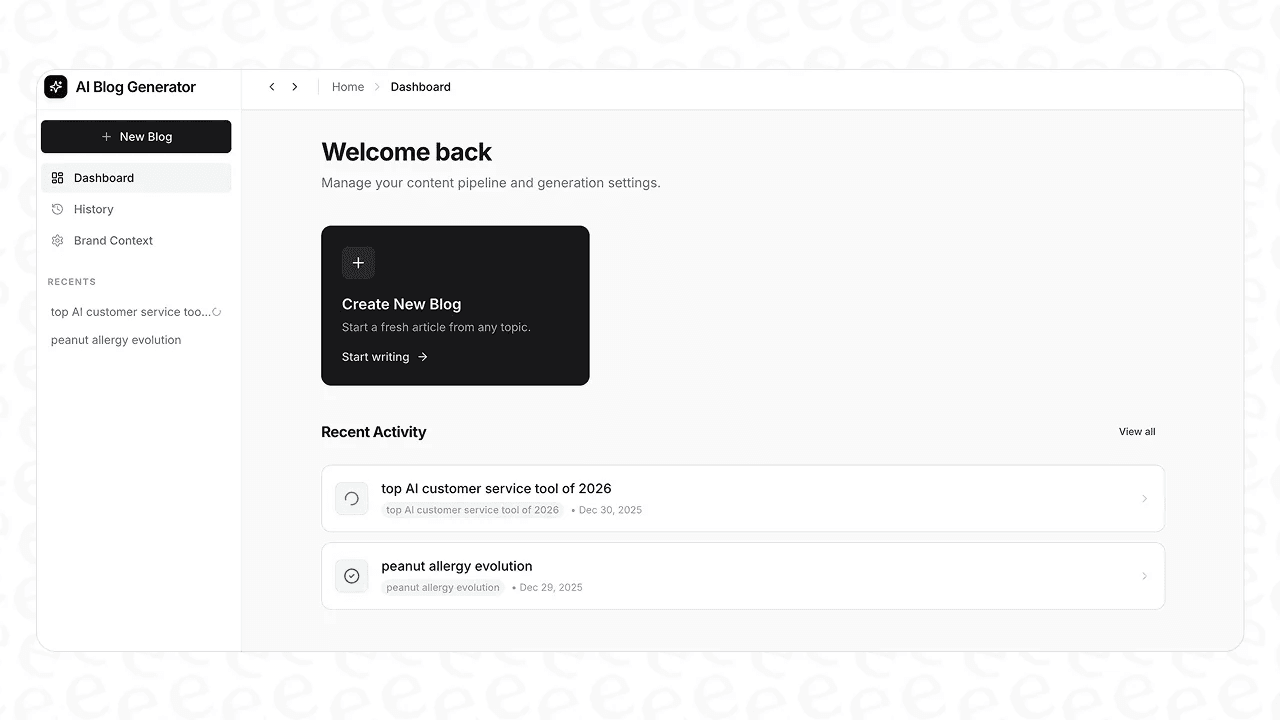
Thankfully, you don't have to reinvent the wheel. All good copy follows proven, human-focused frameworks. These aren't about tricking people; they're about guiding someone to a decision that genuinely helps them. And now, tools can help you use these principles without all the manual effort. For instance, the eesel AI blog writer is built to generate persuasive, human-sounding content by actually learning from your brand's context, making it much easier to apply these ideas.
What is copywriting?
Back in the day, advertising legend John E. Kennedy defined it as "salesmanship in print." That’s still the heart of it, but "print" now covers a lot more ground. Today, copywriting is on websites, in your email inbox, all over social media, and in YouTube video scripts.
What makes copywriting different from, say, a novel or a news article is its single goal: to get the reader to take a specific action. That action could be buying a product, signing up for a newsletter, or clicking a "learn more" button.
Here’s the real secret, though: great copy isn’t about your product’s features. It’s about the reader. It’s about their problems, frustrations, hopes, and desires. As another copywriting giant, Robert Collier, famously said, you have to "join the conversation" that's already going on in the reader's head. When you can do that, you stop selling and start helping.
The P.A.S.T.O.R. framework: A guide to persuasive writing
If you’re looking for a reliable and effective structure for your writing, the P.A.S.T.O.R. framework is a great place to start. Developed by copywriting expert Ray Edwards, this framework helps you act as a guide, leading your customer to a solution that will improve their situation.
Let's break down what each letter means. Here’s a visual breakdown of how the framework guides your writing:
-
P - Person, problem, pain This is your starting point. Before you even hint at your solution, you have to show you understand the problem. Describe the reader's situation using their own language. Talk about their specific pain points. When someone reads your copy and thinks, "Wow, they get me," you've earned their trust.
-
A - Amplify and aspirations Next, you gently touch on the consequences of not solving the problem. What happens if they do nothing? This isn't about scaring them; it's about showing the real "cost of indecision." This connects to a psychological idea called Prospect Theory, which basically says that the pain of losing feels worse than the pleasure of an equivalent gain. After setting the stakes, you pivot to their aspirations. Paint a clear picture of what life could be like once the problem is solved.
-
S - Story, solution, system Now you can introduce your solution, but don't just list its features. Bring it to life with a relatable story. People are wired for stories. Share how you, or someone like them, dealt with the same problem and found a way through with this solution. This makes it feel real and achievable.
-
T - Transformation and testimony Don't sell the product; sell the change it brings. Nobody buys a drill because they want a drill; they want a hole. Focus on the outcome. How will your customer's life be better after using your product? This is also the perfect spot for testimonials. Let other happy customers provide the proof that your solution works.
-
O - Offer Here’s where you lay out the deal. Be clear about what the customer gets. A good rule of thumb is 80/20: spend 80% of your time on the benefits and the transformation, and only 20% on the specific things they'll receive (the features, modules, downloads, etc.).
-
R - Response Finally, you have to ask for the sale. Be direct. Tell the reader exactly what to do next: "Click this button to get started," or "Sign up here for instant access." A clear call to action removes confusion and makes it easy for them to move forward.
Here's a quick summary of the P.A.S.T.O.R. framework to keep handy:
| Letter | Stands For | Purpose |
|---|---|---|
| P | Person, Problem, Pain | Empathize with the reader by describing their problem accurately. |
| A | Amplify & Aspirations | Highlight the cost of inaction and the dream of a solution. |
| S | Story & Solution | Introduce the solution through a compelling and true story. |
| T | Transformation & Testimony | Showcase the results and provide social proof from others. |
| O | Offer | Detail what the customer gets, focusing on benefits over features. |
| R | Response | Clearly ask for the sale and instruct the reader on the next steps. |
Key building blocks for persuasive copy
While a framework like P.A.S.T.O.R. provides the blueprint, you still need the right building blocks. Think of these as the essential ingredients that make your copy work from start to finish.
Grabbing attention
You only have a few seconds to catch someone's eye.
- Headline: The legendary David Ogilvy once said that five times as many people read the headline as the body copy. Its only job is to be an "ad for the ad." It needs to grab attention, make a promise, or spark enough curiosity to make someone keep reading.
- Deck copy: This is the sub-headline, the short sentence right under your main headline. It expands on the headline's promise and pulls the reader further in.
Building the narrative
Once you have their attention, you need to keep it.
- Lead: Your opening paragraph is vital. It has to hook the reader right away and let them know they're in the right place. A good way to do this is by addressing their problem directly, like: "If you've ever struggled with X, then you'll want to read every word of this page."
- Rapport: People buy from those they know, like, and trust. You build that trust by showing real empathy. Acknowledge their frustrations and show them you get what they're going through.
- Bullet points: Bullets are great for breaking up text and highlighting benefits. You can make them even better by using "blind" bullets. These create curiosity by hinting at a benefit without revealing exactly how it's done. For example, instead of "Our software uses an advanced algorithm," try "The 'secret sauce' algorithm that finds hidden savings in 60 seconds." It makes the reader want to know more.
Proving your claims and building credibility
Anyone can make a claim. You have to back yours up.
- Credibility: Your reader is always asking, "Why should I listen to you?" You need to answer that. Share your expertise, credentials, or even your own journey with the problem. Give them a reason to believe you.
- Testimonials: Nothing beats a third-party endorsement. Let your happy customers sell for you. Video testimonials are the best, followed by photos with a full name and a specific story about the results they achieved.
- Risk reversal (the guarantee): The biggest thing holding back a sale is fear, specifically the fear of making the wrong choice or wasting money. A strong, no-questions-asked guarantee (like a 30-day, 100% money-back guarantee) removes that fear. It shifts the risk from the buyer to you, making the decision to buy much easier.
Writing copy that sells at scale with AI
Applying these frameworks consistently across every blog post, email, and landing page is a huge amount of work. It takes time and a deep understanding of your audience. This is where AI can be a great partner, but you have to use it wisely.
IMO opinion, AI is like most tools. Garbage in, garbage out. You can’t throw a Kw at it and expect a week written article. You still need to research proper KWs. You need to study the SERPs. You still need to perfect a great outline. Once all that is done, AI is a crutch, it can assist you.
Understanding general-purpose AI writers
Tools like ChatGPT are useful for brainstorming or creating initial drafts. A key consideration is that they operate without specific context about your business, product, customers, or brand voice unless that information is provided in the prompt. This can result in content that may feel generic and require significant editing to align with a specific brand. It's also important to fact-check the output, as these models can sometimes generate information that is not accurate. Furthermore, these tools typically generate text only, meaning the user is responsible for research, visual asset creation, and SEO.
Using a context-aware AI writer
Context-aware AI content platforms, like the eesel AI blog writer, are designed to address these challenges. The process is simple: you give it a keyword and your website URL, and eesel generates a complete, publish-ready blog post that is designed to be persuasive.
Here's how it uses the copywriting principles we've covered to create better content:
- Context-aware research that goes deeper: Instead of just summarizing top Google results, it understands search intent. It pulls relevant data (like pricing for comparison posts) and even integrates real Reddit quotes to add authentic social proof and join the conversation your customers are already having.
- A genuinely human tone: We've spent over a year refining our AI to produce a conversational tone that people actually like reading. It avoids that stiff, generic feel that screams "written by AI."
- Automatic asset generation: A wall of text isn't very persuasive. eesel creates a complete post with visuals like AI-generated images, infographics, data tables, and embedded YouTube videos to boost engagement.
- Deep brand context for natural product mentions: By scanning your website, it learns your brand voice and products. This lets it weave in product mentions that feel like helpful suggestions, not awkward sales pitches.
It’s the same platform we used at eesel to grow our daily search impressions from 700 to 750,000 in just three months.
For a deeper dive into the practical steps of writing great copy, check out this video which provides a helpful pre-writing checklist to get you started.
Putting it all together
Learning how to write copy that sells isn't about mastering sneaky tricks or being pushy. It's about empathy. It's about understanding your customer and guiding them to a solution using a proven structure like the P.A.S.T.O.R. framework.
Every piece of the puzzle, from your headline and guarantee to your testimonials and call to action, plays a part in building trust and convincing your reader that you have the answer they need.
The best way to learn is by doing. You can apply these principles manually, or you can see them come together in minutes. Start generating publish-ready, persuasive content by trying the eesel AI blog writer for free.

Frequently Asked Questions
Share this article

Article by
Katelin Teen
Katelin is an operations specialist at eesel where she uses her psychology training and education experience to optimize B2B SaaS processes. Outside of work, she unwinds with story-driven games, writing, and keeping up with latest tech innovations.