A deep dive into Helpscout AI resolutions pricing: 2025 guide

Kenneth Pangan

Stanley Nicholas
Last edited December 5, 2025
Let's talk about AI in customer support. It's everywhere now, but figuring out the pricing can feel like you're trying to solve a puzzle in the dark. It's not just about the final number on the invoice; it's about knowing what you're actually paying for and if it genuinely helps your team.
Help Scout's "AI Answers" feature uses a 'per-resolution' model. On the surface, it sounds simple and fair, right? You only pay when the AI successfully solves a customer's problem. But the devil is in the details, and those details can make or break your support budget.
So, let's pull back the curtain on the Help Scout AI resolutions pricing. We’ll get into what it costs, where you might run into trouble (especially if your team is growing), and look at an alternative that offers a more predictable, all-in-one approach.
Help Scout AI Answers: The feature behind the Help Scout AI resolutions pricing
So, what exactly is Help Scout AI Answers? Think of it as an AI assistant that gives your customers instant, automated answers. It’s built on OpenAI's tech and works as an add-on to your existing Help Scout plan. The goal is pretty straightforward: handle the simple, repetitive questions so your human agents don't have to.
The AI gets its smarts from your company's knowledge sources. Its main brain is your collection of Help Scout Docs sites (their knowledge base product). You can also feed it more info by adding other public websites, which is handy for expanding its knowledge.
This all happens inside Beacon, Help Scout's little help widget that you can pop onto your website or into your app. The idea is to boost self-service, cut down on those same-old-question tickets, and let your team focus on the tricky stuff that actually needs a human.
How the Help Scout AI resolutions pricing actually works
Instead of a standard per-user subscription, Help Scout charges you based on results. Sounds pretty good, right? But it's crucial to get into the nitty-gritty. Let's dig into what they actually consider a 'resolution,' what it costs, and how the billing is structured so you don't get a nasty surprise on your invoice.
What counts as a billable resolution?
Help Scout keeps it simple here. A resolution is "a single AI chat session that is resolved without help from a human." This is the core idea behind their AI resolutions pricing.
Basically, you get charged only when the AI handles the entire conversation successfully from start to finish. According to their docs, the cash register only rings if:
-
AI Answers gives a real response to the customer’s question.
-
The customer doesn’t ask for more help after the AI's final answer.
And just as important, you won't be charged if:
-
The AI is just making small talk or asking for clarification without giving a full answer.
-
The customer gets frustrated and asks to talk to a person.
And here's a good thing to know: you’re only charged once per chat session. It doesn't matter if the AI answers one question or five within that single conversation, it's still just one resolution. This simple flowchart breaks down exactly what counts as a billable event.
How much does each resolution cost?
Each successful resolution will set you back a flat $0.75. This is an extra charge on top of your regular Help Scout subscription, no matter which plan you're on (Standard, Plus, or Pro).
To let you try it out, Help Scout gives you a pretty generous 3-month free trial of AI Answers with unlimited resolutions. That’s a decent amount of time to feed it your help docs, see how it handles real customer questions, and figure out if it's actually making a difference before you start paying.
| Feature | Cost | Notes |
|---|---|---|
| AI Resolution | $0.75 | Charged per successfully resolved conversation. |
| Free Trial | 3 Months | Unlimited resolutions to test the feature. |
| Billing Cycle | Monthly, in arrears | Charges for one month appear on the next month's bill. |
How billing and spending caps work
Here’s a little quirk in the billing that’s easy to overlook. Your main Help Scout plan is billed in advance, but the AI resolutions are billed in arrears (meaning, after you’ve used them). So, your AI usage from October will pop up as an extra line item on your November invoice.
To avoid any runaway costs, Help Scout lets you set a monthly spending cap, which is a smart move. You can cap it at a specific dollar amount (like $100 a month) or a total number of resolutions (say, 150).
Once you hit that limit, AI Answers just shuts off for the rest of the month. Your Beacon widget will revert to whatever you had before, like showing your contact form or pointing users to your knowledge base.
Where the Help Scout AI resolutions pricing model can fall short
Paying only for what works sounds great on paper, but this model has a few catches that can mess with your budget and your big-picture automation plans. The simplicity is nice, but it comes with some trade-offs in predictability and what the AI can actually do for you.
Unpredictable costs
The biggest headache here is the unpredictability. Your ticket volume isn't a flat line, right? One product launch, a big marketing push, or an unexpected outage can send a flood of questions your way. When that happens, your AI bill can shoot up way past what you budgeted for.
This makes forecasting your monthly spend a real guessing game. That helpful tool can turn into a budget liability overnight, leaving you with a tough choice: pay an eye-watering bill or have your AI go dark right when customers need it most.
A narrow focus
That $0.75 price tag only covers one job: answering questions in the chat widget. It doesn't include any of the other AI tools that could be making your whole team's life easier.
Sure, Help Scout has other AI features like AI Drafts (for helping agents write replies) and AI Summarize (for long conversation recaps), but those are baked into the per-user price of their more expensive Plus and Pro plans. This means you end up paying for AI in two different ways: once for the chatbot and again for your agent tools. It feels a bit disjointed.
What's more, this model completely ignores the behind-the-scenes work that's key to running a smooth help desk. We're talking about the basics, like auto-tagging new tickets, sending them to the right team, or updating customer info. None of that counts as a 'resolution,' so it's not included here.
Automating one piece of the puzzle
Answering a question is just one step. Real support automation helps with the whole journey of a ticket, from the second a customer hits 'send' to the final follow-up. It should be helping triage new requests, helping agents respond faster, and even doing tasks in other apps for you.
A good AI platform should add value everywhere, not just at the front door. The pricing should match that broad usefulness. For instance, a platform like eesel AI rolls every single AI action, from triage to resolution, into one predictable monthly price.
A more predictable alternative for AI support
For teams who need predictable costs and want to automate more than just simple questions, there are other options out there. Let's look at an alternative built for complete support automation, one that solves the headaches of a per-resolution model.
Fixed pricing means no more budget surprises
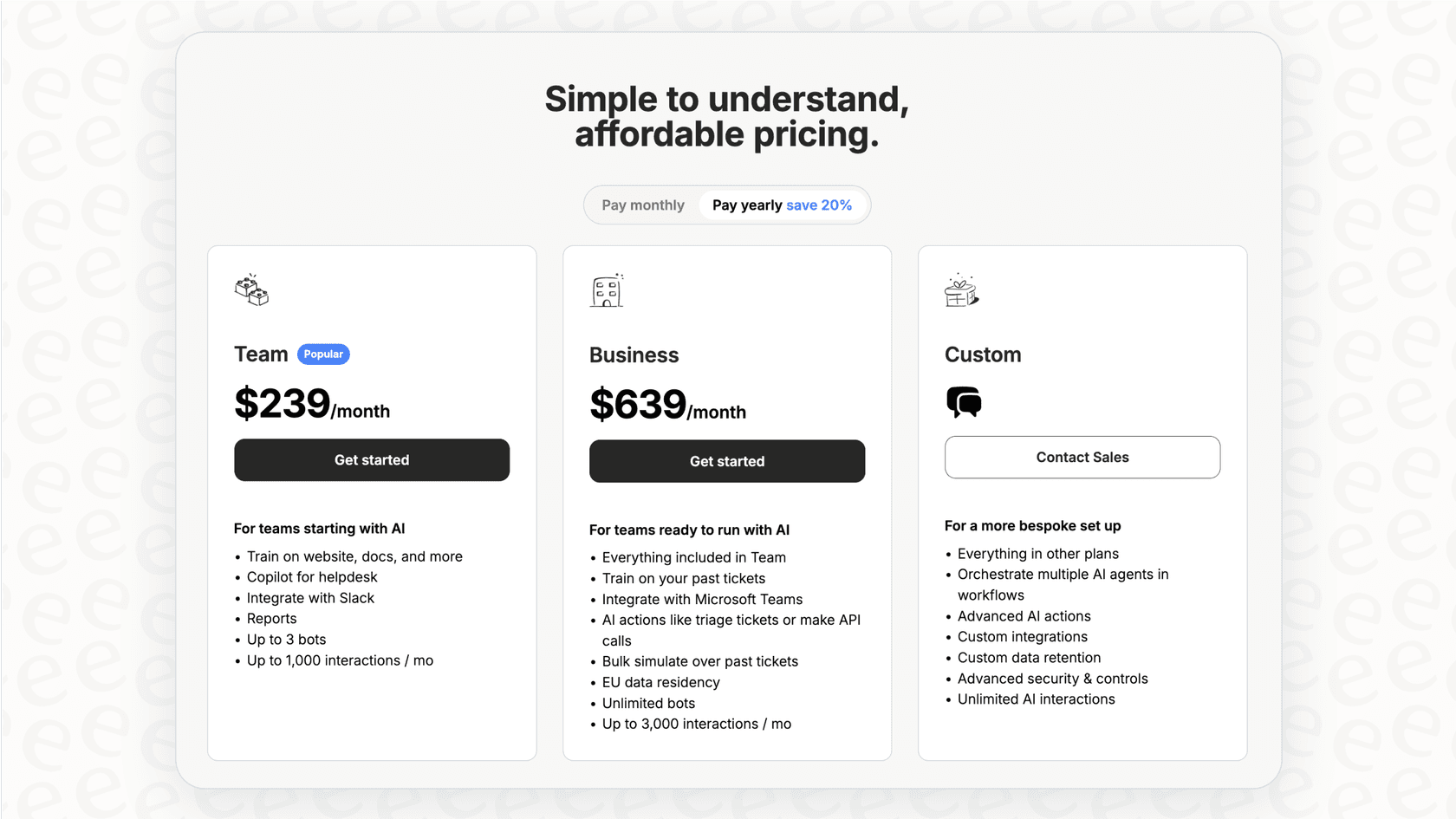
Instead of paying per resolution, some platforms use fixed-tier plans based on interactions. Think of an interaction as any real task the AI performs, whether it's answering a customer, tagging a ticket, or drafting a reply for one of your agents.
This approach gives you total control over your budget. You know exactly what your bill will be every single month, no guesswork involved. For example, eesel AI offers clear, fixed-tier plans with a set number of interactions for a flat monthly fee. That one price covers every single thing the AI does, not just the successful resolutions.
An AI that does more than just answer questions
The biggest drawback of the per-resolution model is that it's a one-trick pony. A platform like eesel AI is built to do so much more, automating your entire support process with features like:
-
AI Triage: It automatically tags, routes, and even closes out spammy or simple tickets before they ever hit an agent's queue. Your inbox stays clean without anyone lifting a finger.
-
AI Copilot: It writes on-brand replies as internal notes for your team. It learns from your past conversations and knowledge base to make sure every suggestion is spot-on, which helps your team work a whole lot faster.
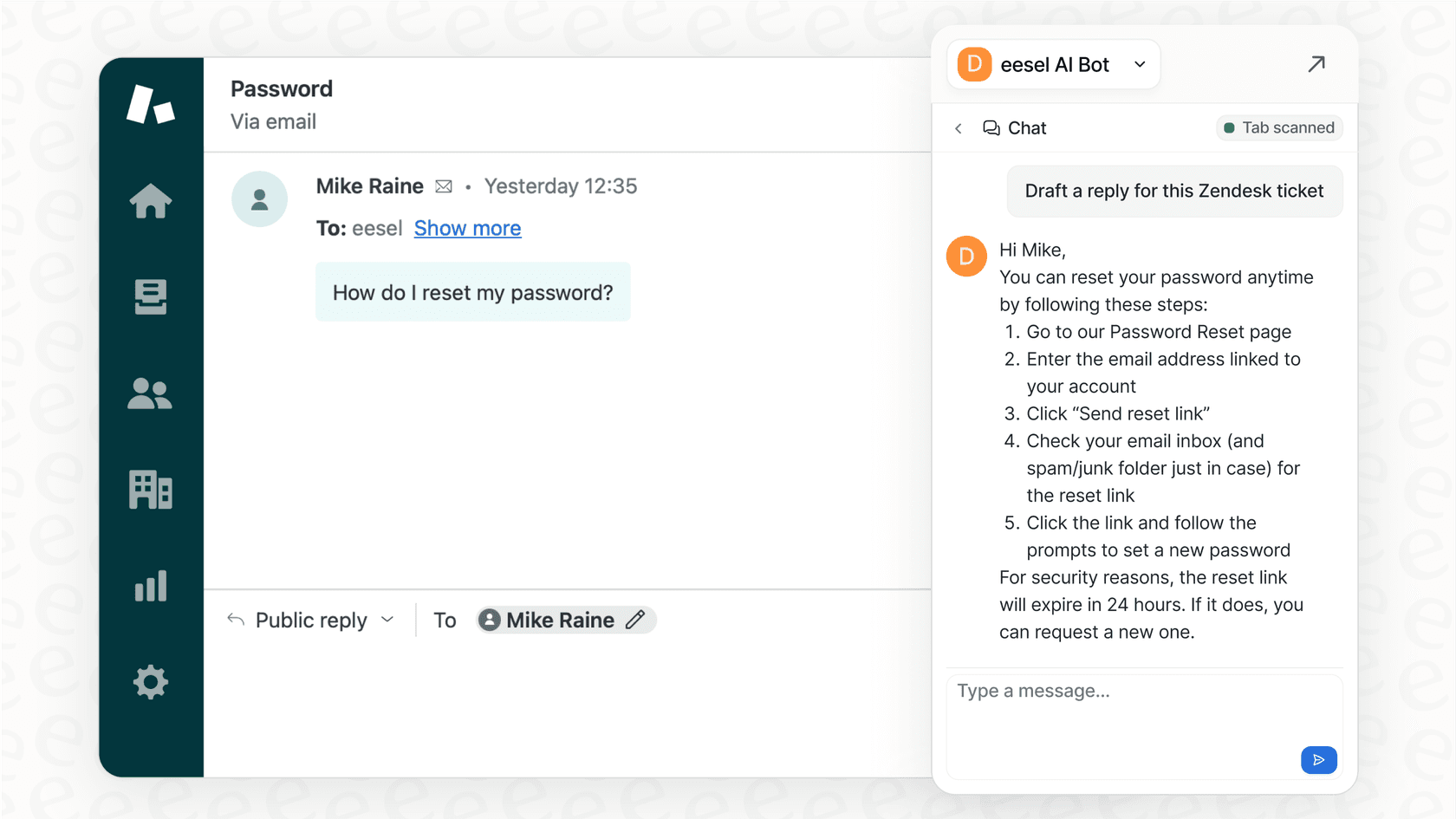
- AI Actions: This is where it gets really powerful. It can connect to your other tools, like integrating with Shopify to check on an order, process a refund, or cancel a subscription, all without leaving the help desk.
When you add it all up, this approach gives you a much bigger bang for your buck. Your flat monthly fee pays for an AI that makes the entire team more efficient, not just one that handles a few chats upfront.
Know what you’re getting before you pay
One of the scariest parts of buying a new AI tool is the uncertainty. The sales page might promise 30% automation, but what if you only get 5%? Signing up for a tool without knowing how it will actually perform for your team is a big gamble.
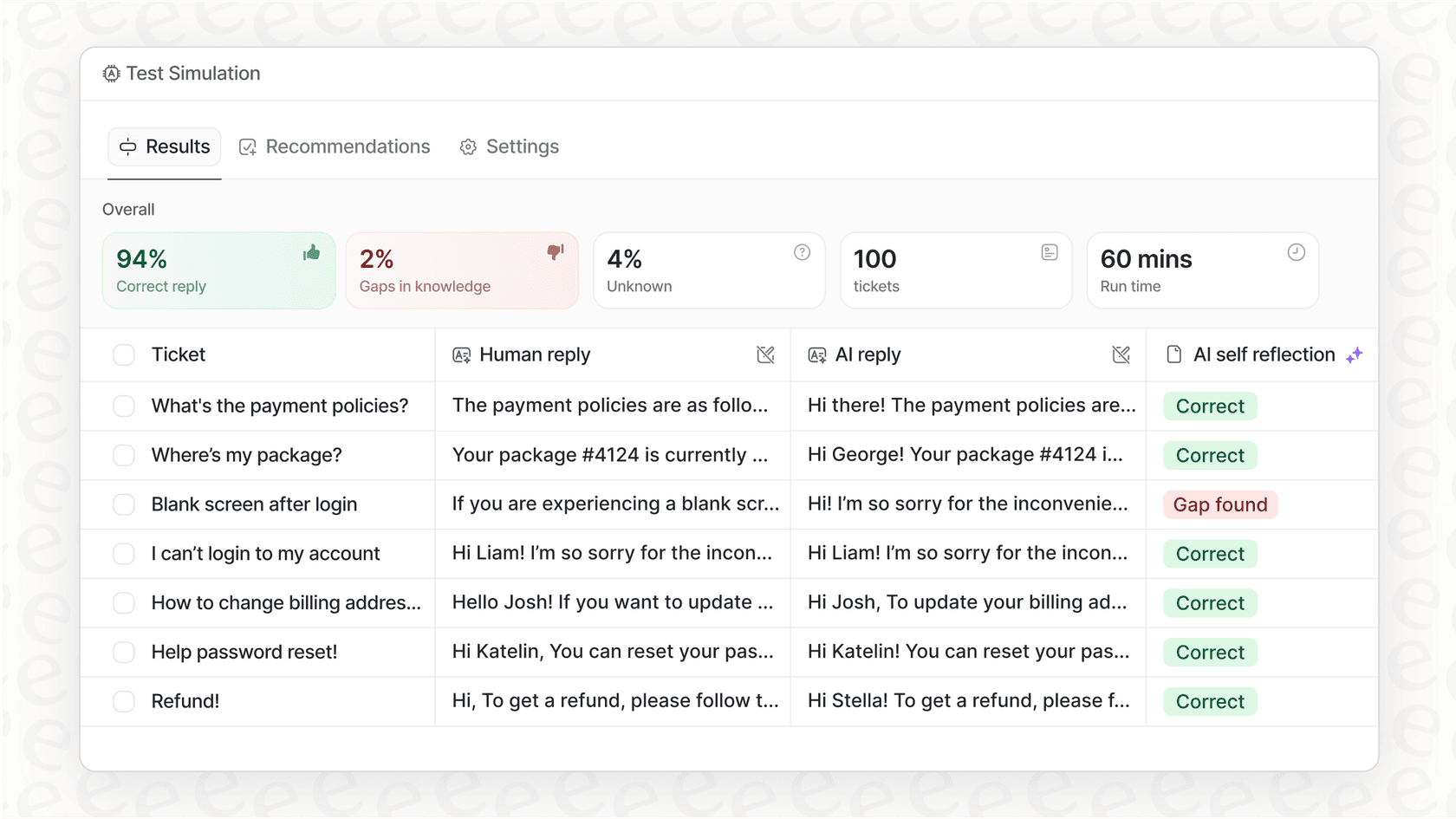
eesel AI takes the guesswork out of it with a simulation mode. Before you even flip the 'on' switch, eesel AI runs its model over your past tickets and shows you exactly how much it could have automated. You get a real, data-backed forecast of your potential automation rate and ROI. No more crossing your fingers and hoping for the best.
Moving beyond the Help Scout AI resolutions pricing model
Help Scout's AI resolutions pricing is a decent entry point for deflecting simple questions. But the unpredictable costs and limited features can be a problem. At $0.75 a pop, a busy month can lead to a surprisingly high bill, all for an AI that only handles one small part of your team's workload.
Today's support teams need more than that. They need budgets they can count on and an AI partner that can handle the heavy lifting, from smart triage and agent assists to actually getting work done in other apps.
Ultimately, the best pricing model isn't just about paying for wins. It's about investing in a platform that gives you steady, predictable value across your entire support operation.
Ready for predictable AI automation?
If you're tired of unpredictable AI bills and want to see what a true end-to-end automation partner can do, give eesel AI's 7-day free trial a spin. You can run a free simulation on your own ticket history to see your potential automation rate and find out just how much time you could be saving.


Frequently asked questions
A billable resolution is defined as a single AI chat session that is successfully resolved without any intervention from a human agent. This means the AI provides a complete, final answer to the customer's question, and the customer does not request further human assistance within that same session.
Help Scout offers a 3-month free trial for its AI Answers feature, which includes unlimited resolutions during this period. This allows your team to fully test the AI's capabilities, feed it your knowledge base, and observe its performance with live customer interactions before any charges apply.
To help manage costs and avoid surprises, Help Scout allows you to set a monthly spending cap for AI resolutions. You can choose to cap it either by a specific dollar amount or a total number of resolutions, and once this limit is reached, AI Answers will temporarily deactivate for the rest of the month.
The $0.75 per resolution specifically applies only to the AI Answers feature for chat resolutions. Other AI capabilities offered by Help Scout, such as AI Drafts for agent replies and AI Summarize for conversations, are typically included as part of the per-user pricing on their more advanced Plus and Pro plans, not under the resolution pricing model.
The per-resolution model can lead to unpredictable costs because customer support ticket volumes are rarely static; they can fluctuate significantly due to product launches, marketing campaigns, or unexpected issues. These spikes in demand directly translate to higher resolution counts and thus a potentially higher, less predictable monthly bill.
While paying only for successful resolutions might initially seem budget-friendly for small businesses, the unpredictability of resolution volumes can still make budgeting challenging. Unexpected surges in customer inquiries can lead to higher monthly bills than anticipated, potentially straining a limited budget.
Unlike your main Help Scout subscription, which is billed in advance, the charges for AI resolutions are billed in arrears. This means that any AI Answers usage from a given month will appear as a separate line item on your Help Scout invoice for the following month.
Share this article

Article by
Kenneth Pangan
Writer and marketer for over ten years, Kenneth Pangan splits his time between history, politics, and art with plenty of interruptions from his dogs demanding attention.