Let's be real: customers today expect a lot. They want quick, helpful answers on whatever channel they happen to be using at the moment, whether it's chat, email, or social media. They definitely don't want to hunt for a single, buried phone number.
But as you add more ways for customers to get in touch, things can get messy. Fast. Managing all these different customer service channels often means your company's knowledge gets scattered. The result? Inconsistent answers that leave both your customers and your support team feeling frustrated.
This guide is here to help you sort through the noise. We’ll look at the most important types of customer service channels, weigh their pros and cons, and talk about how you can build a unified strategy that actually works, without driving your team crazy.
What are customer service channels?
Customer service channels are just all the different ways a customer can get help from your company. Think of them as the various doors someone can knock on when they have a question or a problem. It’s not just about a phone line anymore; it's a whole network of options designed to meet people wherever they are.
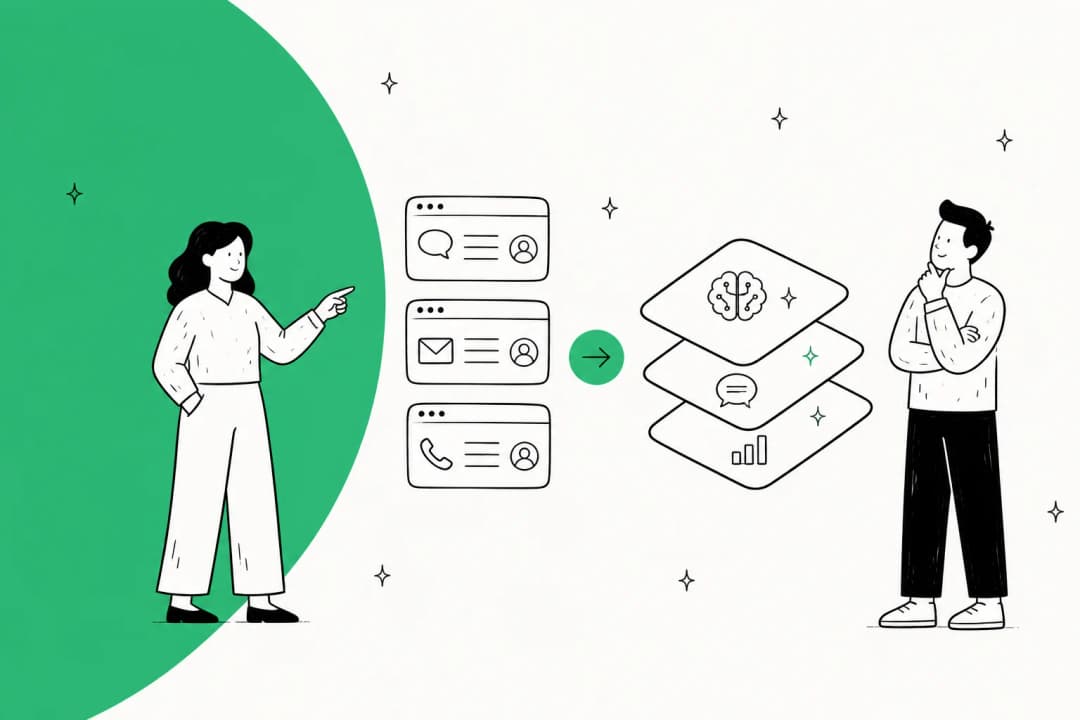
A brief overview of the different customer service channels available to businesses.
You can pretty much group them into three buckets:
-
The Classics (Traditional Channels): This is your phone and email support. They're usually one-on-one conversations that don't always happen in real time.
-
The Here and Now (Digital Channels): This is where most of the action is these days. Live chat, social media, and messaging apps give people that instant or near-instant help they crave.
-
The DIY Section (Self-Service Channels): These are all about letting customers find their own answers. We're talking knowledge bases, community forums, and AI-powered chatbots that are on duty 24/7.
The goal isn't just to offer a bunch of these options (that's what you'd call a multichannel approach). The real win is creating an omnichannel strategy where everything is connected. That means a customer can start a conversation on live chat and pick it up later over email without having to explain their problem all over again. It’s that kind of seamless experience that makes support feel easy.
A closer look at traditional customer service channels
Even with all the shiny new digital tools out there, the old standbys like phone and email are still incredibly important. For certain types of problems, especially the complicated or sensitive ones, they're often the best way to go. Let's dig into why they still deserve a spot in your support lineup.
Phone support: A human connection
Sometimes, you just need to talk to a person. Phone support is perfect for those urgent, complex, or emotionally charged issues where a real-time conversation and a bit of human empathy can completely turn things around. When a customer is truly upset or dealing with a high-stakes problem, hearing a calm, helpful voice can make all the difference.
It’s fantastic for direct communication and getting a feel for the customer's mood. You can pick up on their tone and show you get it, which is something you just can't replicate with text.
Of course, phone support isn't without its headaches. It’s expensive to staff, especially if you want to offer round-the-clock coverage. It can lead to long, frustrating wait times during peak hours, and it’s not something you can easily scale up. Plus, trying to make sure every agent has the exact same information at their fingertips can be a real challenge, often leading to inconsistent advice.
Email support: A documented conversation
Email is the workhorse for non-urgent, detailed questions where having a written record is key. Think billing disputes, formal feature requests, or tricky technical problems where a customer needs to send over a screenshot or two.
The big pluses? It’s asynchronous, meaning customers can send a message whenever it’s convenient for them, and it creates a paper trail for both you and the customer. This gives your team the space to put together thoughtful, detailed responses.
The flip side is that email can be slow, and nothing annoys a customer faster than a slow reply. As the number of emails piles up, it can feel impossible to manage without a solid system. Helpdesks like Zendesk or Freshdesk were built to tame this chaos, but keeping agent responses both fast and accurate is a constant battle.
This is where a smart tool can really help. An AI Copilot, like the one from eesel AI, integrates directly with your helpdesk. It helps your team draft accurate, context-aware email replies in just a few seconds. This keeps your answers consistent across the board and helps you resolve issues faster without having to grow your headcount.

The shift to digital and real-time customer service channels
Our demand for instant gratification has totally reshaped customer service. People now expect fast, convenient support, which is why digital-first channels that offer help in real-time have become so popular.
Live chat and messaging apps
Live chat is a go-to for quick questions or for giving a helping hand to someone who's in the middle of a purchase on your website. Messaging apps like WhatsApp and Facebook Messenger offer that same level of convenience, letting customers get support while they're on the move. It’s really no surprise that customers under 40 are far more likely to prefer a quick chat over making a phone call.
It's easy to see why this is so popular: you get real-time conversations, agents can handle a few chats at once, and customer satisfaction tends to be pretty high.
So, what's the catch? Live chat means agents have to be available right now. If a customer has to wait ten minutes for a response, that "live" promise starts to feel a little empty. And just like with email, if your team doesn't have a single source of truth for information, you run the risk of agents giving different answers depending on the channel.
Social media support: A public-facing channel
Social media has basically become a public stage for customer service. People hop on platforms like X (formerly Twitter), Instagram, and Facebook to ask quick questions, air their grievances, and talk to brands directly. And they expect a fast, public response.
When you handle it well, it's a great way to show you're transparent and on top of things. But because it’s all happening out in the open, one wrong move can damage your brand's reputation in a hurry. It’s one more channel to keep an eye on, and keeping a consistent brand voice is tough when your knowledge is scattered all over.
The challenge of consistency across digital channels
This brings us to the biggest headache of going digital: how do you make sure every customer gets the same answer, whether they're on live chat, sending an email, or tweeting at you? It can feel like an impossible task when your company's know-how is spread across Confluence, Google Docs, and your helpdesk.
This is where an AI Agent really changes the game. A platform like eesel AI can act as a central brain for your support team, unifying all your scattered knowledge sources. It connects to your helpdesk, internal wikis, and other documents to create one single source of truth. This ensures that both your human agents and any AI assistants are delivering consistent, accurate answers on every channel, every single time.

The automation era of self-service and AI-driven customer service channels
The biggest evolution in customer service recently has been the move toward automation and self-service. These tools don't just help cut costs; they also give customers the ability to solve problems on their own terms. In fact, about 67% of customers would rather try a self-service option before reaching out to a support agent.
Knowledge bases and community forums: The foundation of self-service
A well-maintained knowledge base or community forum is your first line of defense. It's a place where customers can go 24/7 to find articles, watch tutorials, or get tips from other users.
This approach is incredibly cost-effective, it's always on, and it can seriously reduce the number of tickets you get for simple, repetitive questions.
The main challenge is that this content can become outdated pretty quickly. And if your knowledge base isn't well-integrated with your other support channels, your agents can't easily use it to help customers. Even worse, a customer who looks for an answer and comes up empty is just left feeling stuck.
AI chatbots and AI agents
It’s really important to know that not all bots are the same. We've come a long way from those basic, rule-based chatbots that could only follow a simple script. Today's AI Agents use generative AI to actually understand what a customer is asking and help them solve their problem.
But a lot of the big AI solutions come with some serious trade-offs.
- Platforms like Salesforce have powerful AI, but their "Agentforce" is locked into their own ecosystem. Setting it up can be a massive project, often requiring you to go all-in on their platform.
- Other tools like Ada are more flexible, but tapping into their API for custom integrations usually means you'll need developers and a lot more setup time.
This is where an AI Agent from eesel AI is different. It’s built to be radically simple and self-serve. You can connect it to your existing helpdesk, whether that's Zendesk or Intercom, in a matter of minutes, not months. It instantly learns from all your company knowledge, past tickets, help center articles, internal docs, to provide autonomous support that feels genuinely helpful. You get full control to decide which tickets the AI handles, and you can even simulate its performance on past tickets before you go live, so there’s no risk.
| Feature | Traditional Chatbot | Enterprise AI (e.g., Salesforce Agentforce) | eesel AI Agent |
|---|---|---|---|
| Setup Time | Days to weeks | Months, requires consultants | Go live in minutes |
| Primary Power | Follows pre-written scripts | Deeply integrated with its own CRM ecosystem | Unifies knowledge from all your existing tools |
| Integration | Limited, often requires developers | Locked into a single vendor's platform | 100+ one-click integrations (Zendesk, Confluence, etc.) |
| Customization | Rigid, rule-based logic | Complex, requires specialized admins | Fully self-serve prompt & workflow editor |
| Pricing Model | Varies, often per-user | High per-agent/platform fees | Transparent, based on AI interactions |
Build a unified strategy for your customer service channels
A great customer service strategy today isn't about having the most channels; it's about having the right channels that all work together without a hitch. The goal is straightforward: meet your customers where they are and give them consistent, accurate information every single time.
The biggest thing standing in the way of this is fragmented knowledge. When your answers are hiding in a dozen different places, your support quality is going to be all over the map, no matter how amazing your team is.
This is why a tool like eesel AI can become the central nervous system for your entire support operation. Our AI Agent plugs into the tools you already use, brings all your knowledge together, and helps automate support across all your customer service channels. You don’t have to switch helpdesks, hire a team of developers, or get stuck in a months-long implementation project.
You can get started in minutes, simulate how much you can automate, and see the results for yourself. Why not try connecting your knowledge sources and see how eesel can transform your customer support today?
Frequently asked questions
For small businesses, starting with essential customer service channels like email and a strong self-service knowledge base is key for efficiency. As you grow, consider adding live chat for real-time support for common queries. Prioritize channels that match your typical customer issues and resource availability.
Multichannel support means offering various customer service channels, but they often operate independently. Omnichannel, conversely, ensures all these channels are integrated, allowing customers to move seamlessly between them without repeating information. The goal of omnichannel is a unified and consistent customer experience across all touchpoints.
AI Agents significantly boost existing customer service channels by unifying scattered company knowledge into a single source of truth. They can automate responses to common queries, draft accurate replies for human agents, and provide 24/7 self-service options. This ensures consistent, fast, and scalable support across all channels.
For urgent, complex, or emotionally charged issues, phone support remains highly effective due to the human connection and real-time dialogue. Email is better for detailed, non-urgent problems requiring a documented conversation or file attachments. Live chat can also be useful for quick, time-sensitive questions that don't require deep investigation.
Ensuring consistent answers across all customer service channels is best achieved by unifying your company's knowledge into a single source of truth. Tools like an AI Agent can connect to all your internal wikis, helpdesk, and documents. This central system then provides accurate, up-to-date information to both human agents and automated assistants, regardless of the channel.
Absolutely, traditional customer service channels like phone and email remain incredibly important in 2025. Phone support provides essential human connection for complex, urgent, or sensitive issues, while email is invaluable for non-urgent, detailed inquiries that require a written record. They complement digital and self-service options to offer a comprehensive support strategy.
Share this post

Article by
Stevia Putri
Stevia Putri is a marketing generalist at eesel AI, where she helps turn powerful AI tools into stories that resonate. She’s driven by curiosity, clarity, and the human side of technology.