
AI agents are becoming first-class citizens of the internet. They book appointments, process documents, and handle customer support. But there's a problem: these agents need to communicate, and email remains the universal protocol that every service and person understands.
AgentMail is an API-first email platform designed specifically for AI agents, giving them their own inboxes to send, receive, and act upon emails. Think of it as Gmail for AI, built with the programmatic control that autonomous agents require.
At eesel AI, we've seen how AI is transforming customer support workflows and internal operations. Communication infrastructure like AgentMail plays a key role in enabling these autonomous systems. In this guide, we'll break down what AgentMail is, how it works, and why it matters for teams building AI-powered products.
What is AgentMail?
AgentMail is the first email provider built from the ground up for AI agents. While traditional email services were designed for humans clicking through web interfaces, AgentMail is API-first, letting developers programmatically create inboxes, send emails, and process responses without any manual intervention.
The company's tagline sums it up: "It's not AI for your email. It's email for your AI." This distinction matters. Tools like Superhuman or Gmail's smart features use AI to help humans write better emails. AgentMail gives AI agents their own identity and inbox, allowing them to participate in email conversations autonomously.
Founded in 2025 by Haakam Aujla, Michael Kim, and Adi Singh, AgentMail is a Y Combinator Summer 2025 company that raised $6 million in seed funding in March 2026. The team of six is based in San Francisco and has already delivered over 100 million emails for customers.
The founders came from impressive backgrounds. Aujla was previously a quant researcher at Optiver. Kim worked at NVIDIA on autonomous vehicles. Singh previously invested at Accel, StepStone Group, and Flex Capital. Their combined expertise in finance, AI infrastructure, and venture capital positioned them well to tackle this emerging infrastructure problem.
How AgentMail works
AgentMail's architecture is built around a simple premise: developers should be able to create and manage email inboxes entirely through code. No manual setup, no web interface clicking, no OAuth gymnastics.
Here's the short version of how it works:
Programmatic inbox creation. You create an inbox with a single API call, specifying the username and domain. The inbox is live in milliseconds. No domain verification delays, no waiting period.
Simple authentication. Unlike Gmail and other providers that require complex OAuth flows, AgentMail uses straightforward API key authentication. You include your key in requests and you're done.
Real-time events. AgentMail delivers email events via webhooks and websockets, so your agents know the moment an email arrives. No polling required.
Multi-language SDKs. AgentMail offers official SDKs for Python, TypeScript/Node.js, Go, and a CLI tool. The GitHub organization shows active development across all these repositories.
MCP integration. AgentMail provides a Model Context Protocol (MCP) server, allowing seamless integration with modern AI agent frameworks like Langchain, Llamaindex, and CrewAI.
Built-in security. Every inbox comes with SPF, DKIM, and DMARC configured automatically. These email authentication protocols ensure your agent's emails land in inboxes, not spam folders.
Key features and capabilities
AgentMail packs features that go well beyond basic email sending. Here's what stands out:
Inboxes API
The core of AgentMail is the ability to create, manage, and operate email inboxes entirely via API. You can spin up new inboxes programmatically, assign custom domains for branded identities, manage conversation threads and replies, and handle attachments. This is infrastructure designed for scale, not a webmail interface with an API bolted on.
AI-specific features
AgentMail includes capabilities specifically designed for AI agents:
- Semantic search across every inbox in your organization, letting agents find relevant emails using meaning rather than exact keyword matches
- Automatic labeling with user-defined prompts, so agents can categorize emails based on your custom criteria
- Structured data extraction from email content, turning unstructured messages into actionable data
- Agent guardrails with built-in permissions and controls to keep autonomous systems within bounds
Scale and reliability
AgentMail's infrastructure is built for serious volume. The platform has delivered over 20 million emails and counting. One customer, CarEdge, uses AgentMail to provision thousands of inboxes and handles millions of emails reliably.
The company is SOC 2 Type II certified, which matters for enterprises evaluating infrastructure partners. Your data is encrypted in transit and at rest, with isolated storage per customer.
AgentMail pricing breakdown
AgentMail uses a tiered subscription model with clear usage limits. Here's the complete pricing structure:
| Plan | Monthly Price | Inboxes | Emails/Month | Storage | Key Features |
|---|---|---|---|---|---|
| Free | $0 | 3 | 3,000 | 3 GB | 100 emails/day limit |
| Developer | $20 | 10 | 10,000 | 10 GB | 10 custom domains, email support |
| Startup | $200 | 150 | 150,000 | 150 GB | Dedicated IPs, SOC 2 report, Slack support |
| Enterprise | Custom | Custom | Custom | Custom | White-label, EU cloud, BYO cloud, SSO |
The pricing scales with your needs. The Free tier lets you test the platform with up to 3 inboxes. Developer tier removes the daily sending limit and adds custom domains. Startup tier unlocks dedicated IPs for better deliverability and Slack channel support. Enterprise adds white-labeling, EU region hosting, bring-your-own-cloud deployment, and OIDC/SAML SSO.
Early-stage startups can apply for a free month on the Startup tier, which helps teams evaluate the platform at scale before committing.
Use cases for AI agents
AgentMail enables several concrete use cases that would be difficult or expensive with traditional email infrastructure:
Browser automation
AI agents can sign up for services, receive verification codes, and complete onboarding flows that require email confirmation. AgentMail makes it easy to extract 2FA and OTP codes from emails, letting browser agents authenticate themselves without human intervention.
Scheduling and executive assistance
Agents can manage calendars by reading meeting requests via email, proposing alternative times, and sending confirmations. They can also distribute summaries and follow-ups after meetings, acting as true digital assistants.
Document processing
Invoices, receipts, and attachments can be parsed automatically. AgentMail's data extraction capabilities turn unstructured email content into structured data that other systems can process.
Customer service
Support emails can be ingested, categorized, and routed to appropriate handlers. With the right setup, agents can even draft and send responses for common issues, escalating only complex cases to humans.
These use cases align with broader trends in agentic AI, where autonomous systems handle tasks that previously required human attention.
AgentMail vs traditional email APIs
To understand why AgentMail exists, it helps to look at what developers were doing before it came along.
The problem with legacy providers
Traditional email APIs like Gmail, SendGrid, and Mailgun weren't built for AI agents. They have several limitations:
-
No programmatic inbox creation. Gmail requires manual setup through a web interface. You can't spin up a new inbox for each agent instance programmatically.
-
Per-inbox pricing. Most providers charge monthly subscriptions per inbox. If you need 1,000 agent inboxes, you're paying 1,000 monthly fees even if each inbox sends only a few emails.
-
Restrictive rate limits. Gmail and similar services impose sending limits that make sense for human users but choke AI agents that might need to send higher volumes.
-
OAuth complexity. Authenticating with these services often requires OAuth flows designed for user consent, not machine-to-machine API calls.
-
One-way focus. SendGrid and Mailgun excel at transactional emails (order confirmations, password resets) but lack the two-way conversation management that agents need.
How AgentMail differs
AgentMail addresses each of these limitations:
| Aspect | Traditional APIs | AgentMail |
|---|---|---|
| Inbox creation | Manual setup | Programmatic via API |
| Pricing model | Per inbox/month | Usage-based (emails sent/received) |
| Rate limits | Restrictive | No limits on paid tiers |
| Authentication | OAuth complexity | Simple API key |
| Conversation type | One-way notifications | Two-way agent conversations |
| AI features | None | Semantic search, auto-labeling, extraction |
The result is infrastructure that actually fits how AI agents work, rather than forcing agents into patterns designed for humans.
Getting started with AgentMail
If you want to try AgentMail, the setup is straightforward:
- Sign up at the AgentMail console (no credit card required for the Free tier)
- Generate an API key from your dashboard
- Install the SDK for your language:
npm install agentmail,pip install agentmail, orgo get github.com/agentmail-to/agentmail-go - Create your first inbox and send a test email
The documentation includes a quickstart guide that gets you from zero to sending emails in minutes. The GitHub organization also provides example code repositories showing common integration patterns.
For support, AgentMail offers a Discord community, email support on paid tiers, and Slack channel support for Startup and Enterprise customers.
eesel AI and AI agent communication
While AgentMail gives AI agents their own email inboxes, we take a different but complementary approach at eesel AI. Our focus is on helping human teams work alongside AI, particularly in customer support and communication workflows.
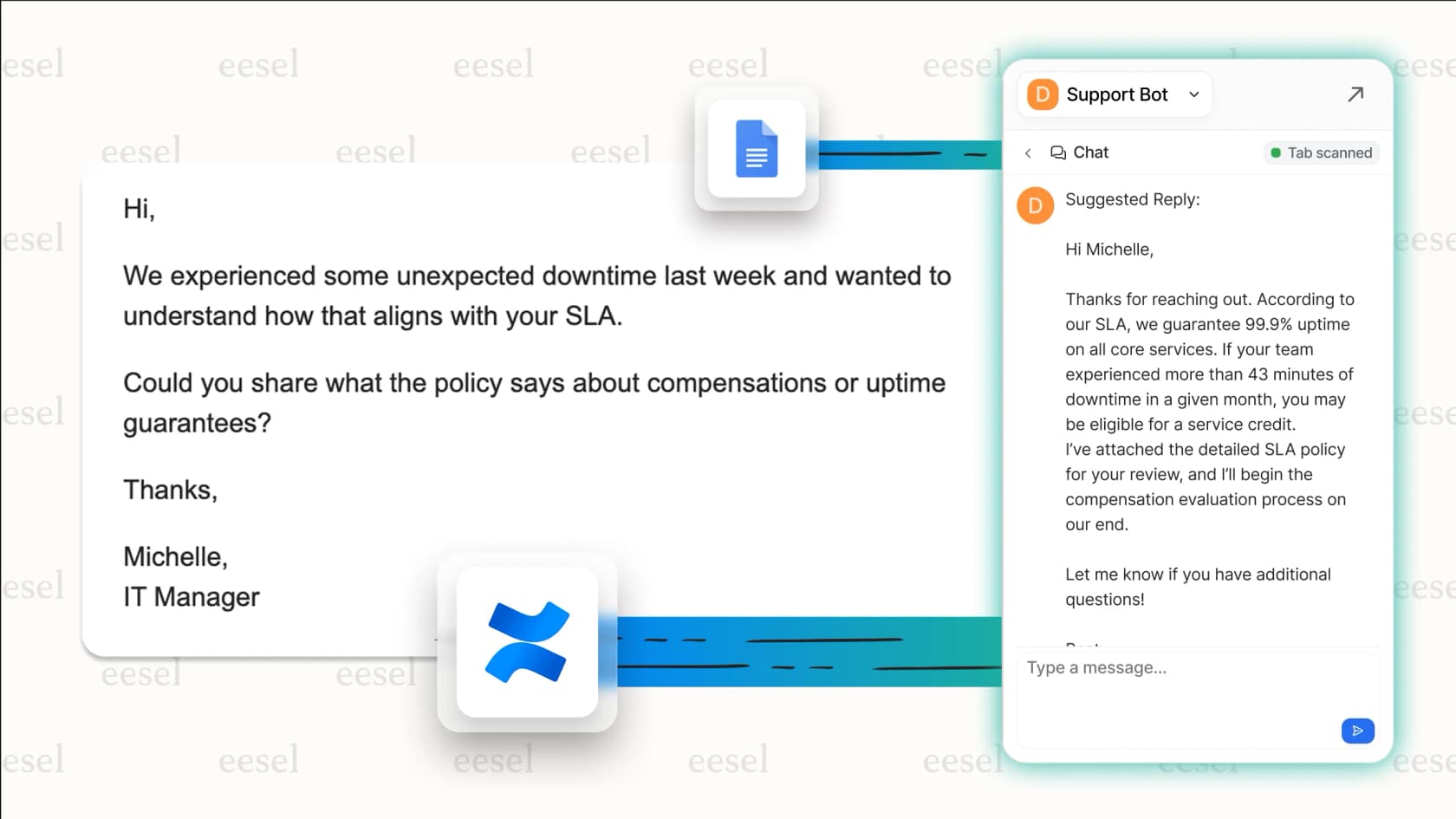
Our AI Email Writer helps support teams draft responses that sound like they came from the agent, not a generic AI. It learns from your past replies and documentation to match your team's voice. Unlike AgentMail, which gives agents their own inboxes, our tool helps humans respond to emails more efficiently.
We also see AI agents becoming more common in customer service workflows. As these agents proliferate, infrastructure like AgentMail becomes essential for enabling agent-to-agent and agent-to-human communication. The future likely involves a mix: some emails handled entirely by autonomous agents using AgentMail, others drafted by AI but sent by humans using tools like ours.
For teams building AI-powered products, the key is choosing the right tool for the job. AgentMail excels when you need agents to have their own email identity. Our AI Email Writer fits when you want to augment human agents with AI assistance while keeping humans in the loop.