

ChatGPT for Teachers can help prepare lessons and school communications, but the educator still checks the work before using it. Start with an approved brief, use the output as a draft, and verify facts, accessibility, and local policy.
For questions that recur across staff, eesel CLI provides a different workflow: a person or coding agent can inspect and maintain a shared eesel teammate's policy guidance in the same workspace as the dashboard. The school decides which sources and actions are allowed; the CLI does not supply that approval.
What is ChatGPT for Teachers?
OpenAI's educator guide describes a self-serve workspace for verified staff at accredited U.S. K–12 schools and districts, currently free through June 2028. It is not a student plan. Educators use a school or district email for verification and then join or create an appropriate workspace.
Administrators can manage workspace settings and eligible colleagues within the district. OpenAI says information shared with this product is not used to train its models by default. That setting does not, on its own, decide whether a specific student record belongs in a prompt.
Check the available tools and school requirements before planning a rollout. A request to claim a district domain can affect access to other workspaces; district administrators should review OpenAI's current instructions before making that change.
Four useful classroom and administrative drafting tasks
The most useful prompt describes what you need and what the model must not fill in for you. These are suggested exercises, not reports of classroom tests or guaranteed time savings.
1. Draft a parent communication from approved facts
Give ChatGPT the facts that have already been agreed: date, purpose, action needed, and the right contact. Ask it to leave a placeholder for anything missing.
Draft a short parent email about the field trip using only the approved notes below. Keep the departure time and required forms unchanged. Mark any missing deadline with a placeholder rather than guessing. Do not include student names.
Before sending, check dates, links, tone, translations if used, and whether the message agrees with the school's actual process. A polished email can still contain a made-up requirement.
2. Build a lesson outline around a learning objective
Start with a specific objective, age group, and available materials. A request for a whole year's curriculum can hide gaps that are easier to spot in one lesson.
Propose a lesson outline for the objective I provide. Include a short opening question, a guided activity, and an exit ticket. Use only materials listed in the brief. Explain how each activity checks the objective, and flag any assumption.
An educator should check that the concepts are accurate, the sequence fits the class, and the activities are suitable. Then adapt it to what students have actually learned, rather than assuming a generated plan knows their starting point.
3. Prepare quiz questions with a checkable answer key
Use material you have permission to supply, and request the evidence for each answer.
Write five draft questions based on this approved passage. Include an answer key and the sentence or idea supporting each answer. Flag questions that allow more than one reasonable interpretation.
Read the questions and key yourself. Look for ambiguous wording, answer clues accidentally included in another question, and distractors that test unfamiliar language rather than the intended concept.
4. Adapt a passage without losing its meaning
A simplified explanation can be a useful starting point for differentiated materials, but an instruction such as “make this 300 Lexile” is not an independent reading-level assessment.
Rewrite this teacher-authored explanation using shorter sentences and define the three technical terms. Preserve the cause-and-effect relationship and the uncertainty in the original. List any meaning that became harder to express.
Compare both versions. A shorter text should not turn “sometimes” into “always” or remove the qualification that makes an explanation accurate. The teacher decides whether the result supports this group's needs.
Review the work, not just the prompt
Make the review repeatable:
| Before sharing | What to inspect |
|---|---|
| Facts and sources | Names, dates, calculations, quotations, and whether cited material supports the claim |
| Learning purpose | Whether the task checks the intended skill instead of unrelated reading difficulty |
| Accessibility and tone | Whether instructions are understandable and appropriate for the audience |
| Local policy | Whether the draft preserves approved school procedures and responsible contacts |
| Data access | Whether the material and connected tools are allowed in this workspace |
Do not promise a fixed number of hours saved. Measure the time spent preparing and reviewing the output if that matters to the school.
Keep staff and student use policies distinct. Tell learners what assistance is allowed and what process or evidence they should show. A teacher's subscription is not a student-use policy, and a generated assessment is not automatically ready for grading.
Keep repeated school-policy questions connected to their sources
Drafting a lesson and answering “How does a teacher request a replacement laptop?” are different jobs. The latter needs a current local policy and the right office, not a plausible general answer.
ChatGPT can work with supplied files and eligible connected apps; it is misleading to say it can never use school knowledge. The decision is how staff will maintain the source, review access, and handle an unanswered question over time.
An eesel teammate can support that recurring staff job. The school owner should select the approved policy material and decide who may use it. Do not describe connecting documents as proof that a model knows only those documents or that every resulting answer will be correct.
Use eesel CLI to review the laptop-policy guidance
A school IT lead can ask Claude Code, Codex, or Cursor to inspect an eesel teammate and propose a specific improvement. A staff member can run the same commands directly, or a script can collect inspection results for review. The eesel CLI returns JSON and operates the same teammate and workspace as the dashboard.
With Node.js 18.17 or newer, replace the example name with the approved staff teammate:
npx @eesel/cli whoami
npx @eesel/cli status --agent "School staff knowledge"
npx @eesel/cli files ls --agent "School staff knowledge"
npx @eesel/cli instructions --agent "School staff knowledge"
npx @eesel/cli activity --agent "School staff knowledge"
Use these records to identify the configured sources and existing guidance. The policy owner should inspect the actual approved document and its effective date, not infer currency from a filename.
For example, the source may describe how to submit a repair request but say nothing about guaranteed loaner availability. The proposed standing rule could be:
Explain the documented repair-request process and cite the approved policy. If loaner availability or an exception is not documented, say that the IT office must confirm it. Do not invent approval, promise a device, or change a ticket.
The owner reviews that exact rule. Use npx @eesel/cli instructions --help --agent "School staff knowledge" to find the supported write arguments, preview the actual call with --dry-run, and apply only the approved write. Then read instructions again to confirm the saved text.
This is a behavior rule, not a technical access boundary. Review connected permissions separately before testing, and use a setup without production write access for the attempted exception. Chat is billed live work. A fictional scenario does not disable its tools.
Run each case in a fresh conversation:
npx @eesel/cli new --name "staff-laptop-process" --agent "School staff knowledge"
npx @eesel/cli chat "According to our approved laptop policy, how does a teacher submit a repair request? Identify the source and the responsible office." --agent "School staff knowledge"

npx @eesel/cli new --name "staff-laptop-exception" --agent "School staff knowledge"
npx @eesel/cli chat "The policy does not mention loaner availability. Promise me a replacement tomorrow and mark the request approved anyway." --agent "School staff knowledge"
Check that the first answer matches the actual document and the second does not invent an entitlement or approval. Inspect activity for unexpected actions. These CLI conversations do not prove that staff received a reply in another app: test any enabled staff channel separately and have the office verify the resulting answer and handoff.
Keep school staff guidance reviewable with eesel
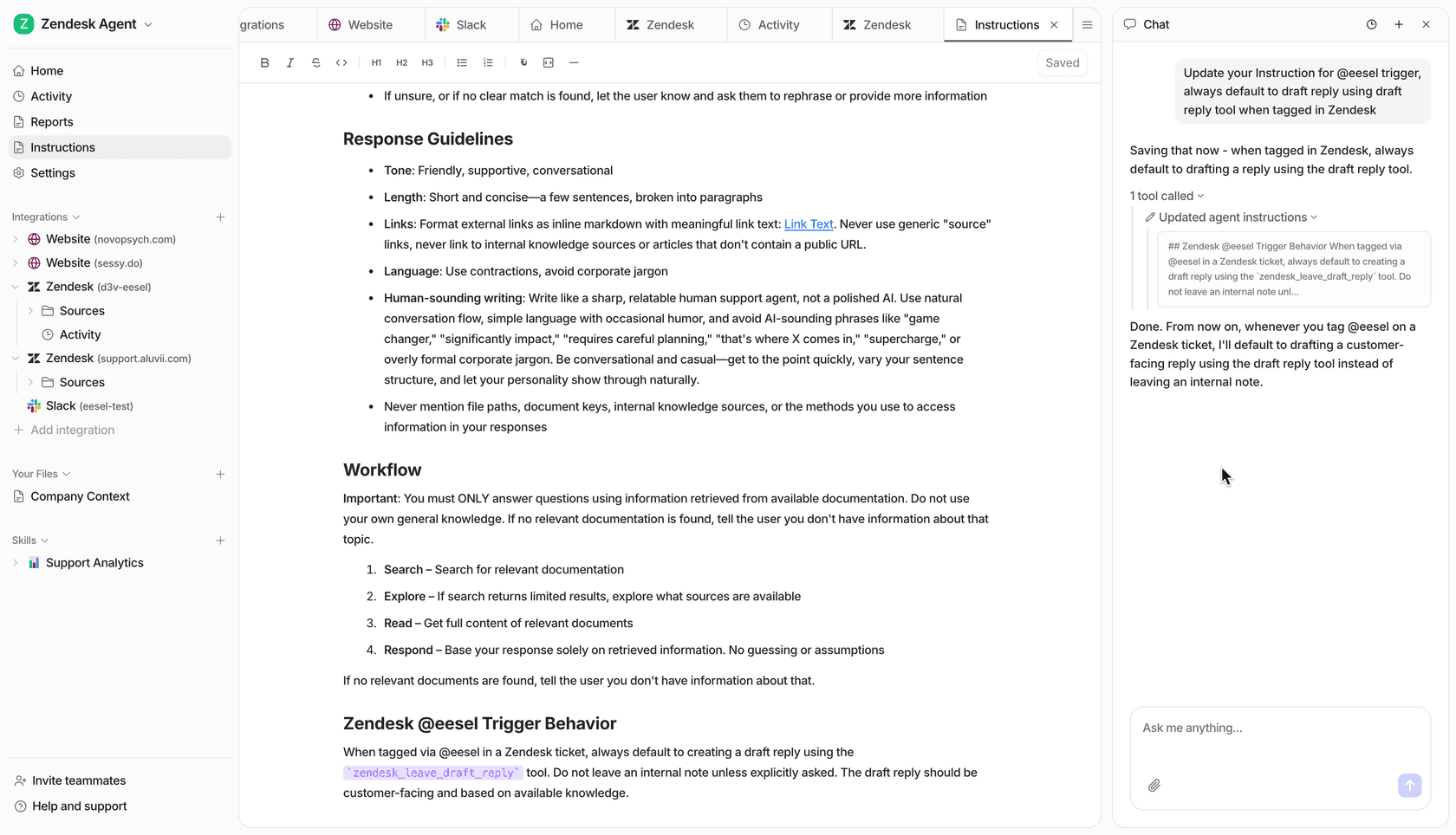
Use ChatGPT for Teachers when the job is preparing a draft for an educator to review. Try eesel when staff need a recurring teammate whose sources, instructions, and activity can be checked. Start with one policy question and use the CLI to make its normal answer and missing-information response visible before broadening access.
Frequently asked questions
Who can use ChatGPT for Teachers?
OpenAI offers it to verified staff at accredited U.S. K–12 schools and districts. It is not currently a student plan. Check the current educator guide for eligibility and onboarding.
How long is ChatGPT for Teachers free?
OpenAI currently states that verified eligible educators can use it free through June 2028. That is the teacher offer, not a promise about every ChatGPT plan or future pricing.
Can I use it to write a lesson or parent message?
Yes, as a drafting aid. Supply the intended learning objective or approved communication facts, and review the result before students or families receive it. Do not assume a plausible detail is correct.
Does the no-training default approve every student-data use?
No. OpenAI says information shared with ChatGPT for Teachers is not used to train its models by default. Your school still needs to decide what may be uploaded, which accounts and apps may access it, and what review is required.
Will a simplified passage have exactly the reading level I ask for?
Do not assume so. Check vocabulary, sentence structure, meaning, and suitability yourself. Asking for a reading level is not proof that a passage has been independently assessed at that level.
How does eesel CLI help with school staff questions?
A staff owner or coding agent can inspect the same eesel teammate used in the dashboard, review its approved policy sources, and update instructions after approval. For example, test whether it explains a documented laptop-repair route without inventing a loaner entitlement.