
Moving your customer support operation to a new platform is a significant undertaking. Whether you're consolidating multiple help desks, replacing a legacy system, or scaling up from a basic ticketing tool, a well-executed migration to Zendesk can transform how your team serves customers.
But here's the reality: migration projects fail not because the technology is complex, but because teams underestimate the planning required. Data gets lost. Integrations break. Agents struggle with the new interface. Customers notice the disruption.
This guide walks you through a proven approach to Zendesk SaaS migration. We'll cover everything from initial assessment through post-migration optimization, including how to enhance your new Zendesk setup with AI once you're live.
Pre-migration planning and assessment
Before you move a single ticket, you need to understand what you're working with. Start by taking inventory of your current environment.
Audit your existing data:
- Ticket volume (active and historical)
- User accounts (agents, admins, customers)
- Knowledge base articles and categories
- Custom fields, tags, and workflows
- Macros, triggers, and automations
- Third-party integrations and API connections
Map your data dependencies:
Your help desk doesn't exist in isolation. It likely feeds data to your CRM, BI tools, Slack channels, and reporting systems. Document every integration and understand which direction data flows. This prevents broken connections post-migration.
Set clear objectives:
What does success look like? Define specific metrics:
- Zero data loss (100% of tickets migrated)
- Maximum acceptable downtime (hours, not days)
- Agent training completion rate
- Customer satisfaction maintained or improved
Build your timeline:
Most Zendesk migrations take 2-6 weeks from planning to go-live. Smaller operations might finish in a week. Enterprise deployments with millions of tickets can take months. Build in buffer time for testing and issue resolution.
If you're planning to enhance Zendesk with AI after migration, consider how tools like eesel AI integrate with Zendesk to extend your platform's capabilities without disrupting your migration timeline.
Data preparation and cleanup
Migration is the perfect opportunity to clean house. Moving dirty data just means you'll have the same problems in a new system.
Remove duplicates:
Duplicate user accounts, organizations, and tickets are common in older systems. Use your current platform's deduplication tools or export to Excel for manual cleanup. The time invested here pays off in data integrity later.
Archive old data:
Do you really need tickets from five years ago? Consider archiving historical data separately rather than migrating everything. Most teams find that tickets older than 2-3 years add clutter without operational value.
Map fields carefully:
Your source platform's "Priority" field might have values like "Low/Medium/High" while Zendesk uses numbers or different labels. Create a mapping document that shows exactly how each field translates. This prevents data from landing in the wrong place.
Test your backups:
Before touching anything, create full backups of your current system. Then verify you can actually restore from them. Too many teams skip this step and regret it later.
For teams comparing platforms before committing, our Freshdesk vs Zendesk comparison breaks down key differences to help you decide if migration makes sense.
Choosing your Zendesk SaaS migration method
You have four primary approaches, each suited to different scenarios.
Native CSV import
Zendesk's built-in import tools work through CSV files. You can bulk import users, organizations, and tickets. This approach is free and straightforward for small datasets.
Best for: Teams with under 1,000 tickets and simple data structures
Limitations: No support for attachments, limited field mapping, manual work required
Third-party migration services
Services like Help Desk Migration specialize in automated platform-to-platform transfers. They handle 90+ platforms including Freshdesk, HubSpot, and ServiceNow.
Their process is straightforward: connect your source and Zendesk accounts, map your fields, run a free demo migration with 20 tickets to verify everything looks right, then execute the full transfer. Most migrations complete in hours, not days.
Pricing: Per-record model where larger volumes cost less per record. A basic migration of 1,000 records runs approximately $100, while 10,000 records costs around $514.
Service packages:
| Package | Support | Key features |
|---|---|---|
| Standard | 9/5 | Free, unlimited demos, 3-day data retention |
| Premium | 16/5 + weekends | 8-hour SLA response, 1 re-migration, 5-day retention |
| Signature | Highest priority | Delta migration, interval scheduling, multi-thread processing |
Best for: Medium to large migrations where preserving data relationships matters
API-based custom migration
For teams with development resources, Zendesk's API offers complete control. You can build custom scripts that handle complex transformations, merge data from multiple sources, or integrate with proprietary systems.
Best for: Organizations with unique data structures or specialized integration requirements
Requirements: Development time, API expertise, testing infrastructure
Hybrid approaches
Many enterprises use a combination: automated tools for standard ticket data, custom scripts for proprietary integrations, and manual processes for edge cases. This balances efficiency with flexibility.
Executing the migration
Once you've chosen your method, follow this sequence to minimize risk.
Step 1: Set up your Zendesk environment
Configure your new instance before migrating any data. Create custom fields, set up user roles, configure business rules, and establish your help center structure. This ensures migrated data lands in a ready environment.
Step 2: Sandbox testing
Run your entire migration process in a test environment first. Verify field mappings, check that attachments transfer correctly, and confirm user permissions work as expected. Fix issues here, not in production.
Step 3: Demo migration
Whether using native tools or a third-party service, start with a small sample. Migrate 20-50 tickets and have your team review them thoroughly. Are the timestamps correct? Do attachments open? Are custom fields populated?
Step 4: Full data transfer
Execute the complete migration during a low-traffic period. For most B2B companies, this means weekends. E-commerce teams might prefer Tuesday mornings when support volume is typically lowest.
Step 5: Delta migration
If your migration takes more than a few hours, you'll have new tickets created in your old system during the transfer. Delta migration captures these recent additions without duplicating what you already moved.
For a deeper understanding of what Zendesk offers once you're live, see our complete Zendesk ticketing system guide.
Post-migration validation and optimization
Going live isn't the finish line. You need to verify everything works before declaring victory.
Data integrity checks:
- Compare ticket counts between source and Zendesk
- Spot-check user accounts and organization memberships
- Verify attachments open correctly
- Confirm custom field values transferred accurately
- Test that historical conversation threads are readable
Workflow validation:
Re-enable your triggers and automations one by one. Test each to ensure they fire correctly. A broken escalation rule or misrouted ticket can frustrate customers quickly.
Team training:
Even intuitive platforms require adjustment. Schedule training sessions that cover:
- Navigating the agent interface
- Using macros and shortcuts effectively
- Managing tickets across channels
- Accessing and updating the knowledge base
Reporting setup:
Rebuild your dashboards and reports. Compare metrics between old and new systems to ensure you're capturing the same data points. This continuity matters for trend analysis.
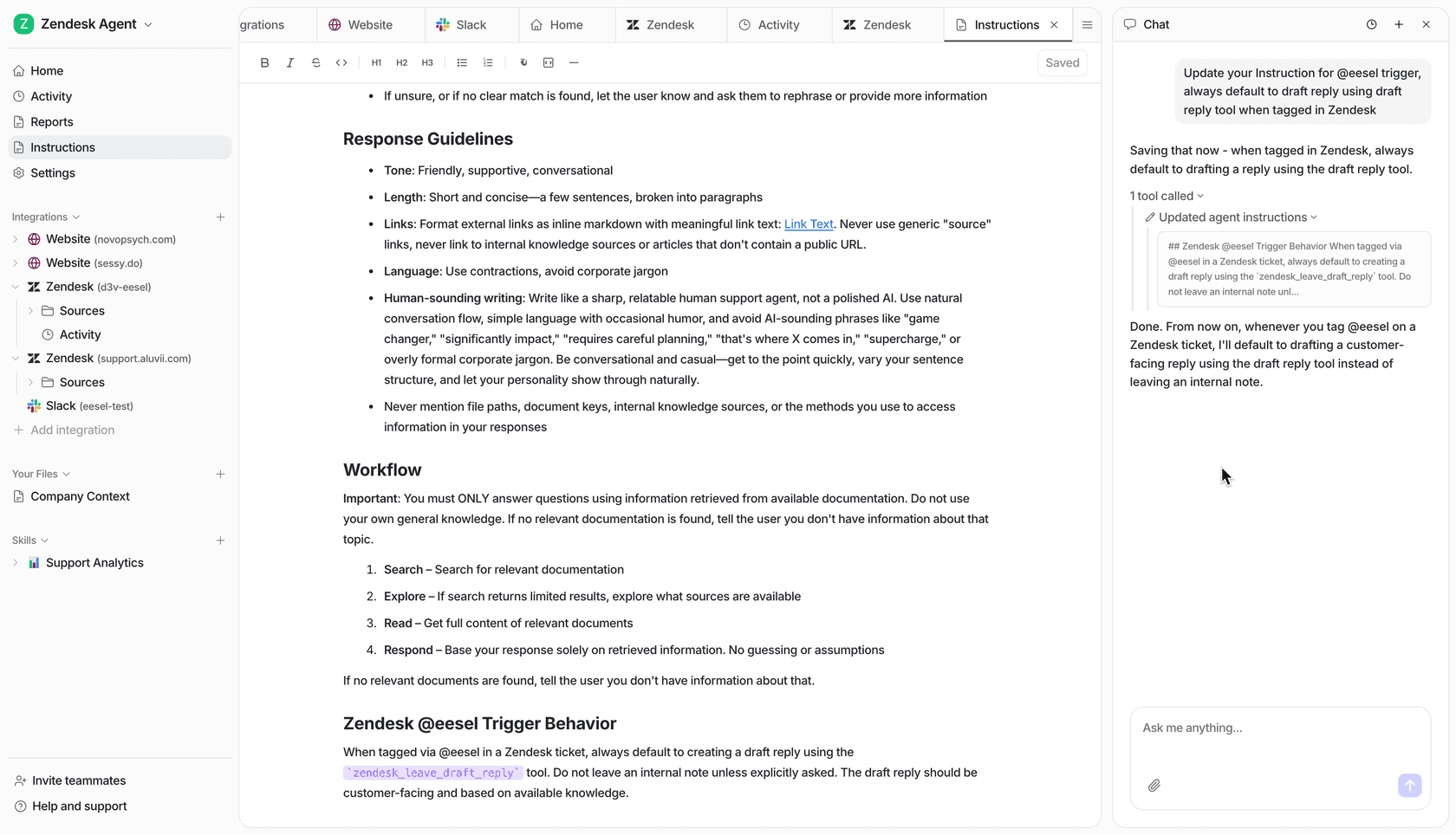
Once your team is comfortable with Zendesk, consider how AI can amplify their effectiveness. Our AI Agent for Zendesk learns from your historical tickets and help center to handle routine inquiries autonomously, letting your team focus on complex issues.
Enhancing Zendesk with AI after migration
Migration gets you onto a modern platform. AI takes you further.
Once your Zendesk environment is stable, adding an AI teammate can dramatically improve efficiency. Unlike traditional chatbots that require extensive configuration, modern AI agents learn from your existing data.
Here's how it works: connect the AI to your Zendesk instance, and it immediately analyzes your past tickets, help center articles, and macros. Within minutes, it understands your products, common issues, and how your team communicates.
Start with guidance:
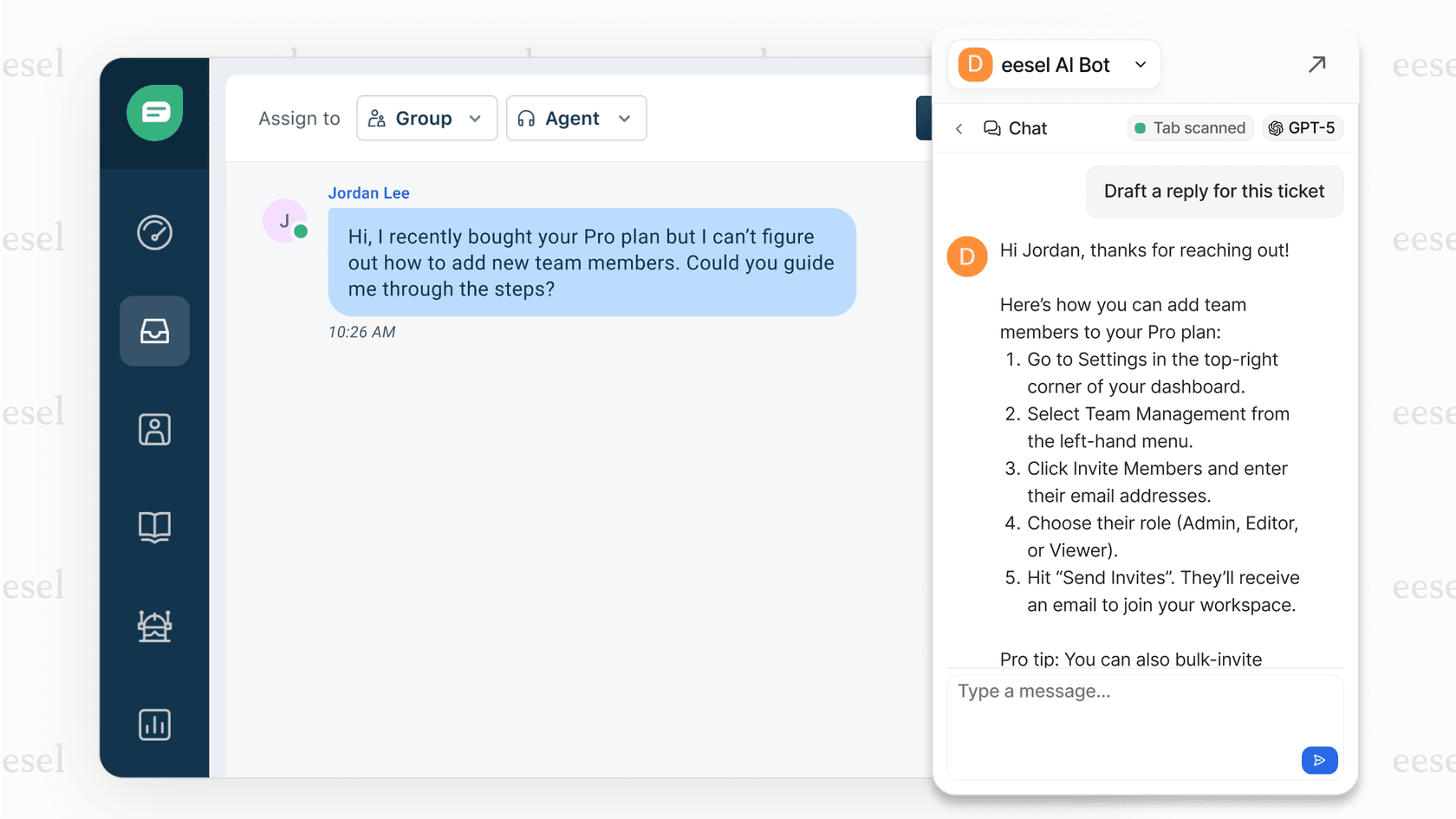
Have the AI draft replies that agents review before sending. This lets you verify accuracy before customers see responses. Most teams run this way for 2-4 weeks.
Level up gradually:
As the AI proves itself, expand its scope:
- Let it respond directly to simple FAQs
- Handle specific ticket types (password resets, order status)
- Work during business hours, then expand to 24/7 coverage
- Escalate only edge cases you define
Define escalation in plain English:
No complex decision trees. Just write instructions like: "If the refund request is over 30 days, politely decline and offer store credit" or "Always escalate billing disputes to a human."
For teams not ready for full automation, our AI Copilot for Zendesk drafts replies for agent review without taking over conversations entirely. See our transparent pricing to compare options.
Common migration pitfalls and how to avoid them
After helping hundreds of companies migrate, we've seen the same mistakes repeatedly.
Underestimating data complexity:
That "simple" ticket export often contains hidden relationships. A ticket links to a customer, who belongs to an organization, which has custom fields, which reference other data. Map these relationships before you start.
Skipping the cleanup phase:
Migrating 10 years of tickets sounds comprehensive. It's actually clutter. Be selective about what you bring forward.
Inadequate testing:
One successful demo migration isn't enough. Test edge cases: tickets with 50+ comments, users with special characters in names, attachments over 50MB. Find the breaking points before go-live.
Poor change management:
Your agents didn't choose this migration. Involve them early, address their concerns, and provide adequate training. A platform is only as good as the people using it.
Neglecting post-migration optimization:
The goal isn't just to replicate your old system in Zendesk. It's to improve it. Review your workflows, eliminate redundant steps, and take advantage of features your old platform lacked.
Start your Zendesk SaaS migration with confidence
A successful migration isn't about perfection. It's about preparation. Understand your data, choose the right method, test thoroughly, and plan for the unexpected.
The payoff is substantial: a unified customer view, streamlined workflows, and a foundation for AI-powered support that actually works.
If you're ready to enhance your Zendesk setup with AI that learns your business in minutes rather than weeks, invite eesel AI to your team. Start with a free trial to see how an AI teammate can handle routine tickets while your human agents focus on what matters most.


