
Moving your help desk from Freshdesk to Zendesk is like relocating a busy office. You have years of customer conversations, ticket histories, and institutional knowledge that all need to arrive intact. Get it wrong and your support team spends weeks hunting for context. Get it right and you unlock Zendesk's enterprise-grade capabilities without missing a beat.
This guide walks you through the entire Zendesk migration from Freshdesk process: what to audit before you start, which migration method fits your situation, how to execute the move, and how to optimize your new setup once you're there.
Pre-migration planning: What to audit and map
A successful Zendesk migration from Freshdesk starts long before you touch any import tools. You need to know exactly what you're moving and how it maps between systems.
Data inventory checklist
Start by cataloging everything in your Freshdesk account:
- Tickets both open and closed, including full conversation history
- Contacts and companies customer profiles and organizational relationships
- Agent profiles your team's user accounts and roles
- Knowledge base articles categories, sections, and all content
- Custom fields ticket, contact, and company fields you've created
- Tags how you categorize and route tickets
- Attachments and inline images files associated with tickets
- Macros and automations for reference (these get rebuilt, not migrated)
Mapping your data structure
Freshdesk and Zendesk use different terminology. You'll need to map:
| Freshdesk | Zendesk | Notes |
|---|---|---|
| Companies | Organizations | Domain associations transfer |
| Contacts | Users | Email required for requesters |
| Groups | Groups | Recreate manually first |
| Ticket Types | Ticket Forms | Different structure |
| Status: Open | Status: Open | Direct match |
| Status: Pending | Status: Pending | Direct match |
| Status: Resolved | Status: Solved | Slight terminology difference |
| Status: Closed | Status: Closed | Direct match |
The mapping step is where most migrations stumble. Spend time here. Document how your custom fields translate, which tags need to be preserved, and how ticket statuses align. Skipping this analysis leads to data that arrives technically intact but contextually broken.
Choosing your migration method
You have three primary approaches for a Zendesk migration from Freshdesk. The right choice depends on your ticket volume, technical resources, timeline, and budget.
Method 1: Professional migration services
Best for: Large volumes (50,000+ tickets), limited technical resources, or tight timelines
Services like Help Desk Migration or Helpando handle the entire process. They connect to both platforms, map your data, run test migrations, and execute the full transfer.
Pros:
- No coding required
- Tested processes reduce error risk
- Support included if issues arise
- Delta migration options (sync new tickets after initial transfer)
Cons:
- Higher cost than DIY
- Less direct control over the process
- Dependency on third-party timeline
Pricing: Volume-based. Help Desk Migration, for example, charges approximately $100 for 1,000 records and $514 for 10,000 records under standard conditions. They also offer service tiers: Standard (free, 9/5 support), Premium (up to 50,000 records, 16/5 support), and Signature (large migrations with delta and interval options).
Method 2: Automated migration tools
Best for: Mid-size teams wanting balance of control and convenience
Tools like Klamp.ai (available on the Freshworks Marketplace) provide a self-service interface for mapping and migrating data. You configure the connections, set field mappings, and run the migration through a wizard.
Pros:
- Visual field mapping
- Testing capabilities before full migration
- Faster than DIY API approach
- No coding required
Cons:
- Configuration still required
- May have limitations on complex custom fields
- Less hand-holding than full services
Method 3: DIY API migration
Best for: Technical teams with specific customization needs
Zendesk provides a Ticket Import API specifically for migrations. The endpoint POST /api/v2/imports/tickets accepts tickets with historical timestamps, comments, and attachments. Bulk import accepts up to 100 tickets per request via POST /api/v2/imports/tickets/create_many.
Pros:
- Full control over data transformation
- No ongoing service fees
- Custom logic for edge cases
- Can preserve exact timestamps and authorship
Cons:
- Requires development resources
- Time-intensive to build and test
- Error risk without proper validation
- Must handle rate limits and error recovery
Open-source resources exist to help. The fd2zd Ruby script on GitHub provides a starting framework for teams comfortable with code.
Key API considerations:
- Triggers don't run on imported tickets
- Zendesk metrics and SLAs aren't calculated for imported tickets
- Attachments must be uploaded separately and referenced by token
- The
archive_immediatelyparameter can send closed tickets directly to archive (useful for 750,000+ ticket migrations)
Executing the migration: Step-by-step
Once you've chosen your method, follow this sequence to minimize disruption.
Step 1: Set up your Zendesk foundation
Before importing any data, configure Zendesk to receive it:
- Create agents, groups, and roles
- Set up business hours and SLA policies
- Configure custom fields and ticket forms
- Install required apps (Jira, Slack, etc.)
- Disable welcome emails for new end users during migration
- Create a sandbox environment for testing
This scaffolding ensures your imported data has valid references to link against.
Step 2: Prepare your Freshdesk data
- Export tickets, contacts, and companies
- Clean duplicates and outdated records
- Verify API access credentials
- Document any custom workflows that need rebuilding
Step 3: Migrate in the right sequence
Data relationships matter. Import in this order:
- Companies/Organizations Tickets reference these
- Contacts/Users Tickets reference these too
- Ticket schema Custom fields must exist before tickets
- Tickets and conversations The core data
- Knowledge base articles Can happen anytime after
- CSAT data If applicable
Step 4: Validate and test
After migration, verify:
- Ticket counts match between systems
- Attachments and inline images are accessible
- Agent assignments transferred correctly
- Knowledge base formatting is intact
- Custom field values populated as expected
- Links between related tickets work
Run spot-checks on high-priority tickets and recent conversations. Test a few agent workflows to ensure routing and assignments function.
Post-migration: Optimizing your Zendesk setup with eesel AI
The migration gets your data into Zendesk. Now you need to get value from it.
This is where we can help. Our AI agent for Zendesk integrates with Zendesk to turn your migrated data into immediate productivity gains. Here's how:
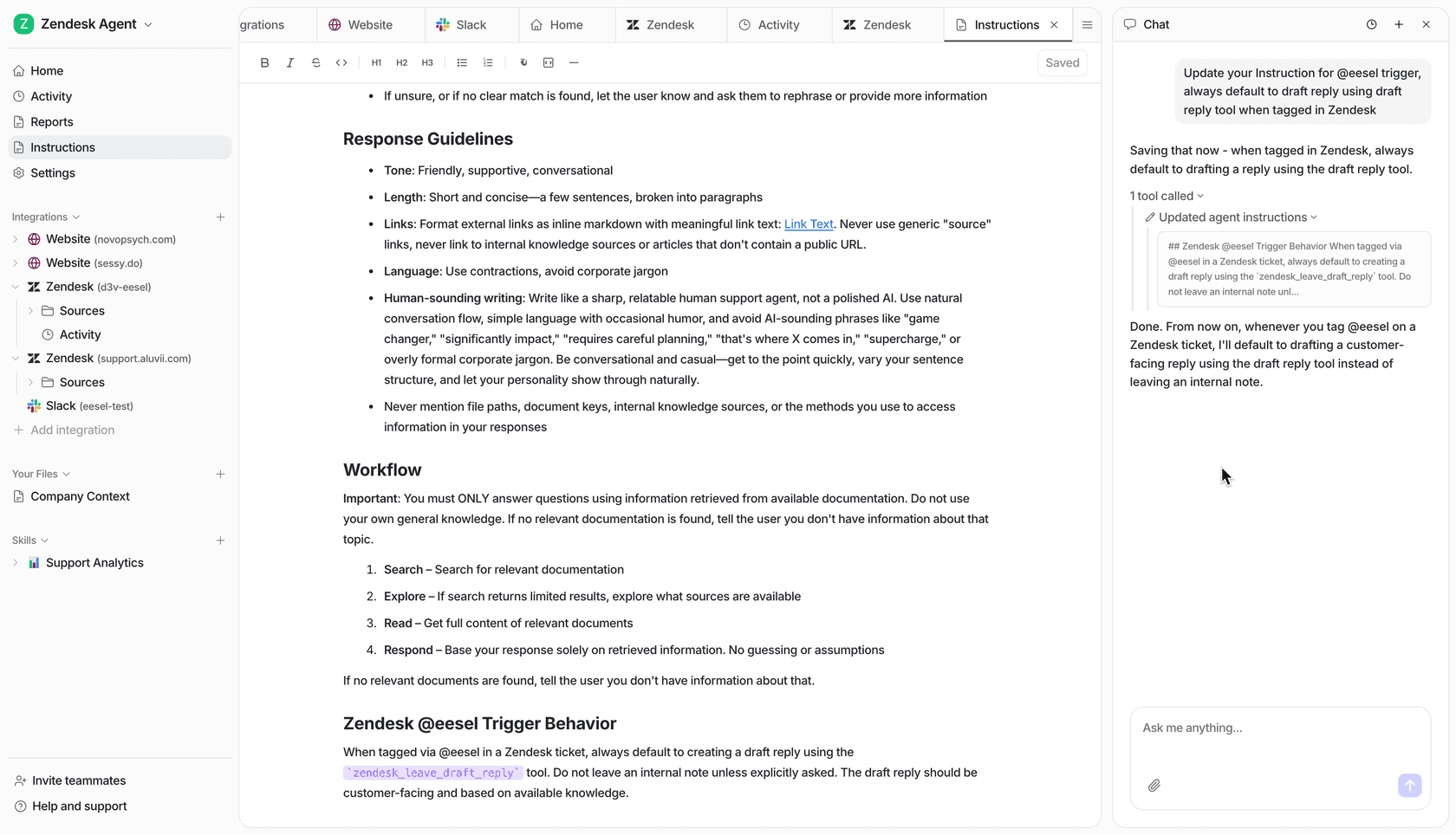
AI Agent for autonomous resolution. Our AI Agent handles frontline support tickets end-to-end, learning from your migrated ticket history to resolve issues without human intervention. Mature deployments achieve up to 81% autonomous resolution with typical payback under 2 months.
AI Copilot for faster responses. For tickets needing human attention, our AI Copilot drafts replies grounded in your knowledge base and past resolutions. Agents review, edit if needed, and send. The drafts improve over time as agents provide feedback.
AI Triage for queue management. Automatically tag, route, prioritize, and close tickets based on content. This keeps your queue clean without manual sorting.
The advantage of adding eesel AI post-migration: we learn from your complete Zendesk history immediately. Connect us to your help desk and we absorb your past tickets, help center articles, macros, and any connected docs (Confluence, Google Docs, Notion) to understand your business context from day one.
You can see how eesel AI works with Zendesk or explore our AI Agent and AI Copilot products directly.
Common migration pitfalls and how to avoid them
Even with careful planning, these issues trip up many teams:
Data loss from skipped testing. Always run test migrations on a representative sample. Verify that custom fields populate correctly, attachments transfer, and relationships stay intact before committing to full migration.
Broken ticket relationships. Freshdesk ticket IDs don't transfer to Zendesk. The original ID can be stored in a custom field or tag for reference, but links between tickets need updating.
Timestamp confusion. Zendesk's import API allows setting historical created_at and updated_at times, but dates before 1970 get rounded up. Verify your historical data falls within valid ranges.
Agent authorship issues. If Freshdesk agents don't exist in Zendesk, tickets may show as created by the API user. Map agent IDs or create placeholder accounts before migration.
Workflow disruption. Automations, triggers, and SLAs don't migrate. Plan time to rebuild these in Zendesk's framework. Use the migration as an opportunity to simplify and improve your workflows.
Storage limits. Zendesk plans have file storage limits (10 GB base + per-agent allocation). Large attachment libraries may require cleanup or storage upgrades.
Getting the most from your Zendesk migration
A successful Zendesk migration from Freshdesk comes down to three things: thorough pre-migration planning, choosing the right execution method for your resources, and validating everything before declaring victory.
The work doesn't end when the last ticket imports. Your team needs training on Zendesk's interface. Your workflows need rebuilding. And this is the perfect time to add AI capabilities that weren't available in Freshdesk.
If you're planning a migration and want to accelerate value from your new Zendesk setup, invite eesel AI to your team. We learn from your migrated data in minutes and can start assisting your agents immediately, whether through autonomous resolution, draft replies, or intelligent triage.