Zendesk help center search and facets: A complete guide for 2026

Stevia Putri
Last edited February 25, 2026
When customers hit your help center, they're usually already frustrated. They have a problem, they want an answer, and every second they spend digging through articles tests their patience. That's where search comes in. It's not just a nice-to-have feature. It's the difference between a quick self-service resolution and another support ticket clogging your queue.
This guide breaks down everything you need to know about Zendesk help center search and facets. We'll cover the native search methods available in Zendesk Guide, how to use advanced search syntax, what the analytics tell you, and when it makes sense to look beyond Zendesk's built-in capabilities. We'll also look at how AI teammates like eesel AI can build on your help center content to deliver answers directly, not just links to articles.
What is Zendesk help center search?
Zendesk Guide is the knowledge base component of the Zendesk Suite. At its core, it's a searchable repository of help articles that your customers (and agents) can access. The search functionality is what makes this knowledge base usable at scale. Without effective search, even the best-written articles go unread.
The connection between search and ticket deflection is straightforward. When customers find answers on their own, they don't submit tickets. Zendesk offers multiple search methods to match different use cases, from instant suggestions as users type to deep advanced searches for power users.
Here's the short version: Zendesk provides four distinct search methods, each designed for a specific scenario. Understanding when each one activates helps you optimize your content strategy and set realistic expectations for what search can achieve.
Native search methods in Zendesk
Instant search
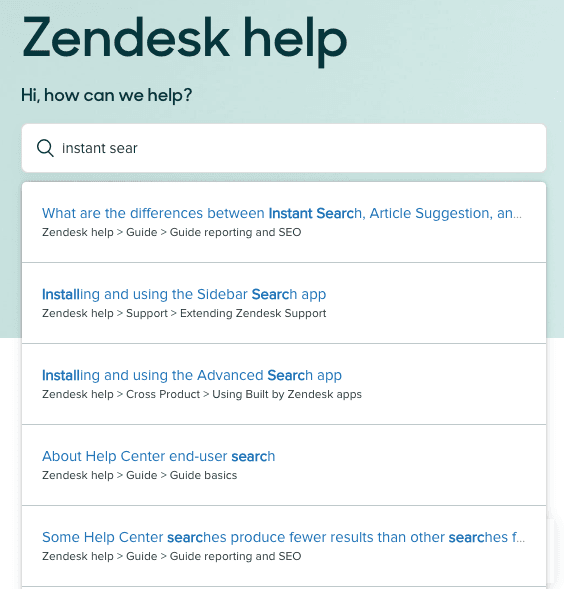
Instant search kicks in as soon as someone starts typing in your help center search box. It uses partial word matching against article titles only. So if a customer types "refund," they'll see articles with "refund," "refunding," or "refunds" in the title.
The upside is speed. Results appear immediately, often before the user finishes their thought. The downside is scope. Instant search doesn't look at article body text, labels, or community posts. If your article titles aren't keyword-optimized, customers might miss relevant content.
Native help center search
Once a user presses Enter, native search takes over. This is a full word search that scans article titles, body text, and labels. Results appear on a dedicated search results page with vote counts and comment numbers displayed next to each result.
Users can filter results by content type (knowledge base articles vs. community posts) and then by category or topic. This is where facets start to matter. They let users narrow down broad result sets without starting over.
Article suggestion search
This method activates when an end user starts submitting a support request. As they type in the Subject field, Zendesk suggests relevant articles based on title, content, and tags. The suggestions use a relevance score to order results.
The goal here is ticket deflection. If a user clicks a suggested article and finds their answer, the ticket never gets created. This is one of the highest-ROI optimizations you can make. Improving article titles and ensuring your top issues have comprehensive coverage directly reduces ticket volume.
Knowledge in the context panel
For agents, the context panel in tickets includes a Knowledge section. Zendesk bots automatically suggest relevant articles based on the ticket content. Agents can also manually search, then link or quote content directly in their responses.
This serves two purposes. It helps new agents find the right answers faster, and it ensures consistent information across your team. When everyone pulls from the same knowledge base, customers get the same answer regardless of which agent they reach.
Understanding search facets and filters
Facets and filters are what turn an overwhelming list of search results into a manageable set of relevant articles. Zendesk offers several filtering dimensions depending on where you're searching.
In the help center, users can filter by content type first (articles vs. community posts), then by category or topic. This hierarchical approach makes sense because content type is usually the broadest distinction. Someone looking for an official answer wants an article, not a forum discussion.
In the analytics dashboard, filters get more sophisticated. You can slice search data by time range, brand, search channel, user role, and locale. This matters because search behavior varies significantly across these dimensions.
For example, searches from mobile devices might use different keywords than desktop searches. Users in different regions might describe the same issue using different terminology. Without faceted analytics, these patterns stay hidden.
The key thing to remember is that facets improve precision. They don't change what content exists, but they help users find the right content faster. That speed translates directly to customer satisfaction and ticket deflection.
Advanced search syntax and operators
Beyond the basic search box, Zendesk Support offers advanced search capabilities using operators and property-based keywords. This is where power users (and administrators) can pinpoint exactly what they need.
Property-based keywords let you restrict searches to specific data fields. For example, searching type:ticket status:open returns only open tickets. You can search by assignee, requester, organization, tags, and custom fields.
Boolean operators (AND, OR, NOT) let you combine or exclude terms. Date ranges help you find content from specific time periods. This is useful for tracking down that ticket from last month or finding articles published this quarter.
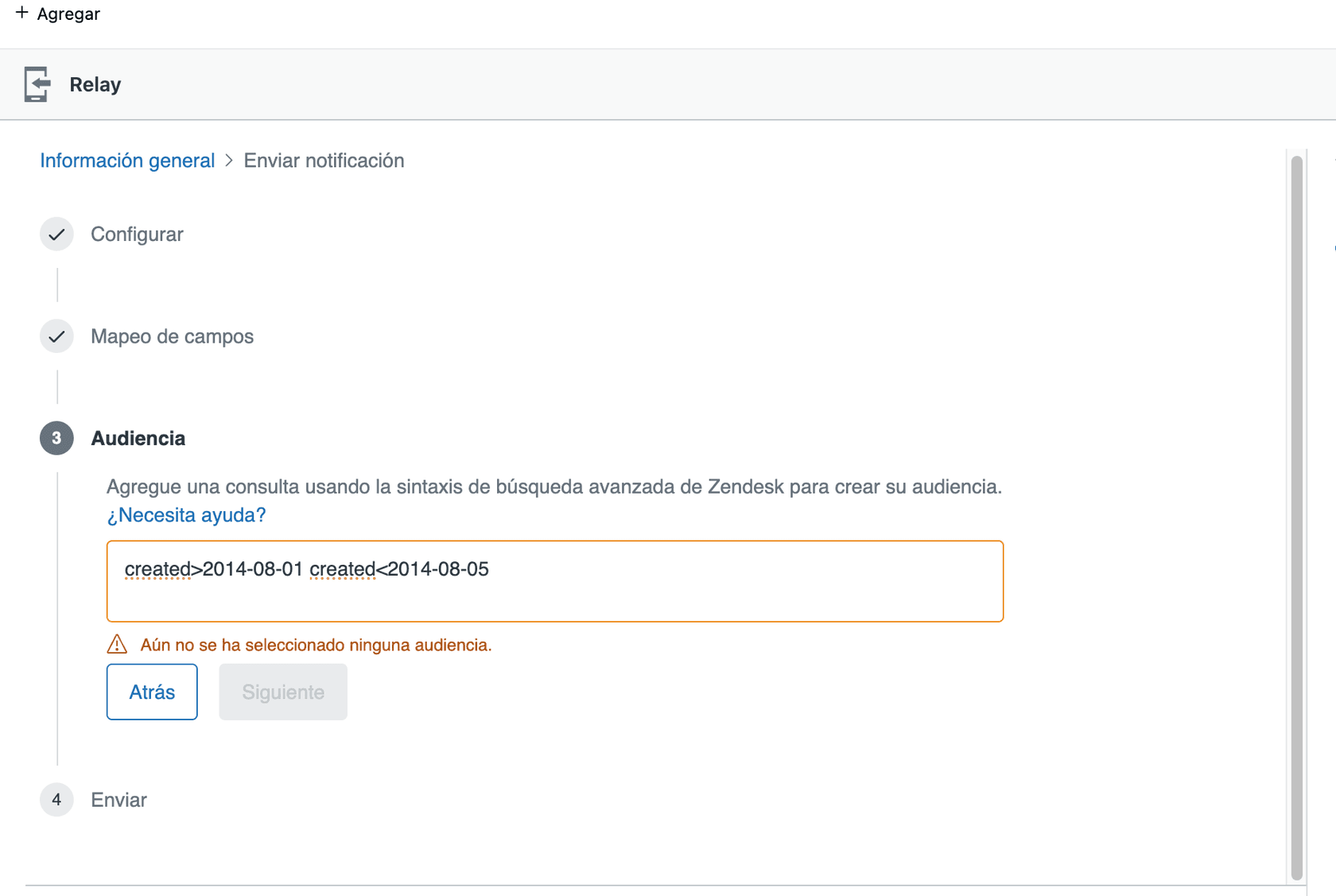
Here are a few common scenarios where advanced search saves time:
- Finding all tickets from VIP customers created in the last week
- Locating articles tagged with "deprecated" that need updating
- Identifying unassigned tickets older than 48 hours
- Searching custom fields like
customer_id:12345for account-specific issues
The syntax follows a predictable pattern: property:value. Once you learn the available properties, you can construct complex queries that would take minutes to find manually.
Analyzing and optimizing search performance
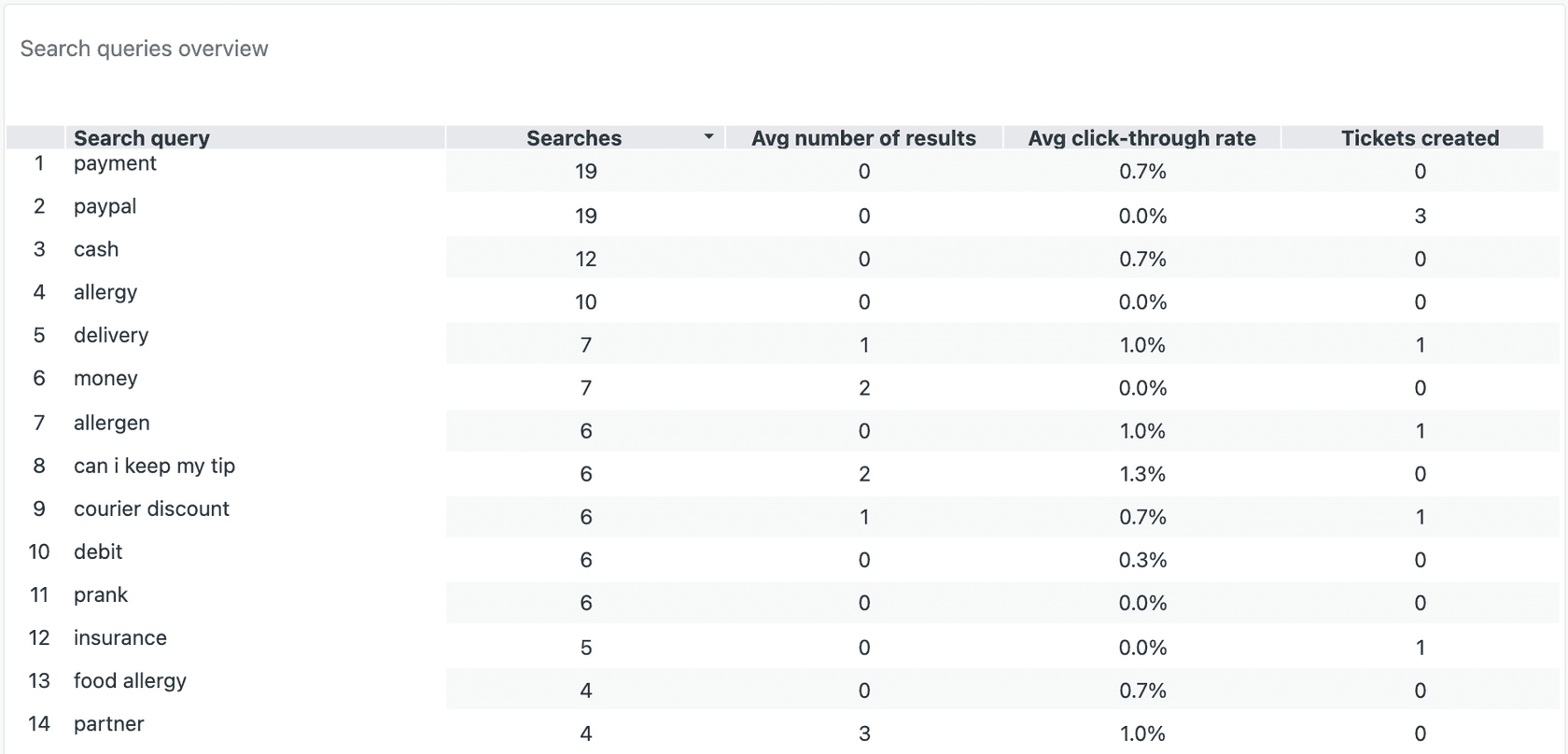
Zendesk includes a prebuilt Search dashboard in the Analytics section. This is where you move from guessing about search behavior to knowing exactly what users are looking for.
The headline metrics tell the story at a glance:
- Total searches: Volume of search activity
- Searches with no results: Content gaps you need to fill
- Average click-through rate: How often users find what they need
- Tickets created: The correlation between search and support volume
The dashboard lets you filter by time, brand, search channel, user role, and locale. This matters because a high no-results rate for one user segment might be acceptable for another.
The real optimization opportunity is in the no-results searches. When users search for something and get zero results, that's a signal. Either your content is missing, or your titles don't match the words customers actually use. Mining these failed searches gives you a prioritized list of articles to write or update.
You can also track whether search volume correlates with ticket creation. If searches spike and tickets spike with them, your help center isn't answering the questions people have. If searches spike but tickets stay flat, your content is doing its job.
AI-enhanced search: generative and semantic capabilities
In 2023, Zendesk rolled out semantic search capabilities. Instead of relying solely on keyword matching, semantic search uses embedding models to understand the meaning behind queries. The system re-ranks Elasticsearch results based on vector similarity between the query and document embeddings.
The results were measurable. Zendesk reported a 9% improvement in Click Through Rate and a 14% improvement in Mean Reciprocal Rank. For customers, that means relevant articles appear higher in results even when the query uses different words than the article.
Then in 2024, Zendesk introduced generative search through an Early Access Program. This feature provides AI-powered "Quick Answers" at the top of search results. Instead of just listing articles, the system generates a direct answer synthesized from your content.
The generative search feature works with federated content, meaning it can pull from external sources you've connected to Zendesk. For teams using the Copenhagen theme, adding the {{generative_answers}} placeholder enables the feature. Custom themes require more manual implementation.
There are limitations to consider. The generated answers are text-only, so they won't surface screenshots or videos. Each query runs independently, so follow-up questions don't build on previous context. And the feature requires the right theme configuration to display properly.
For teams already invested in the Zendesk ecosystem, these AI enhancements add value without requiring new vendors. But they also highlight a broader trend: search is evolving from "find the document" to "answer the question." That shift has implications for how you structure your help center content.
When to consider third-party search solutions
Native Zendesk search works well for many teams, but there are signs that indicate you've outgrown it:
- High no-results rate: If 20%+ of searches return nothing, your content strategy or search technology needs help
- Complex content libraries: When you have content across multiple platforms (Zendesk, Confluence, SharePoint), federated search becomes essential
- Need for result curation: Sometimes you want to manually boost certain articles for specific queries
- Advanced analytics requirements: When you need deeper insights than Zendesk's built-in dashboard provides
Third-party options like Swiftype and SearchUnify address these gaps. Swiftype offers drag-and-drop result ranking and federated search across help centers, forums, and FAQs. SearchUnify provides enterprise-grade AI agents and unified search across virtually any content source.
Both require integration work and come with additional costs. Swiftype pricing is not publicly disclosed, requiring a sales conversation. SearchUnify positions itself as an enterprise solution with custom pricing based on deployment size.
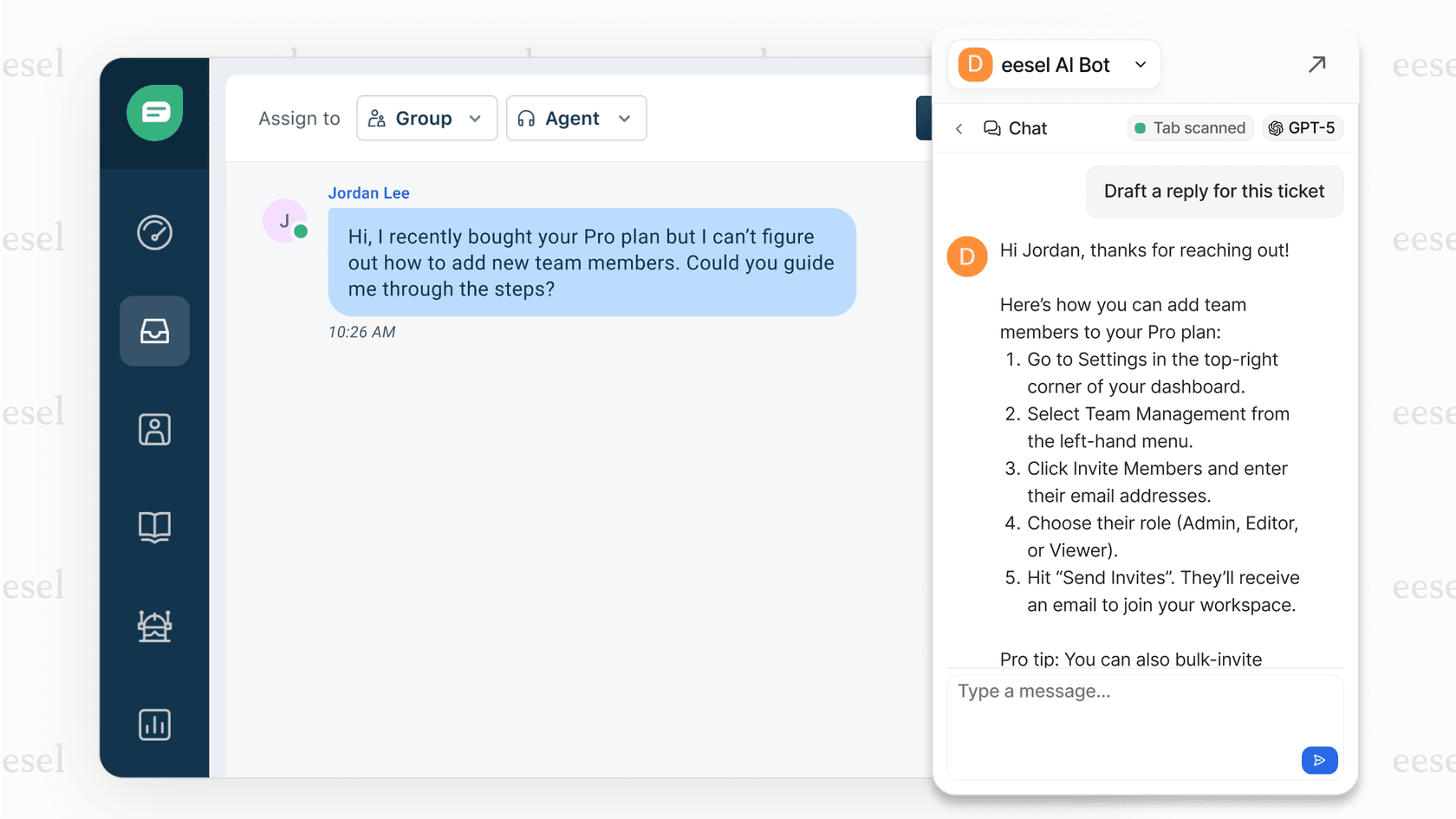
Here's where the landscape gets interesting. Traditional search, whether native or third-party, follows the same pattern: user searches, system returns links, user clicks and reads. AI teammates like eesel AI flip that model. Instead of returning links to articles, eesel learns from your help center content and answers questions directly.
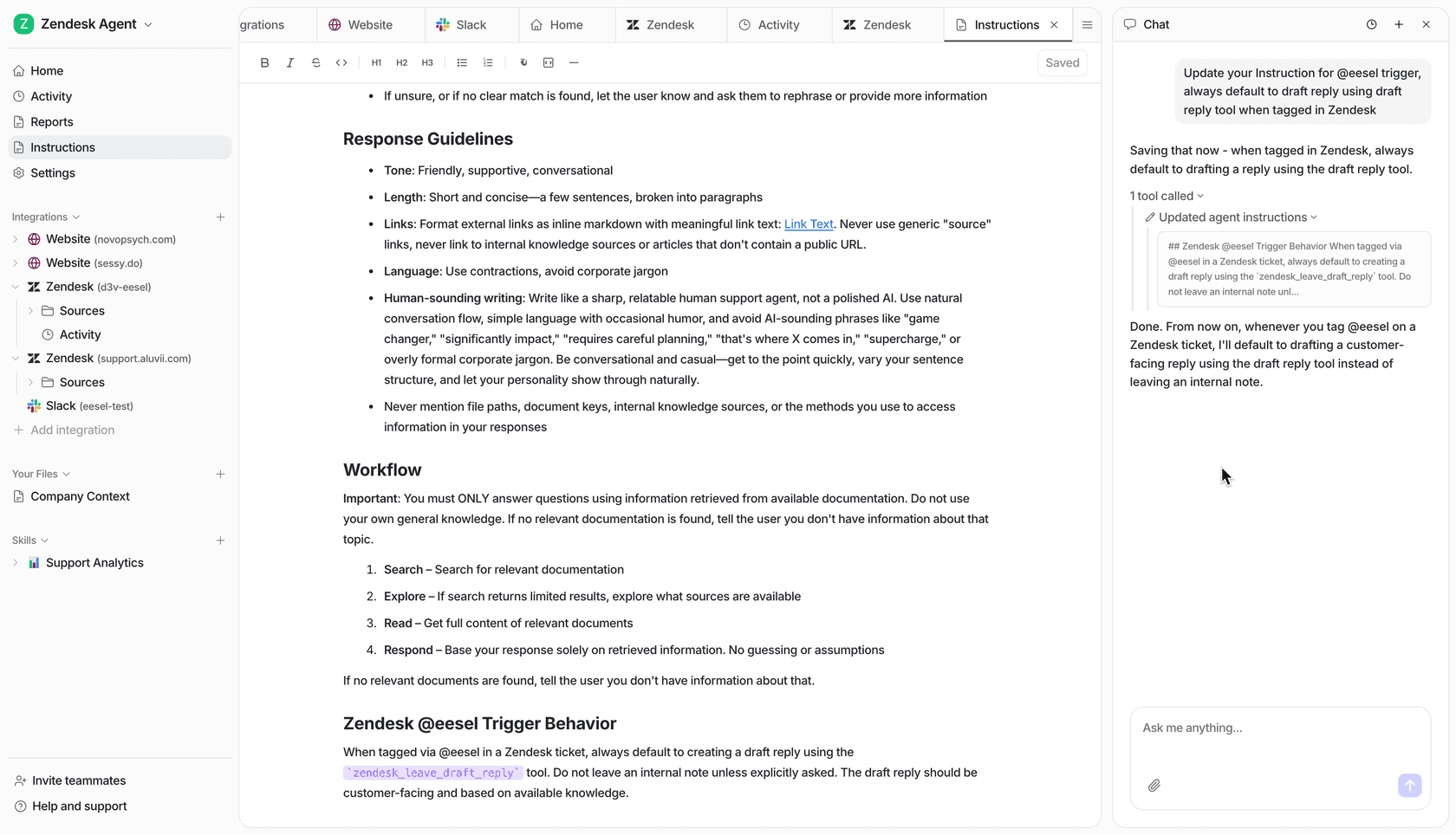
Our Zendesk integration connects to your existing knowledge base, past tickets, and connected documentation. From there, eesel can operate as an AI agent handling frontline tickets, an AI copilot drafting replies for agents, or an AI chatbot on your website. The difference is that eesel doesn't just find content. It understands it well enough to have conversations.
Choosing the right approach for your help center
The right search strategy depends on your team size, content volume, and technical resources. Here's a simple framework:
Start with native optimization. Before adding complexity, make sure you're getting the most from what Zendesk provides. Audit your no-results searches, improve article titles, and ensure your top 20 issues have comprehensive coverage. This costs nothing and often delivers the biggest improvements.
Consider AI enhancements next. If you're on a Professional or Enterprise plan, enable semantic and generative search features. These add intelligence without requiring new vendors or integrations.
Evaluate third-party search when: You need federated search across multiple platforms, advanced result curation, or deeper analytics than Zendesk provides. Be prepared for integration work and ongoing costs.
Look at AI teammates when: You want to move beyond "search and read" to actual conversation. eesel AI learns from your help center content to answer questions directly, handle tickets autonomously, and assist agents in real time. It's not a replacement for search. It's a different approach to the same problem: getting customers answers quickly.
Bottom line? Search technology has evolved. The question is no longer just "how do we help customers find articles?" It's "how do we get customers answers with minimal friction?" Sometimes that means better search. Sometimes it means skipping the search entirely and letting AI handle the conversation.


Frequently Asked Questions
Share this article

Article by
Stevia Putri
Stevia Putri is a marketing generalist at eesel AI, where she helps turn powerful AI tools into stories that resonate. She’s driven by curiosity, clarity, and the human side of technology.