
If you have ever tried to move content in or out of Zendesk Guide (now Zendesk Knowledge), you have probably hit the same wall everyone else does: there is no built-in export button. Zendesk does not provide a native tool for bulk exporting your help center articles, which leaves many teams scrambling for workarounds when they need to migrate, backup, or restructure their knowledge base.
The good news? You have options. Several of them, actually. Whether you are comfortable writing Python scripts or prefer a point-and-click interface, there is a method that will work for your team. In this guide, we will walk through every approach available for importing and exporting Zendesk Knowledge articles, from the Help Center API to third-party apps and professional migration services.
Understanding Zendesk Guide's content structure
Before you start moving content around, you need to understand how Zendesk organizes it. Unlike a simple folder system, Zendesk Knowledge uses a three-layer hierarchy:
- Categories are the top-level containers
- Sections live inside categories and hold your articles
- Articles are the actual content pieces
This structure matters because you cannot just import a bunch of articles and sort them out later. You need categories and sections in place first. If you are migrating from another platform, you will need to map your existing structure to this three-layer model.
There is also an optional layer called user segments, which control who can see what content. If you have restricted sections (like internal documentation or VIP-only articles), you will need to set up these segments before creating the sections that use them.
Bottom line? Planning your structure before you start importing will save you hours of cleanup work later.
Method 1: Using the Help Center API
The Zendesk Help Center API is the most powerful and flexible option for importing and exporting content. It is also the approach Zendesk officially recommends when you need to move large amounts of data.
What you will need
Before you start with the API method, make sure you have:
- A Zendesk account with API access enabled
- An API token or OAuth credentials for authentication
- Basic familiarity with REST APIs (or a developer on your team)
- Python (recommended) or another language for scripting
Exporting content via API
To export your existing articles, you will use the List Articles endpoint:
GET /api/v2/help_center/articles
The API supports cursor-based pagination (preferred) and offset pagination. For large help centers, cursor pagination is more reliable. You can activate it by adding ?page[size]=100 to your requests.
Zendesk provides a Python script example that walks through backing up your entire knowledge base. The script handles pagination automatically and saves each article as an HTML file.
Keep in mind the API follows the same rate limits as the Zendesk Support API. If you are exporting thousands of articles, you will need to build in rate limit handling.
Importing content via API
Importing is more complex because you need to create content in the right order:
-
Import authors as Zendesk users first. Set their role to "agent" and record the user IDs returned by the API.
-
Create categories using the Create Category endpoint. Record the category IDs for the next step.
-
Create user segments (optional) if you need restricted access. Record the segment IDs.
-
Create sections within your categories, assigning the appropriate category_id and user_segment_id.
-
Create articles within your sections, setting the author_id and section_id for each.
-
Upload attachments separately if your articles contain inline images that are not hosted publicly.
Here is what a basic article creation request looks like:
POST /api/v2/help_center/sections/{section_id}/articles
{
  "article": {
    "title": "Getting Started Guide",
    "body": "<p>Welcome to our product...</p>",
    "author_id": 9873843,
    "locale": "en-us"
  }
}
The API returns the new article ID, which you can use to associate attachments or create translations.
When to use the API approach
The API method is best for:
- Technical teams with development resources
- Large-scale migrations (thousands of articles)
- Regular automated backups
- Complex migrations requiring data transformation
It is probably overkill if you just need to move a dozen articles once.
Method 2: Third-party apps and tools
If writing Python scripts is not your thing, several apps in the Zendesk Marketplace can handle imports and exports with a visual interface.
Help Center Import by Zenplates
The Help Center Import app by Zenplates is a $99 one-time purchase that gives you a visual interface for bulk importing content. It supports:
- Up to 500 categories per import
- Up to 500 sections per import
- Up to 1,000 articles per import
- Up to 1,000 article comments per import
The workflow is straightforward. You start by creating rows in an interactive table, either manually, by importing a CSV file, or by pulling from another public Zendesk knowledge base. You can edit fields directly in the table, bulk update rows, and get immediate visual feedback if any field values are invalid.
Once your data looks right, you review it in the app (sorting and filtering as needed), then click Import. A progress indicator shows you the status, and when it is done, you get a completion report with all the newly created record IDs.
Limitations to know about:
- Article attachments are not imported (content only)
- Link and image references within articles are not modified
- Content imports into your primary brand only
- You will need to review inline images after import
For teams moving content from another platform via CSV, this app eliminates most of the technical complexity.
kBackup
kBackup is a free app by Felix Stubner that focuses specifically on backups. It is lightweight, requires no installation, and works with a single click.
Here is what it does:
- Exports your Help Center content as HTML files named [ArticleId].html
- Verifies the user exists in your domain before running (security feature)
- Works even if you use host mapping (it uses the original Zendesk subdomain)
- Completely safe read-only operation
The app is particularly useful if you need to create offline copies of your content for translation workflows or periodic backups. However, it is export-only. If you need to import content back into Zendesk, you will need another tool.
Note: The app was last updated in 2017, so while it still works, it is not actively maintained.
When to use third-party apps
Apps are ideal when:
- You want a visual interface instead of writing code
- Your migration is medium-sized (hundreds of items, not thousands)
- You need to import from CSV or another Zendesk instance
- You prefer a one-time cost over ongoing service fees
Method 3: Manual copy-paste and theme export
Sometimes the simplest approach is the best one. If you only need to move a few articles, manual copy-paste might be faster than setting up APIs or buying apps.
When manual makes sense
Manual migration works well when:
- You are migrating fewer than 20-30 articles
- It is a one-time move where setup time exceeds copy time
- Content needs heavy editing during migration anyway
Exporting theme code
If you need to backup or migrate your Help Center theme (the HTML, CSS, and JavaScript that controls the look and feel), Zendesk does provide built-in tools for that.
On Guide Professional or Enterprise plans, you can import and export your theme and manifest file directly from the admin interface. This gives you a ZIP file containing all your theme code.
For lower-tier plans, you will need to manually copy and paste the code into a text editor. There is no API access to theme code on those plans.
Limitations of the manual approach
- Time-consuming for large content volumes
- No way to preserve metadata (author, creation date, etc.)
- Images and attachments must be handled separately
- No bulk operations possible
Best practices for successful migration
Regardless of which method you choose, following these practices will save you headaches:
Plan your structure first
Map out your category and section hierarchy before you start importing. It is much easier to get the structure right upfront than to reorganize hundreds of articles later.
Test in a sandbox
If you have access to a Zendesk sandbox environment, run your import there first. This lets you catch formatting issues, broken links, and permission problems before touching your live help center.
Handle images and attachments carefully
Most import methods do not automatically handle inline images or file attachments. You will typically need to:
- Host images on a public server (like AWS S3) before import, or
- Upload attachments separately after importing articles, or
- Use the API to upload attachments and update article HTML with the new URLs
Manage author attribution
If you are importing articles with specific authors, those users must exist in your Zendesk account before you import. The API requires valid user IDs for author attribution.
Set up redirects for SEO
If you are migrating from another platform and your article URLs will change, set up 301 redirects to preserve your search rankings. This is especially important if your help center gets significant organic traffic.
Common issues and troubleshooting
Even with careful planning, you might hit some snags. Here is how to handle the most common ones:
API rate limits
If your script hits rate limits, implement exponential backoff in your retry logic. The Zendesk API returns a Retry-After header telling you how long to wait.
Formatting and HTML cleanup
Content imported from other platforms often brings along messy HTML. Consider running your content through an HTML cleaner before import, or plan time to fix formatting issues afterward.
User permission errors
If imports fail with permission errors, verify that:
- The API token has the right permissions
- The user account has agent or admin privileges
- You are using the correct subdomain (especially for multi-brand setups)
Broken image links after migration
If images were hosted on your old platform, they will break after migration. Either migrate the images to a new host and update URLs, or use the API to upload them as Zendesk attachments.
A better approach: Modern AI-powered knowledge management with eesel AI
Here is the thing about all these migration methods: they are workarounds for a fundamental problem. Traditional help centers were not designed to easily move content between systems. Every platform locks you into its own format, its own structure, its own way of doing things.
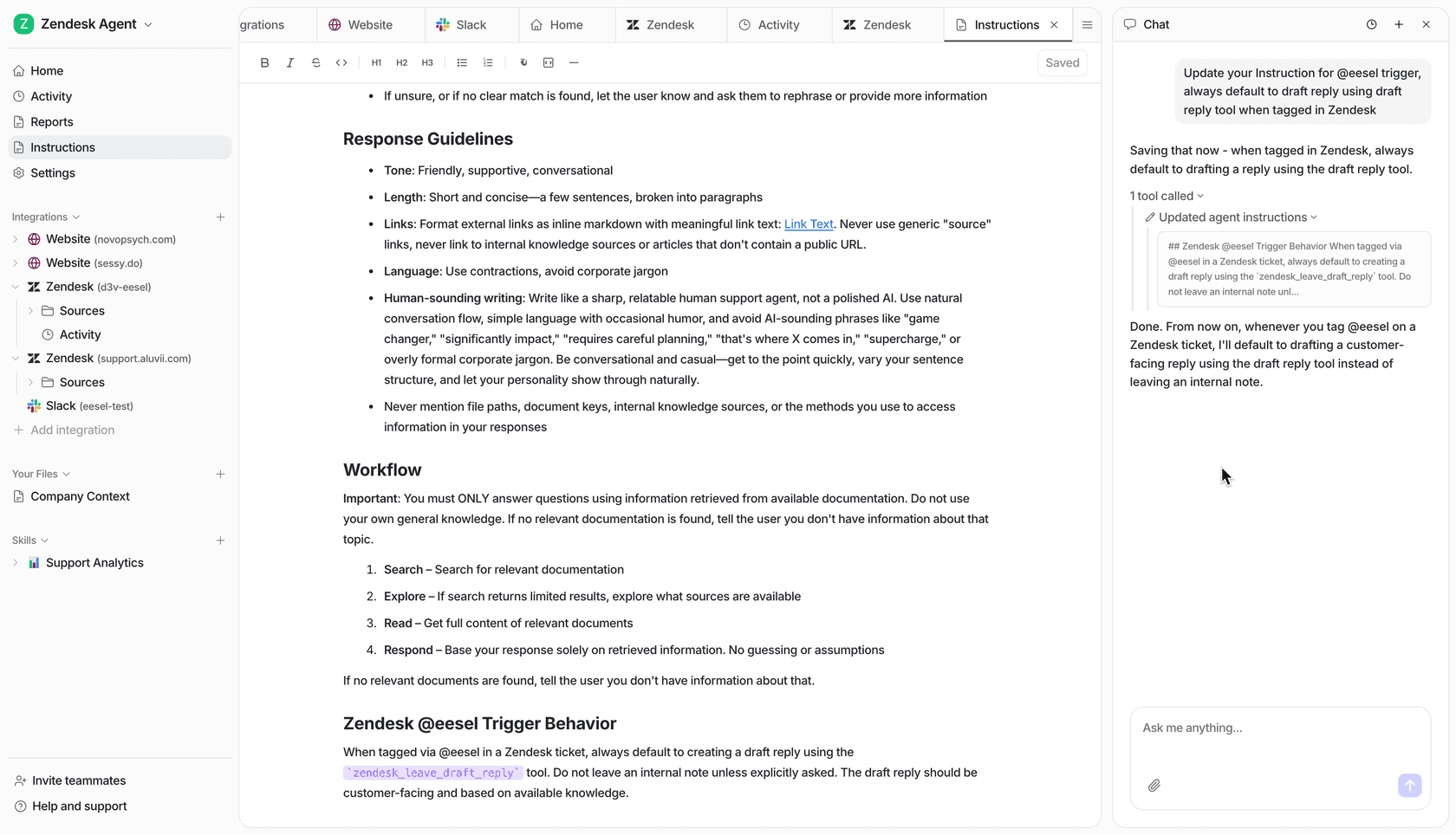
We built eesel AI to solve this at the source. Instead of forcing you to export, transform, and import content, eesel AI connects directly to the tools you already use. It learns from your existing help center, your past support tickets, your Confluence docs, your Google Drive files. No migration required.
When you connect eesel AI to your Zendesk account, it immediately starts learning your content and can answer customer questions based on that knowledge. If you later add a Slack integration or connect your Notion workspace, eesel AI learns from those sources too. All without exporting a single article.
This means:
- No more migration headaches when you want to add a new channel
- No more maintaining the same content in multiple places
- No more worrying about which platform has the "master" copy
Your content stays where it lives today. eesel AI just makes it accessible through an AI agent that can handle frontline support, draft replies for your team, or answer employee questions in Slack.
If you are tired of wrestling with CSV files and API scripts just to move your knowledge base around, it might be time to try a different approach. You can try eesel's AI agent for Zendesk and connect it to your existing tools in minutes, not weeks.