If you've ever wanted to automate ticket creation, pull data for custom reports, or integrate Zendesk with your other tools, the Zendesk API is what makes it possible. It's the bridge between Zendesk and the rest of your tech stack.
But where do you start? The documentation is comprehensive, which is great once you know what you're looking for. Not so great when you're staring at a blank terminal wondering which endpoint to call first.
This guide covers what the Zendesk API actually is, how to authenticate, the core endpoints you'll use most, and some practical examples to get you started.
What is the Zendesk API?
Think of an API like a waiter at a restaurant. You sit at the table (your application) and order a dish (request data or an action). The waiter carries that order to the kitchen (Zendesk's servers) and brings back your meal (the response). The API is the messenger that makes the exchange possible.
The Zendesk API is a REST API that uses JSON for all data exchange. It follows standard REST conventions: you use HTTP methods like GET to retrieve data, POST to create, PUT to update, and DELETE to remove. The API gives you programmatic access to tickets, users, organizations, help center content, and more.
Why use the API instead of the web interface? A few scenarios come to mind:
- Bulk operations: Create 100 tickets at once instead of clicking through the UI one by one
- Data export: Pull ticket data into your own reporting tools or data warehouse
- Integrations: Connect Zendesk to your CRM, internal tools, or custom applications
- Automation: Trigger actions in Zendesk based on events in other systems
For teams that want automation without writing code, there are alternatives. We built eesel AI for Zendesk to work as an AI teammate inside Zendesk, handling tickets autonomously without API integration work. But when you need custom functionality, the API is the way to go.
Getting started with Zendesk API authentication
Before you can make any API calls, you need to authenticate. Zendesk offers two main methods: API tokens and OAuth.
API token authentication
API tokens are the quickest way to get started. They're auto-generated passwords you create in your Zendesk Admin Center under Apps and integrations > APIs > Zendesk API.
Here's what you need to know:
- You can have up to 256 active tokens per account
- Tokens act as passwords and can impersonate any user, including admins
- Use the format
{email_address}/token:{api_token}for authentication
A curl request with an API token looks like this:
curl https://your-subdomain.zendesk.com/api/v2/tickets.json \
  -u jdoe@example.com/token:6wiIBWbGkBMo1mRDMuVwkw1EPsNkeUj95PIz2akv
Source: Zendesk Security and Authentication
OAuth access tokens
OAuth is the better choice if you're building an app for multiple Zendesk customers or need to make client-side API requests from a browser. OAuth tokens are scoped to a single Zendesk instance and use the Bearer token format:
Authorization: Bearer gErypPlm4dOVgGRvA1ZzMH5MQ3nLo8bo
If you're distributing an app to multiple customers, you'll need to use global OAuth tokens. Regular API tokens won't work because Zendesk prohibits customers from sharing their credentials with third parties.
Rate limiting
All API requests are subject to rate limits. If you exceed your limit, you'll get a 429 Too Many Requests response with a Retry-After header telling you how long to wait.
Response headers include your current rate limit status:
X-Rate-Limit: 700
X-Rate-Limit-Remaining: 699
Source: Zendesk Rate Limits
Core Zendesk API endpoints and what they do
The Zendesk API is organized around resources: tickets, users, organizations, and so on. Here are the endpoints you'll use most often.
Tickets API
The Tickets API is where you'll spend most of your time. It handles the core support functionality.
Key endpoints:
GET /api/v2/tickets.json- List tickets (paginated, 100 per page)POST /api/v2/tickets.json- Create a new ticketGET /api/v2/tickets/{id}.json- Get a specific ticketPUT /api/v2/tickets/{id}.json- Update a ticketDELETE /api/v2/tickets/{id}.json- Delete a ticket
Bulk operations let you work with up to 100 tickets at once. This is useful for mass updates or imports. The API also supports idempotency keys for ticket creation, which prevents duplicate tickets if you need to retry a failed request.
Source: Zendesk Ticketing API
Users and Organizations API
Managing your customer data happens through the Users and Organizations APIs.
Key endpoints:
GET /api/v2/users.json- List all usersPOST /api/v2/users.json- Create a userGET /api/v2/organizations.json- List organizationsPOST /api/v2/organizations.json- Create an organization
The API lets you create up to 100 organizations in a single request. Compare that to the UI, where you can only create one at a time. If you're migrating from another system, the API will save you hours.
Search API
The Search API is one of the most powerful tools in the Zendesk API. It can find tickets, users, organizations, and groups using the same query syntax as the Zendesk web interface.
The endpoint is simple:
GET /api/v2/search?query={query}
But the query syntax is where the power lies. You can search by:
- Ticket status:
type:ticket status:open - Tags:
tags:escalation_one,escalation_two - Date ranges:
created>2024-01-01 - Custom fields:
custom_field_123:priority
One key advantage over the UI: the Search API includes archived tickets. Zendesk views filter out archived tickets after 120 days, but the API search finds everything.
The Search API has its own rate limit of 2,500 requests per minute and returns up to 1,000 results per query. For larger datasets, use the Export Search Results endpoint with cursor-based pagination.
Source: Zendesk Search API
Help Center API
If you use Zendesk Guide for your knowledge base, the Help Center API lets you manage articles, categories, and community posts programmatically. You can create content, manage translations (40+ languages supported on higher plans), and control article permissions.
Practical Zendesk API examples
Let's look at some real-world examples you can adapt for your own use cases.
Creating a ticket with curl
Here's a complete example of creating a ticket:
curl https://your-subdomain.zendesk.com/api/v2/tickets.json \
  -d '{"ticket": {"subject": "Printer offline", "comment": { "body": "My printer is offline. Restarting doesn't help." }}}' \
  -H "Content-Type: application/json" \
  -v -u jdoe@example.com/token:YOUR_API_TOKEN -X POST
Breaking this down:
- The
-dflag sends the JSON payload with the ticket subject and comment Content-Type: application/jsontells Zendesk you're sending JSON-uprovides your authentication credentials-X POSTspecifies this is a create operation
A successful response returns a 201 Created status with the full ticket object, including the assigned ID.
Searching tickets by tag
Say you need to find all tickets tagged with both escalation_one and escalation_two for a quarterly report. The UI views won't show archived tickets, so you use the API:
curl "https://your-subdomain.zendesk.com/api/v2/search.json" \
  -G --data-urlencode "query=tags:escalation_one,escalation_two" \
  -v -u jdoe@example.com/token:YOUR_API_TOKEN
The -G flag tells curl to append the data as URL parameters, and --data-urlencode handles the URL encoding automatically. This query returns all tickets with both tags, including archived ones.
Bulk updating user records
When you need to update multiple users at once, use the bulk update endpoint:
curl https://your-subdomain.zendesk.com/api/v2/users/update_many.json \
  -d '{"users": [{"id": 123, "tags": ["vip"]}, {"id": 456, "tags": ["vip"]}]}' \
  -H "Content-Type: application/json" \
  -v -u jdoe@example.com/token:YOUR_API_TOKEN -X PUT
This updates both users in a single request. Remember the limits: you can update up to 100 users at once, and there's a rate limit of 5 requests per minute per user.
Zendesk API pricing and limits
Good news: every Zendesk plan includes API access. There are no additional fees to use the API, though higher-tier plans get higher rate limits.
| Plan | Monthly Price (Annual) | API Rate Limit |
|---|---|---|
| Support Team | $19/agent | 200 requests/min |
| Suite Team | $55/agent | 200 requests/min |
| Suite Professional | $115/agent | 400 requests/min |
| Suite Enterprise | $169/agent | 700 requests/min |
If you need more than 700 requests per minute, the High Volume API add-on increases the limit to 2,500 requests per minute. It's available on Suite Growth and above, and Support Professional and above, with a minimum of 10 agent seats.
Other limits to keep in mind:
- Pagination returns maximum 100 records per page
- Search returns maximum 1,000 results per query
- Bulk operations handle maximum 100 records per request
- You can queue up to 30 background jobs at once
Source: Zendesk Pricing
When to use the Zendesk API vs. no-code alternatives
The API is powerful, but it's not always the right tool for the job. Here's how to decide.
When the API makes sense
- Complex integrations: You need to connect Zendesk to proprietary systems or custom applications
- Bulk data operations: You're migrating thousands of records or need regular data exports
- Custom reporting: You need analytics that Zendesk's built-in dashboards don't provide
- Workflow automation: You want to trigger complex, multi-step processes across multiple systems
When no-code tools are better
- Simple automations: Routing rules, auto-responses, and basic ticket handling
- Small teams: You don't have developer resources to build and maintain API integrations
- Quick setup: You need something working today, not next sprint
- AI-powered support: You want an AI agent that can handle tickets without writing code
This is where we come in. eesel AI works as an AI teammate inside Zendesk. It learns from your past tickets and help center, then handles frontline support autonomously. No API coding required. You start with eesel drafting replies for review, then level up to full automation as it proves itself.
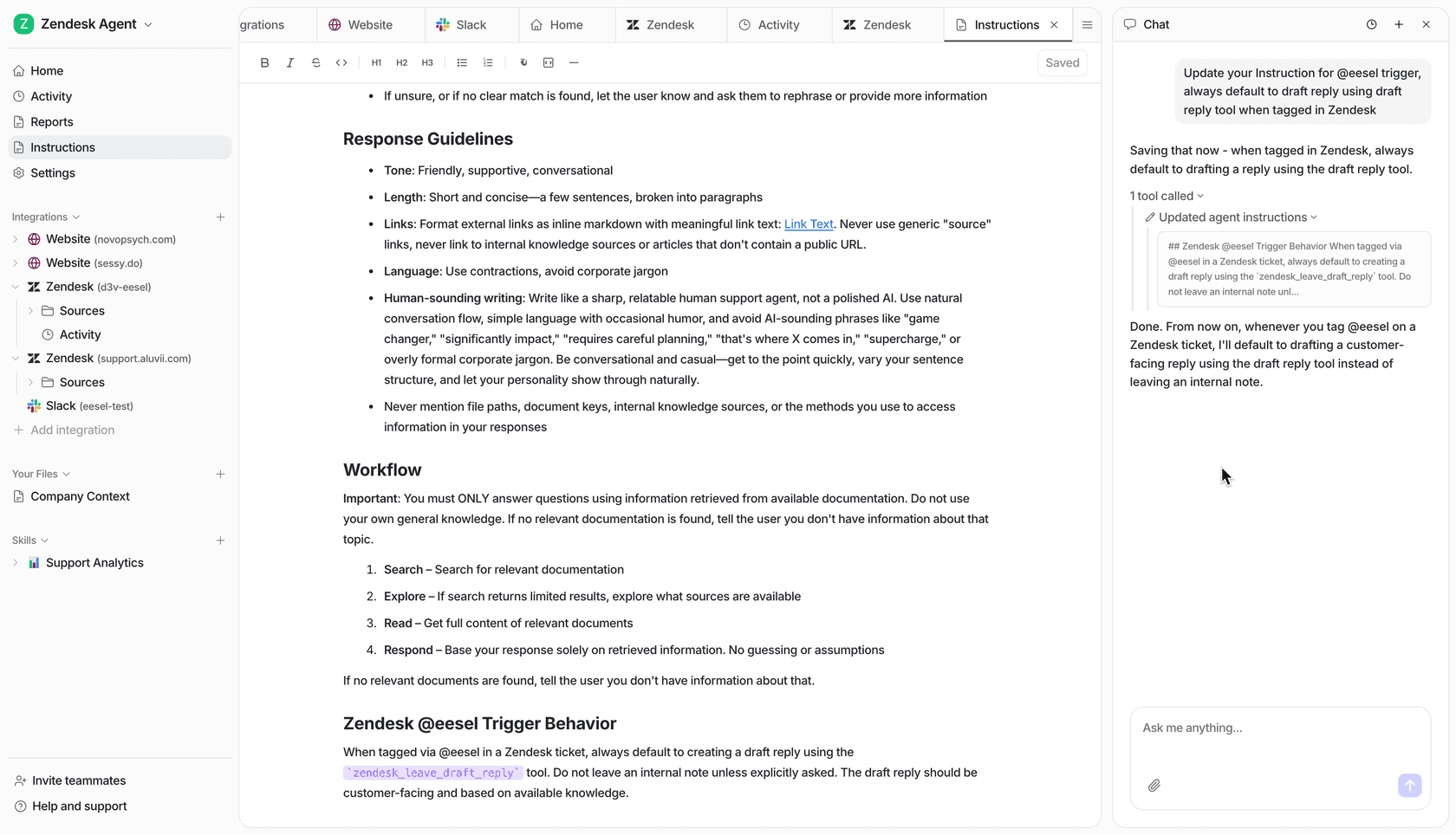
The API and AI agents aren't mutually exclusive. Many teams use both: the API for data integrations and custom workflows, and AI agents for handling routine customer conversations.
Start automating your Zendesk workflow today
The Zendesk API gives you programmatic control over your support operation. Whether you're bulk importing data, building custom integrations, or creating automated workflows, the API has the endpoints you need.
Key takeaways:
- API tokens are the fastest way to start; OAuth is better for multi-customer apps
- Rate limits range from 200 to 2,500 requests per minute depending on your plan
- The Search API includes archived tickets that UI views miss
- Bulk operations handle up to 100 records per request
If you're looking for automation without the development work, invite eesel AI to your team. Our AI agent integrates directly with Zendesk, learns your business in minutes from your existing tickets and docs, and can handle up to 81% of your frontline support autonomously. You control the scope, review performance before going live, and scale up as eesel proves itself.
Whether you choose the API route or an AI-powered approach, the goal is the same: less manual work, faster responses, and better customer experiences.