
The goal of using AI for SEO is to efficiently create content that ranks well. Tools like SEO.AI aim to automate content strategy. However, a common challenge in the market is that some AI tools produce generic text that requires significant rewriting.
Marketers and business owners need tools that create content that connects with people and understands search intent. The key is finding an AI that saves time rather than adding to the editing workload.
So, in this review, we're going to take a close look at SEO.AI. We'll check out its features, pricing, and what it claims to do best to see if it's all it's cracked up to be and where it could fit into your workflow.
What is SEO.AI?
SEO.AI is an AI-powered platform made to automate the SEO content process, mostly for small businesses, e-commerce brands, and agencies. Its main job is to take care of everything from finding keywords and writing content to getting it published, all to boost your organic traffic.
The tool's proposition is "SEO on autopilot." It claims it can handle the whole workflow. According to their website, it can scan your site for content gaps, map out a publication schedule, research topics, write articles, add internal links, and even push them live to your CMS. It's a bold claim to be an all-in-one solution.
Based on its features, SEO.AI seems to be for e-commerce brands, retailers, and marketing teams who are always short on time. It also has specific tools for agencies and freelancers juggling several clients.
Key features of SEO.AI
To figure out if SEO.AI is for you, we need to look at what it actually does. This is based on the features they list on their site and what folks in the SEO world are discussing.
SEO on autopilot for content creation
This is the platform's main attraction. It claims to automate the entire content process, from planning to publishing. That includes analyzing your site to find content you're missing, building a content calendar, writing articles with formatting like lists and tables, and adding internal links.
For teams stretched thin who can't keep a consistent SEO schedule, this hands-off style could be a huge help. The ability to connect directly to WordPress, Shopify, and Webflow is a nice touch, as it does make the process simpler.
But here's the reality check: while full automation sounds amazing, AI "agents" aren't quite ready to run the whole show by themselves. One analysis notes that they still need a human nudge to get from one step to the next. The content it produces needs a person to check for accuracy and make sure it sounds like your brand. AI can be a bit tone-deaf, often missing the subtle parts of human language and current trends.
E-commerce specific tools
A big piece of SEO.AI is its e-commerce focus. The platform has a feature called Product Feed Optimization, which automatically spruces up product details for the Google Merchant Center. The goal is to improve your organic product listings without you having to fiddle with spreadsheets.
This is a really practical feature for online stores with hundreds or thousands of products. Automating product details can save a ton of time and could seriously improve your visibility in Google Shopping.
The catch, though, is that it all depends on how good the AI's work is. If the suggestions are too generic or don't match how your customers search for things, the results might be pretty underwhelming. It's a great idea, but it lives or dies by the AI's ability to get your specific products and customers.
Content analysis and optimization
SEO.AI also has tools for content analysis, audits, and optimization. It uses an SEO score that it says is based on 5.7 million data points to give you pointers. Some key features are identifying keywords you've missed, suggesting a word count by looking at your competitors, and writing meta descriptions.
The "Missing Keywords" metric is pretty helpful. It shows you what keywords the top-ranking pages are using, which helps you cover all your bases. In the same vein, getting competitor benchmarks for article length removes some of the guesswork.
However, AI-driven SEO scores can sometimes point you in the wrong direction. They might encourage you to stuff keywords at the expense of readability, leading to text that sounds unnatural. One Capterra user even mentioned that some of the platform's automated technical fixes could hurt a website. This just goes to show that you need a careful human review before you let it make any automated changes.
SEO.AI pricing
SEO.AI has a few subscription plans, and it's good to know the costs to see if it's a good fit. They have separate plans for their "autopilot" service and their standalone tools.
Why is it so expensive? $49 for just 10 articles. Anyone has tried and found it useful?

The main pricing is for their "AI Teammate" service, which is the one that automates content writing.
| Plan | Monthly Price | Key Features |
|---|---|---|
| Trial | $1 | 7-day trial of the Single Site plan. |
| Single Site | $149 | For 1 website in one language. Includes content gap analysis, publication plan, article writing, internal linking, and auto-publishing. |
| Multi Site | $299 | For up to 3 websites or languages. Includes all features of the Single Site plan for each site. |
The pricing structure positions it as an alternative to hiring an SEO agency. The $149 per month Single Site plan seems like a decent deal for small businesses. But the real value depends on the quality of the "autopilot" content. If you find yourself heavily editing every single article, the service becomes less of an independent teammate and more of a pricey drafting assistant.
It's also worth pointing out that there are separate plans, starting at $49 per month, for features like product feed optimization. So, the total cost could end up being higher than what's advertised upfront.
General user sentiment on SEO.AI
After digging into SEO.AI, it's clear the platform has promise for automating some of the more repetitive SEO jobs. It's particularly useful for e-commerce businesses that can use its product feed optimization. Its ability to create a content plan and publish articles automatically can certainly help teams that find it hard to be consistent.
But, it's not a "set it and forget it" tool. The main issue with any AI content tool, SEO.AI included, is its ability to understand context, nuance, and what a user is actually looking for. As the marketing pros at TrafficSoda point out, AI often gets user intent wrong and can come up with ideas without access to real-time data. The output almost always needs a human touch to make sure it matches your brand and gives the reader something of value.
The "autopilot" feature offers convenience, but it also carries risks. If you don't have a person reviewing the content, you could end up publishing articles that are factually wrong, have the wrong tone, or just don't resonate with your audience. The platform seems best used as a strong assistant that can handle the heavy lifting of research and drafting, but a human editor should always have the final say. The point of AI in SEO isn't just to make more content; it's to make content that works.
They are totally inferring that content directly written by ai will be penalized, but don’t mind you using it as a tool to help your writing. They just aren’t being straight forward for some reason.
An alternative for content scaling: eesel AI
For teams looking for a tool that delivers a more complete article, the eesel AI blog writer is another option. It is designed to manage the content creation process from start to finish, aiming to address the challenge of generic AI text. This tool was developed and used internally to grow the eesel blog from 700 to 750,000 daily impressions over three months by publishing over 1,000 optimized posts.
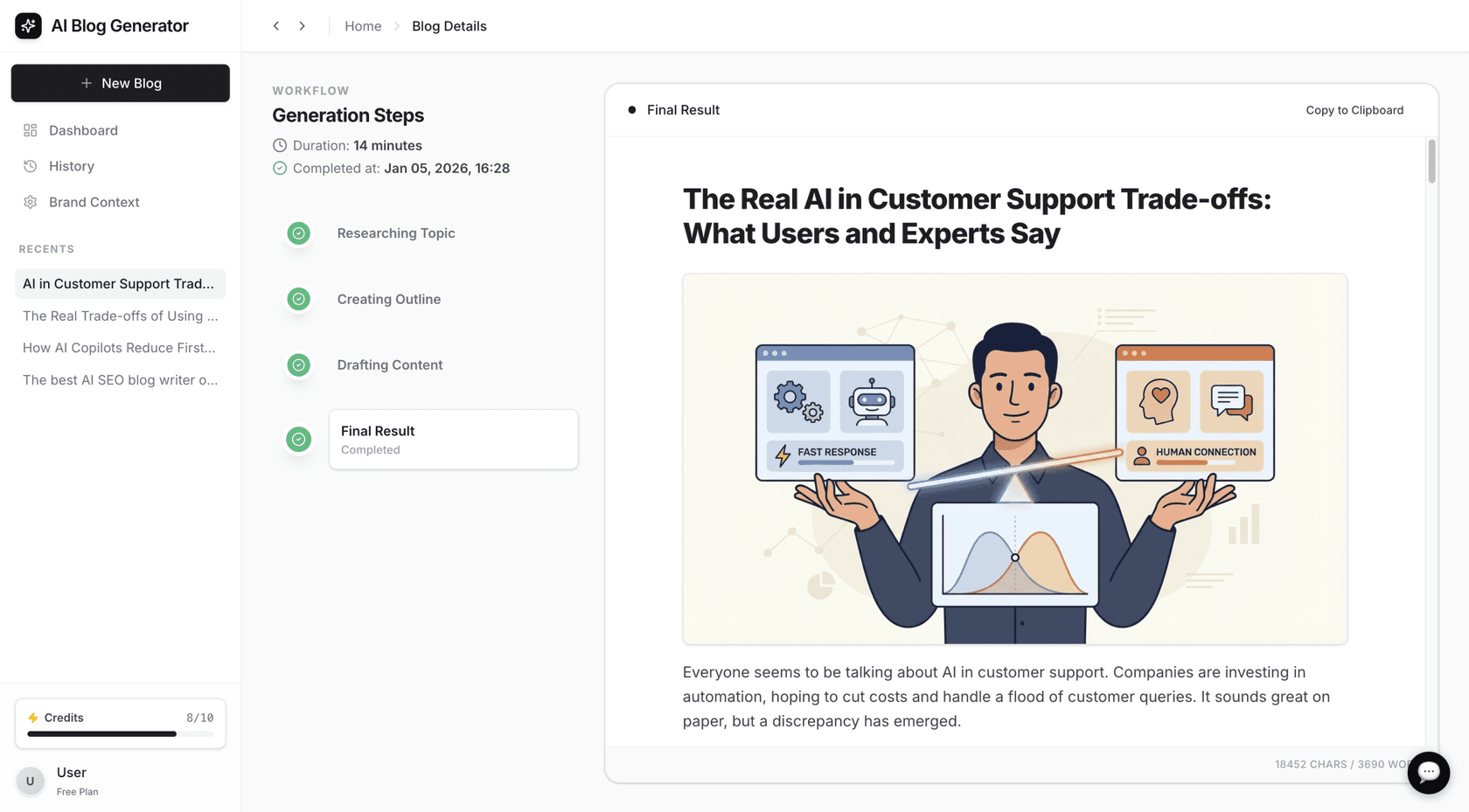
Here’s what makes its output different:
-
Context-aware research: The eesel AI blog writer performs research based on the type of post you are creating. If you’re writing a product comparison, it pulls pricing and feature data. For a technical guide, it finds the relevant specs. It does the kind of detailed research a human would do, automatically.
-
Human-like tone: The models have been refined to produce content with a conversational and informative style, avoiding robotic phrasing common in some AI-generated text.
-
Assets and media included: To create more engaging posts, the eesel AI blog writer automatically includes AI-generated images, infographics, tables, and even finds relevant YouTube videos to embed.
-
Real-world insights with Reddit integration: To add a layer of authenticity and address what real users are asking, it pulls in actual quotes and discussions from relevant Reddit threads. This gives your content social proof and helps nail E-E-A-T (Experience, Expertise, Authoritativeness, Trust).
-
Optimized for AI answer engines (AEO): It’s not just about ranking on Google anymore. Our content is structured to get picked up by Google AI Overviews, ChatGPT, and Perplexity, making sure your brand stays visible in the new era of search.
To use it, you provide a keyword and your website URL, and it generates an article intended to be publish-ready, reducing the need for extensive rewriting or asset sourcing.
Choosing the right AI SEO tool
The AI SEO tool landscape is evolving rapidly. Tools like SEO.AI are useful for automating drafts and managing e-commerce feeds, though the output may require significant editing to meet specific quality standards. The ideal AI tool should align with a team's workflow, whether they need a drafting assistant or a more end-to-end content creator.
For teams looking to scale content marketing and increase organic traffic, it's important to choose a tool that fits their needs. The eesel AI blog writer is designed as an end-to-end solution. It handles research, structuring, media integration, and optimization for both traditional and AI-powered search engines. This approach allows teams to focus on high-level strategy while the AI handles content execution.
Ready to see the difference for yourself? Try the eesel AI blog writer for free and generate your first publish-ready article in just a few minutes.

Frequently asked questions
A trustworthy SEO AI review should go beyond just listing features. Look for honest feedback on the quality of the AI-generated content, how much human editing is required, and whether it truly understands user intent. Real-world examples or case studies are a big plus.
Even with a glowing SEO AI review, it's wise to be cautious. Full automation can be risky. Always have a human in the loop to check for factual accuracy, brand voice, and overall quality. Think of AI as a powerful assistant, not a replacement for a human editor.
Pricing is a key part of any SEO AI review. Consider the true cost versus the value. If a tool costs $149 a month but saves you 20 hours of work, it might be a great deal. If you still have to spend 15 hours editing its output, it's more like an expensive drafting tool.
A major red flag in an SEO AI review is the promise of a "set it and forget it" solution with no mention of drawbacks. Every AI tool has limitations, especially when it comes to nuance and creativity. An honest review will discuss both the pros and the cons.
The best way to test a tool after reading an SEO AI review is to use its trial period effectively. Don't just generate one or two articles. Create a handful of different content types relevant to your business and see how much work it takes to get them publish-ready. This will give you a real sense of its value.
Share this article

Article by
Kenneth Pangan
Writer and marketer for over ten years, Kenneth Pangan splits his time between history, politics, and art with plenty of interruptions from his dogs demanding attention.