What is an SEO AI agent and how does it actually work?

Katelin Teen
Last edited January 19, 2026
If you’ve spent any time doing SEO, you know the grind. You're wrestling with spreadsheets for keyword research, trying to spy on competitors, and tweaking content one page at a time. It’s a slow, manual process that can feel like you’re constantly playing catch-up.
This is where the idea of an SEO AI agent pops up. It’s a new kind of tool that’s more than just simple automation. Think of it less like another SEO platform and more like a smart assistant that gets your goals and can manage complex, multi-step tasks on its own.
The whole point is to get you out of the weeds of repetitive data work so you can spend your time on what really matters: big-picture strategy, creative ideas, and building actual relationships.
What is an SEO AI agent?
In plain English, an SEO AI agent is an AI-powered system designed to handle a bunch of SEO tasks by itself. We’re talking about everything from research and analysis to optimization and even making changes, often without much human hand-holding.
You might be thinking, "Isn't that just ChatGPT?" Not really. The big difference is that a standard chatbot like ChatGPT gives you generic SEO advice based on old training data. A real SEO AI agent plugs into live, real-time data. For example, Writesonic's agent uses real-time data to see what’s happening on search engine results pages (SERPs) right now. This gives you insights you can actually use, not just educated guesses from last year.
Here’s a good way to look at it: an SEO AI agent is like having a junior SEO specialist on your team. It can do the heavy lifting of gathering data, running initial analysis, and handling routine jobs. A chatbot is more like a research intern who can only pull up information you specifically ask for.
Key capabilities of an SEO AI agent
A proper SEO AI agent isn't a one-trick pony. It can manage a variety of connected tasks across the whole SEO workflow. Its skills usually fit into four main categories.
Automated keyword research and clustering
An SEO AI agent can totally change how you find keywords. It can automatically check search volume, guess how hard it'll be to rank for a term, and even figure out what the user is trying to do. For instance, Nightwatch's NightOwl agent uses its AI to automatically hunt for valuable keywords for you.
But it doesn't stop there. The better agents can also group keywords into logical topic clusters. This is a massive help for building topical authority and saves you from spending hours sorting keywords in a spreadsheet. You could give it a starting keyword like "project management software," and it would spit out separate clusters for "best project management tools," "free project management software," and "project management for startups."
Content optimization and generation
From a simple topic to a full draft, an SEO AI agent can look at the top-ranking pages for a keyword and create a data-driven content brief or even write a full first draft. A tool like Writesonic's AI Article Writer analyzes what competitors are doing to deliver fact-checked, SEO-friendly articles.
These agents can also review your existing content and suggest ways to improve on-page elements like keyword usage, internal links, and readability. Some platforms, like Alli AI, offer AI-driven suggestions for internal links to help boost your page authority. Of course, AI-generated content is a decent starting point, but it almost always needs a human to add brand voice, unique insights, and real value for the reader.
Technical SEO audits and fixes
An SEO AI agent can crawl your whole website to find technical problems like broken links, crawl errors, slow pages, and duplicate content. The Nightwatch SEO AI Agent is built to constantly scan for these issues and give you clear advice on how to fix them.
Some of these tools can even apply the fixes for you automatically. For example, Alli AI can make code changes, like minifying code or adding schema markup, without you having to bother a developer. That being said, you should always keep an eye on automated fixes, especially when they're done at a large scale. A small mistake in a rule could have a huge, negative effect on your rankings.
Competitor and SERP analysis
Instead of doing a competitor check-in once a quarter, an SEO AI agent can watch their content strategies, track their new keywords, and analyze their backlink profiles in real-time. This turns competitor analysis from a periodic chore into something that’s always on.
More importantly, it doesn't just throw raw data at you. A good agent turns SERP analysis into clear, actionable next steps. It might find a "content gap" where a competitor ranks for a keyword you don't, or it might see a pattern in top-ranking pages (like everyone using video) that you can copy to get an edge.
Popular SEO AI agent platforms
The market for these tools is getting crowded, with a few platforms taking different approaches to automation. Here’s a quick rundown of some of the major players, based on their own marketing.
Writesonic
Writesonic bills itself as an all-in-one platform for both old-school SEO and something it calls Generative Engine Optimization (GEO). The idea is to help you track and improve your brand’s visibility on Google and AI search platforms like ChatGPT and Perplexity, basically trying to replace your entire marketing toolkit.
Key Features:
- AI Visibility Tracking: It monitors your brand's presence on over ten AI platforms, tracking mentions, sentiment, and your share of the conversation.
- Action Center: It turns insights into a prioritized to-do list, suggesting things like creating new content, fixing technical problems, or finding new citation sources.
- SEO & Content AI Agent: This is an AI chat assistant that does research, creates content briefs, and analyzes competitors using live data from sources like Ahrefs and Google Keyword Planner.
- AI Article Writer: Generates articles that are fact-checked and optimized for SEO, with automatic internal linking and citations.
Pricing: Plans with the core SEO and content features start with the Lite plan at $49/month. The more advanced AI Search Tracking (GEO) features are on the Professional plan, which starts at $249/month.
Limitations: Since it’s a huge, all-in-one platform, it might feel a bit bloated if you’re just looking for a simple tool to solve one specific problem.
Nightwatch
Nightwatch sells its NightOwl as a "24/7 AI SEO Specialist" that automates research, technical audits, and rank tracking. The main selling point is saving your team time on all those repetitive SEO jobs.
Key Features:
- Autonomous Execution: It constantly watches your website's performance, finds opportunities for optimization, and can implement changes on its own.
- Keyword & Competitor Analysis: It uses AI to dig for market insights and automates competitor analysis to find good keywords.
- AI & LLM Tracking: A big feature is its ability to monitor your brand's visibility in AI responses from models like ChatGPT, Claude, and Gemini. It gives you metrics like an AI Visibility Score and Share of Voice.
- Technical Audits: It scans your site for over 100 technical issues, like broken links and missing meta tags.
Pricing: The basic rank tracking plans start at $32/month when billed annually. But, the AI Tracking feature is a separate add-on that costs another $99/month for 100 prompts. There's a 14-day free trial for the main platform.
Limitations: Its main focus is on tracking and monitoring. While it gives content suggestions, it’s not really a full-blown content creation platform. The pricing model also splits core SEO tracking from AI tracking, so getting all the features is a lot more expensive than the starting price implies.
Alli AI
Alli AI is all about scaling on-page SEO automation, especially for sites built with modern JavaScript frameworks like React or Vue. Its main pitch is helping AI crawlers (like GPTBot) see content on sites that would otherwise look like a blank page to them.
Key Features:
- AI Crawler Enablement: Its server-side rendering tech spots AI crawlers and shows them pre-rendered HTML, making JavaScript-heavy sites visible to over 50 AI platforms.
- Rule-Based Deployment: You can create one optimization rule (like for title tags) and apply it across thousands of pages on multiple sites at once.
- Visual Editor: A point-and-click live editor lets you make on-page SEO changes right in your browser without needing a developer.
- Automated Fixes: It can automatically create and deploy schema markup, optimize meta descriptions, and fix other technical problems.
Pricing: The Business plan starts at $249/month (billed annually) and covers 5 sites and 500 keywords.
Limitations: A third-party review highlights a pretty significant catch: because all the optimizations are done through a JavaScript snippet, they are removed if you cancel your subscription. This could make you dependent on the tool just to keep your rankings, which is definitely something to think about.
For a more hands-on look at how these agents can be built and deployed, the following video demonstrates how to automate an entire SEO agency's content process using a team of 15 AI agents without writing any code.
The human touch: Limitations of an SEO AI agent
It’s easy to get excited about the tech, but it's important to remember that these agents are powerful assistants, not replacements for human strategists. They run on data and algorithms, but they don't have the intuition, creativity, or business sense that a human expert has.
AI can still make mistakes. It might misunderstand search intent, pull from a bad data source, or make an automated "fix" that breaks something else. Human supervision is non-negotiable for double-checking recommendations and watching any changes that are made.Regarding AI Agents: They work great if you provide them with context and prepare the data properly. In my opinion, the most important part is testing prompts. You will always get an output from the AI Agents, but sometimes it’s just off. Completely useless or sentences that sound strange. So, if you want to create your own SEO Agents, make sure they have accurate data, clearly explain what you want them to do with it, and ideally use structured outputs.

Plus, an agent can tell you what your competitors are doing, but it can't always tell you why. It can't copy human creativity, understand your brand's unique personality, or build real relationships for link-building. A person still needs to set the overall strategy and goals.
Finally, you hit the content bottleneck. While many of these agents can help with content briefs or even rough drafts, actually creating high-quality, engaging, and publishable content is still the biggest challenge. This is where teams spend most of their time, and it's a problem that most all-in-one agents don't really solve.
A focused approach to AI content creation
For teams focused on the challenge of content creation, a specialized tool can be an effective solution. The eesel AI blog writer is designed for this purpose.
The eesel AI blog writer is designed to generate a complete, SEO-optimized, and publish-ready blog post from a single keyword.
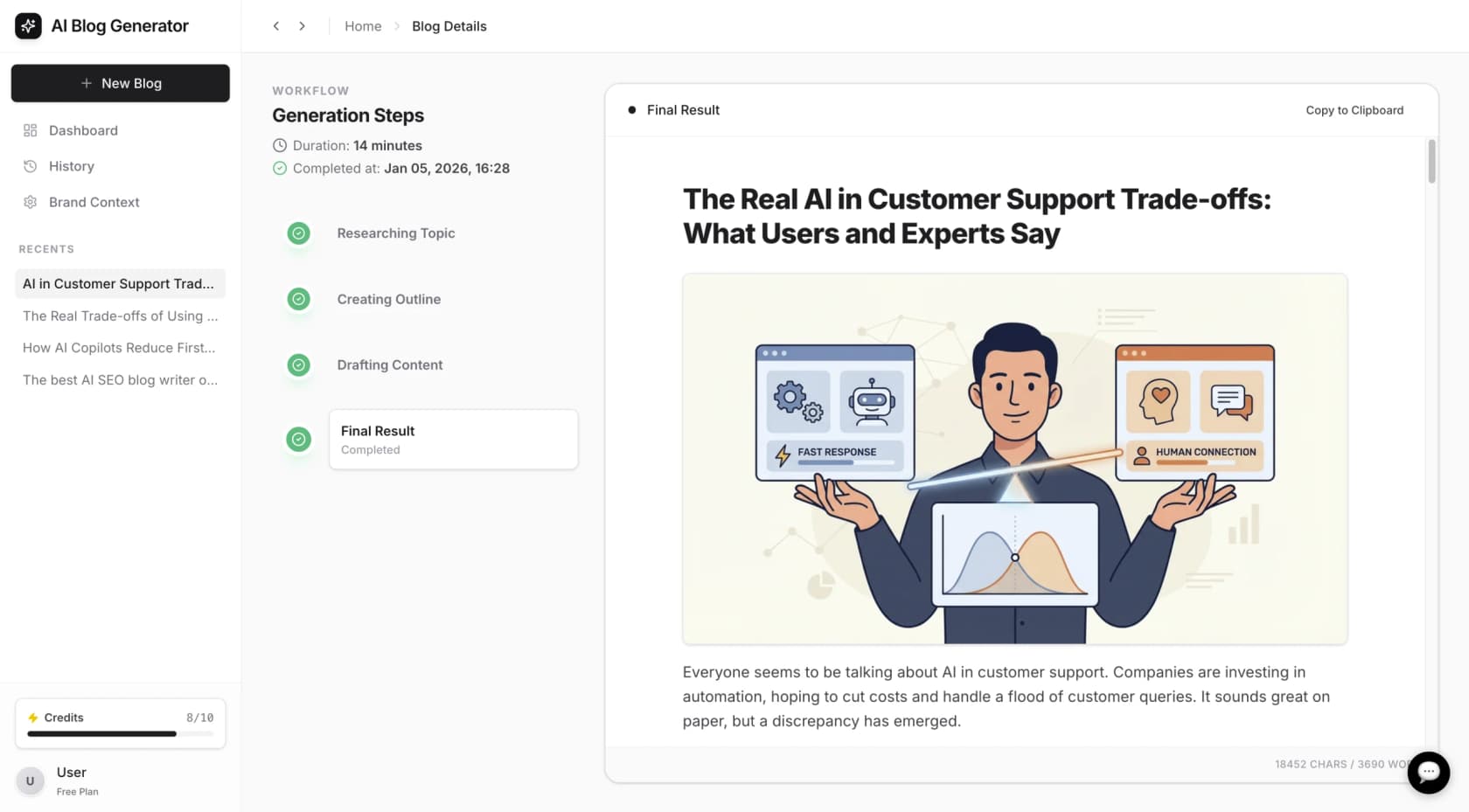
Here are some of its features:
- Full-length posts: It creates content with a full structure, including an intro, H2 and H3 headings, a conclusion, and even an FAQ section.
- Automatic Assets Included: eesel AI automatically adds relevant, AI-generated images, infographics, tables, and embeds related YouTube videos.
- Real-World Context: It pulls in actual Reddit quotes and forum comments to add social proof and human perspectives, making the content more interesting and trustworthy.
- Proven Results: We used this tool to grow our own site at eesel AI from 700 to 750,000 impressions per day in just 3 months by publishing over 1,000 optimized blogs.
It is a tool designed to handle the process of writing and creating assets, which can free up teams to focus on topic selection and overall strategy.
Scaling SEO with an SEO AI agent
An SEO AI agent can be incredibly useful for automating repetitive tasks, but they still need a human in the driver's seat and a smart strategy. At the end of the day, the biggest wins usually come from solving the content creation problem, which is still the most time-consuming part of SEO.
The best way to see what truly complete, AI-driven content generation can do is to try it out.
We invite you to try the eesel AI blog writer for free. You can generate your first complete, asset-rich blog post in just a few minutes with no strings attached and see the publish-ready quality for yourself.

Frequently Asked Questions
Share this article

Article by
Katelin Teen
Katelin is an operations specialist at eesel where she uses her psychology training and education experience to optimize B2B SaaS processes. Outside of work, she unwinds with story-driven games, writing, and keeping up with latest tech innovations.