
When Salesforce first introduced Einstein AI in 2016, it promised to bring machine learning directly into CRM workflows. Nearly a decade later, the platform has evolved from predictive lead scoring to generative AI and now agentic AI through Agentforce. But one question remains central for teams considering the investment: how accurate is it, really?
The answer, like most things in enterprise software, is nuanced. Accuracy depends heavily on your data quality, implementation approach, and ongoing maintenance. In this guide, we'll break down how Salesforce measures AI accuracy, what benchmarks you can realistically expect, and what factors influence performance. We'll also look at how alternative approaches like eesel AI handle accuracy through a different lens: simplicity and progressive learning. For more context on Salesforce AI pricing and options, check out our guide to Salesforce AI pricing.
What is Salesforce Einstein AI?
Einstein AI is Salesforce's native artificial intelligence layer embedded across the entire Customer 360 platform. It powers everything from lead scoring in Sales Cloud to case classification in Service Cloud to campaign optimization in Marketing Cloud.
The platform has evolved through three distinct phases:
- Predictive AI (2016): Traditional machine learning for forecasting, lead scoring, and churn prediction
- Generative AI (2023): LLM-powered content creation through Einstein GPT and the Trust Layer
- Agentic AI (2024): Autonomous agents through Agentforce that plan, reason, and execute tasks independently
Einstein processes over one trillion predictions weekly across these capabilities. But volume doesn't necessarily equal accuracy. Understanding how Salesforce measures and optimizes accuracy requires looking under the hood at their methodology. If you're exploring AI options for Salesforce, you might also want to check out our comparison of the best Salesforce chatbot solutions.
How Salesforce measures Einstein AI accuracy
Salesforce employs a multi-layered approach to measuring AI accuracy, combining statistical rigor with practical observability tools.
The confusion matrix and model metrics
At the technical core, Einstein uses confusion matrix mathematical formulas to evaluate classification model performance. The platform tracks 12 key metrics including:
- MSE (Mean Squared Error): Measures how close predictions are to actual outcomes
- RMSE (Root Mean Squared Error): The standard deviation of prediction errors
- R-squared: Percentage of variance explained by the model (0-100%)
- MAE (Mean Absolute Error): Average magnitude of prediction errors
- AIC (Akaike Information Criterion): Model quality relative to complexity
These metrics are calculated by the Machine Learning Observability Platform (MLOP), which continuously compares model predictions against ground truth data.
Einstein Accuracy Analytics App
For business users, Salesforce provides the Einstein Accuracy Analytics App. This tool offers:
- Dashboards visualizing prediction accuracy over time
- Trend charts showing model performance degradation
- Drift detection to identify when accuracy declines
- Actionable recommendations for improvement
The app monitors both logistic and linear regression models, though it's worth noting it's not compatible with high-volume prediction writeback scenarios.
Apache Spark distributed processing
To handle the scale of enterprise data, Salesforce leverages Apache Spark's distributed computation. This allows the MLOP team to analyze tens of millions of data points in parallel, examining model performance across different segments (geography, demographics, customer types) to identify where accuracy varies.
Salesforce Einstein AI accuracy benchmarks
Salesforce and third-party research provide some concrete numbers around accuracy expectations:
| Metric | Value | Source |
|---|---|---|
| Forecasting accuracy | 79% | Aberdeen research (28% higher than non-AI methods) |
| Forecasting time reduction | 20% | Aberdeen research |
| Sales leader confidence in AI | 97% | Salesforce internal data |
| Sales leader confidence in traditional forecasting | 45% | Salesforce internal data |
The 79% forecasting accuracy figure comes from Aberdeen research cited by Salesforce partners. This represents a significant improvement over manual methods, but it's important to understand the context: this applies to mature deployments with proper data preparation and ongoing tuning.
The gap between the 97% of sales leaders who say AI gives reps more time and the 45% who have high confidence in traditional forecasting highlights an important point. AI accuracy isn't just about hitting precise numbers; it's about directional correctness that helps teams prioritize and work more efficiently.
Factors that affect Einstein AI accuracy
Several variables influence how accurate Einstein predictions will be for your specific implementation. For teams using Salesforce Service Cloud specifically, our guide to Salesforce Service Cloud AI integration covers additional considerations:
Data quality and volume
Einstein's models are only as good as the data they're trained on. The platform requires sufficient historical data to identify meaningful patterns. Salesforce recommends 10-20 observations per parameter for statistical significance, though in practice, most enterprise deployments have far more data than this minimum threshold.
Setup and configuration
Unlike some AI tools that work out of the box, most Einstein features require setup, data preparation, and customization. Administrators must:
- Configure which data fields the models should use
- Set up proper data harmonization
- Define business rules and escalation criteria
- Enable features at the org level
This complexity means accuracy varies based on implementation quality. If you're planning an AI chatbot implementation, our article on implementation of AI chatbots in Salesforce offers practical guidance.
Regional and demographic differences
One interesting finding from Salesforce's engineering team: models trained in one region may underperform in another. A model trained on New York customer data performed poorly when applied to Oklahoma, where customer values and communication patterns differed. This highlights the importance of segment-specific model tuning.
Ongoing maintenance
Model accuracy degrades over time as business conditions change. Regular monitoring through the Accuracy Analytics App and periodic retraining are essential to maintain performance.
Common accuracy limitations and challenges
Despite Salesforce's robust measurement infrastructure, users report several challenges that affect real-world accuracy:
Implementation complexity
Typical Einstein deployments take 2-3 months from initial setup to production-ready models. During this period, accuracy may be lower as models learn from your specific data patterns.
Data quality issues
Gartner reviews cited by third-party analysts mention "issues related to data storage and migration that need to be addressed in updates". Poor data hygiene directly impacts model accuracy.
Insight relevance
One finance associate noted: "Few teething problems and sometime the AI doesn't bring back the particular insights we're looking for so we have had to go back to the old ways with deadlines but that could be down to user error."
Einstein employs Machine Learning and Natural Language Processing to analyze data to predict sales outcomes, provide insights into customers, and even automate routine tasks. However, it has issues related to data storage and migration that need to be addressed in updates.
Gartner
Add-on dependencies
Full AI functionality often requires multiple add-ons. Predictive AI features like lead scoring and forecasting are only available in Unlimited edition ($350/user/month) or as add-ons to Enterprise. This fragmented approach can lead to incomplete data for model training.
How to improve Einstein AI accuracy
If you're already invested in Salesforce or committed to the platform, several practices can help maximize accuracy:
Invest in data preparation
Before enabling Einstein features, audit your data quality. Clean up duplicate records, standardize field values, and ensure historical data is complete. The models can only learn from what they can see.
Start with guided deployment
Rather than enabling everything at once, start with specific use cases where you have high-quality data. Lead scoring is often a good starting point because it has clear historical outcomes (converted vs. not converted) to learn from. For ticket classification specifically, see our guide on how to use AI to classify or tag support tickets.
Use the Accuracy Analytics App actively
Schedule regular reviews of the Einstein Accuracy Analytics App. Look for:
- Declining trend lines that indicate model drift
- Segment-specific performance differences
- Recommendations for retraining
Segment your models
If you operate across different regions or customer types, consider whether separate models might perform better than a single global model. The New York/Oklahoma example shows that one-size-fits-all approaches can hurt accuracy.
Incorporate user feedback
Salesforce's human-at-the-helm patterns include feedback mechanisms. When users correct AI-generated recommendations, that feedback should flow back into model training.
eesel AI: A different approach to accuracy
While Salesforce Einstein focuses on deep integration within the Salesforce ecosystem, eesel AI takes a fundamentally different approach to achieving accurate AI results: simplicity and progressive learning.
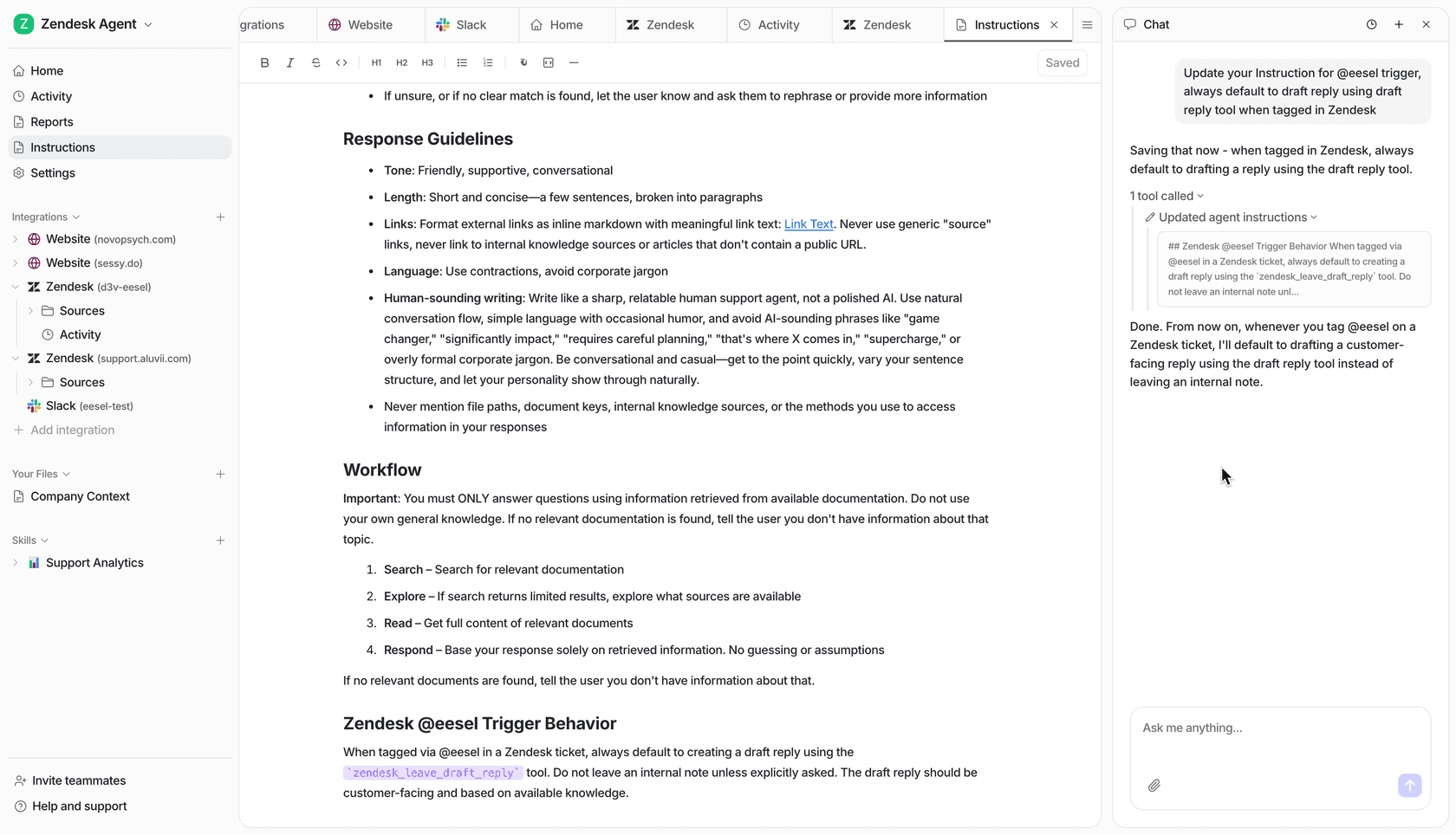
Instead of requiring months of configuration, eesel AI works more like hiring a new team member:
Minutes to onboard, not months Connect eesel to your help desk and it immediately learns from your past tickets, help center articles, macros, and connected docs. No manual training, no documentation uploads, no configuration wizards.
Progressive accuracy improvement Rather than expecting perfect accuracy from day one, eesel starts by drafting replies for human review. As it proves itself, you expand its scope: from drafts to direct replies, from simple FAQs to complex issues, from business hours to 24/7. This approach means you're never exposing customers to unproven AI.
Natural language control Instead of complex configuration, you define behavior in plain English: "If the refund request is over 30 days, politely decline and offer store credit." This reduces the configuration errors that often hurt Einstein's accuracy.
Simulation before deployment Run eesel on thousands of past tickets before going live. See exactly how it would have responded, measure resolution rates, and tune instructions. This pre-flight testing is built-in, not an afterthought.
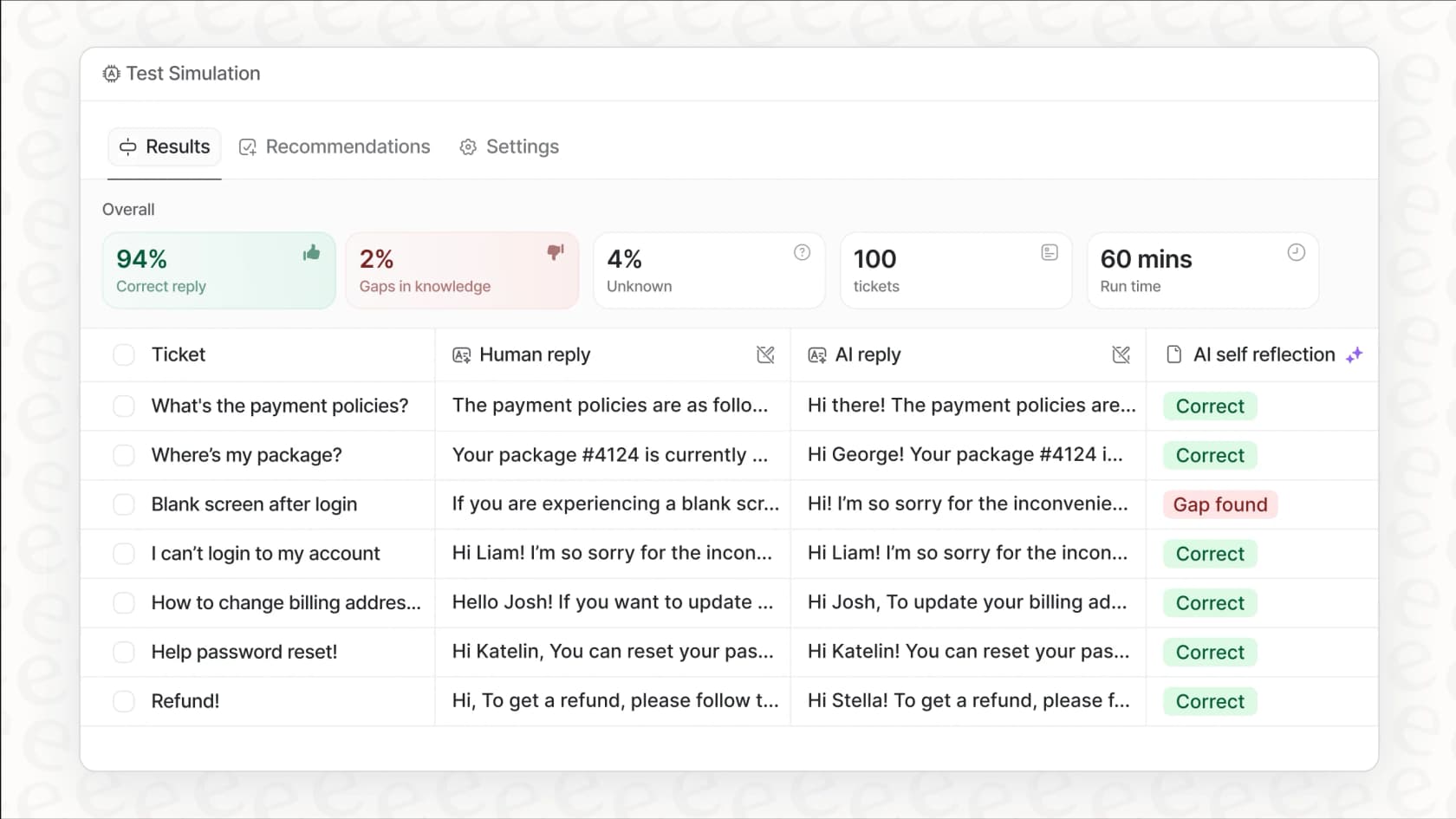
For teams who want AI accuracy without the complex implementation, eesel AI offers an alternative path. Our pricing starts at $299/month for 500 credits (1 credit per ticket or chat), with a free plan of 100 credits, no platform fee and no per-seat fees.
Choosing the right AI approach for your team
Salesforce Einstein AI can deliver strong accuracy for forecasting, lead scoring, and case classification when properly implemented. The 79% forecasting accuracy benchmark is achievable for teams with clean data, technical resources, and patience for the 2-3 month implementation cycle.
But accuracy doesn't exist in a vacuum. It needs to be weighed against:
- Implementation timeline: How quickly do you need results?
- Technical resources: Do you have dedicated Salesforce admins and data teams?
- Budget: Are you prepared for $175-550/user/month plus add-ons?
- Ecosystem commitment: Are you all-in on Salesforce, or do you need multi-platform support?
For teams deeply embedded in Salesforce with the resources to optimize it, Einstein is a powerful option. For teams who want accurate AI without the complexity, alternatives like eesel AI offer a simpler path forward.
The key is matching the tool to your team's capabilities and timeline. The most accurate AI in the world won't help if you can't get it deployed.