
So, you’re digging into Noupe pricing and you've probably noticed that their AI chatbot is completely free. That’s a pretty hard offer to ignore. But when it comes to AI tools for a growing business, what does "free" really get you? Let's be honest, the sticker price is almost never the whole story.
In this guide, we're going to pull back the curtain on Noupe's free model, take a look at the wider world of AI chatbot costs, and uncover the hidden limitations that often come with "free" tools. We'll explore what you get, what you don't, and what you should actually be looking for in a solution that can grow with you.
What is the Noupe AI chatbot?
Noupe is a no-code AI chatbot that learns by scraping your public website. You just pop a single line of code onto your site, and it starts answering visitor questions based on whatever it can find there. It’s a simple tool built for a simple purpose: dishing out basic, automated answers without a complicated setup.
As a product from Jotform, Noupe has promised to stay free until at least the start of 2026. This makes it a super easy entry point for anyone curious about AI chatbots. It's a way to test the waters without having to get your company card out.
The "free" model: A real look at Noupe pricing and its limits
Let's just get right to it. While you don’t pay for Noupe with money, you pay for it with what it can't do. It’s really important to understand those trade-offs before you invest your time, even if it is a free tool.
What you get with the free Noupe pricing model
There are some definite perks to a tool like Noupe, especially if you're just starting out or have a pretty simple website. You get:
-
A super-fast setup: You can honestly get it up and running in a few minutes with that one line of code.
-
Basic Q&A: It can handle the simple, repetitive questions that are probably already answered somewhere on your site.
-
A low-risk experiment: It’s an easy way to see if your visitors would even bother talking to a chatbot.
The hidden costs and limitations of the free Noupe pricing model
The same simplicity that makes Noupe so attractive is also its biggest weakness. A chatbot that only knows what’s on your homepage isn't going to solve tricky customer problems. Here’s where the "free" model starts to feel a bit flimsy.
-
Surface-level knowledge: A bot trained only on public website pages can't handle anything nuanced or specific to a customer's account. Imagine a customer asking, "Why was my last invoice higher than usual?" or "Can you tell me the status of my order #12345?" A website scraper will just draw a blank. It doesn't have access to the deep, private knowledge needed to give a useful answer, which just leads to frustration.
-
No learning from your actual support history: The most valuable goldmine of knowledge for any support AI is your team's past conversations. That's where your brand's true voice, clever workarounds, and the real problems your customers face are all hiding. Platforms like eesel AI are built to train on your historical support tickets from day one. This allows them to give responses that are way more accurate and genuinely sound like they came from one of your own experienced agents.
-
Limited integrations and zero ability to take action: A free bot might be able to answer a question, but it can’t do anything about it. It can't look up an order in Shopify, tag a ticket in your help desk, or escalate a complex issue to the right team. This is where a tool like the AI Agent from eesel AI really changes the game. By connecting directly to help desks like Zendesk or Freshdesk, it can take custom actions, turning the bot from a simple FAQ into an active part of your support workflow.
-
A lack of control and customization: With a basic tool, what you see is what you get. You can't define a custom persona for your bot, set up detailed rules for when it should hand off to a human, or tell it to only pull answers from specific, trusted sources. In contrast, eesel AI gives you complete control through a powerful prompt editor and a selective automation engine. This means you get to decide exactly which questions the AI handles and how it responds.
Beyond Noupe pricing: A full spectrum of chatbot pricing models
Once you decide to move past the "free" tier, you'll find the AI chatbot market has a few common ways of charging you. Getting a handle on these is the key to finding a tool that fits your budget without any nasty surprises down the road.
Comparing other AI chatbot pricing models
Here’s a quick rundown of how most companies will charge you for their AI support tools.
-
Free plans: These are awesome for a quick test run. But, as we've seen with Noupe, they’re almost always held back by feature limits and can't really grow with you. They often exist just to get you in the door, with the hope that you'll eventually upgrade to a paid, more capable plan.
-
Usage-based pricing (pay-per-resolution or conversation): In this model, you pay for each ticket the AI successfully resolves or each conversation it handles. It sounds fair at first, right? "Only pay for what you use." The problem is that it leads to wildly unpredictable costs. If you have a busy month, or a marketing campaign suddenly drives a ton of traffic to your site, your bill could go through the roof. This model basically penalizes you for being successful.
-
Fixed monthly fees (per-seat or tiered): This is great for budgeting because you know exactly what you'll pay each month for a certain number of agent "seats" or a specific feature tier. The downside is that it can be inefficient. Paying per agent doesn't always make sense when the goal is to automate work, and you might end up paying for more capacity than you actually use.
-
Hybrid models (platform fee + usage): Some platforms try to get the best of both worlds by combining a fixed monthly fee with some usage-based charges. This can work, but it also runs the risk of getting overly complicated and hard to forecast, which brings you right back to the problem of unpredictable bills.
Pro Tip: Look for a provider with predictable pricing that actually lines up with the value you're getting. For instance, eesel AI uses a transparent, tiered model based on a generous pool of "AI interactions" (which can be a reply or an action the bot takes). The most important part? There are no per-resolution fees. This gives you the budget certainty of a fixed fee while making sure your costs don't spiral out of control just because your business is growing.
| Pricing Model | Best For | Key Advantage | Major Drawback | eesel AI's Approach |
|---|---|---|---|---|
| Free (e.g., Noupe) | Hobbyists, initial testing | No financial risk | Severe functional limits, doesn't scale | Starts with a powerful free trial, then transparent tiers |
| Usage-Based | Businesses with low, variable volume | Pay-as-you-go flexibility | Unpredictable costs, penalizes growth | No per-resolution fees, predictable interaction-based tiers |
| Per-Seat | Teams with a fixed number of agents | Simple to understand | Doesn't scale with the value of automation | Pricing is based on AI value, not agent headcount |
| Fixed Tier | Businesses wanting budget certainty | Predictable monthly cost | May pay for unused capacity on lower tiers | Generous interaction limits provide flexibility within tiers |
Key factors influencing costs beyond the basic Noupe pricing
The monthly subscription is just one piece of the puzzle. The best pricing model for you depends on other things that affect your team's time and the long-term value you get. The "true cost" goes way beyond the number on the invoice.
Implementation time and effort: A hidden factor
How long does it take to go from signing up to having a fully working AI assistant? A lot of enterprise-level solutions involve long sales calls, mandatory demos, and weeks of work from your developers. The internal cost of all that time and effort can add up fast.
This is where a tool built for you to set up yourself really shines. With eesel AI, the setup is radically self-serve. You can connect your help desk and other knowledge sources with one-click integrations for tools like Slack and go live the same day. That speed saves you money and gets you a return on your investment much faster.
Integration depth and capabilities: How they affect value
A cheap tool that can't connect to your other systems is like having an employee who refuses to talk to anyone else on the team. If your chatbot can't communicate with your help desk, internal wikis like Confluence, or document hubs like Google Docs, it just creates more work for your team as they manually copy and paste information.
A platform's real value is in its ability to pull all your scattered knowledge into one reliable source of truth. eesel AI instantly connects to over 100 sources, from your past support tickets and macros to all that knowledge buried in different documents, giving your AI a complete understanding of your business from the get-go.
Testing and scalability: Considerations for growth
Rolling out a new AI tool without testing it properly is a huge gamble. If it starts giving customers wrong or unhelpful answers, you could damage the trust you've built and actually create more work for your human agents. The cost of a bad customer experience is massive.
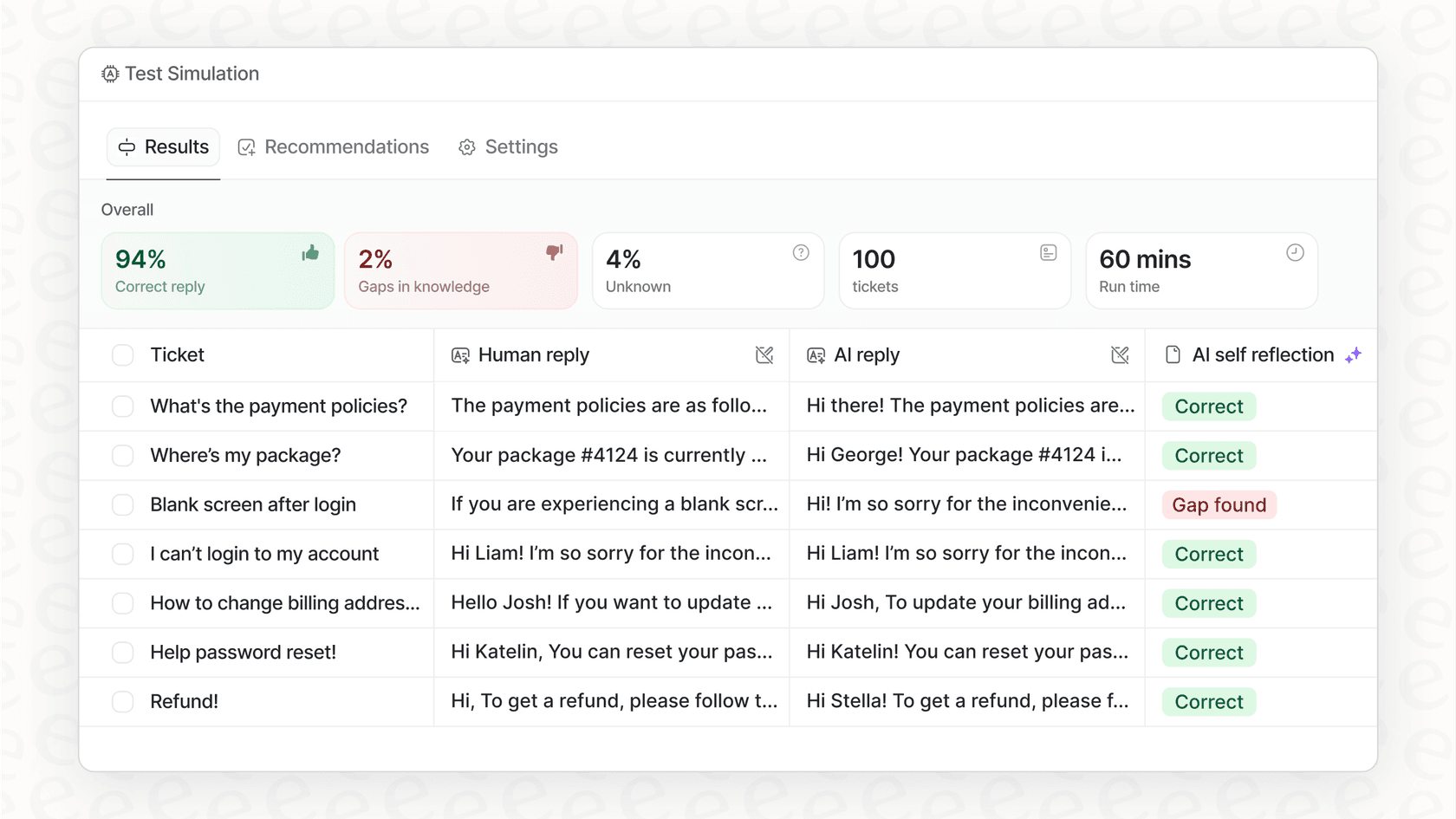
That's why having a safe way to test is so critical. One of the most powerful features of eesel AI is its simulation mode. It lets you test your AI setup on thousands of your own historical tickets in a secure sandbox environment. You can see exactly how it would have responded, measure its potential resolution rate, and tweak its behavior before it ever talks to a live customer. This risk-free approach means you can go live with confidence and scale up your automation as you build trust in the system.
Moving beyond the free Noupe pricing model to find real value
While the Noupe pricing model is definitely tempting because it's free, that "free" comes with some big trade-offs in what the tool can do, how much control you have, and whether it can grow with you. It’s a perfectly fine tool for getting a feel for chatbots, but it isn’t built for businesses that are serious about improving their customer support.
For those businesses, the conversation needs to shift from just the price tag to the total value. True value is found in a tool that saves you time during setup, connects deeply with the systems you already rely on, and gives you a clear, predictable path to grow. The right solution should empower your team with powerful automation, not box them in with new limitations.
Ready to see what a truly powerful AI support platform can do?
eesel AI goes way beyond simple website scraping. It learns from all your scattered company knowledge, integrates smoothly with the tools you already use, and lets you test with confidence before you ever go live.
Start your free trial today and see how quickly you can automate your support, not just answer a few questions.

Frequently asked questions
The free Noupe model offers basic Q&A capabilities by scraping your public website content, with a very fast setup. Its main limitations include surface-level knowledge, no learning from your past support interactions, and a lack of advanced integrations or customization.
The free Noupe model is generally not designed to scale with a growing business. Its basic functionality and lack of features like deep integration, customization, and learning from extensive support history mean it struggles to meet increasing and complex customer demands.
Noupe offers limited integration, primarily relying on public website scraping. In contrast, paid solutions like eesel AI provide deep, one-click integrations with over 100 sources, including help desks, wikis, and document hubs, allowing the AI to access comprehensive internal knowledge.
Common alternative models include usage-based pricing (paying per resolution or conversation), fixed monthly fees (per-seat or tiered plans), and hybrid models combining fixed and usage-based charges. Each comes with its own trade-offs regarding predictability and value.
Beyond the initial cost, prioritize factors such as quick and self-serve implementation, deep integration capabilities with your existing systems, and the ability to thoroughly test and confidently scale the AI. These elements are crucial for long-term value and efficiency.
Share this article

Article by
Kenneth Pangan
Writer and marketer for over ten years, Kenneth Pangan splits his time between history, politics, and art with plenty of interruptions from his dogs demanding attention.