I tested 20+ marketing AI tools: Here are the 6 best for 2026

Stevia Putri

Katelin Teen
Last edited January 6, 2026

Many lists of the "best marketing AI tools" are available, making it challenging to distinguish between genuine recommendations and promotional content. With new tools emerging frequently, it's important to find reliable information.
This guide is based on direct experience with each tool mentioned. The focus is on platforms that demonstrate practical value in scaling organic traffic and improving workflow efficiency.
The objective is to highlight how AI can enhance marketing outcomes, such as increasing engagement, streamlining workflows, and improving search rankings. This guide provides a practical overview of six recommended tools for 2026.
What are marketing AI tools?
Simply put, marketing AI tools use artificial intelligence to help with, automate, or improve marketing tasks. This could be anything from writing a blog post and crunching data to personalizing customer emails and figuring out where your ad budget should go.
There are typically two main categories. First, there's generative AI, which is what most people picture: tools that create new things like articles, social media captions, or images. Then there's analytical AI, which works behind the scenes to analyze data, find patterns, and help you make smarter calls.
Effective tools act as assistants, handling the tedious, heavy-lifting parts of the job. This frees you up to focus on what humans do best: strategy, creativity, and actually connecting with people.
Selection criteria for the best marketing AI tools
The selection of these tools was based on the following criteria:
-
Functionality: The tool needed to deliver measurable results, such as improved search rankings, faster content creation, or enhanced campaign performance.
-
Usability: Platforms were selected for their intuitive interfaces, allowing users to gain value quickly.
-
Value: The pricing had to be justifiable for the features offered. The availability of a free trial or a functional free plan was considered a significant advantage.
-
Unique Capabilities: The list prioritizes platforms that excel at a specific function or solve a particular problem more effectively than alternatives.
Comparison of top marketing AI tools for 2026
Here’s a brief comparison of the selected tools.
| Tool | Best For | Key Feature | Starting Price |
|---|---|---|---|
| eesel AI blog writer | Scaling SEO content | Generates complete, publish-ready blog posts | Free to try, then $99/month |
| Jasper | AI copywriting assistance | Brand Voice and 100+ templates | $59/month (billed annually) |
| Surfer SEO | Content optimization | Real-time content scoring and briefs | $79/month (billed annually) |
| Semrush | All-in-one marketing strategy | AI Visibility and competitor research | $165.17/month (billed annually) |
| Gumloop | Workflow automation | No-code AI agent builder | Free plan available, paid from $37/month |
| Blaze AI | Social media content | Automated content calendar and post generation | Free plan available, paid from $46/month |
Six leading marketing AI tools
The following six tools represent a core marketing stack, with each serving a specific function. They are suitable for individual marketers and larger teams.
1. eesel AI blog writer
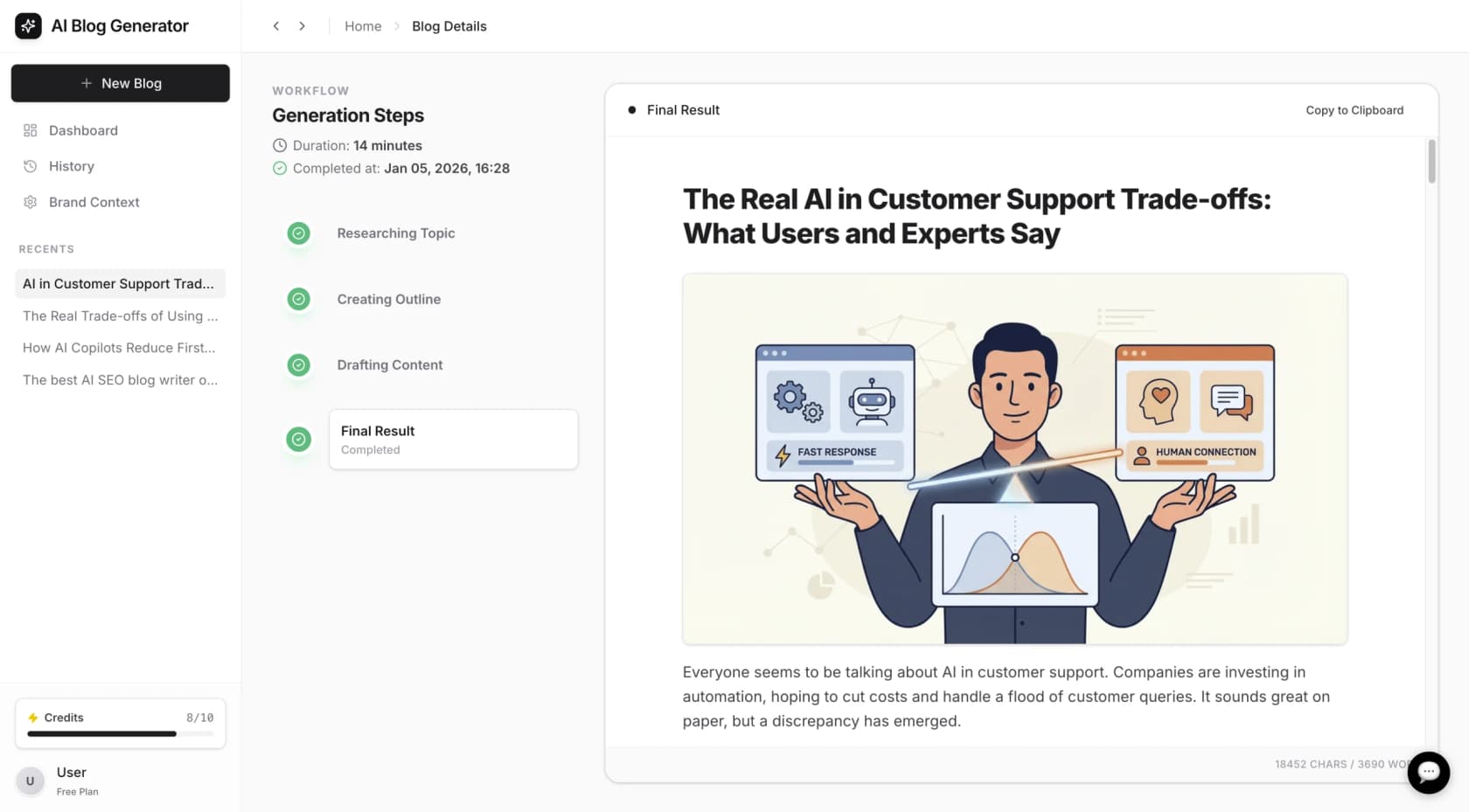
The eesel AI blog writer is a specialized tool. It turns a single keyword into a full blog post. The tool is designed to produce a comprehensive first draft, including research, SEO structure, and visual elements.
-
Pros and Cons: Its biggest plus is that it delivers a finished article. That means AI-generated images, data tables, relevant YouTube video embeds, and even real Reddit quotes for social proof. The time savings are significant. For instance, it was used to grow impressions significantly in just three months by enabling high-volume publishing. A potential limitation is its specialized focus on long-form blog content, so it is not intended for short-form copy like social media captions.
-
Pricing: You can try it for free to see the quality for yourself. The Early Bird plan is $99/month for 100 blog posts, which offers a cost-effective way to scale content.
-
Our Take: This tool is suitable for those focused on using content to generate organic traffic. It closes the gap between a simple AI writer and a complete content workflow, producing high-quality articles that are ready to rank on Google and in AI Answer Engines.
2. Jasper
Jasper is a well-known AI writing tool. It serves as a versatile tool for copywriters, suitable for generating creative text for various formats. It is a good option when you need copy for social media, ads, product descriptions, or emails. Its library of over 100 templates is useful for overcoming creative blocks.
Based on Sprout Score comparisons, Jasper scored higher (8.2) for brand voice and long-form consistency, especially in team use.

-
Pros and Cons: Jasper's flexibility is its main appeal. The Brand Voice feature is also useful for keeping all your copy consistent. The downside is that for long-form content like a blog post, it requires more manual effort to assemble. Unlike the eesel AI blog writer, it doesn't automatically create rich assets like images, charts, or video embeds to go with the text.
-
Pricing: The Pro plan starts at $59 per seat/month when billed annually. They also offer a 7-day free trial.
-
Our Take: A reliable AI tool for many marketing teams. Jasper is a strong option for producing high volumes of short-form copy for different channels and brainstorming ideas.
3. Surfer SEO
Surfer SEO is a content intelligence tool that helps your content rank. Instead of creating articles from scratch, it analyzes the top-ranking pages for your keyword and provides a data-driven framework to follow. It provides guidance on which keywords to use, what topics to cover, article length, and structure.
Surfer - really strong for on-page/content optimization. Helps structure articles to match SERP and AI search expectations, with clear keyword and heading suggestions.
-
Pros and Cons: Surfer is effective for optimizing new and existing content. The real-time Content Editor provides a live score during the writing process. It also has an AI Tracker to see how visible your brand is in AI answers, which is growing in importance. The main limitation is that it's an optimization tool, not a creation tool. You still have to do the writing yourself or use another AI to fill out the brief it generates.
-
Pricing: The Essential plan starts at $79/month when billed annually.
-
Our Take: A useful tool for SEOs and content marketers. It takes the guesswork out of optimization. It can be paired effectively with an AI generator, you can create a draft with one tool and then use Surfer's insights to polish it for search engine rankings.
4. Semrush
Semrush is a comprehensive marketing suite. While known for its SEO and competitor research features, it has also integrated AI into its platform. Tools like its AI Writing Assistant and the new AI Visibility Toolkit help you see how your brand is showing up in AI search results.
-
Pros and Cons: Semrush provides access to extensive data. It covers everything from SEO and PPC to content and social media. Its tools for tracking brand performance in AI search are leading the pack. The only issue is that its comprehensive feature set can have a steep learning curve for beginners, and it costs more than the specialized tools on this list.
-
Pricing: The Starter plan begins at $165.17/month when billed annually.
-
Our Take: A suitable choice for marketing teams seeking a central hub for all their SEO and competitive research. The added AI features make an already powerful platform valuable for navigating changes in search.
5. Gumloop
Gumloop is an AI-native automation platform that lets you connect your favorite apps (like Semrush, Slack, or Google Docs) and build custom AI agents without writing any code. It functions similarly to Zapier but is designed for creating AI-driven workflows that can do research, analyze info, and take action on their own.
-
Pros and Cons: Gumloop is useful for automating repetitive, data-heavy tasks. For example, you could build an agent that monitors competitors' blogs, uses AI to summarize new posts, and delivers a report in Slack. It’s flexible, but it does take a bit more time to learn than the single-purpose tools.
-
Pricing: It has a free plan with 2,000 credits/month. Paid plans start at $37/month for the Solo plan.
-
Our Take: This is a powerful tool for marketers who are ready to move beyond simple automation. It’s perfect for creating custom AI workflows that fit your team's exact needs, saving hours of manual work.
6. Blaze AI
Blaze AI is focused on generating, scheduling, and posting content for social media, blogs, and newsletters. It acts like a "virtual marketing team" by building out a complete content calendar based on your brand. It's designed to automate a large portion of your top-of-funnel content creation.
-
Pros and Cons: Blaze is a good solution for teams that need a consistent social media presence but are short on time. It generates a mix of content, including images and videos, and handles the entire posting schedule. A potential drawback, as with any fully automated system, is that the content can sometimes feel generic. It still needs a human to check in and make sure it aligns with your brand and current events.
-
Pricing: A free plan is available that lets you try it out, though posts are limited and watermarked. The paid Starter plan is $46/month when billed annually.
-
Our Take: A viable choice for brands looking to automate their social media. It’s an effective way to keep your channels active, freeing you up to focus on bigger marketing projects.
Tips for using marketing AI tools effectively
Subscribing to a tool is only the first step. Here’s how to get the most value out of them:
-
Start with a specific problem: Avoid trying to automate all tasks simultaneously. Identify a primary challenge, such as scaling blog content or managing social media. Find a tool that solves that one thing really well and master it before adding another.
-
Serve as the editor: AI is a tool to assist, not replace, human expertise. It's crucial to review, edit, and fact-check AI-generated content to add unique insights and ensure accuracy.
-
Provide clear instructions: The quality of the output from an AI tool depends on the quality of the input. Detailed keywords, brand voice guides, and specific prompts yield better results.
-
Combine tools for an integrated workflow: The effectiveness of these tools can be amplified when used together. A great content workflow could be: use Semrush for keyword research, plug that keyword into the eesel AI blog writer to generate a full article, then run it through Surfer SEO for a final optimization check.
Choosing the right marketing AI tools
AI is changing marketing practices, but its primary value lies in strategic application rather than simple automation. It's about picking the right marketing AI tools for specific jobs and using them to support your strategy and creativity. It's about working smarter, not just faster.
Each of the tools on this list has been tested and has delivered results, whether that’s driving a jump in organic traffic or improving day-to-day workflow efficiency.
For a deeper dive into how different tools can boost creativity and drive better results, the following video offers a review of some of the best AI platforms for marketing and brand development.
It is advisable to start with your most significant challenge. If scaling high-quality, SEO-optimized blog content is at the top of your list, then this tool is a suitable starting point.
Generate your first blog post for free and see the difference for yourself.

Frequently asked questions
For small businesses, it's about maximizing value. I'd recommend starting with tools that solve a major time-sink. A tool like the eesel AI blog writer is great for handling your entire content pipeline, while something like Blaze AI can put social media on autopilot. Look for tools with solid free plans or trials to start.
Start by identifying your biggest bottleneck. Is it content creation, data analysis, or workflow automation? Avoid seeking a single tool for all tasks. Instead, build a small stack of specialized marketing AI tools. For example, use Semrush for research, eesel AI for writing, and Surfer SEO for optimization. Always test a tool before committing.
No. The best marketing AI tools are assistants, not replacements. They handle the repetitive, data-heavy tasks, which frees up human marketers to focus on strategy, creativity, and building relationships. They augment a team's capabilities.
Yes. Many powerful tools offer generous free tiers. Gumloop, for instance, lets you build complex automations for free. Blaze AI has a free plan for social media, and you can generate your first few articles with the eesel AI blog writer for free to test its quality. These are great for getting started without a budget.
The biggest benefit is scale and data-driven precision. Marketing AI tools like Surfer SEO analyze top search results to give you a clear optimization roadmap, removing guesswork. Meanwhile, tools like the eesel AI blog writer let you produce high-quality, optimized content at a scale that would be impossible for a human team, helping you capture more organic traffic.
It varies, but the tools on this list were chosen partly for their ease of use. Most modern marketing AI tools have intuitive interfaces and you can get started in minutes. Platforms like Jasper and eesel AI are very straightforward. More complex tools like Semrush or Gumloop might have a learning curve, but they offer plenty of tutorials to get you up to speed.
Share this article

Article by
Stevia Putri
Stevia Putri is a marketing generalist at eesel AI, where she helps turn powerful AI tools into stories that resonate. She’s driven by curiosity, clarity, and the human side of technology.