How to improve internal linking: A practical guide for better SEO

Amogh Sarda
Last edited January 15, 2026
Ever write a great blog post only to feel like it's stranded on its own little island, completely cut off from the rest of your site? It’s a common problem, but the fix is often simpler than you think: internal linking.
Think of internal links as the roads connecting all the different parts of your website. They turn a random bunch of pages into a cohesive, organized resource that helps both your visitors and search engines find their way around. When you get it right, your SEO and user experience can really take off.
In this guide, we’ll cover why internal linking is so important, share some practical strategies you can use right away, and show you how to spot and fix the most common mistakes. The biggest challenge is often just having enough related content to link together. Building a solid network of links requires a decent volume of articles on similar topics, and creating that much content can feel like an impossible task. That’s where a tool like the eesel AI blog writer can make a huge difference, but we'll get to that in a bit.
What is internal linking and why does it matter?
So, what’s an internal link? It's simply a hyperlink that points from one page on your website to another page on the same website. That's it.
Imagine your website is a city. Your pages are the buildings: shops, houses, and landmarks. Your internal links are the roads that connect everything. Without those roads, people (and Google’s search bots) would have a tough time getting around. A good road system makes a city easy to navigate, and a smart internal linking structure does the same for your site.
Think of it as veins in your body. Blood flows from and to different parts of your body via veins. That's how users and search engines will discover/find pages on your site, via internal linking. Also that's how SEO juice (the blood in this analogy) flows from one page to another.

It's also helpful to know the difference between internal and external links.
| Feature | Internal Links | External Links |
|---|---|---|
| Destination | Another page on the same domain | A page on a different domain |
| Purpose | Site navigation, spreading authority, establishing topic hierarchy | Citing sources, providing additional resources, building relationships |
| SEO Impact | Helps Google crawl your site, passes link equity between pages | Can establish trustworthiness, but passes link equity to another site |
Now, why should you care? Here are the main benefits of a good internal linking strategy:
- It helps search engines find your stuff: Search engine crawlers discover and index new pages by following links. If a page has no links pointing to it, it’s considered an "orphaned page" and is basically invisible to Google. As Google themselves say, good linking [helps them "make sense of your site more easily."](https://www.eesel.ai/blog/how-to-show-up-in-ai-overviews-seo)
- It spreads authority across your site: Some pages on your site are more powerful than others. Your homepage, for example, likely has the most authority (or "link equity") because other websites tend to link to it. When you link from your homepage to a blog post, you're passing along some of that power, which can help the blog post rank higher.
- It shows you know your topic: When you link related articles together, you're signaling to Google that you're an expert on that subject. This creates a "topic cluster" that demonstrates your depth of knowledge, and Google really likes that.
- It makes for a better user experience: A smart linking structure helps visitors find what they need without having to constantly hit the back button. This keeps them on your site longer, lowers your bounce rate, and signals to search engines that your site is providing value.
Core strategies for improving internal linking
Okay, let's get to the practical side of things. Here are the main strategies you can use to build an internal linking structure that actually works.
The key is being strategic, not just adding random links. focus on: -supporting underperforming pages with links from high-authority pages -creating content clusters around main topics -using exact-match anchor text for competitive terms don't waste time manually reviewing every post. Automate the analysis, then spend your time implementing the high-impact links that actually move rankings
Build content hubs
One of the best ways to organize your content is with the topic cluster model, sometimes called the hub-and-spoke model.
Here’s the breakdown: You create a main "pillar page," which is a comprehensive, long-form guide on a broad topic. Then, you create several shorter "cluster pages" that explore specific subtopics related to that pillar.
For instance, you might have a pillar page on "Content Marketing." This page would link out to cluster pages on topics like "Keyword Research," "On-Page SEO," and "Content Distribution." And, importantly, each of those cluster pages would link back up to the main "Content Marketing" pillar page.
This structure is brilliant for two reasons: it proves your expertise to search engines by showing you've covered a topic thoroughly, and it creates a logical path for your readers to follow.
Use descriptive anchor text
The anchor text is the clickable text in a hyperlink. It’s a huge clue for both users and search engines about what the linked page is about.
Best bet is to keep internal links natural and relevant - use descriptive anchor text when it makes sense (not just 'click here'), but don’t over-optimize with exact-match keywords everywhere.
According to Google's official documentation, your anchor text should be descriptive, concise, and relevant. That means you have to stop using generic phrases like "click here" or "read more."
A few best practices to follow:
- Be descriptive and relevant: Instead of "click here," use something like "our guide to on-page SEO."
- Keep it short: A few words are usually enough. Don't link an entire sentence or paragraph.
- Don't stuff keywords: Your anchor text should sound natural. Forcing in keywords where they don't fit is a bad look, and as Google points out, "keyword stuffing is a violation of our spam policies."
Here’s a quick comparison to make it obvious:
| Anchor Text Example | Verdict | Why |
|---|---|---|
| "Click here to learn about our services." | Bad | Too generic; provides no context. |
| "Read our guide to cheese making." | Good | Descriptive, concise, and relevant. |
| "We have an article about that." | Bad | "article" is not descriptive. |
| "The Knitted Cow invites local residents to their grand re-opening." | Good | Natural and reasonably concise. |
Pass authority from your strongest pages
Like we mentioned, some pages on your site carry more weight than others, usually because they have more external links pointing to them. You can use these powerful pages to give your other content a nice boost.
Here’s a simple way to do it:
- Find your top-performing pages. You can do this for free with Google Search Console. Just go to the Performance report, click the Pages tab, and sort by clicks or impressions.
- Once you have your list of powerhouse pages, look for relevant places to link from them to newer or less visible content that you want to rank.
- Adding these links shares the "link juice," helping your weaker pages get more visibility in search results.
Pro tip
Make it a habit to review your most popular articles regularly. Whenever you publish a new piece of content, go back to your top posts and see if there are any natural spots to add a link to the new article. This keeps your internal linking structure fresh and effective.
Keep pages close to the homepage
"Crawl depth," or "click depth," is just the number of clicks it takes to get from your homepage to any other page on your site. A good rule of thumb is to make sure your most important pages are no more than three clicks away from the homepage.
Why does this matter? Pages that are buried deep in your site’s structure are seen as less important by Google and are crawled less often. If you want a page to rank well, you need to make it easy for both users and search engines to find it.
A few easy ways to reduce click depth are to add links to key blog posts in your main navigation menu, feature them on your homepage, or create well-organized category pages that link out to all the relevant articles.
Finding and fixing common mistakes
We all make mistakes. The important thing is to regularly audit your site and clean up any issues you find. Here are a few common ones to watch for.
Find and fix orphaned pages
An orphaned page is a page with no internal links pointing to it. It’s that lonely island we talked about earlier. If no pages on your site link to it, it's very unlikely that search engines or users will ever find it.
To fix this, you need to run a site audit. Tools like Semrush's Site Audit can automatically find orphaned pages by comparing the pages it crawls with data from your sitemap and Google Analytics. Once you've found them, the fix is easy: just find relevant pages on your site and add links to the orphaned content.
Eliminate broken links
Broken links: These point to a page that doesn't exist anymore, leading to a 404 error. They create a dead end for users and waste any authority the link might have passed. Auditing tools like Ahrefs' Site Audit can easily find these for you by flagging links with a 4XX status code. You can then either update the link to the correct URL or remove it.
Redirect chains: These occur when one page redirects to another, which then redirects to a third (e.g., Page A -> Page B -> Page C). This slows down your site and uses up your "crawl budget" (the time Google's bots spend on your site). The fix is to update the original link on Page A to point directly to Page C.
Avoid too many links on one page
While there's no magic number for how many links a page should have, stuffing hundreds of links onto a single page is a bad move. It dilutes the value of each link and can make your page look spammy to search engines.
The best way to go is to focus on quality over quantity. Every link on your page should have a purpose and offer real value to the reader. If a link is unnecessary or doesn't add anything helpful, it's better to just get rid of it.
For a more visual walkthrough of these strategies, the following video offers some excellent tips on building an internal linking structure that boosts your SEO.
Scale your internal linking strategy with the eesel AI blog writer
So, here’s the biggest catch with internal linking: it depends on having a lot of high-quality, topically related content. Building out topic clusters by hand takes a massive amount of time and effort. We ran into this exact problem and used the eesel AI blog writer to solve it, growing our own blog from 70k to over 750k impressions in just three months.
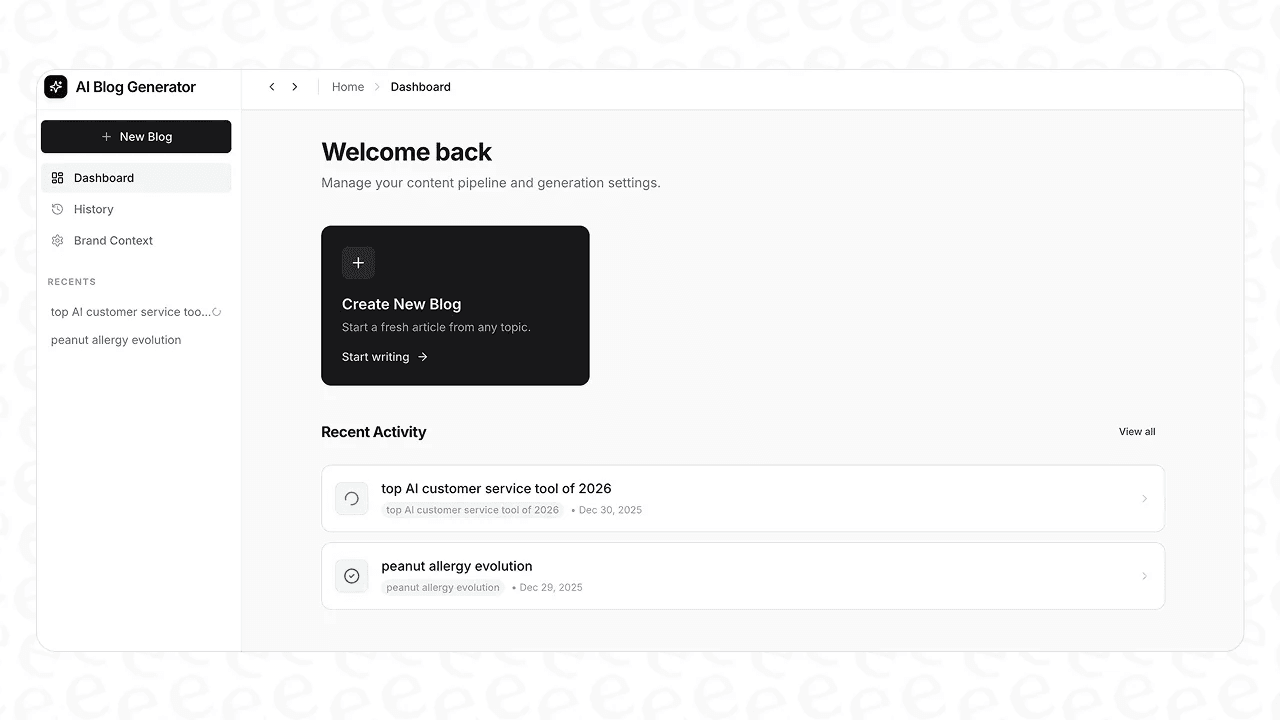
Here’s how it helps you build a killer internal linking structure, fast:
- Build topic clusters instantly: You can take a single pillar page topic, like "customer service," and use eesel AI to generate a dozen high-quality, supporting cluster articles in minutes. This gives you a whole content hub that's ready to be interlinked.
- Automated and relevant linking: The AI is smart enough to automatically add relevant links to your own internal pages and cite external sources while it writes. This means your site structure gets stronger right from the start, with no extra work from you.
- Human-like content that earns links: The articles don't sound like they were written by a robot. They have a natural tone and are full of value, including AI-generated images, tables, and even authentic social proof from real Reddit threads. This creates content that you'll actually want to link to.
Strengthening your site with internal links
Let's wrap this up. A strong internal linking strategy is one of the most powerful (and often overlooked) SEO tools you have. It's a win-win that boosts your search rankings and gives your visitors a much better experience on your site.
Just remember the key ideas: build content hubs with topic clusters, use descriptive anchor text, pass authority from your strongest pages, and regularly check your site for errors like broken links and orphaned pages.
At the end of the day, the foundation of great internal linking is great content. When you can produce content at scale, you can build a powerful, interconnected site that both search engines and users will love.
Ready to build a content engine that supports a world-class internal linking strategy? Try the eesel AI blog writer for free and generate your first publish-ready article in minutes.

Frequently Asked Questions
Share this article

Article by
Amogh Sarda
CEO of eesel AI. Amogh Sarda is obsessed with making the ultimate AI for customer service teams. He lives in Sydney, Australia and has previously worked at Atlassian and Intercom. Outside of work he’s usually surfing or on stage doing improv.