
I'm sure you've seen plenty of comparisons. Most of them are pretty broad, though, covering coding, data analysis, and other stuff you might not care about if you just want to write a good blog post. So, let's cut to the chase. This article is all about one thing: which model is actually better for writing blogs?
And while these big models are impressive, sometimes the best tool for the job is one made specifically for it. It's the difference between buying all the ingredients to cook a meal and getting a meal kit that has everything perfectly portioned and ready to go. Specialized tools are the meal kit for blog writing.
What is OpenAI's GPT-4?
You've almost certainly heard of OpenAI. Their GPT-4 model and its newer versions, like GPT-5.2, are the brains behind tools like ChatGPT. They're known for being incredibly good at reasoning things out.
If GPT were a person on your team, it'd be the one with the off-the-charts IQ. Its main strength is its flexibility. It can jump between text, images, and code without breaking a sweat and is great at untangling complicated, multi-step problems. OpenAI has different models for different needs, from quick "workhorse" versions to more powerful "planner" reasoning models for complex tasks that can really dig into tricky logic.
This makes it a solid choice for things like creating detailed outlines, writing technical pieces that need to be spot-on, or digging through data for blog post insights. If your blog needs to be logical, well-structured, and factually correct, GPT has long been the default option.
What is Anthropic's Claude?
Then you have Claude, a family of models from Anthropic. While it's also very smart, Claude was built with a big emphasis on safety, reliability, and having more natural, human-like conversations.
If GPT has the high IQ, Claude brings the high EQ (emotional intelligence). Its real talent is producing expressive and nuanced writing that just flows well. Many writers have found it does a much better job of matching a specific brand voice or tone without needing a mountain of instructions. With its latest models, like the intelligent Opus 4.5 and the balanced Sonnet 4.5, it's definitely a top contender.
It’s especially good at keeping a consistent style throughout a long article, which makes it a favorite for creative writers or anyone who wants their blog to sound like it was written by an actual person. It's designed for applications that need rich, human-like interactions.
Round 1: Style and tone
Alright, let's get into what really counts for a blog post: how does the writing actually sound?
This is where you can see a real difference between the two.
Claude tends to create more expressive, conversational writing right from the start. The sentences flow a bit more smoothly, and it's better at understanding the subtleties of a certain tone. If you're trying to match a specific brand voice, whether it's witty, empathetic, or formal, Claude usually gets you closer on the first attempt. It’s perfect for writing engaging stories or discussing topics that have an emotional side.
Claude seems to write better, softer, more nuanced. It feels nicer.

GPT-4/5.2 is a pro at grammar and structure, but its default writing style can sometimes come across as a little stiff or academic. It's like talking to a very smart professor. You can definitely push it to be more casual with detailed prompts, but some people feel its initial output is less "human" than what Claude produces. It really performs best when clarity and precision matter more than creative flair.
Verdict: For pure writing quality, creative flow, and a human touch in your blog posts, Claude often has the edge.
Round 2: Research and accuracy
A good blog post isn't just well-written; it has to be correct. Here, we're looking at how well each model handles facts, does research, and builds a logical argument.
GPT-4/5.2 is an absolute beast when it comes to reasoning. OpenAI has put a lot of effort into creating dedicated reasoning models (like their o-series) that are built to solve complex problems. If you're writing a blog post that's full of data, needs in-depth research, or has to lay out a step-by-step argument, GPT's analytical power makes it a more dependable choice. It's less likely to get confused by vague instructions and better at pulling together information from different places.
Claude has improved a lot in this area, with models like Opus 4.5 positioned for complex tasks. Anthropic also places a huge emphasis on safety and cutting down on misinformation through things like its Responsible Scaling Policy. This focus on reliability means it's pretty good at sticking to the facts it's given. Still, for raw logical power and navigating tricky, data-heavy topics, it can sometimes trail behind GPT's specialized abilities.
Verdict: For technical, data-driven blog posts that need solid logic and factual accuracy, GPT's specialized reasoning models give it a clear advantage.
Round 3: Long-form content
Claude is the clear winner here. Its paid plans offer a massive 200K token context window, which is about 500 pages of text. Some enterprise plans can even get a 1-million-token window. This means you can give it a whole style guide, past articles, and detailed notes, and it will stay perfectly consistent through a massive 10,000-word guide.
GPT-4/5.2 also has a large context window, but it's not as big as Claude's. The ChatGPT Pro plan has a 128K context window, which is more than enough for most blog posts. But on some of its business plans, the window can be smaller (around 32K). For really long or complicated articles, there's a greater chance the model might forget earlier instructions, which can lead to an inconsistent tone or story.
Verdict: For long-form blog content where staying consistent over thousands of words is key, Claude's much larger context window gives it a very practical edge.
Pricing comparison
So, what's all this going to set you back? Both platforms have a few plans for individuals and teams. Here’s a quick look at their consumer and team options.
| Plan Type | OpenAI ChatGPT | Anthropic Claude |
|---|---|---|
| Free | Limited access to flagship models. | Free for everyone with limited usage. |
| Individual Pro | Plus: $20/month. Adds advanced reasoning models and more usage. | Pro: $20/month ($17/mo if billed annually). More usage and access to more models. |
| Individual Max | Pro: $200/month. Full access to GPT-5.2 Pro and maximum features. | Max: From $100/month. 5-20x more usage than Pro. |
| Team / Business | Business: $25/user/month (billed annually). Includes a secure workspace and admin controls. | Team: $30/seat/month ($25/seat if billed annually). For teams of 5 or more. |
Note: Prices are based on information from the OpenAI and Claude pricing pages as of 2026 and may vary. Always check the official sites for the most current information.
An alternative approach: Specialized blog writing tools
After comparing these two, you might be wondering which one to pick. However, this comparison raises another question: is a general-purpose model the most efficient tool for this specific task? Using a general-purpose AI for a specific task like SEO blog writing can be compared to using a multi-tool for a complex construction project. While it can perform many functions, a dedicated tool is often more effective.
These models just give you raw text. That's it. A great blog post needs a proper SEO structure, headings, visuals, social proof, internal links, and brand alignment. With a general model, the user is responsible for structuring the content, optimizing for SEO, creating visuals, and ensuring brand alignment.
Go beyond text generation with the eesel AI blog writer
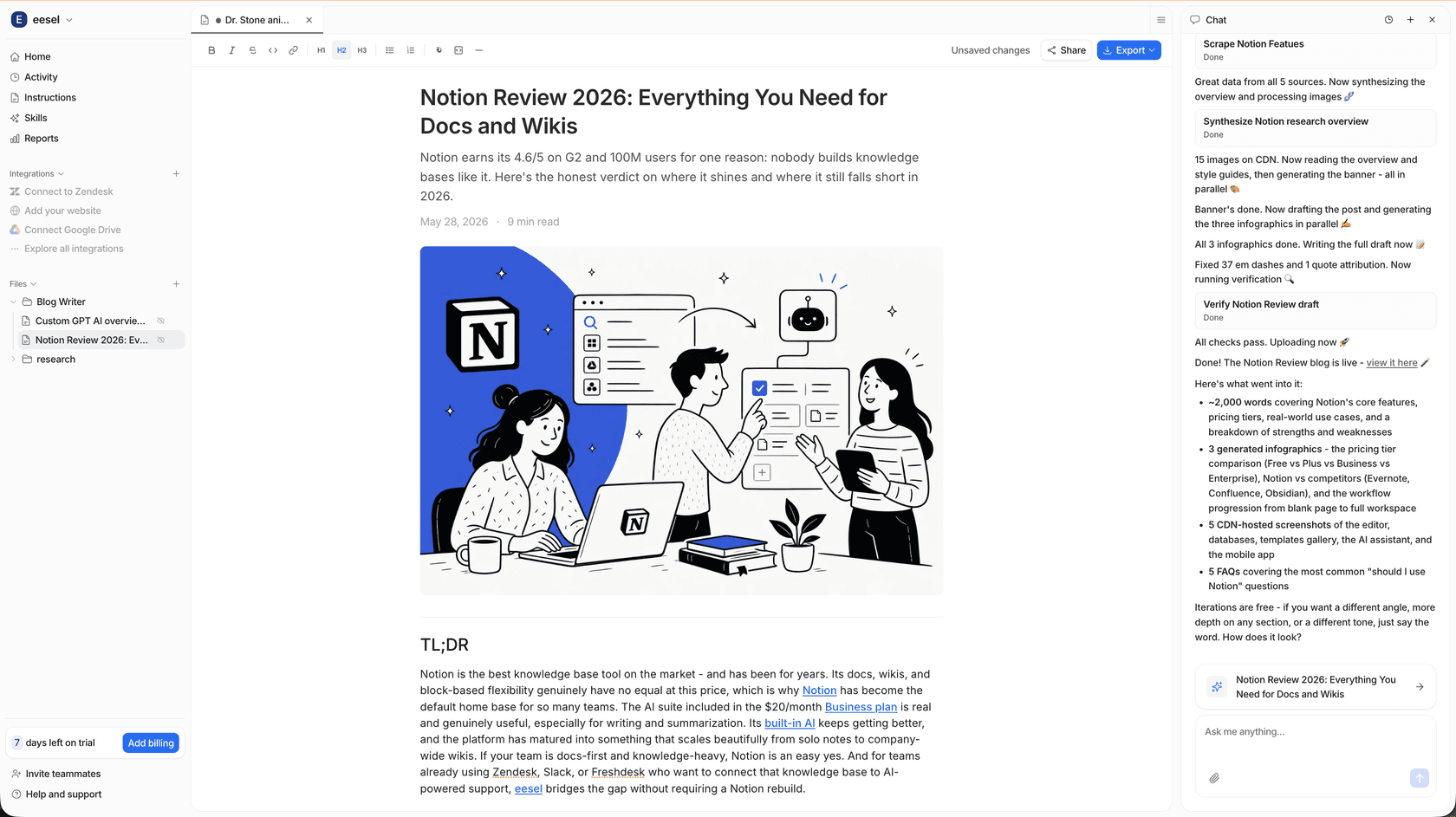
It takes care of the problems that general AIs leave for you to solve:
- It creates complete articles, not just drafts. You get a fully structured post with an intro, headings, a conclusion, and a human-like tone that people will actually read.
- It adds automatic assets. The AI generates and embeds relevant images, tables, and infographics right into the post. This saves you hours of work and makes your content much more engaging.
- It integrates social proof. To add a layer of authenticity, it automatically finds and includes real quotes from Reddit threads and embeds relevant YouTube videos.
- It's optimized for both SEO and AEO. The content is structured to rank on search engines like Google and to provide direct answers for AI answer engines (like Google AI Overviews and Perplexity).
We used this exact tool at eesel AI to grow our organic traffic from 700 to 750,000 impressions per day in just 3 months. It is also free to try.
Watching these models in action can provide a clearer picture of their strengths and weaknesses. For a direct head-to-head comparison, the following video breaks down the key differences between Claude and ChatGPT, helping you decide which one might be a better fit for your specific writing needs.
GPT-4 vs. Claude: Which is right for your blog?
So, who wins this matchup?
- Go with GPT-4 or its successors for their powerful logic when you're writing data-driven, technical posts where accuracy is the most important thing.
- Lean on Claude for its expressive writing and huge context window when your brand voice, tone, and story flow are your top priorities.
In the end, the best solution isn't just about picking one model over the other. It's about using a specialized platform that uses the power of these models and adds the important layers of SEO, asset creation, and structure that turn raw text into a blog post that actually performs.
For those looking for a more streamlined workflow, a specialized tool like the eesel AI blog writer can generate a complete, SEO-optimized article and is free to try.