A practical guide to EEAT in SEO: What it is and why it matters

Stevia Putri

Katelin Teen
Last edited February 1, 2026
With so much AI-generated content flooding the internet, it's getting harder to make your voice heard. It seems like anyone can be a publisher these days, but not all content is actually helpful. This is why Google is doubling down on quality; it's not just a passing phase.
In this guide, we're going to pull back the curtain on E-E-A-T, the framework Google relies on to define "quality." We'll dig into Experience, Expertise, Authoritativeness, and Trustworthiness, using Google's official Search Quality Rater Guidelines as our guide.
But let's be real: creating content that hits all these marks consistently is a massive undertaking. The good news is you don't have to do it all manually. Tools like the eesel AI blog writer are designed to help you produce top-notch, E-E-A-T-friendly content without exhausting your team.
What is EEAT in SEO and how did we get here?
E-E-A-T is short for Experience, Expertise, Authoritativeness, and Trustworthiness. It's a set of principles from Google's Search Quality Rater Guidelines, which is pretty much the instruction manual for the 16,000 or so people who manually check the quality of Google's search results.
One thing to get straight right away: E-E-A-T is not a direct ranking factor. You won't see an "E-E-A-T score" anywhere. Think of it more like a concept. Google's algorithms are built to find signals that point to these four qualities. As Google puts it, their systems "identify a mix of factors that can help determine which content demonstrates aspects of experience, expertise, authoritativeness, and trustworthiness." It's the guiding principle for their search algorithm.
While E-E-A-T itself isn't a specific ranking factor, using a mix of factors that can identify content with good E-E-A-T is useful. For example, our systems give even more weight to content that aligns with strong E-E-A-T for topics that could significantly impact the health, financial stability, or safety of people, or the welfare or well-being of society. We call these 'Your Money or Your Life' topics, or YMYL for short.

You might remember its older sibling, E-A-T. The extra "E" for "Experience" was tacked on in December 2022, and it was a pretty big shift. Google made it clear they wanted to prioritize content from people who've actually been there and done that. For example, a product review from someone who genuinely used the product, not just someone who read a bunch of other reviews.
This whole framework is extra important for topics Google calls "Your Money or Your Life" (YMYL). We're talking about health, finance, and legal stuff, where bad advice can do real damage. For these kinds of topics, Google's standards are incredibly high, and E-E-A-T is the main event.
Breaking down the four pillars of EEAT in SEO
Demonstrating first-hand experience
Experience is all about proving you’ve actually done the thing you’re writing about. It means your content shows you've personally used a product, visited a place, or lived through a situation. It’s the difference between explaining how a camera works from a spec sheet versus showing off the photos you took with it on your last trip.
This is how you build real authenticity. It answers the reader's silent question: "Why should I listen to you?" It instantly sets your content apart from generic articles that just rephrase the top ten search results. When you share a genuine experience, you create a connection with your reader because they can tell you know what you're talking about. <quote text="* Show real experience – screenshots, examples, 'we tested this and saw X'. Matters more than word count IMO.
- Clear authorship – real name, short bio explaining why you’re qualified, link to socials/other work.
- Internal links with intent – link to related posts to show topical depth, for the human more than the SEO.
- Cite legit sources – official docs, studies, trusted sites.
- Basic trust pages – About, Contact, Privacy. Boring but important.
- Schema – Article + Author, FAQ but only if genuinely relevant.
If I had to pick 2 that move rankings most: real first-hand experience in content and obvious, credible authorship" sourceIcon="https://www.iconpacks.net/icons/2/free-reddit-logo-icon-2436-thumb.png" sourceName="Reddit" sourceLink="https://www.reddit.com/r/DigitalMarketingHack/comments/1qel34v/comment/o0gpbtq/">
Here are a few ways to work "Experience" into your content:
- Show, don't just tell: Use your own original pictures and videos instead of stock photos. If you’re reviewing software, include screenshots of you actually using it. If it’s a physical product, do an unboxing.
- Share personal stories: Talk about your own experiences. What mistakes did you make? What did you discover that was surprising? Anecdotes and case studies make your content stick.
- Get specific: Don't just say a product is "easy to use." Walk through the exact steps you took to set it up and point out what made it so simple. Details make an experience feel real.
- Bring in the real world: Embed relevant quotes from Reddit threads or other forums. Including perspectives from other real people can add another layer of authenticity.
Showcasing expertise
Expertise is about having the right knowledge and skills in a specific field. It’s about showing you’re qualified to give advice on the topic. This can come from formal education, professional certifications, or just years of hands-on work in an industry.
It’s easy to confuse Experience and Expertise, but they are different. Experience is about doing, while expertise is about knowing. You might have experience changing a tire, but a mechanical engineer has the expertise to explain the physics of torque and load distribution.
Interestingly, for some YMYL topics, Google notes that first-hand life experience can be a powerful form of expertise. For instance, a patient who has lived with a chronic illness for years offers a unique and valuable perspective that a doctor's clinical expertise can't fully capture.
To put your expertise on display, try these methods:
- Highlight your authors: Create detailed author bios that list their credentials, education, relevant job titles, and links to their LinkedIn or professional portfolios. Don't be shy about showing why they are the right person for the topic.
- Back up your claims: Always cite your sources, especially when you're using statistics or stating facts. Linking to reputable, primary sources shows you've done your research.
- Go deep: Don't just scratch the surface. Create comprehensive content that explores a topic from every angle. A real expert knows what questions the reader will have next and answers them ahead of time.
Building authoritativeness
Authoritativeness is about your reputation. It’s about whether you, your brand, or your website is seen as a go-to source of information in your industry. While expertise is something you possess, authoritativeness is something you earn from others.
So, how does Google figure this out? Its raters are told to go off-site and research the reputation of a website and its creators. They look for things like mentions from other experts, articles in well-known publications, and high-quality backlinks from other respected sites in your field. If other authorities are pointing to you, it's a good sign that you're an authority yourself.
Building authoritativeness is a long-term play, but here’s where you can start:
- Earn high-quality backlinks: Focus on digital PR, write guest posts for respected industry blogs, and create original research or data that others will want to link to.
- Showcase social proof: Encourage and display positive reviews, testimonials, and case studies. When real customers speak for you, it builds your authority.
- Join the conversation: Get active in your industry's communities. Answer questions on forums, speak at events, and get quoted by other experts. Make your name known.
An infographic showing the factors that build authoritativeness for EEAT in SEO, including backlinks, media mentions, positive reviews, and expert citations.
Earning trustworthiness
Trust is the foundation that holds all of E-E-A-T together. In fact, Google says that "trust is most important." An untrustworthy page is automatically seen as low-quality, no matter how much experience, expertise, or authority it seems to have. Without trust, the other three pillars don't matter.
Trust is about making your readers and Google feel confident that your site is legitimate, secure, and that your information is accurate. It’s about being transparent and taking responsibility for the content you create.
This comes down to a few key signals, both on your site and off:
- Secure your site: Make sure your website uses HTTPS. An SSL certificate is a must-have in 2026. It’s a basic signal that you care about user security.
- Be transparent: Have a clear "About Us" page that explains who you are. Your "Contact Us" page should be easy to find and include a physical address and phone number where it makes sense.
- Keep content current: Regularly go back and update your old articles. Fix any inaccuracies, refresh outdated info, and add a "Last updated" date to show that your content is still reliable.
How to apply EEAT in SEO to your content strategy
Okay, that's the theory. But how do you actually put this into practice without every blog post becoming a massive research project?
- Who: Is it perfectly clear who created this content? Do you have author bios and a solid "About Us" page?
- How: How was this content made? Was it based on original research, personal testing, or just summarizing other articles? Are you open about your process (including if you used AI to help)?
- Why: What was the main reason for creating this content? Was it to genuinely help people, or was it just to chase clicks from search engines?
The biggest challenge for most teams is simply the amount of work involved. Consistently creating content that shows first-hand experience, deep expertise, and solid trustworthiness requires a lot of time and resources. This is where many content strategies stumble.
Creating content for EEAT in SEO with the eesel AI blog writer
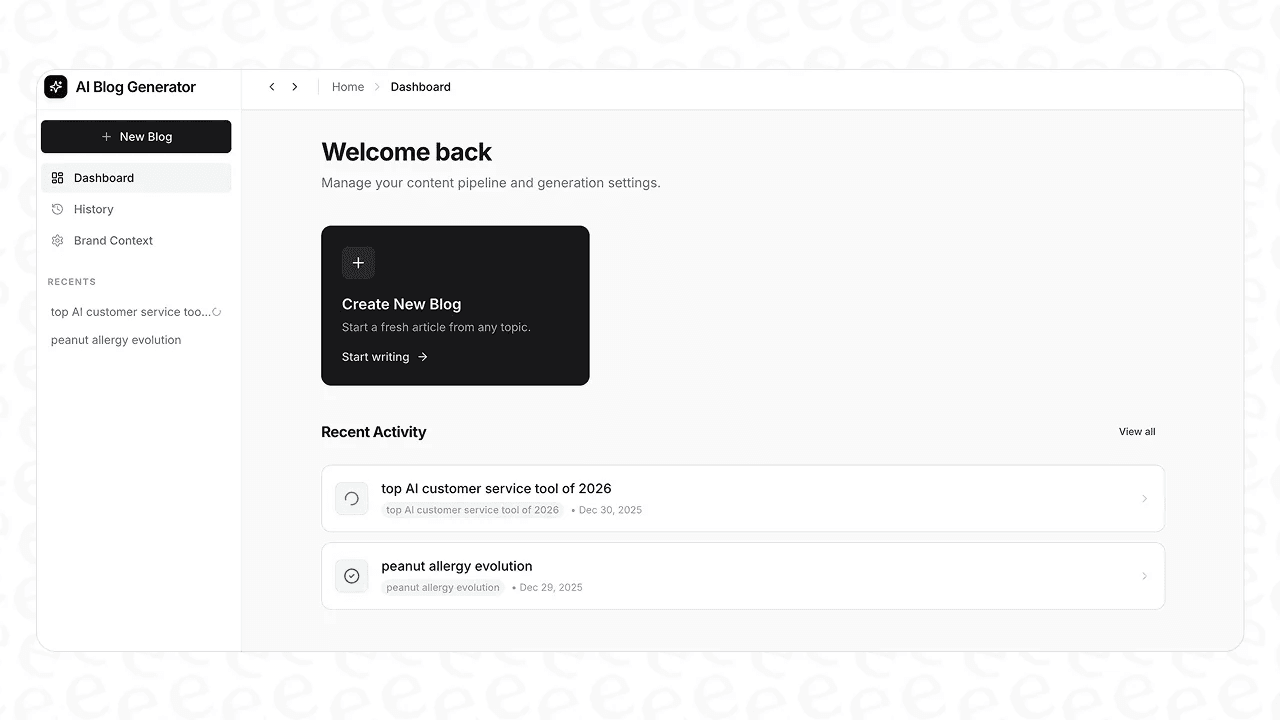
Here’s how it helps with each part of the E-E-A-T framework:
- Experience: The eesel AI blog writer can automatically find and include real Reddit quotes and relevant YouTube videos. This injects authentic, first-hand perspectives right into your content, showing you've done the work to understand what real users are saying.
- Expertise & Authoritativeness: It conducts context-aware research and cites external sources, making sure your content is factually correct and well-supported. It assists in building a well-researched piece.
- Trustworthiness: It generates complete, structured articles with assets like tables and charts. By giving it a topic and your website URL, it learns your brand's context to create content that feels credible and professional.
In the end, it helps you answer Google's "Why" question with confidence. The eesel AI blog writer is all about creating content that meets search intent and actually helps people, which is the heart of any good long-term SEO strategy.
For a deeper visual dive into these concepts, the following video from Semrush offers a great explanation of what E-E-A-T means for your SEO strategy and provides actionable tips on how to improve it.
Making EEAT in SEO your competitive advantage
E-E-A-T isn't just another SEO acronym to memorize. It’s about committing to creating valuable, helpful, and people-first content. In an age where AI is everywhere, this human-centered approach is the best way to build a lasting SEO strategy that earns both trust and rankings.
To see how these principles can be applied, you can generate a blog post for free with the eesel AI blog writer and see the difference for yourself.

Frequently Asked Questions
Share this article

Article by
Stevia Putri
Stevia Putri is a marketing generalist at eesel AI, where she helps turn powerful AI tools into stories that resonate. She’s driven by curiosity, clarity, and the human side of technology.