Educational blog writing: A complete guide to sharing knowledge and building authority

Kenneth Pangan

Stanley Nicholas
Last edited January 20, 2026
Expert Verified
If you want to build an audience, don't sell. Help. That’s the whole idea behind educational blog writing. Instead of pushing another sales pitch, you’re offering real value, answering questions, and solving problems for your readers. It’s a long-game strategy, for sure, but it’s the best way to build trust and establish yourself as the go-to expert in your field.
Why educational blog writing is essential for building trust
Let's face it, nobody likes being sold to. We've all got a pretty good radar for a thinly veiled advertisement. Educational blog writing flips that dynamic. Instead of shouting about your product, you’re focused on teaching something genuinely useful. This approach builds a real connection with your audience because you're helping them, not just trying to hit a quota.
When you consistently share helpful knowledge, you become a trusted resource. People start to see your brand as an authority, and when they eventually need a solution like yours, you’ll be top of mind. The best part? Modern AI tools can make this process a whole lot easier. For instance, we used the eesel AI blog writer to create high-quality educational posts from just a keyword. It’s the same tool that helped us scale our own blog from a humble 700 daily impressions to over 750,000 in just three months.

What is educational blog writing?
Educational blog writing is pretty much what it says on the tin: creating content with the primary goal of teaching your audience something. It’s about providing clear, valuable, and actionable information that helps them solve a problem, get their head around a complex topic, or learn a new skill.
Unlike a product update or a company announcement, this kind of content puts the reader’s needs first. As academic blogging experts note, the focus is on being useful to the reader, not promoting the author. Think of yourself as a helpful guide, not a salesperson. You're not trying to push a product; you're trying to empower your reader with knowledge.
The main purpose is to answer a question or solve a pain point so well that your audience sees you as a credible source. Over time, this is how you build long-term authority. By consistently delivering value, you create a library of resources that not only attracts new readers through search engines but also builds a loyal following that trusts what you have to say.
Finding your niche for educational blog writing
You can't create helpful content if you don't know who you're helping or what they need. The most successful educational blogs are laser-focused on a specific niche and a well-defined reader. This makes sure every post you publish is relevant and actually lands.
How to identify your niche
Before you write a single word, you need to know what you’re going to write about. Your niche is the foundation of your authority. If you try to be everything to everyone, you’ll end up being nothing to anyone.
Here are a few ways to lock down your niche:
- Lean into your expertise: What do you know better than most? Start with your professional experience, skills, or even your hobbies. You can't fake authentic knowledge.
- Check for demand: Is anyone actually searching for information on this topic? Use keyword research tools to see what people are looking for and what questions they're asking.
- Get specific: Don't just pick a huge topic like "marketing." Niche down. For example, you could focus on "AI-powered SEO for e-commerce startups." A specific niche has less competition and helps you attract a more dedicated audience.
Creating a reader persona
Once you have your niche, you need to understand who you’re writing for. A reader persona is a semi-fictional profile of your ideal reader. It helps you get inside their head and write content that speaks directly to their needs, which is the secret to being able to create spectacular content.
Your persona should include details about their job, their goals, and what’s getting in their way. Here’s a quick example:
| Component | Example Persona: "Startup Sarah" |
|---|---|
| Role | Founder of a small e-commerce business |
| Demographics | Age: 32, Location: Austin, TX |
| Goals | Increase organic traffic without a big marketing budget |
| Challenges | Not enough time, small team, overwhelmed by complicated SEO advice |
| Reading Habits | Scans articles for actionable tips, prefers "how-to" guides and case studies |
With a persona like "Startup Sarah" in mind, you know exactly how to frame your content. You’d skip the corporate jargon, focus on budget-friendly tips, and structure your posts for easy scanning.
Aligning topics with audience intent
Your persona’s challenges are basically your content calendar. Your goal is to create articles that directly answer the questions they’re typing into Google. Use keyword research tools to find these questions, and don't forget to check out forums like Reddit, where people describe their problems in their own words.
When you create content that perfectly matches what your audience is looking for (their "search intent"), you’re not just helping them—you're also telling search engines that your page is a valuable result. This is a big deal for ranking well in traditional search and getting cited by newer AI answer engines.
The anatomy of a perfect educational post
A great educational post isn't just about what you say; it's about how you say it. The structure and formatting are just as important as the information itself. Online readers are usually short on time and attention, so you need to make your content as easy to consume as possible.
Crafting an effective title
Your title is your first impression, and it has one job: get someone to click. A good title has to be compelling while accurately describing what the article is about. Nobody likes clickbait.
Research suggests that titles promising to solve a problem or teach a skill work really well for time-short readers. Try using proven formulas like:
- How to [Achieve a Desired Outcome]
- A Complete Guide to [Topic]
- Tips for [Solving a Problem]
These formats clearly state the value of the post and set the right expectations for the reader.
Structuring your post for readability
People don't read online; they scan. Your job is to make your content scannable. Use short paragraphs (2-3 sentences is a good rule of thumb), clear headings, and lists to break up long blocks of text.
- Use headings and subheadings: They act like signposts, guiding readers through your article and letting them quickly find the sections that matter most to them.
- Keep paragraphs short: Big walls of text are a turn-off. Short paragraphs are much more inviting and easier to read on any device.
- Use bullet points and numbered lists: They’re great for listing steps, features, or key takeaways, making complex information much easier to digest.
And remember to put your most important information first. You can't assume everyone will read to the end, so deliver the core value right away.
Using visuals to enhance understanding
Visuals are a powerful tool for engagement. They break up the text, make complicated ideas easier to grasp, and can make your post more memorable. Think about including screenshots to show a process, infographics to summarize data, or charts to show comparisons.
Finding your tone
The best educational blogs feel like a conversation with a smart friend. Ditch the overly academic language or corporate speak whenever you can. If you have to use a technical term, just take a second to explain it simply.
As writing experts have noted, many strong blog posts use a friendly, direct tone. Write like you talk. Use contractions like "you're" and "it's," and address the reader directly with "you." This simple change makes your content feel more personal and engaging, helping you build a stronger connection with your audience.
How to scale educational blog writing with the eesel AI blog writer
Consistently creating high-quality educational content takes a lot of time and effort. You have to research topics, outline articles, write, edit, and create visuals. This is where AI can be a huge help. Different AI writing tools serve different purposes; for example, the eesel AI blog writer is designed to generate complete, publish-ready educational posts that are optimized to rank.
We built it to solve our own problem, and it worked. We scaled from 700 to 750,000 daily impressions in three months by publishing over 1,000 blogs with this tool.
Go from a single keyword to a post
The process is surprisingly simple. You start with a keyword or topic, like "how to improve customer retention." Then, you add your website URL. That’s it. The AI uses your website to understand your brand, voice, and services.
From there, it generates a fully structured blog post, complete with an introduction, logical headings, a conclusion, and even FAQs. It's designed to be a finished product you can publish right away, not a starting point that needs hours of editing.
Generating assets and social proof
The eesel AI blog writer also creates more than just words. Each article comes with a full set of assets to make your content more engaging and credible.
This includes AI-generated images, infographics, and charts that are relevant to the topic. It also searches the web to embed helpful YouTube videos and, most uniquely, pulls in real quotes from Reddit threads. This adds a layer of genuine human perspective and social proof that you just can't get from standard AI text.
Maintaining brand voice with AI
Because the AI learns from your website, it can weave in natural mentions of your products or services where they make sense. It doesn't feel forced or salesy; it just connects the educational topic back to the solutions you offer.
The content is also optimized for AEO (Answer Engine Optimization). This means it's structured in a way that makes it easy for answer engines like Google's AI Overviews and Perplexity to use your content as a source, putting you right at the top of the results.
A look inside the eesel AI dashboard
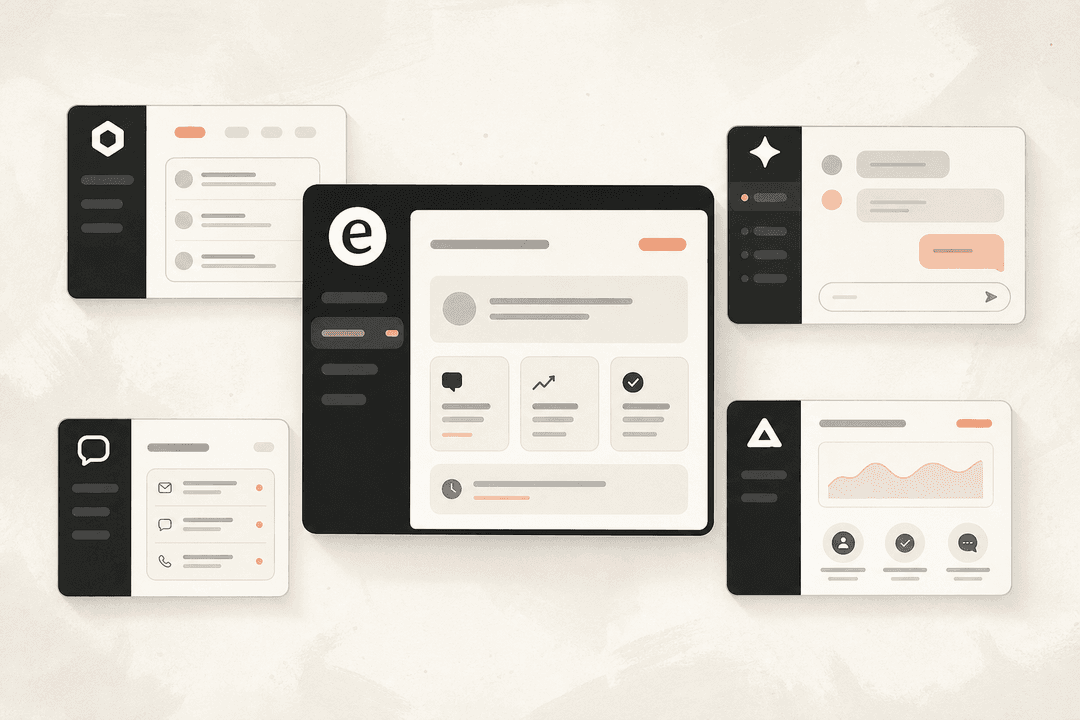
When you start, the interface is clean and simple. You have clear fields to enter your target keyword and your company’s URL. Once you provide the context, the tool generates a detailed outline for you to review before it writes the full post, giving you control over the final structure and direction of the content.

Promoting your educational blog and building a community
Writing a fantastic blog post is only half the job. If nobody sees it, it can't help anyone. Once you hit "publish," it's time to get the word out and start building a community around your content.
Using social media for promotion
Share your articles on the platforms where your target audience actually spends their time. For most B2B niches, that means LinkedIn and X (formerly Twitter). Don't just drop a link and disappear; add a personal thought or ask a question to get a conversation going.
Online communities on sites like Reddit can also be a great source of traffic, but you have to play by their rules. Be a helpful member of the community first. Answer questions and provide value, and only link to your content when it’s genuinely relevant and useful.
Expanding your reach with guest posts
Guest posting is when you write an article for another blog in your industry. It's a great way to get your name and expertise in front of a whole new, established audience. It can even be a less time-consuming way to build authority than trying to grow your own blog from scratch.
Do some digging to find reputable blogs in your niche that accept guest posts. Pitch them a few unique topic ideas that would be valuable to their readers, and be sure to highlight your own expertise on the subject.
Engaging readers to build loyalty
Your blog shouldn't be a monologue. When readers take the time to leave a comment or ask a question, make sure you respond. This is your chance to start a conversation and build a real relationship.
Engaging with your readers shows that you value their input and helps create a sense of community around your blog. Plus, their questions and feedback are an amazing source of inspiration for future content ideas.
To see these principles in action, check out this helpful video that walks through the process of getting started with your own educational blog.
A video explaining the first steps of educational blog writing and how to create your first post.
Turn your expertise into authority with educational blog writing
At the end of the day, successful educational blog writing boils down to a few key things: defining your niche, deeply understanding your audience, creating well-structured and genuinely helpful content, and promoting it effectively. It’s a marathon, not a sprint, but the payoff in trust and authority is huge.
Consistency is what separates blogs that grow from those that fizzle out. The more value you provide, the larger your readership will become. So, find your corner of the internet, start sharing what you know, and build something that lasts.
Ready to speed up your content creation? Generate your first blog post for free with the eesel AI blog writer and turn your expertise into high-ranking content.
Frequently Asked Questions
Share this post

Article by
Kenneth Pangan
Writer and marketer for over ten years, Kenneth Pangan splits his time between history, politics, and art with plenty of interruptions from his dogs demanding attention.