

Let's be honest, running an online store is a 24/7 gig. Your customers shop at all hours, and they expect answers right away, whether they're asking about a product at 2 PM or trying to find their order at 2 AM. For most support teams, this means being buried under a mountain of the same questions, day in and day out. It also means losing out on sales from shoppers who get stuck and leave because they couldn't get a quick answer.
This is where ecommerce chatbots can make a real difference. Forget the clunky, frustrating bots from a few years ago. Today’s AI assistants are smart enough to not only lighten the load on your support team but also help you make more sales. This guide will walk you through what they are, what they’re good at, the common traps to look out for, and how to pick the right one for your business.
What exactly are ecommerce chatbots?
At their core, modern ecommerce chatbots are AI-powered assistants that chat with customers on your online store. Think of them as your digital front-line team, ready to handle everything from sales questions to support requests.
You probably remember the old rule-based bots that felt like you were navigating an automated phone menu. They were rigid, easily confused, and could only answer a few pre-programmed questions. Today's chatbots are in a completely different league. They use natural language processing (NLP) and generative AI to understand what your customers are actually asking, even if there are typos or slang.
More importantly, they're much more than a fancy FAQ page. The best chatbots plug directly into your business systems. Imagine a bot connected to your Shopify store or your Gorgias helpdesk. It can perform actions like tracking an order, processing a return, or searching your product catalog to help a customer find the perfect gift. They act as a true extension of your team, just one that's available around the clock. The infographic below shows just how much they have evolved.
Key use cases and benefits of modern ecommerce chatbots
The right chatbot can improve things at multiple points in the customer journey, from the moment someone lands on your site to long after they’ve bought something. Here’s where they usually have the biggest impact.
Offer 24/7 instant customer support
Your customers have questions, and a lot of them are repeats: "Where is my order?", "What's your return policy?", "Do you ship to Canada?". A chatbot can answer these instantly, any time of day, without needing a coffee break.
This isn't just about being fast; it’s about making your team more effective. When a bot takes care of the simple, repetitive stuff, your human agents have more time to focus on the tricky conversations that need a personal touch. It’s a win-win: customers get instant answers, and your team gets to focus on more interesting work. In fact, research from IBM has shown that conversational AI can lower customer service costs by up to 30%.
Drive sales and increase conversions
Think of a great chatbot as a helpful personal shopper. It doesn't have to just sit there and wait for questions; it can guide users who are browsing. By asking a few smart questions, it can narrow down their options and suggest products by pulling information directly from your catalog.
One of the biggest wins here is tackling cart abandonment. We’ve all been there: a cart full of items, a last-minute question about shipping, and no one around to answer. A chatbot can pop up and engage someone who seems stuck or is about to leave, offering to help. This simple step can be surprisingly effective. Some studies even show that a proactive chat can lead to a 35% recovery rate for abandoned carts.
Automate the post-purchase experience
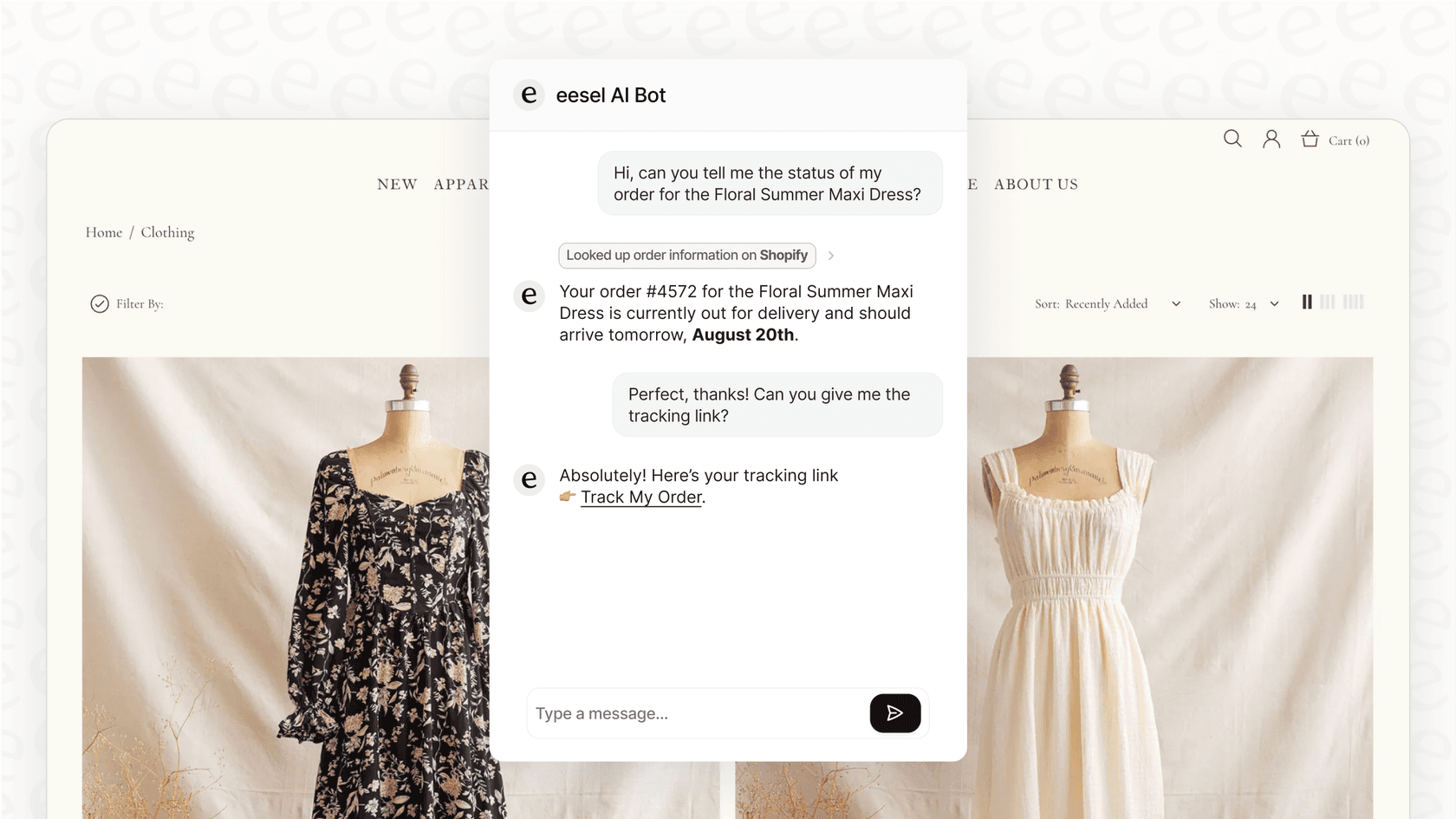
The moments after a customer clicks "buy" are really important. They’re excited, but they also might be a little anxious, wondering, "Did my order go through?" or "When will it ship?". A good chatbot can ease that anxiety by providing real-time order tracking, starting a return, or even processing a cancellation automatically.
This is where having deep integrations with your other tools is key. A chatbot needs to do more than just talk; it needs to take action. For example, a platform like eesel AI connects directly to your Shopify store. This lets it use specific tools to pull up order details or start a return, creating a smooth, self-serve experience that customers appreciate.
Gather valuable customer insights
Every conversation your chatbot has is a source of useful information. The chat logs give you direct, unfiltered feedback from your customers. Are people always asking about a specific product feature that’s missing from your descriptions? Are they confused about your shipping policy?
Looking at these interactions can show you common frustrations, gaps in your help articles, or even ideas for new products. It's a great way to get feedback that can help you make smarter business decisions, all without having to send out a single survey. The diagram below illustrates this valuable feedback loop.
Common challenges and limitations of ecommerce chatbots
Of course, not all chatbots are helpful. Many businesses have been burned by bad bot experiences, and it’s worth looking at why. Knowing the common pitfalls is the first step to finding a solution that actually works.
Lack of real integration and context
The most common complaint? A chatbot that can’t actually do anything. We've all dealt with bots that can't check inventory, look up an order, or do anything besides spit out a generic FAQ answer. They end the conversation with a frustrating, "Sorry, I can't help with that. Please email support."
This completely defeats the purpose. The customer is forced to switch to a different channel and explain their problem all over again, which is the exact opposite of a good experience. This usually happens when a chatbot is just a chat window sitting on top of your website, with no real connection to your other tools.
Risk of inaccurate or "hallucinated" answers
Another big fear is the "rogue AI" that just makes things up. Chatbots trained on random data from across the internet can give incorrect or weirdly off-brand information, which is a fast way to lose a customer's trust. Many business owners worry about what a bot might "hallucinate" when talking to a customer.
The solution is a chatbot that learns only from information you give it. For instance, eesel AI is designed to be trained only on your company's specific data, your help center, past support tickets, Shopify product details, and internal documents. This keeps every answer accurate, secure, and on-brand.
Poor escalation and unpredictable costs
A chatbot should know when to ask for help. One of the most annoying things for a customer is being trapped in a loop with a bot, unable to reach a person. On the other hand, a bot that passes every other question to an agent isn't very useful either. As one Reddit user put it, their bot had usage limits, and they couldn't control what was handled versus escalated, making it not "worth keeping."
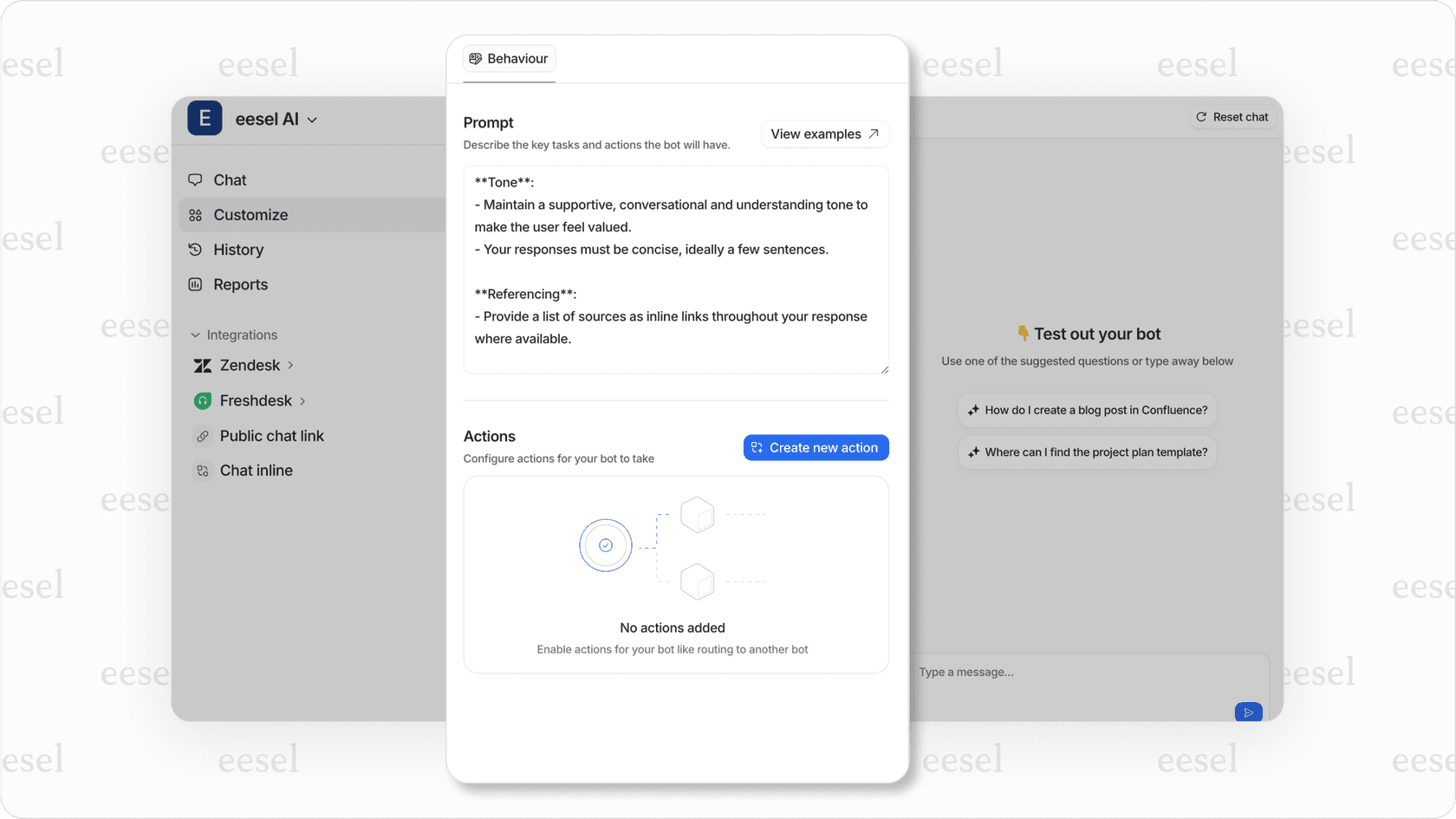
On top of that, pricing can be a minefield. Some platforms charge you for each agent and for each AI resolution, which can make your costs hard to predict. You need to have clear control over your escalation rules. With eesel AI, you can set up these rules directly in its prompt and actions settings, letting you fine-tune the workflow without any surprises.
Long and complex setup
Finally, many people assume that setting up a decent chatbot requires a team of developers and months of work. For some of the big, old-school platforms, that can be true. They often come with long sales processes, complicated setup, and need a lot of engineering help.
Thankfully, that's not the only option anymore. Modern, self-serve platforms are built to be fast. With eesel AI, you can connect your knowledge sources and helpdesks like Zendesk or Gorgias with one-click integrations and have it running in just a few minutes, not months.
How to choose the right ecommerce chatbot for your business
So, how do you find a chatbot that avoids these problems? Here’s a practical checklist to help you sort through your options.
-
It connects to your core tools: This is a must-have. The chatbot has to connect smoothly with your ecommerce platform (like Shopify) and your helpdesk. Don’t just ask if it "integrates"; ask if it can actually do things like look up orders, process returns, and update tickets.
-
You’re in control: You need to be in the driver's seat. A good platform will let you define the bot's tone of voice and, most importantly, the exact rules for when it should handle a query versus when it should pass it to a human. You should have full control over how it works.
-
Your data is safe: Your customer data is sensitive. Look for platforms that meet high security standards like SOC2 compliance and are GDPR-ready. A trustworthy company will never use your data to train general AI models for other businesses. This is a core part of eesel AI's security policy.
-
The pricing is clear: Find a pricing model that's easy to understand and grows with your business. Be careful with platforms that have hidden fees or complicated plans that make it impossible to guess your monthly bill.
Pro Tip: Always pick a platform that offers a simulation mode or a free trial. This lets you test the chatbot on your past support tickets to see how it would have performed and estimate your savings before you commit. eesel AI has this feature, so you can check its effectiveness without any risk.
Comparing pricing for leading ecommerce chatbots
Pricing models for ecommerce chatbots can be all over the place, and it's important to understand what you're paying for. Some platforms charge per agent, others by ticket volume, and some by the number of AI interactions. This can really change your total cost.
| Platform | Pricing Model | Starting Plan (Annual) | Key Considerations |
|---|---|---|---|
| eesel AI | Per interactions | Team Plan: $299/mo for 1,000 interactions | Unlimited users. The Business plan ($799/mo) adds crucial integrations and autonomous actions. |
| Gorgias | Per ticket volume | Basic: $50/mo for 300 tickets | AI resolutions are an extra add-on cost (e.g., $0.90 per resolution on the Pro plan). |
| Zendesk | Per agent seat | Suite Team: $55/agent/mo | Includes basic "Essential" AI agents, but advanced AI capabilities require a paid add-on. |
Get started with ecommerce chatbots that actually work
Modern ecommerce chatbots aren't just a nice-to-have anymore; they're a key part of driving sales and offering great support. But being successful with one means choosing a platform that avoids the common traps: bad integrations, no control, and wrong answers.
The best way to get started is with a tool that plugs right into your existing setup, gives you full control from day one, and lets you prove its value without any risk. eesel AI was built from the ground up to do just that. It connects to your tools in minutes and has been shown to automatically resolve up to 81% of support conversations.
Ready to see how an AI chatbot can improve your ecommerce support? Start your free eesel AI trial and see it in action today.

Frequently asked questions
Modern ecommerce chatbots use AI and natural language processing to understand complex queries, unlike older rule-based bots that were rigid. They can also connect to your business systems to perform actions like tracking orders or processing returns, offering a much richer, more interactive experience.
Yes, absolutely. Beyond instant support, effective ecommerce chatbots can proactively engage shoppers, answer product questions, and address last-minute concerns, significantly helping to reduce cart abandonment and increase conversion rates. They act as a [digital sales assistant](https://www.eesel.ai/blog/e-commerce-ai-assistant) guiding customers.
A primary risk is receiving inaccurate or "hallucinated" answers from bots trained on unverified external data. To mitigate this, choose ecommerce chatbots that are exclusively trained on your specific company data, like your help center and product catalog, ensuring reliable and on-brand information.
Yes, [deep integration is crucial](https://www.hellorep.ai/) for ecommerce chatbots to be truly effective. Without connections to your ecommerce platform and helpdesk, they can only offer generic answers and cannot perform actions like looking up orders or initiating returns, which defeats their primary purpose.
Modern platforms like eesel AI are designed for quick setup, often within minutes, using one-click integrations with tools like Shopify or Zendesk. You no longer need extensive developer input or months of work to deploy advanced ecommerce chatbots.
With the right platform, you should have extensive control over your ecommerce chatbots. This includes defining their tone, setting precise rules for when they handle a query, and establishing clear escalation paths to human agents, preventing customers from getting stuck.
Look for platforms that adhere to high security standards like SOC2 compliance and GDPR readiness. A reputable provider of ecommerce chatbots will explicitly state that your data is never used to train general AI models for other businesses, ensuring your sensitive customer information remains private and secure.
Share this article

Article by
Kenneth Pangan
Writer and marketer for over ten years, Kenneth Pangan splits his time between history, politics, and art with plenty of interruptions from his dogs demanding attention.
