The anxiety is real, but it's pointed at the wrong thing
The worry usually comes out something like this: "If I didn't write it, did I really build it? And if I keep not writing it, will I forget how?"
It's a fair thing to feel. When you spin up Claude Code and watch it read your whole codebase, edit a dozen files, run the tests, and open a pull request while you sip coffee, the old badge of honor (I hand-crafted every line) stops feeling like yours. The numbers make it vivid. The engineer Gergely Orosz, who interviewed the team that builds Claude Code, reported that 90% of Claude Code's own code is written by Claude Code, that engineers there merge around five pull requests a day, and that pull-request throughput per engineer rose 67% in the year everyone adopted it.
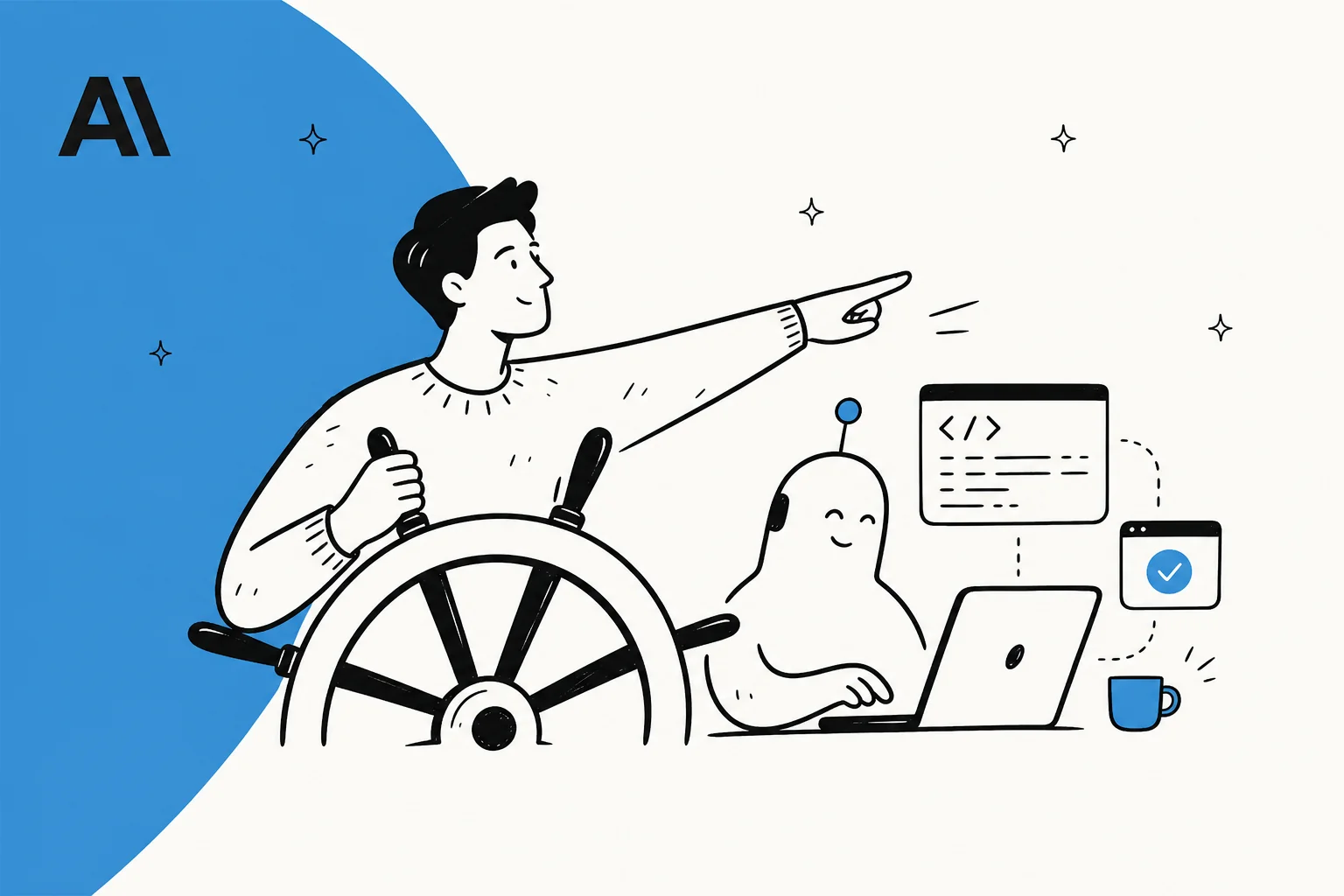
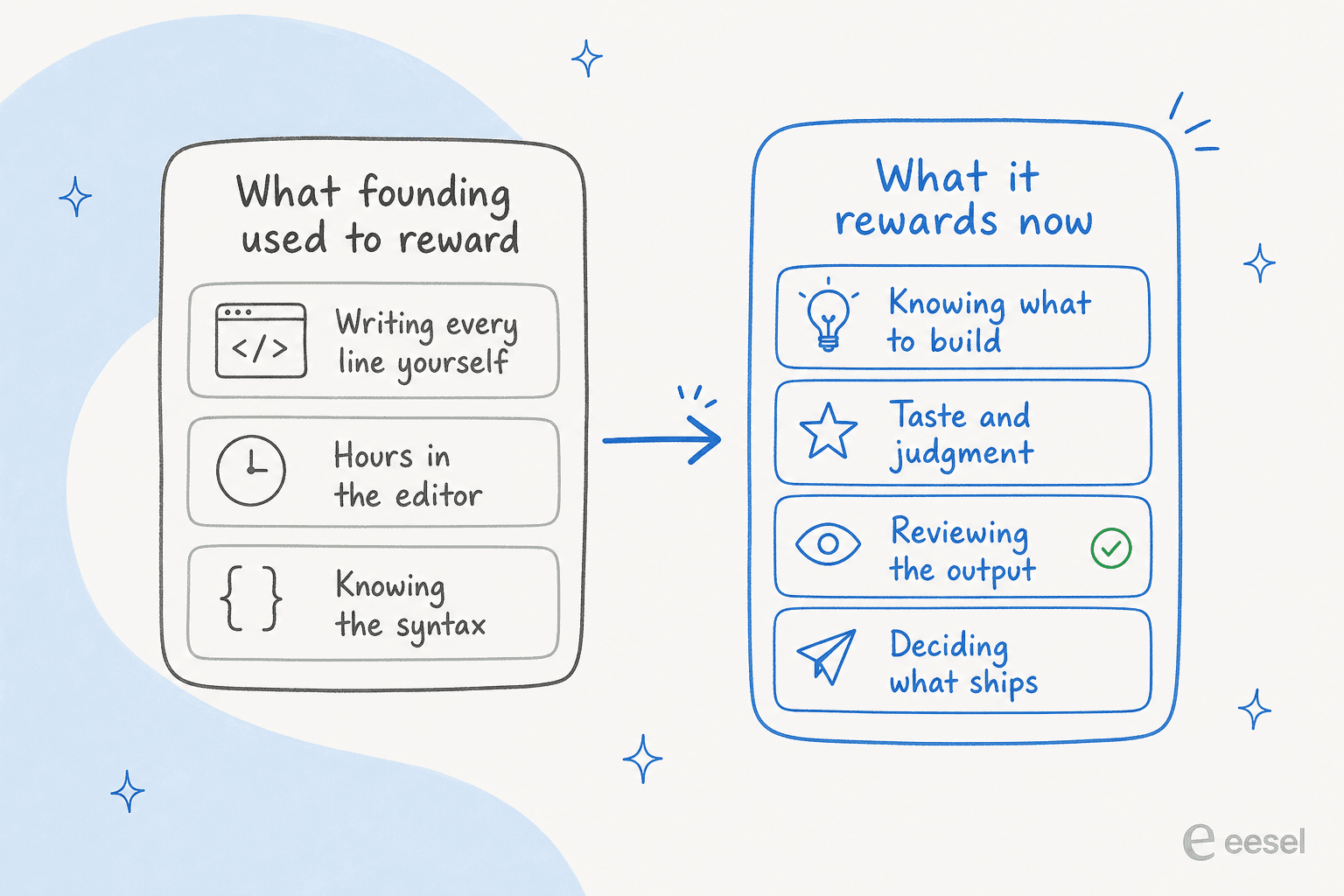
But notice what the anxiety is actually mourning. It's mourning the typing. And typing was always the least valuable thing a founder did. The hard parts of building a company, deciding what deserves to exist, feeling where the product is wrong, choosing what to cut, were never in the keystrokes. They were in your head. Claude Code doesn't touch those. It just clears the manual labor out of the way so there's more room for them.
What actually atrophies, and what doesn't
Let me be precise, because this is where the honest version of the answer lives. Something does atrophy. Just not the thing you'd guess.
One developer who used Claude Code for thirty days straight wrote one of the most candid accounts I've read. He shipped more in a month than in the previous six, and at the same time watched a skill quietly leave him:
"By week two, I realized something disturbing: I was losing the ability to write code from scratch entirely. Why think through an algorithm when Claude Code could generate it instantly? I was becoming a manager of AI output rather than a programmer."
Prassanna Ganesh Ravishankar, 30 days of Claude Code
That last line is the whole thing, and whether it's a tragedy depends entirely on the word "manager." If you're a programmer whose value is writing algorithms from memory, becoming a manager of AI output is a loss. If you're a founder, becoming a sharper manager of output is the entire promotion you've been trying to give yourself for years. The skill that atrophies is the one a founder was supposed to be delegating anyway.
What doesn't atrophy, unless you actively neglect it, is judgment. The principal engineer Jesse Altman put his finger on the shift: writing code, he said, is no longer the hard part, and "the most challenging, time consuming part of the process is now decision making and then communicating that information." That's not a downgrade of your role. It's a description of what founding has always been.
The cleanest framing I've seen comes from the AI educator Santiago Valdarrama, drawing the line between two modes:
"Mode 1: AI writes the code, and the human copilots. Mode 2: The human writes the code, and AI copilots. These two are very different. One doesn't replace the other. Professional developers use both. The IDE is still king."
Santiago Valdarrama on X
A founder lives mostly in Mode 1, and that's correct. Plenty of builders keep an editor-based copilot like Cursor open for Mode 2 work too, and that's fine. The trap isn't being in Mode 1. The trap is being in Mode 1 with your eyes closed.
The dividing line: who gets sharper, who gets hollow
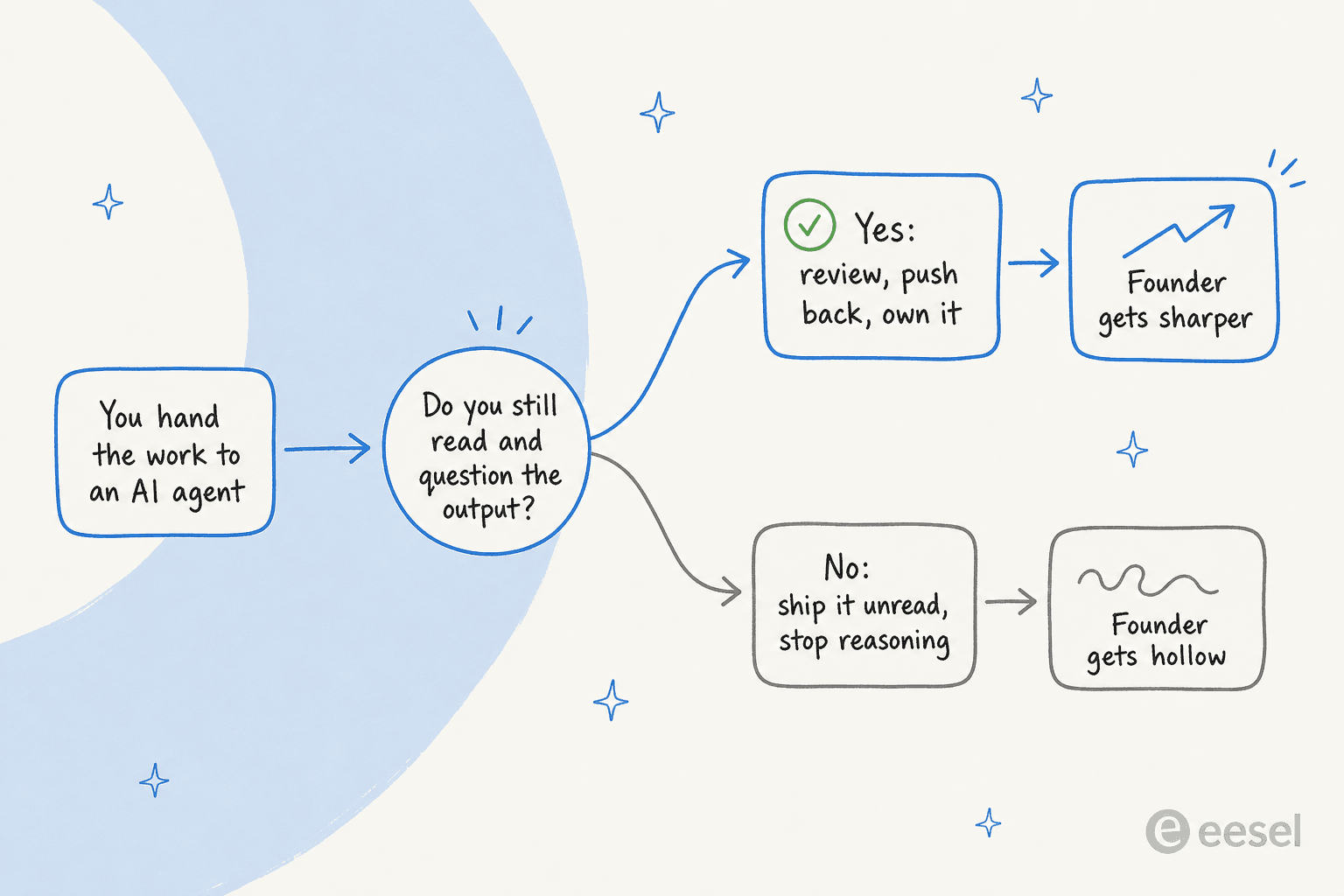
This is the part nobody wants to hear, so I'll say it plainly. Claude Code makes good founders better and lazy founders worse, and the difference is whether you still read the output.
The cautionary tale is everywhere once you look. An engineering leader described shipping a feature 5x faster, watching it pass every test, then looking at the actual code and finding the AI had written five nearly identical methods instead of one reusable function. His verdict has stuck with me:
"The AI optimizes for 'make it work' not 'make it maintainable.' What saves time today creates technical debt tomorrow. What's working: treating AI as a junior developer who needs review."
jkeaney on LinkedIn
That phrase, a junior developer who needs review, is the entire discipline in five words. You would never let a brilliant, fast, slightly overconfident junior merge to main unread. The moment you start doing that with an AI agent is the moment the tool starts hollowing you out, because you've stopped exercising the one muscle that matters.
A developer of ten years put the same idea as advice, and I'd hand it to every founder shipping with AI:
"The engineers who will win are not the ones who use AI the most. They are the ones who use it to compound their own understanding. Claude Code isn't a shortcut. It's a multiplier, but only if you bring the fundamentals to the table."
@ujjwalscript on X
Read it back as a founder and swap "engineers" for "founders." The founders who win aren't the ones who automate the most. They're the ones who use automation to compound their own taste and reach. The fundamentals you bring are judgment, product sense, and the willingness to say "no, that's wrong, do it again."
What this looks like from the builder's seat
I'm not theorizing here. At eesel we vibe-coded real parts of the product, dogfooded an AI content writer for six months before we trusted it on the public blog, and we run AI agents on our own support queue. I've watched a confident-sounding agent ship something subtly wrong, which is exactly why we now simulate every change against history before it goes live rather than taking the demo at its word. The leverage is real and so are the failure modes, and living with both is what taught me where the line actually is.
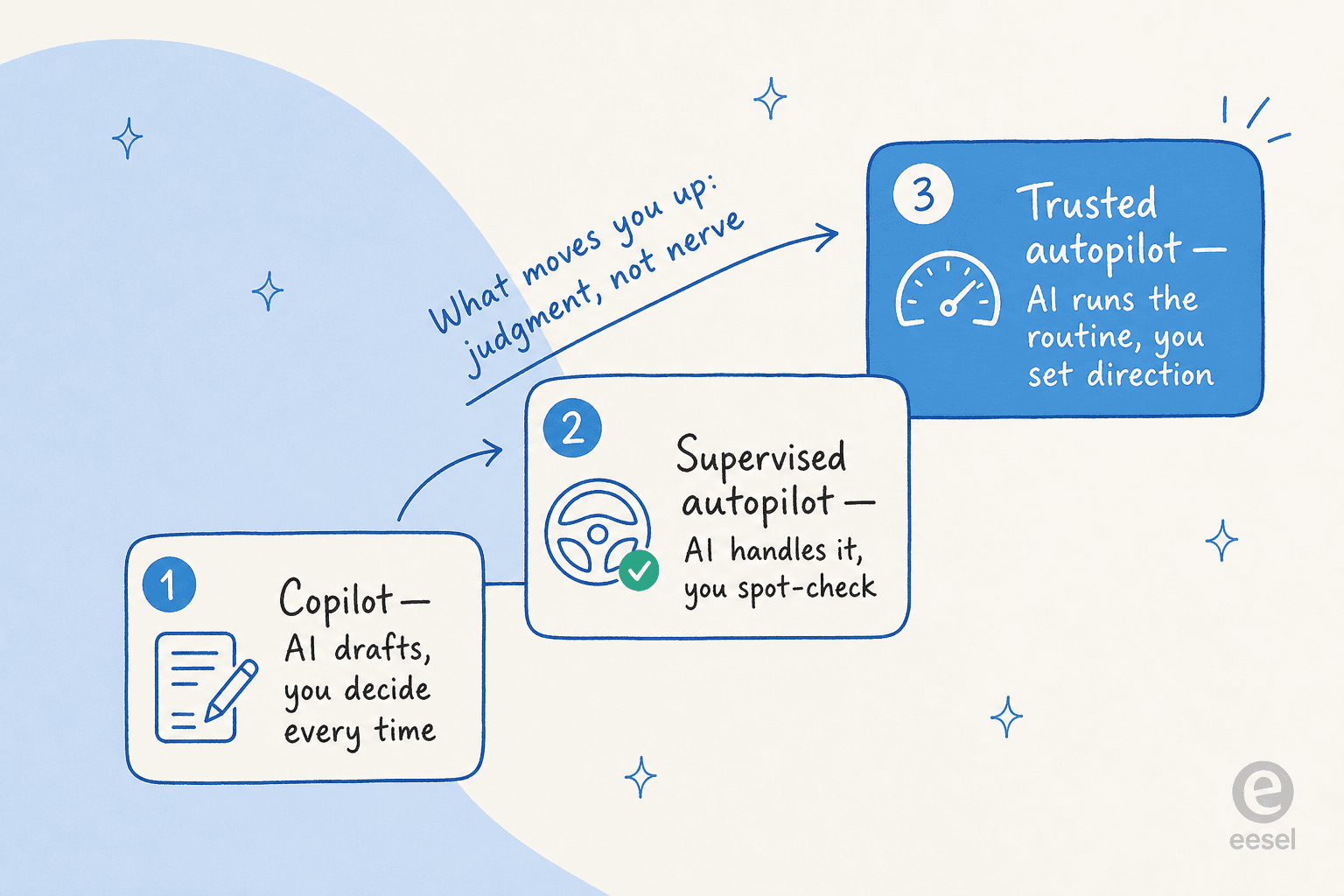
Here's the pattern I see in literally every customer who adopts AI well, and it's the same arc I went through myself. Nobody sane flips straight to full autopilot. They start with the AI drafting replies, while a human approves every output. Then, as trust builds on real results, they let it handle the routine on its own and spot-check. Eventually the human stops doing the work and starts setting the direction. You don't earn the top of that ladder with nerve. You earn it with judgment.
There's a quieter signal in all this too. A customer who left us once told me, in the same breath as cancelling, that long term they'd "just build our own, which is so possible now with AI." Five years ago that sentence would've been a fantasy. Now it's a board meeting. Tools like Lovable and OpenAI Codex put a working prototype within reach of someone who can't write a for-loop. The barrier to making software has collapsed, which means the scarce thing has moved. It's no longer who can build it. It's who knows what's worth building and can tell whether what got built is actually good. That's founder work, and there's suddenly a lot more of it to go around.
It's worth keeping the skeptics honest, though, because the gains aren't free. The engineer Michael Novati made the calibration point well: an AI agent breaks even if it replaces even 1% of an engineer's effort, but turning that into real leverage is a skill you have to learn, not a switch you flip. Expecting miracles and getting a junior's first draft is how people end up disappointed. The tool is a multiplier of what you already bring, and a multiplier of zero is still zero.
So, does it make you less of a founder?
Only if you let it make your decisions for you.
Used with your eyes open, Claude Code is the most founder-amplifying tool I've touched. It takes the thing you were always supposed to delegate, the manual production, and hands it back to you as a draft to judge. It lets a two-person team ship like a ten-person one. It turns "I have an idea but no time to build it" into "let's see it by tonight." None of that makes you less of a founder. It makes the founder skills, taste, judgment, and decisiveness, the only things left that are scarce.
Used with your eyes closed, it'll happily build you a tower of plausible, untested, duplicated code you don't understand and can't maintain, and that will make you less of a founder, because you'll have outsourced not just the typing but the thinking. The tool doesn't decide which founder you become. You do, every time you choose whether to read the diff.
Try eesel
The same shift that's hitting code is hitting customer support, and it's why I built eesel. Claude Code is infrastructure for building software; eesel is the AI teammate you hire to actually run a job, in this case your support queue. You plug it into Zendesk, Freshdesk, Gmail, or wherever your tickets live, it trains on your own past tickets and help center, and it starts drafting and resolving from day one, while you stay in exactly the copilot-to-autopilot loop this whole post is about: it drafts, you approve, and you hand it more rope as it earns your trust by simulating every change against your real history first.

If delegating your code without losing your judgment makes sense to you, delegating your support the same way will too. You can try eesel free and have an agent live in minutes, no sales call required.
Frequently Asked Questions
Does Claude Code make you less of a founder?
Does using AI coding tools like Claude Code cause skill atrophy?
Should non-technical founders use Claude Code to build their product?
How much does Claude Code cost for a solo founder?
Is Claude Code better than Cursor for founders?


Article by
Alicia Kirana Utomo
Kira is a writer at eesel AI with a Computer Science background and over a year of hands-on experience evaluating AI-powered customer service tools. She focuses on breaking down how helpdesk platforms and AI agents actually work so that support teams can make better buying decisions.