Choosing knowledge base software feels like picking a long-term partner for your documentation. Get it right, and your team produces helpful content that actually reduces support tickets. Get it wrong, and you're stuck with a clunky editor, frustrated writers, and customers who still can't find answers.
Document360 and Helpjuice are two established players in this space, both founded in 2011 but with different philosophies. Document360 positions itself as an AI-powered documentation suite for enterprises. Helpjuice emphasizes customization and white-glove service. Both have thousands of customers, but which one fits your team?
Let's break down what each platform actually offers, how they compare on pricing and features, and who should choose which tool.
What is Document360?
Document360 is a knowledge base platform developed by Kovai, a UK-based company. It targets mid-size to enterprise companies that need to create, manage, and publish documentation at scale. Think user manuals, API documentation, standard operating procedures, and customer help centers.
The platform emphasizes AI features. Document360's "Eddy AI" powers search, writing assistance, chatbots, and even text-to-audio conversion. The company claims its AI search delivers answers in under a minute, improving SLA compliance.
Document360 serves thousands of businesses across 150+ countries. Notable customers include McDonald's, VMware, Virgin Red, Ticketmaster, NHS, and Gong. The platform holds a 4.7/5 rating on Capterra and ranks as a Leader on G2.
What is Helpjuice?
Helpjuice calls itself "the knowledge base platform engineered for growing companies." Founded in 2011 and based in the US, Helpjuice serves over 130,000 users from 8,500+ knowledge bases.
The platform's core pitch centers on customization and service. When you sign up, Helpjuice handcrafts your knowledge base design, manually skinning it until it's pixel-perfect. This "white-glove" approach extends to their customer support, with an average response time of about 2 minutes.
Helpjuice also emphasizes AI, with features like "Swifty" AI search, AI article writing, and a Chrome extension called Wizardshot that automatically creates step-by-step tutorials from screen recordings. The platform supports 50+ languages with AI translation to 40+ languages.
Notable customers include Amazon, Bank of America, Virgin, TCL, Shipt, Hertz, and the World Health Organization. Helpjuice maintains a 4.8/5 rating on Capterra and 4.5/5 on G2.
Document360 vs Helpjuice: Feature comparison
Both platforms cover the basics: WYSIWYG editors, version control, analytics, and integrations. But they differ in approach and execution.
Content creation and editing
Document360 offers dual editor support: both Markdown and an Advanced WYSIWYG editor. The company claims this improves editing speed by up to 30%. You also get reusable content blocks, global find and replace, and template management on all plans.
Helpjuice provides a visual WYSIWYG editor plus direct HTML/CSS access for deeper customization. The platform includes live collaboration, scheduled publishing, and an article planner that works like a Kanban board. Version history and content reuse features come standard.
AI capabilities
Document360's AI suite includes:
- AI Search: ChatGPT-style instant answers from your knowledge base
- AI Writing Agent: Generate documentation from video, text, audio, or prompts
- AI Chatbot: 24/7 documentation-driven support
- AI Glossary: Auto-generate glossaries to explain technical terms
- Text to Audio: Convert documents to natural-sounding audio
- Article Summarizer: Create concise summaries of complex content
Helpjuice's AI suite (available on higher-tier plans) includes:
- AI Writer: Generate articles from topics or bullet points
- AI Search (Swifty): Context-aware search that understands intent
- AI Chatbot: Real-time answers from your knowledge base
- AI Article Translation: One-click translation to 40+ languages
- AI Step-by-Step Tutorial Builder: Create visual interactive tutorials
- Wizardshot: Chrome extension that auto-creates tutorials from screen recordings
Search functionality
Both platforms promise intelligent search. Document360 emphasizes AI-powered search with typo tolerance and synonym recognition. Helpjuice focuses on contextual understanding through "Swifty AI," which claims to understand what users mean even when their spelling isn't perfect.
Customization and branding
Document360 allows custom domains, site branding, SEO settings, and custom CSS/JavaScript on all plans. The platform provides standard themes and customization options.
Helpjuice goes deeper. Every plan includes "fully customized" design where their team manually skins your knowledge base. Higher tiers add unlimited customization credits (valued at $1 million on the top tier). You get both a visual editor and direct code access.
Integrations
| Category | Document360 | Helpjuice |
|---|---|---|
| Helpdesk | Zendesk, Freshdesk, Freshservice, Intercom | Zendesk, HelpScout |
| Communication | Slack, Microsoft Teams, Drift | Slack |
| CRM | Salesforce | Salesforce |
| Translation | Crowdin, Phrase | Built-in AI translation |
| Automation | Zapier, Make | - |
| Version Control | GitHub | - |
Document360 offers more integration options, particularly for helpdesk and automation tools. Helpjuice focuses on the essentials but adds built-in translation capabilities that Document360 handles through third-party services.
Document360 vs Helpjuice: Pricing comparison
This is where the two platforms diverge significantly.
Document360 pricing
Document360 uses quote-based pricing. The company doesn't publish specific prices on its website. Instead, you contact sales for a custom quote based on your needs.
| Plan | Pricing | Key Features | Notable Limitations |
|---|---|---|---|
| Professional | Quote-based | Core KB features, standard analytics, SSL, SOC 2 | No approval workflows, no backup/restore, limited integrations |
| Business | Quote-based | Adds approval workflows, backup/restore, Zendesk/Slack/Teams integrations | No Salesforce integration, no search within attachments |
| Enterprise | Quote-based | All features including Salesforce, custom email domain, IP restrictions, search within attachments | - |
Document360 offers a 14-day free trial with full feature access. Payment options include credit cards, debit cards, and bank transfer.
Helpjuice pricing
Helpjuice publishes transparent pricing with three tiers:
| Plan | Monthly Price | Users | Storage | AI Suite | Key Features |
|---|---|---|---|---|---|
| Knowledge Base | $249/mo | 30 | 12GB | Not included | Essential features, customization, live collaboration, AI article translation (40+ languages) |
| AI-Knowledge Base | $449/mo | 100 | 24GB | Included | All previous + SSO, AI Writer, AI Search, AI Chatbot, Auto-Updating Chrome Extension, Tutorial Builder |
| Unlimited AI-Knowledge Base | $799/mo | Unlimited | 38GB | Included | All previous + unlimited customization credits |
The AI Suite includes: AI Writer, AI Search, AI Chatbot, Auto-Updating KB Chrome Extension, Step-by-Step Tutorial Builder, AI Article Request, AI-Support Tickets, and Article Creation via AI.
Helpjuice offers a 14-day free trial with no credit card required. The company also provides free migration support from Document360, Zendesk, Confluence, and HelpScout within 24 hours.
Value analysis
Document360's opaque pricing makes direct comparison difficult. If you prefer predictable costs and need to budget accurately, Helpjuice's published tiers offer clarity. However, Document360 may offer better value for very large deployments where custom pricing could beat Helpjuice's per-user model.
Helpjuice's per-user pricing can become expensive as you scale. Moving from 30 users ($249/mo) to 100 users ($449/mo) nearly doubles your cost. The jump to unlimited users ($799/mo) is significant but potentially cost-effective for large organizations.
User experience and reviews
Both platforms receive strong ratings from users, with slight variations across review sites.
| Platform | Document360 | Helpjuice |
|---|---|---|
| TrustRadius | 9.2/10 | 8.9/10 |
| Capterra | 4.7/5 | 4.8/5 |
| G2 | Leader | 4.5/5 |
| User Satisfaction | 93% recommend | 94% recommend |
What users praise
Document360:
- Intuitive interface requiring minimal training
- Powerful search functionality
- Comprehensive analytics and reporting
- Excellent customer support (4.8/5 rating)
- Strong version control and workflow features
Helpjuice:
- Exceptional customization capabilities
- Responsive customer support (~2 minute response time)
- Powerful AI translation features
- Clean, user-friendly interface
- Effective search functionality
What users criticize
Document360:
- Opaque pricing requires contacting sales
- Some users report the editor can be buggy with media handling
- Limited integration options compared to competitors
- Approval workflows only on Business tier+
Helpjuice:
- AI Suite only available on $449+/mo plans
- Per-user pricing model gets expensive for growing teams
- Some users find the editor limited compared to dedicated writing tools
- Storage caps (12GB-38GB) may constrain media-heavy knowledge bases
Document360 vs Helpjuice: Which should you choose?
The right choice depends on your priorities, team size, and budget approach.
Choose Document360 if:
- You need robust version control and approval workflows for compliance-heavy industries
- You want AI features included without jumping to a higher pricing tier
- You prefer a quote-based pricing model that might offer volume discounts
- You need extensive integrations with helpdesk and automation tools
- You're building API documentation or technical docs that benefit from GitHub sync
Choose Helpjuice if:
- Deep customization and brand alignment are top priorities
- You need multilingual support with AI translation to 40+ languages
- You want white-glove onboarding and design assistance
- You have a smaller team (30 users or fewer) where the $249/mo entry point works
- You value transparent, published pricing over negotiating custom quotes
An alternative approach: AI-powered customer support with eesel AI
Knowledge bases are only useful if people actually use them. Even the best documentation doesn't help if customers can't find answers and still open support tickets.
We take a different approach at eesel AI. Instead of just storing knowledge, we built an AI teammate that actively resolves customer issues.
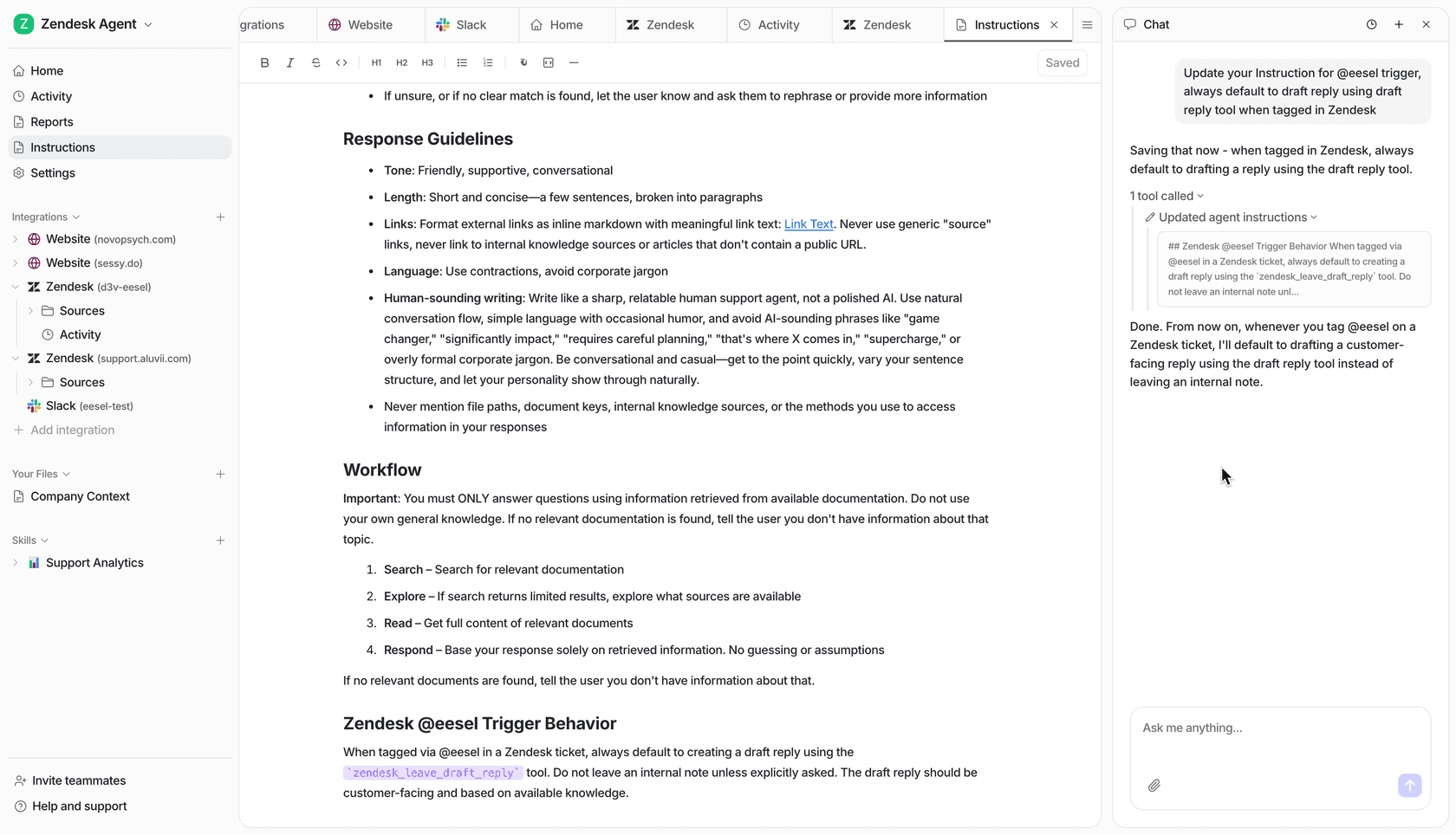
Here's how it works. You connect eesel AI to your help desk (Zendesk, Freshdesk, Intercom, Gorgias, whatever you use). It reads your past tickets, help center articles, and connected docs. Within minutes, it understands your business, your tone, and your common issues.
Then eesel AI starts handling frontline support. It drafts replies for your agents to review. Once you're confident in its performance, you let it send responses directly. Mature deployments achieve up to 81% autonomous resolution, with typical payback periods under two months.
The difference is that Document360 and Helpjuice help you create documentation, while eesel AI helps you eliminate the need for customers to read it by resolving their issues directly.
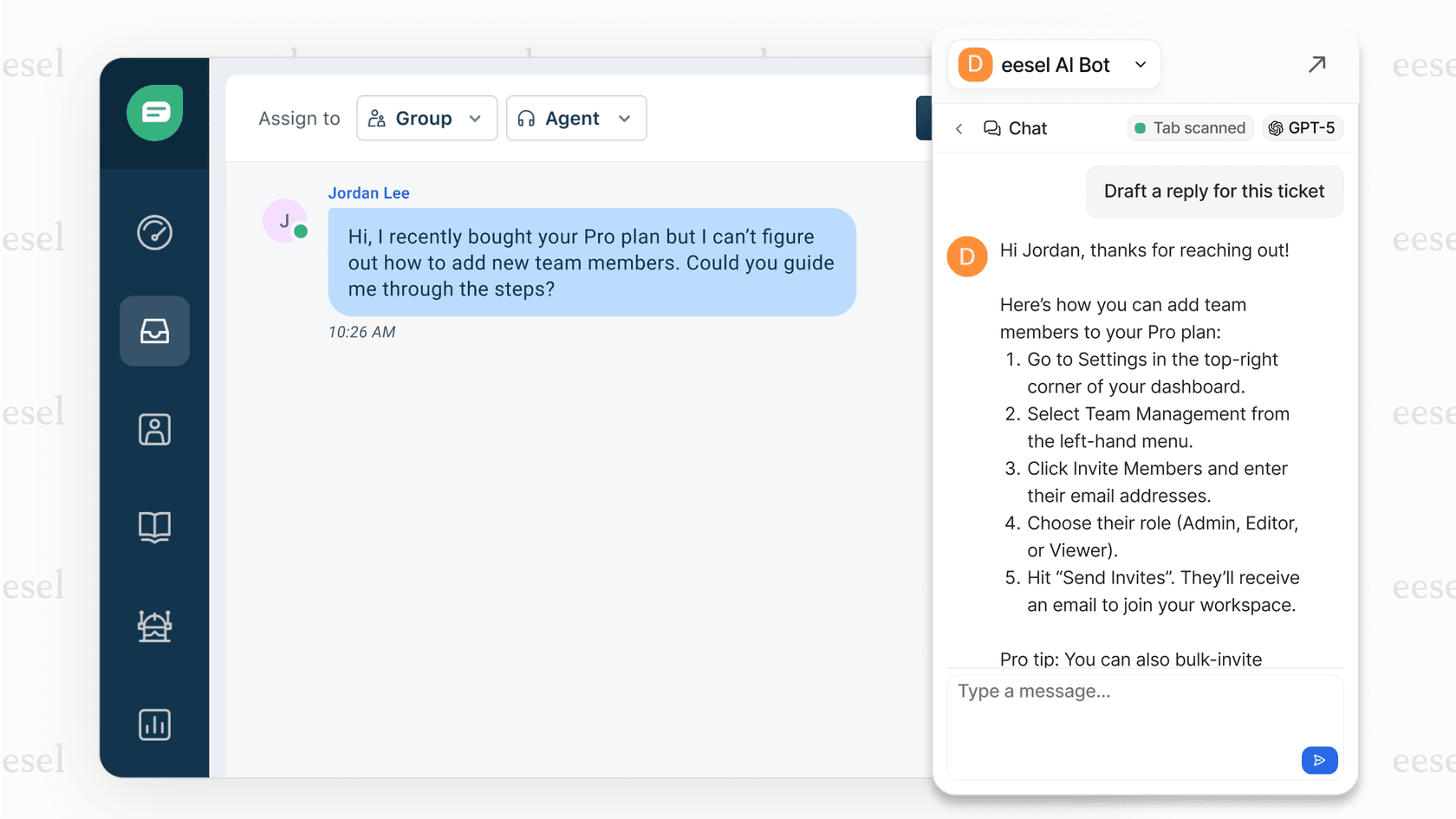
You can start with guidance: have eesel AI draft replies that agents review before sending. As it proves itself, you expand its scope until it's handling full frontline support 24/7. You define escalation rules in plain English, like "always escalate billing disputes to a human" or "for VIP customers, CC the account manager."
If you're evaluating knowledge base software because you want to reduce support tickets, it might be worth asking whether a knowledge base is the right solution. Sometimes the better answer is an AI teammate that handles the tickets directly.