


It's pretty amazing to watch an AI generate an image from a simple text prompt. But it's even more fun when you do it with other people. That's what's happening on Discord right now. Teams are brainstorming ad visuals, online communities are making art together, and friends are just bringing goofy ideas to life, all in real time. You can feel the energy when someone types a prompt and everyone reacts instantly.
But actually getting DALL·E 3 to work inside your Discord server isn't always a walk in the park. You have a few different paths you can take, and each one comes with its own set of trade-offs around effort, control, and security. This guide is here to walk you through the options for creating Discord integrations with DALL·E 3. We'll look at the good, the bad, and the genuinely tricky parts, so you can figure out what makes the most sense for your server, whether it’s for a group of friends or for your business.
What are Discord integrations with DALL·E 3?
Before we get into the "how," let's do a quick refresh on the "what." Knowing the two main parts of this equation makes the rest of the process much easier to follow.
A quick look at DALL·E 3
DALL·E 3 is OpenAI's latest and greatest text-to-image model. What makes it special is how well it understands detailed and subtle prompts. You can throw something complex at it like, "an impressionist oil painting of a capybara sitting in a field of tulips at sunrise," and it will actually nail the request, right down to the artistic style. Since it’s built right into ChatGPT Plus, it's gone from a niche tool to something millions of people can play with.
How Discord integrations with DALL·E 3 work
Think of Discord integrations as third-party apps and bots you can add to your server to give it new abilities. You've probably already used them for server moderation, playing music, or running polls. In our case, an integration acts as a middleman, connecting your Discord server to an external service like OpenAI's API. When you type a command in a channel, the bot grabs it, sends a request to the DALL·E 3 API, and then posts the finished image back in the chat for everyone to see.
Three ways to create Discord integrations with DALL·E 3
Alright, so you want to get DALL·E 3 up and running on your server. When you boil it down, you have three main options. Let's take a look at each one.
Option 1: Build a custom bot
This is the route for anyone who's comfortable with code and isn't afraid of a challenge. It means writing your own application from scratch, probably in a language like Python or JavaScript, to link the OpenAI API with the Discord API.
-
Pros: You get complete control. Every feature, every command, and every little interaction can be built exactly how you want it. You're the one in charge, and the only real limit is your coding ability.
-
Cons: This path is full of technical headaches. You need a good grasp of programming, API authentication, and how to handle errors when they pop up. A quick search through developer forums shows people wrestling with weird 403 errors that aren't even in the official documentation, dependency issues, and the need to constantly update things as both Discord and OpenAI make changes. It’s not a one-and-done project; it’s a serious time commitment.
Option 2: Use no-code or low-code platforms
If coding isn't your strong suit, you might look at visual automation platforms like Make, Latenode, or Pipedream. These tools let you connect different apps by dragging and dropping blocks to create workflows.
-
Pros: They definitely make things more accessible if you're not a developer. You don't have to write code to connect the APIs, and you can get a basic integration running fairly quickly with their pre-built connectors.
-
Cons: Just because there's no code doesn't mean there's no complexity. These workflows can turn into a messy web of nodes, triggers, and filters that are just as confusing to debug as a page of code. The learning curve can be surprisingly steep, and trying to fix a broken connection in a visual editor can be a real pain. On top of that, their pricing is often based on how many "tasks" or "operations" you use, which can make your costs unpredictable and expensive if your server gets busy.
Option 3: Use pre-built public bots
The fastest and simplest way to get going is to find a bot on a marketplace like Top.gg that already has DALL·E 3 built-in and just invite it to your server.
-
Pros: It’s almost instant. A few clicks, and the bot is on your server, ready for prompts. You don't need any technical skills at all.
-
Cons: You're stuck with what you get. Customization is either minimal or non-existent. You have to use the bot's commands, its branding, and live with its limitations. More importantly, you're handing your data to a third-party developer. For a casual community server, that might not be a big deal, but for a business, it's a huge security and privacy risk. Who's seeing your prompts? How are they using your data? Many of these bots also use a freemium model, meaning the best features are often hidden behind a paywall.
Key considerations for your integration
Picking how to build your integration isn't just about choosing the easiest option. You have to think about what it will mean for your server and your team in the long run.
Setup time and maintenance
A custom bot might take you weeks to build and will need regular updates. A no-code tool can seem fast, but setting up and testing a solid workflow can still take days, and you're counting on the platform to stay up and running. The hidden cost of maintenance is a real thing; when an API changes or a service has an outage, you're the one who has to fix it.
This is a big difference compared to a truly self-serve platform that’s designed to be ready in minutes. The best solution takes care of all the backend stuff for you, letting you focus on what the bot does, not how it works.
Customization, control, and context
A generic bot only understands one thing: a command to make a picture. But what if you need it to do more? What if you want your bot to sound like it fits your company's brand? Or what if you want it to check an internal style guide before it even thinks about writing a prompt for DALL·E 3?
This is where most pre-built and simple no-code tools just can't keep up. A really useful AI assistant needs to be more than just a command-line tool; it needs to understand your specific knowledge and context.
Security, privacy, and business use
If you're using Discord for business, this should be your number one concern. When your team is brainstorming ideas for a new product or a marketing campaign, those prompts are sensitive company information.
You need to ask some tough questions:
-
Where are my prompts and the images being stored?
-
Is my data being used to train another company's AI model?
-
Does this tool meet basic security standards like GDPR?
Public bots and general-purpose automation platforms often don't have the kind of security and data privacy features that a business needs. Your data is one of your most valuable assets, so you shouldn't hand it over to a tool that doesn't protect it.
A better approach: Building an integrated AI assistant
A simple DALL·E 3 bot is a fun toy. But a business needs an AI assistant that does more than just make pretty pictures. You need an assistant that understands your entire company's context, connects to your other tools, and actually helps your team get work done.
This is where a platform like eesel AI comes into the picture. While it can power AI interactions in chat tools like Discord or Slack, its real strength is its ability to pull all your scattered knowledge together and turn it into a helpful assistant.
Unify your knowledge for smarter integrations
Instead of just sitting in a silo, eesel AI connects to all your company's knowledge sources with a single click. Think about your pages in Confluence, files in Google Docs, old support tickets, and internal wikis. This gives the AI the background information it needs to be genuinely useful.
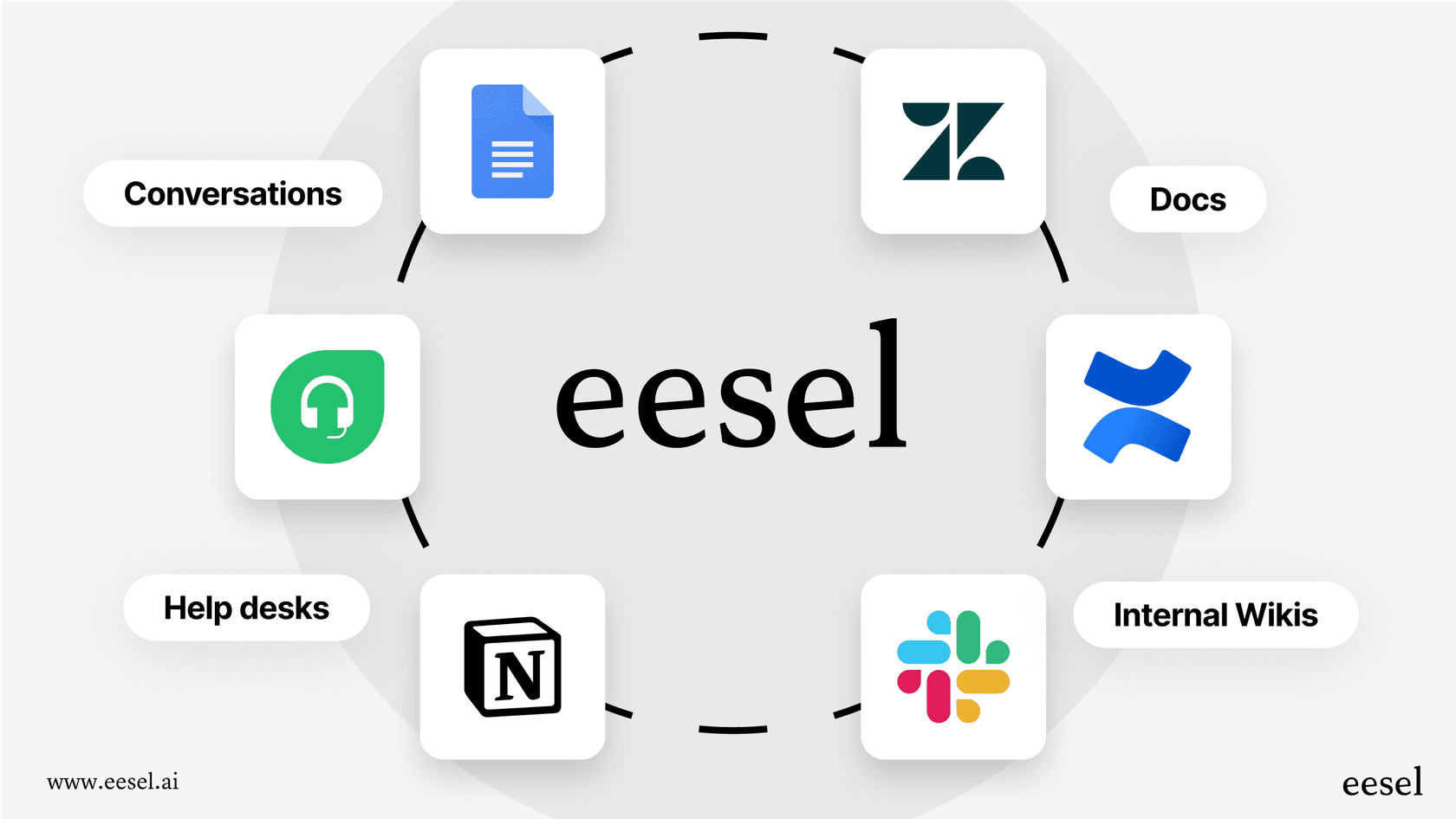
For example, a marketing team using Discord could ask: "Generate a DALL·E 3 image for our summer sale, and make sure it follows the brand guidelines on our Confluence page."
A normal bot can't do that. It has no idea what your brand guidelines are. But eesel AI can access that Confluence page, understand what's in it, and use that info to write a much better, more relevant DALL·E 3 prompt.
Go beyond answers with custom actions
A smart assistant doesn't just talk; it does things. eesel AI includes a customizable workflow engine that lets it take action in your other tools.
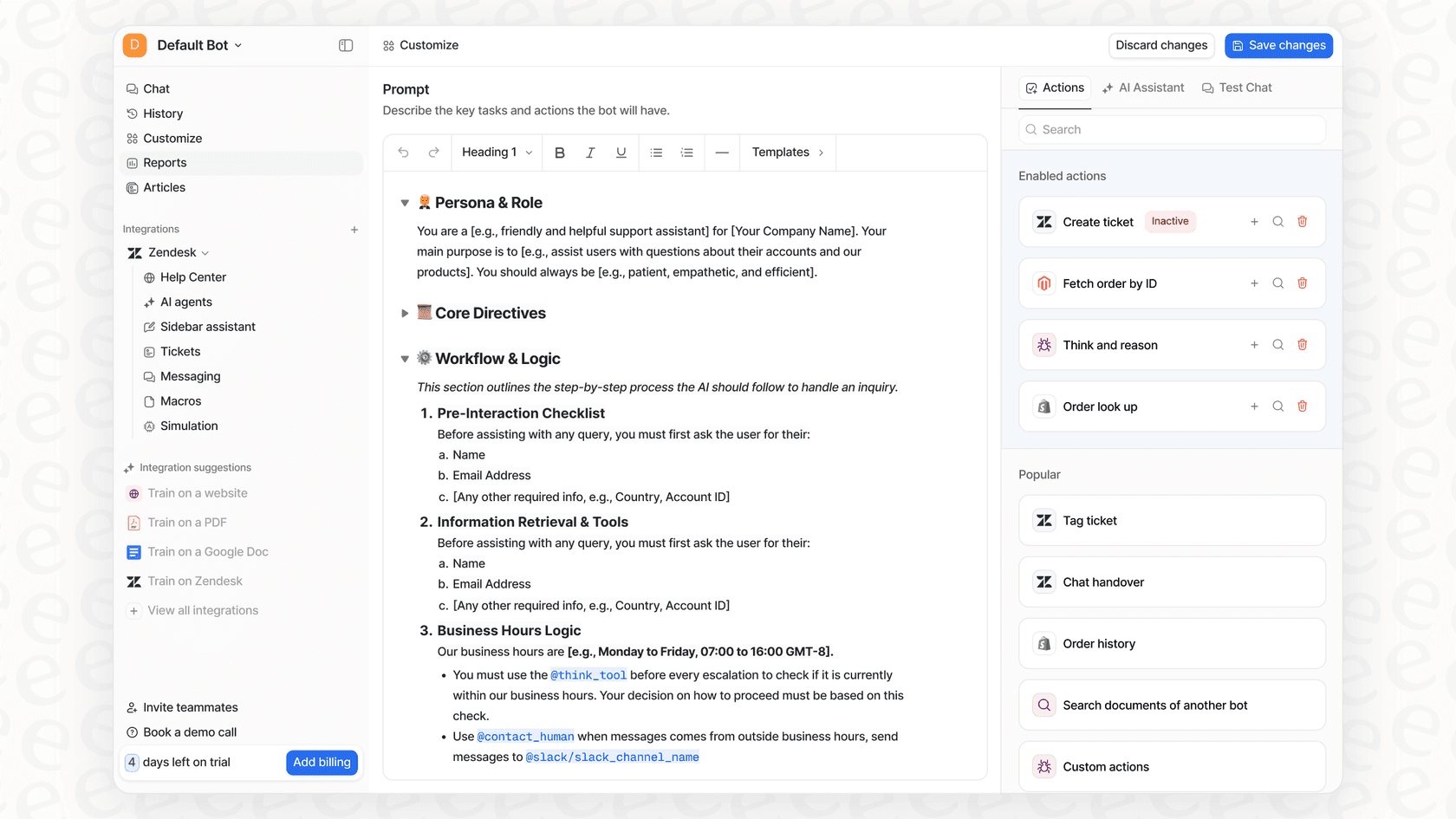
After the AI generates the perfect image, a team member could say: "This looks great. Can you create a Jira ticket for the design team to review this and attach the image?"
The eesel AI assistant can then hop over and create that ticket automatically. The whole creative process gets streamlined, and no one ever has to leave Discord.
Set up your integration in minutes with full control
The best part? You don't need a team of developers or a month-long project to get started. eesel AI is designed to be completely self-serve. You can connect your knowledge sources, customize the AI's prompts and personality, and launch a secure, context-aware assistant in just a few minutes. You get all the power of a custom-built solution without the headaches, giving you fine-grained control over what your AI knows and what it can do.
Why the right integration makes all the difference
When it comes to Discord integrations with DALL·E 3, you've got choices. You can roll up your sleeves and code it yourself, wrestle with a complicated no-code platform, or grab a quick-and-easy public bot. Each option has its own pros and cons in terms of control, effort, and security.
But for businesses and teams that need more than a novelty, the path forward is pretty clear. A simple image bot is fun, but a secure, context-aware, and actionable AI assistant is what actually helps you work better. The future isn't just about plugging in different AI tools; it's about building integrated AI systems that understand your business and improve how you work.
Instead of fighting with code or clicking through endless menus, you can build a truly smart assistant that connects to all your tools. See how eesel AI can bring your knowledge together and automate workflows in Discord, Slack, and your help desk. You can get started in minutes, not months.

Frequently asked questions
Setting up Discord integrations with DALL·E 3 varies. While custom bots require coding, no-code platforms offer a visual approach, and pre-built bots are the quickest, requiring no technical skills at all. Each option has a different learning curve and complexity.
For businesses, security is paramount. You should be concerned about where your prompts and generated images are stored, if your data is used for AI training, and if the solution meets privacy standards like GDPR. Public bots often lack the robust security features businesses need.
Customization largely depends on your chosen method. Pre-built bots offer minimal customization. DIY solutions provide complete control, while advanced platforms like eesel AI allow you to connect internal knowledge and define custom actions, making the AI assistant far more versatile than basic image generation.
Maintenance effort differs significantly. Custom bots demand ongoing updates and error handling, while no-code platforms can still require debugging complex workflows. Solutions like eesel AI aim to minimize your maintenance burden by managing backend infrastructure, allowing you to focus on the AI's utility.
Yes, costs vary. Custom bots have initial development time and [hosting costs](https://openai.com/pricing). No-code platforms often charge based on "tasks" or "operations," which can become unpredictable and expensive. Many pre-built bots use a freemium model, locking advanced features behind a paywall.
To be truly useful, Discord integrations with DALL·E 3 should integrate with your team's existing knowledge and workflows. Platforms like eesel AI can connect to your company documents and wikis, allowing the AI to generate images based on internal brand guidelines or even create follow-up tasks in other tools.
Share this article

Article by
Kenneth Pangan
Writer and marketer for over ten years, Kenneth Pangan splits his time between history, politics, and art with plenty of interruptions from his dogs demanding attention.
