The complete guide to using a content writer AI

Stevia Putri
Last edited January 14, 2026
If you're a marketer, you probably feel like you're on a content treadmill that just keeps speeding up. There's a constant demand for high-quality, SEO-optimized articles to drive growth. You have to publish consistently to stay relevant, but making great content takes a huge amount of time and resources.
This is where a content writer AI can make a real difference. While many tools promise to help you write faster, the most powerful ones do much more than just generate text. They function more like an entire content team, handling everything from research and outlining to writing and even creating visuals.
This guide explains the difference between a basic AI text generator and a comprehensive content engine. We will cover the must-have features and compare some of the top platforms out there. We'll show you what to look for in a tool that can genuinely scale your content strategy.
Full disclosure: we built the eesel AI blog writer to solve this exact problem for ourselves. It’s the same tool we used to take our own blog from a modest 700 to over 750,000 daily impressions in just three months, so we've learned a thing or two about what works.
What is a content writer AI?
A content writer AI is a specialized application designed to generate complete, long-form content like blog posts from just a single keyword or topic. Think of it as a machine built specifically for content creation, not a general-purpose chatbot.
That’s the main difference between a dedicated AI content writer and a generalist AI like ChatGPT.
While generalist tools can assist with many tasks, creating a complete blog post often requires a multi-step prompting process where the user guides the AI through each step of content creation. This can involve asking for an outline, then each section, then a meta description, and so on.
A dedicated content writer AI is different. It’s built to handle the entire workflow. You give it a keyword, and it handles the rest: the research, structuring, writing, and even creating assets. It uses the same powerful Large Language Models (LLMs) under the hood, but it’s fine-tuned to turn one simple input into a finished article that's ready to publish. This infographic illustrates the difference in workflow.
Key features of a powerful content writer AI
Different AI writers offer varying capabilities. The features below distinguish a basic text generator from a more comprehensive platform designed to support business goals.
Deep research and search intent alignment
The best content comes from understanding what people are actually looking for. Top-tier AI content writers do live research. Before generating a single word, they analyze high-ranking articles for a target keyword to understand common themes and structures that appeal to readers and search engines.
This research has to be context-aware. For example, if you're writing a comparison post, the AI should be smart enough to pull in current pricing data and feature lists. If it’s a "how-to" guide, it needs to outline clear, actionable steps.
This automated research can save significant time compared to manual analysis of search results, helping ensure the final article is relevant from the start.
Complete asset generation
Visuals and media are crucial for reader engagement in long-form content. Modern articles are rich with media, and a powerful content writer AI should be able to generate more than just paragraphs.
A complete platform should automatically create and embed different kinds of assets, including:
- AI-generated images, infographics, and charts to break up text and explain key points.
- Structured data tables for easy comparison of features or pricing.
- Relevant YouTube videos to add more depth and keep people engaged.
- Social proof, like real quotes pulled from Reddit forums, to add an authentic human perspective.
This feature can be a huge time-saver. It removes the bottleneck of having to manually find or create visuals for every single post, letting you publish fully-formed content much faster.
Built-in SEO and AEO optimization
A good content writer AI must have SEO as a core component. This means automatically including your target keywords in the right places, generating meta titles and descriptions, and creating a logical heading structure (H2s, H3s, etc.) that search engines can easily follow.
An emerging area is Answer Engine Optimization (AEO). AEO is all about structuring your content so AI models like Google's AI Overviews and Perplexity can easily pull information from it and cite it in their answers. With Gartner predicting that traditional search volume will drop 25% by 2026, AEO is becoming increasingly important for online visibility. Some tools are already preparing for this change.
Natural brand integration and linking
Finally, a smart tool should get to know your brand. It should be able to scan your website to learn your tone of voice and what you sell, which lets it naturally mention your services where it makes sense.
It should also handle linking for you. This includes adding internal links to your other blog posts to improve your site structure and keep readers on your page, as well as citing credible external sources to build authority and trust.
A look at the top content writer AI platforms
Now that we know what to look for, here are some of the leading platforms on the market.
1. eesel AI blog writer
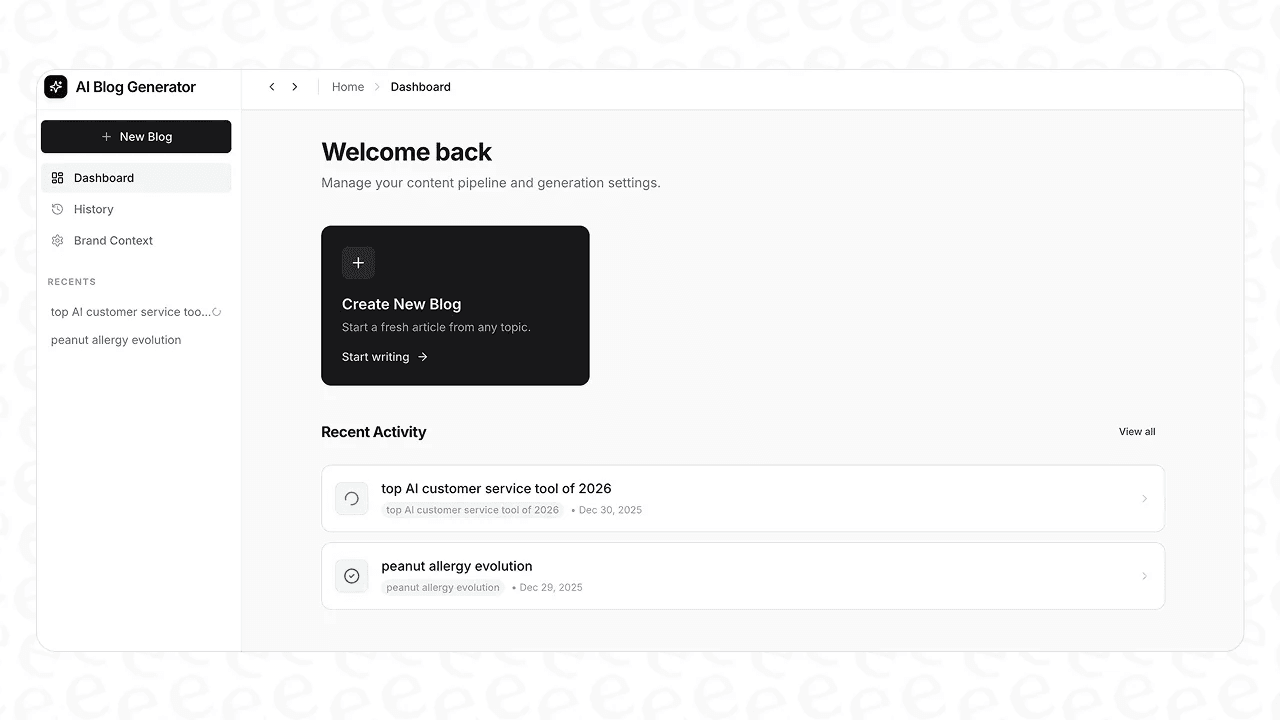
Key Features:
- One-click workflow: You enter a keyword, and eesel AI handles everything else, from deep SERP research and writing to full SEO/AEO optimization and asset creation. The process is designed to be straightforward.
- Complete asset suite: It automatically generates custom images, infographics, and data tables. It also finds and embeds relevant YouTube videos and authentic Reddit quotes to add layers of social proof and engagement.
- Context-aware research: The platform scans your website to learn your brand voice, making sure that any mentions of your products or services sound natural. Its research is also tailored to the article type, pulling specs for reviews and pricing for comparisons.
- Proven results: We built this tool for our own use, and the results speak for themselves. We used it to publish over 1,000 blogs, growing our site from 700 to 750,000 daily impressions in just three months.
Limitations: It is highly specialized for long-form blog content and may not be the primary choice for users needing short-form copy, such as social media captions or ad headlines.
Pricing: It uses a simple credit system. You can get started with a plan of $99 for 50 blog posts. It’s free to try, so you can see the quality for yourself without any commitment.
2. Jasper
Jasper is one of the biggest names in the AI space, positioned as an all-in-one platform for enterprise marketing teams. It offers a large suite of tools that go beyond blog writing, aiming to automate the content lifecycle with features it calls "Content Pipelines."
Key Features:
- Jasper IQ: This feature acts as a central brain, combining your knowledge base with your brand voice to ensure consistency across all your content.
- 100+ marketing apps: Jasper has a massive library of pre-built apps for specific tasks, like writing ad campaigns, social media posts, or product descriptions.
- Team collaboration: It’s built for larger companies with features like user roles, permissions, and content analytics.
Limitations: Jasper is a comprehensive platform, which may mean a steeper learning curve for some users. Its extensive feature set may be more than required for teams focused solely on scaling SEO blog content. Users may find that blog post outputs require human editing to fully align with specific search intent. The platform's focus is on text generation, so rich media assets like embedded videos or social proof may need to be added manually.
Pricing:
- Pro: Starts at $69 per seat/month ($59/month when billed annually).
- Business: Custom pricing for enterprise-level features, API access, and dedicated support.
3. Copy.ai
Copy.ai has shifted over the years from a simple copy generator to what it now calls a "GTM AI Platform." Its focus is broader than just content creation, as it aims to automate go-to-market workflows for both sales and marketing teams.
Key Features:
- Workflow automation: You can set up and automate multi-step processes for tasks like inbound lead qualification, sales prospecting, and account-based marketing.
- Sales-focused tools: It includes features like a Prospecting Cockpit designed to help sales reps with account research and writing personalized outreach emails.
- LLM agnostic: The platform isn't tied to a single language model, so it can use different models to find the best one for a specific task.
Limitations: With a primary focus on sales and marketing automation, its long-form content generation serves as one component of a larger suite of tools. The process for creating a blog post is integrated within its broader workflow automation system. The text output may require significant editing to meet competitive SEO standards.
Pricing:
- Chat: Starts at $29 per month for up to 5 users, offering unlimited words in their chat interface.
- Agents: For access to their workflow automation features, plans start at $249/month, which includes a set number of automation credits.
4. ChatGPT
Of course, we have to mention ChatGPT. While it's not a dedicated content writer AI, it’s an incredibly versatile conversational AI that many marketers use for all sorts of tasks like brainstorming ideas, summarizing articles, and drafting short-form copy.
Key Features:
- A very flexible and easy-to-use conversational interface.
- Great for generating titles, outlines, meta descriptions, and social media posts.
- Can be a helpful assistant for tasks like keyword grouping and repurposing existing content.
Limitations: ChatGPT is a foundational tool, not a complete solution for content creation. It has no built-in SEO capabilities, does no real-time SERP analysis, and can't generate visuals or embed other assets. Creating a full, optimized blog post requires a long and manual multi-step process. While it is a powerful assistant, the user is responsible for the strategic direction, research, and final assembly of the content.
Pricing:
- Free: Access to the base model with some usage limits.
- Plus: $20/month for priority access, faster response times, and advanced features.
- Business: Starts at $25/user/month (when billed annually) for team features and higher usage caps.
For a broader look at the current landscape of AI writing tools, this video provides a comprehensive review of 20 different platforms, helping you understand the variety of options available.
Adapting from SEO to AEO
For years, the primary focus has been on Search Engine Optimization (SEO), optimizing content to rank in search engine results. This landscape is evolving.
The new focus is Answer Engine Optimization (AEO). This means optimizing your content not just to be found, but to be directly cited and featured in AI-generated answers from platforms like Google AI Overviews, ChatGPT, and Perplexity.
In practice, this means creating content with clear headings, concise answers to common questions, structured data like lists and tables, and verifiable facts that an AI can easily understand and trust. It’s about making your content the most useful and digestible source of information on a topic.
Some content generation platforms, including the eesel AI blog writer, are beginning to incorporate features designed for AEO. This can provide an advantage as search behavior continues to change.
Choosing a content writer AI
A comprehensive content writer AI can function as a strategic partner. It can act as your researcher, writer, designer, and SEO strategist, all in one platform.
When evaluating options, consider features beyond simple text generation. The features that will actually make a difference for your business are deep research, full asset creation, and optimization for both today's SEO and tomorrow's AEO.
The point isn't just to write faster. It's to consistently create high-quality, competitive content that gets real results, like more organic traffic, leads, and brand authority. Trying a comprehensive content engine can demonstrate its potential impact.
Generate your first publish-ready blog post for free with the eesel AI blog writer.

Frequently Asked Questions
Share this article

Article by
Stevia Putri
Stevia Putri is a marketing generalist at eesel AI, where she helps turn powerful AI tools into stories that resonate. She’s driven by curiosity, clarity, and the human side of technology.