
Picking an AI writing assistant can involve comparing tools with different strengths. Claude is a versatile AI that functions as a creative partner for crafting detailed content. In contrast, Writesonic is a platform built to help marketers create SEO content and track brand visibility in AI search.
This guide will break down the features, pricing, and ideal user for each tool. While both are effective for generating first drafts, other tools like the eesel AI blog writer offer a different approach by turning a keyword into a complete, publish-ready article with images and media included.
What is Claude?
Claude comes from Anthropic, an AI company focused on creating assistants that are safe, accurate, and secure. It is less of a content-churning machine and more of a very capable creative partner. It is built to help with a wide range of tasks, from writing and editing complex documents to brainstorming ideas and even helping with code.
Its real strength is generating sophisticated, human-like text. It is great at understanding nuance, tone, and complex instructions. You can upload documents like research papers or spreadsheets and have it analyze or summarize them for you. One of its best features is "Artifacts," a separate window where you can edit and refine the content Claude generates, making the whole process feel very collaborative. It is a great fit for people and teams who need a reliable AI assistant for deep work and creating high-quality, thoughtful content from scratch.
What is Writesonic?
If Claude is a creative partner, Writesonic is a marketing engine. It's an all-in-one platform built around a concept they call Generative Engine Optimization (GEO). That's a way of saying it helps make sure your brand shows up when people ask questions to AI assistants like ChatGPT, Gemini, or Perplexity.
Writesonic is designed to help marketing and SEO teams create content and also track and improve their performance in the new world of AI search. It includes a content generator for creating SEO-optimized articles, AI visibility tracking to see which competitors are getting mentioned by AI chats, and an "Action Center" that points out content gaps you need to fill. It's made for people whose job is to dominate search rankings, both on Google and in AI chat.
Core features showdown: Claude vs Writesonic
Content generation and writing quality in Claude vs Writesonic
Claude: When it comes to pure writing quality, Claude gets a lot of praise. Its output is sophisticated, nuanced, and often needs much less editing to get the tone right. It excels when you're working on creative pieces or technical articles where subtlety and accuracy are important. The process is more hands-on, though. You guide it, refine its output, and work together. It sacrifices the instant speed of other tools for a higher degree of control and a better final product.
Claude Pro gave me the best writing every single time. Furthermore, it understood what I wanted better than any other tool.

Writesonic: This platform is all about speed and efficiency. It uses a template-driven system that can produce a full article in just a few minutes. Its AI Article Writer is designed to be factual and hit all the right SEO points. The catch is that the output can sometimes feel a bit generic. You'll probably need to spend some time editing it to add your brand's unique voice and personality.
Writesonic gave great results for much less money. Therefore, it’s perfect for small businesses watching their budget.
SEO and AI search visibility: A Claude vs Writesonic comparison
Claude: This one's simple: Claude doesn't have any built-in SEO tools. It's a general writing assistant. You can prompt it to write SEO-friendly text, and it'll do a decent job, but it won't give you keyword research, site audits, or performance tracking. As some side-by-side comparisons note, that's just not what the tool was made for.
Writesonic: This is where Writesonic really stands out. SEO and GEO are its entire focus. It offers a complete suite of tools: an AI Article Writer that analyzes competitors, an SEO optimizer to fine-tune your content, automated technical SEO fixes, and its flagship AI visibility tracking. On its higher-tier plans, you can monitor your brand's performance across more than ten different AI platforms, giving you a significant advantage.
A look at research capabilities in Claude vs Writesonic
Claude: Claude is excellent at research, but in a particular way. It can read and analyze large documents, PDFs, and even CSV files that you upload. This is fantastic for tasks like summarizing a dense report, pulling key data from a spreadsheet, or answering questions based on a specific knowledge base you provide.
Writesonic: Writesonic's research tool is its chatbot, Chatsonic, which has real-time access to the web, so its information is always current. But its most unique feature is the ability to track real user prompts from AI chats, not just keywords. This gives you an incredible look into the exact questions your potential customers are asking AI assistants, which is a goldmine for content strategy.
A quick comparison table
| Feature Category | Claude | Writesonic |
|---|---|---|
| Primary Use Case | Collaborative writing & problem-solving | SEO, Content Marketing & AI Search Visibility |
| Writing Quality | High, nuanced, requires collaboration | Fast, SEO-focused, template-driven |
| Built-in SEO Tools | None | Yes (Keyword research, site audits) |
| AI Search Tracking (GEO) | No | Yes (On Professional plans and higher) |
| Research Ability | Analyzes user-uploaded documents | Real-time web search (Chatsonic) |
| Key Integration | Google Workspace | WordPress, Google Search Console |
Pricing comparison for Claude vs Writesonic: Which offers better value?
Claude pricing plans in the Claude vs Writesonic matchup
Claude's plans are straightforward, focusing mainly on usage limits and team features.
- Free: A basic plan with limited usage, perfect for giving it a try.
- Pro: Costs $17 per month when billed annually. This gives you much more usage and access to the latest models.
- Team: Starts at $25 per user per month (billed annually) for teams of five or more. It adds collaboration features and admin tools.
- Max: Starts at $100 per month and offers 5-20 times more usage than the Pro plan, for power users and developers.
Writesonic pricing plans in the Claude vs Writesonic matchup
Writesonic’s pricing is all about unlocking more advanced SEO and GEO features as you go up the tiers.
- Lite: For $39 per month (billed annually), you get basic SEO tools and can generate up to 15 articles.
- Standard: At $79 per month (billed annually), you get more articles and integrations with Google products.
- Professional: This is the first plan that unlocks AI search visibility tracking, coming in at $199 per month (billed annually).
- Advanced: For $399 per month (billed annually), you get more user seats and deeper GEO analytics, like sentiment analysis.
The verdict on value for Claude vs Writesonic
Claude offers great value for individual writers, researchers, developers, and anyone who prioritizes high-quality AI collaboration. If your main goal is to create exceptional, nuanced text with an AI partner, the Pro plan is a steal.
Writesonic provides its value to marketing teams and agencies that are focused on search rankings. The higher price is justified by its specialized toolkit for SEO and GEO. If tracking your brand's footprint in AI search is a priority, this is where you'll get your money's worth.
An alternative for publish-ready content: eesel AI blog writer
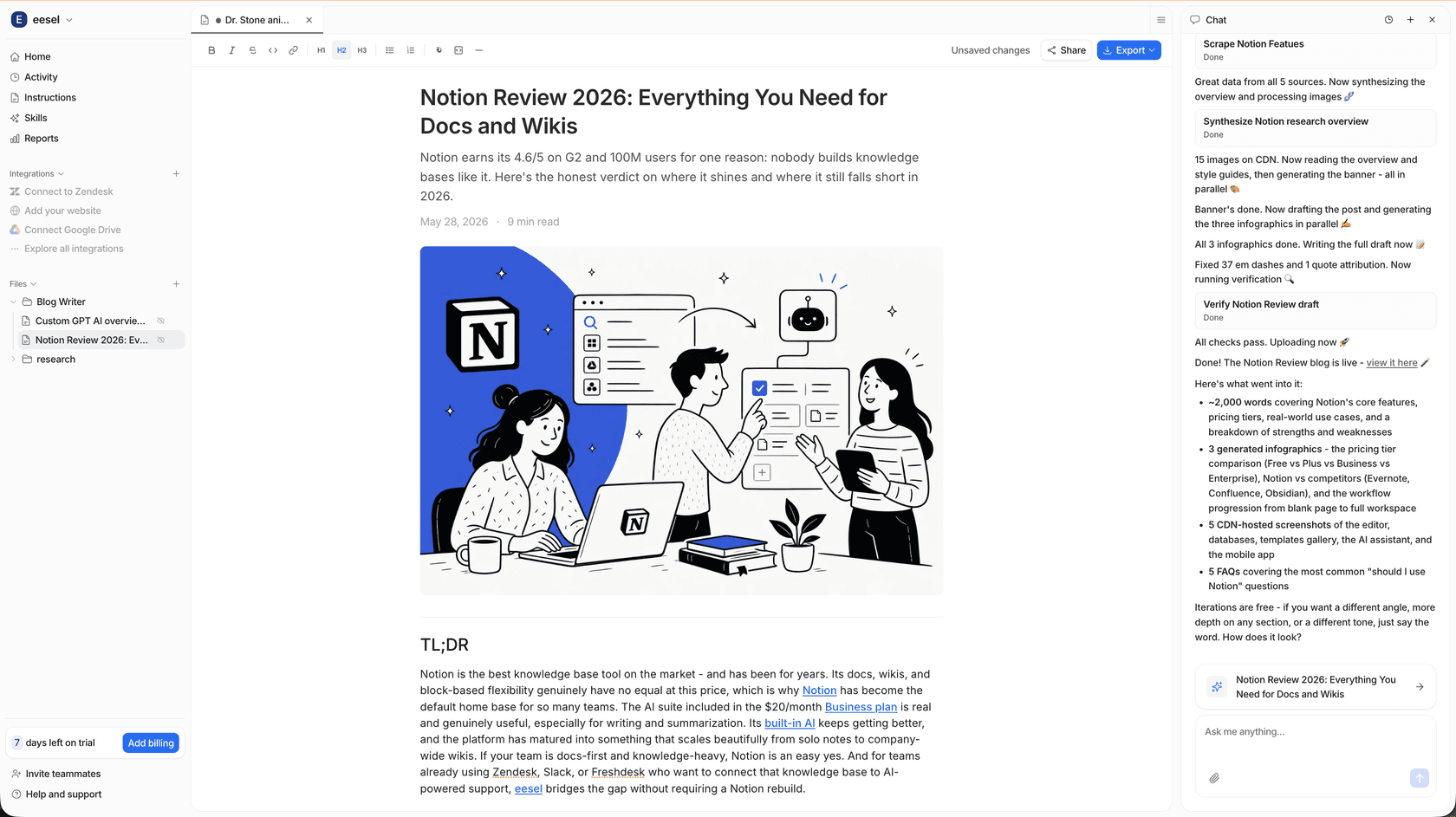
The eesel AI blog writer is designed to generate a complete, publish-ready blog post from a single keyword. You provide a topic, and the tool pulls brand context from your website, conducts research, and generates a structured article.
Key features include:
- Automatic Assets: The platform generates images, tables, and infographics to accompany the text.
- Media Integration: It can embed relevant YouTube videos and find quotes from Reddit threads to add more perspective to the content.
- AEO Optimization: The content is structured for AI Answer Engines like Google AI Overviews and Perplexity, in addition to traditional SEO.
We used this tool at eesel AI to grow from 700 to 750,000 impressions per day in three months. It is free to try, allowing users to evaluate the output quality.
For a deeper dive into how these tools compare, check out this video breakdown that covers the key differentiators in performance and features.
Final verdict: When to choose Claude vs Writesonic
To summarize, the best choice depends on your primary goal.
Choose Claude if:
- You are a writer, researcher, or developer who needs a partner for creating long-form, thoughtful content.
- Your priority is high writing quality and a human-like tone.
- You prefer a collaborative process to refine the final output.
Choose Writesonic if:
- You are an SEO specialist or part of a marketing team focused on search rankings.
- You need a platform that combines content generation with SEO optimization and AI search tracking.
- Your goal is to produce a high volume of SEO-focused content and monitor its performance.
Both Claude and Writesonic are effective for generating initial content drafts. The final step always involves editing, formatting, and adding assets to prepare the content for publication. The choice between them, or an alternative that automates more of the final steps, depends entirely on your team's workflow and priorities. For those interested in a tool that aims to deliver a more complete article from the start, the eesel AI blog writer is available to try for free.