Picking the right AI writing tool these days feels a bit like standing in the cereal aisle. There are many options, and they all claim to be the best. The market is exploding, with the academic AI writing space alone hitting $890 million. Two of the biggest names you'll run into are Claude and Grammarly, but they're designed for completely different tasks.
So, what’s the real story? Claude, from AI research company Anthropic, is a flexible AI assistant that’s good at chatting, creating content from scratch, and analyzing documents. It's like having a creative partner. Then there's Grammarly, a tool used by over 40 million people that has been the standard for years. It’s a focused writing assistant that helps make your writing correct, clear, and professional.
The main question is this: do you need a brainstorming partner for the first draft, or a sharp editor for the final polish? The answer really depends on how you work. But what if you're trying to create a complete, SEO-optimized blog post from start to finish? For that, you might need a tool that handles the entire process, like the eesel AI blog writer, which can turn a single keyword into a full article ready for publishing.
Let's dig into what Claude and Grammarly do best so you can decide which one is right for you.
What is Claude?
Claude is a set of large language models from Anthropic, an AI company focused on safety and research. At its heart, Claude is a conversational AI built to be helpful, honest, and harmless, thanks to its "Constitutional AI" training method. It’s more than just a chatbot; it's a tool that can handle a lot of different jobs.
Here’s a quick rundown of what it can do:
- Analyze almost anything you give it: You can upload text files, spreadsheets, and even images, and Claude will help you understand them.
- Write and fix code: It has a Claude Code feature that makes it a useful assistant for developers.
- Summarize long documents: With its huge context window, it can process and summarize very long texts, like 15 financial reports in one go.
- Get current information: Unlike some AI models that have a knowledge cut-off date, Claude includes web search results in its chats, so its information is up-to-date.
It’s already being used widely, with some business teams seeing productivity increases from 25% to 100%.
What is Grammarly?
If you’ve written anything on a computer in the last ten years, you’ve probably come across Grammarly. It’s an AI-powered writing partner that has become a standard tool for many writers. Its main purpose is to give you real-time suggestions on grammar, spelling, punctuation, clarity, and tone, right inside the apps you already use.
But it's evolved from a simple proofreader into a complete writing assistant. It now has a suite of AI agents to make your writing sound less robotic.
One of the great things about Grammarly is its focus on privacy. They are very open about the fact that they do not sell your content, which is a big relief. It's easy to see why it’s trusted by over 50,000 organizations around the world.
Feature comparison: Claude vs. Grammarly
| Feature | Claude | Grammarly |
|---|---|---|
| Best For | Content generation & creative ideation | Polishing & error correction |
| Primary Function | Conversational AI assistant | Real-time writing assistant |
| Content Generation | Excellent for long-form drafts | Limited to sentence/paragraph rewriting |
| Grammar & Style | Basic, on-demand checks with mixed results | Advanced, real-time suggestions |
| Plagiarism Check | No | Yes (Pro and Enterprise plans) |
| Web Access | Yes, integrated web search | No |
| Document Analysis | Yes, up to 200K token context window | Yes, for proofreading purposes |
| Starting Price (Paid) | $20/month | $12/month (billed annually) |
Content generation
Claude: This is Claude's strong suit. It's excellent for generating first drafts, brainstorming topics, and creating long-form content.
Reddit users often say its tone is "softer, more nuanced," which makes it great for creative writing or drafting dialogue. Its massive 200K token context window lets it read and understand very long documents to synthesize information for new content.Claude seems to write better, softer, more nuanced. It feels nicer.

Grammarly: Grammarly is all about improving text that's already written, not creating it from nothing. Its generative AI features, which give you up to 2,000 prompts a month on the Pro plan, are useful for rewriting sentences or tweaking the tone of a paragraph. It helps you refine your message, but it won’t write a whole article for you.
Verdict: It's pretty straightforward. Claude is the generator; Grammarly is the refiner.
Grammar checking
Grammarly: This is Grammarly's territory, and it's the clear winner. It provides advanced, real-time feedback on everything from grammar and style to tone and clarity. The Pro plan also has a powerful plagiarism checker that scans your text against billions of web pages and ProQuest’s academic databases. It can also help you format citations in APA, MLA, and Chicago style.
Claude: You can ask Claude to check your grammar, but the results can be inconsistent. One user who tested it found the corrections to be "mixed," and mentioned that it even made some "completely incorrect assertions" about the text. It simply doesn't offer the real-time, specialized feedback that makes Grammarly so effective for editing.
Verdict: Grammarly is, by far, the better tool for correcting errors and polishing your writing.
Research capabilities
Claude: Claude has a big advantage here. It can analyze information from files you upload and has web search built-in, even on the free plan. Its knowledge is also more current, with the latest models having a knowledge cutoff in mid-2025.
Grammarly: Grammarly doesn't do real-time research. Its suggestions come from linguistic patterns and a huge, but static, knowledge base. It knows the rules of language perfectly, but it can’t tell you about what's happening in the news or pull facts from the internet.
Verdict: Claude wins this round easily, thanks to its ability to access and analyze up-to-date information from both the web and your documents.
Choosing the right tool for your job
The best AI writing assistant for you is all about what you need to get done. Let's look at who would get the most out of each platform.
Who should use Claude?
- Content creators and writers: It's great for breaking through writer's block, generating first drafts of articles, and exploring creative concepts. It’s also surprisingly good at writing natural, even "sassy," dialogue.
- Researchers and analysts: If you need to summarize dense reports, academic papers, or a ton of user feedback, Claude is a huge help. Just upload the files and let it work.
- Developers: It’s a capable assistant for writing, debugging, and explaining code snippets in several different languages.
- Business professionals: It's handy for drafting strategic documents, analyzing sales call transcripts, or even summarizing complex contracts to find key terms and potential issues.
Who should use Grammarly?
- Professionals and teams: It's vital for ensuring all your business communications, from emails to reports, are error-free and consistent with your brand, especially with features like Style Guides.
- Students: It’s a lifesaver for proofreading essays, checking for plagiarism, and formatting citations correctly to maintain academic integrity.
- Non-native English speakers: It’s a fantastic learning tool for improving grammar, vocabulary, and sentence structure with immediate, real-time feedback.
- Anyone who cares about polish: From perfecting your resume to making sure your social media posts are clean, Grammarly helps you present yourself well.
Pricing plans compared
Both tools offer free versions that are quite useful, but the paid plans are where the real power is. Here’s how their pricing compares.
Claude pricing
- Free ($0/month): You get plenty of access to the web, iOS, and Android apps for chatting, creating content, analyzing documents, and using web search. Usage limits just depend on server traffic.
- Pro ($20/month or $17/month billed annually): This gives you 5x more usage than the free tier, access to their top models like Opus 4.5, and priority access during busy times.
- Team ($30/seat/month or $25/seat/month billed annually): For teams of five or more, this plan offers a larger context window, a central admin dashboard, and SSO.
- Enterprise (Custom pricing): For large companies needing extra security, customization, and dedicated support.
Grammarly pricing
- Free ($0/month): This plan covers the basics with grammar, spelling, and punctuation checks. You also get tone detection and 100 generative AI prompts each month.
- Pro ($30/month or $12/month billed annually): You get everything in the free plan, plus full-sentence rewrites, tone adjustments, plagiarism detection, style guides, and a jump to 2,000 AI prompts per month.
- Enterprise (Custom pricing): This adds unlimited AI prompts, dedicated support, SAML SSO, and advanced security features like data loss prevention.
An alternative for blog creation: eesel AI
Claude is great for getting ideas down, and Grammarly is perfect for polishing them. But what if your goal is to consistently publish SEO-optimized blog content that ranks well? For that, you might want a different kind of tool.
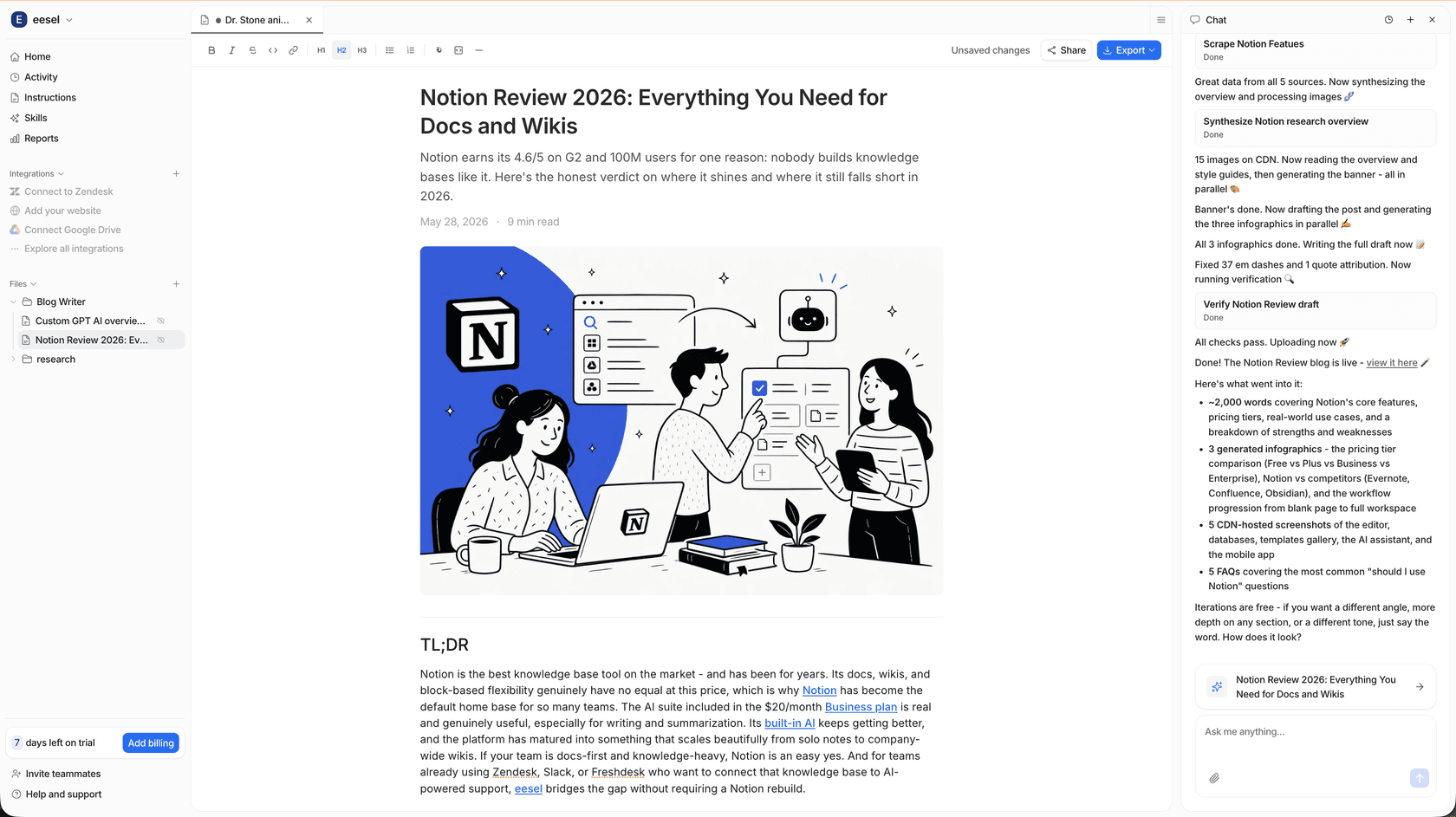
Here’s what sets it apart:
- Context-Aware Research: It understands the type of blog you're writing. For a comparison post, it automatically seeks out pricing data. For a product review, it finds technical specs.
- Automatic Assets: It doesn't just write words. It generates and adds relevant images, tables, and infographics to make the content more visually appealing and easier to read.
- Authentic Social Proof: It adds credibility to your content by embedding relevant YouTube videos and finding real quotes from Reddit discussions on your topic.
- AEO Optimization: The content is optimized for Answer Engine Optimization (AEO), which means it's structured to appear in Google's AI Overviews and other AI-powered search results.
This is the exact tool we used at eesel AI to grow from 700 to 750,000 daily impressions in just three months by publishing over 1,000 optimized blogs. It's completely free to try, so you can see the quality for yourself.
For a deeper look at how different AI writing tools stack up, this video offers a helpful overview of the current landscape, touching on many of the concepts we've discussed.
Final thoughts on choosing your AI writing partner
So, Claude or Grammarly? The final takeaway is pretty simple: they're both excellent tools, but they solve different problems.
Claude is a flexible AI partner for thinking and creating. It’s your best bet for brainstorming, writing first drafts, and analyzing complicated information. Grammarly is a dedicated editor. It’s essential for perfecting text you’ve already written, making sure it's professional, polished, and free of errors.
To be honest, they work really well together. You could use Claude to write a solid first draft and then use Grammarly to catch any mistakes and fine-tune the tone.
But if you're trying to scale your content production and want to bypass the manual drafting and editing cycles, a dedicated platform like the eesel AI blog writer provides the quickest route from a simple keyword to a high-ranking, ready-to-publish article.