ChatGPT vs Anyword: An honest comparison

Stevia Putri
Last edited January 26, 2026
The boom in AI writing tools is beneficial, but it has also created a new challenge: determining which one is right for your business. It’s easy to feel overwhelmed by options, with every platform offering to solve content problems.
Two of the most prominent names are ChatGPT, an AI that can handle many tasks, and Anyword, a tool made for marketers who focus on conversion rates. ChatGPT can be seen as a generalist, while Anyword is more of a specialist. This post will break down how they compare on features, performance, pricing, and security to help you make an informed decision.
For those looking to scale blog content with an SEO-first approach, we'll also discuss a third option, "eesel AI blog writer", which is designed to take you from a single keyword to a fully published post.
What is ChatGPT?
ChatGPT, from OpenAI, is a large language model that helped introduce AI to a wide audience. At its core, it's a conversational AI that can handle a massive range of text-based tasks. You can ask it to brainstorm blog post ideas, draft an email, explain complex topics in simple terms, or write code.
Its main strength is its versatility. Because it is not designed for one specific job, it is a useful tool for many users, including developers, students, project managers, and writers. Users open a chat window and start typing. The latest models, like the powerful GPT-5.2 available on paid plans, can generate sophisticated text.
honestly the AI tool landscape is getting ridiculous. i've been testing stuff for growth marketing at Gamma and half these tools promise the moon but deliver like.. a rock. for content creation, claude's been solid for first drafts and brainstorming (way better than chatgpt for marketing copy imo). perplexity is clutch for research - saves me hours vs traditional googling.

For marketers, that "blank canvas" approach can also present challenges. ChatGPT's output requires direction. Users need to be skilled at writing detailed prompts, and the generated text often needs significant editing to match a brand's voice and be ready for publication. It does not have built-in tools to predict copy performance. For businesses concerned about security, OpenAI offers SOC 2 Type 2 compliance and does not train on customer data for its Business and Enterprise plans.
What is Anyword?
Anyword is a different type of tool. It's a generative AI platform built for marketers, advertisers, and go-to-market teams. Its purpose is to create copy that converts and drives business results.
Its key feature is the Predictive Performance Score. As you write, Anyword analyzes your copy and provides a score, predicting how well it will perform with your target audience. The company states this is 82% accurate, compared to 52% for a generic model like GPT-4o. This allows users to A/B test copy before it goes live, which can save time and ad spend.
Personally love **ChatGPT, Jasper, and Canva’s AI tools** — they save me hours on content, visuals, and ideas. Also **Zapier** for automations and **Anyword** for ad copy optimization. Simple tools, real impact. 🚀
Anyword is geared toward marketing. It has features for setting up a consistent Brand Voice, a Data-driven Editor for optimizing short-form copy like ads and social media posts, and security protocols. It is enterprise-ready, with SOC 2, ISO 27001, GDPR, and HIPAA compliance, making it suitable for businesses that handle sensitive data.
Feature comparison: ChatGPT vs. Anyword
Core capabilities
ChatGPT is a general-purpose tool. You provide a prompt, and it can generate content ranging from a poem to a sales pitch. The quality of the output depends on the quality of the prompt. It can be used for brainstorming and creating first drafts. To help users stay organized, it offers a feature called Projects, which lets you organize chats and context in one place.
Anyword is a specialized tool. It has a structured workflow built for marketing tasks. It includes over 100 marketing templates for items like Facebook ad copy, email subject lines, landing page headlines, and product descriptions. Users are guided through a process designed for creating conversion-focused copy.
Performance analytics
This is where a key difference between the two tools emerges.
ChatGPT does not offer built-in performance analytics. It can generate five different headlines, but it cannot predict which one is most likely to be clicked. Users must determine this through other methods, which often involves running A/B tests.
Anyword focuses on performance. Its Predictive Performance Score is a central feature. It grades copy from 0 to 100 and provides demographic insights into which audiences may respond best. This allows users to optimize copy before launching an ad campaign, which is a significant advantage for performance marketers who want to optimize their A/B testing.
Brand voice management
Keeping a consistent brand voice is important, and both tools handle it differently.
ChatGPT uses Custom Instructions and Characteristics. You can provide it with information about your brand, tone, and audience, and it will attempt to follow those rules in its responses. This can be an effective method, but consistency may vary, sometimes requiring users to repeat instructions.
Anyword has a dedicated Brand Voice hub. Here, you can centralize brand rules, create a "Copy Bank" of pre-approved messages, and define target audience personas. This feature is designed to ensure that all copy generated by the team remains on-brand.
Security and compliance
For many businesses, security is a top priority.
ChatGPT offers enterprise-level security on its Business and Enterprise plans. This includes SOC 2 Type 2 compliance, SAML SSO for secure login, and data encryption. For these plans, business data is not used to train OpenAI's models.
Anyword has a security framework that meets SOC 2, ISO, GDPR, and HIPAA standards, making it suitable for regulated industries. For its enterprise customers, it also offers privately hosted language models, which means customer data is isolated.
Pricing breakdown
Price is often the deciding factor, so let's see what you'll pay for each tool.
ChatGPT pricing
ChatGPT's pricing is split between individual and business use.
- Individual Plans:
- Free: Gives you limited access to their base model. It's fine for simple, everyday tasks.
- Plus ($20/month): This unlocks access to more advanced models like GPT-5.2, gives you faster response times, and includes tools like the DALL-E image generator and Sora video generation.
- Business Plans:
- Business ($25/user/month, billed annually): Made for teams, this plan provides a collaborative workspace with unlimited GPT-5.2 messages, admin controls, SAML SSO, and the important guarantee that your data won't be used for training.
- Enterprise (Custom Pricing): For large organizations that need advanced security, custom solutions, and dedicated support.
Anyword pricing
Anyword's pricing is aimed at professional marketers and teams.
- Starter ($39/month, billed yearly): This is for solo marketers and freelancers. It includes unlimited copy generation, 1 brand voice profile, and access to their Blog Wizard.
- Data-Driven ($79/month, billed yearly): For small marketing teams, this plan includes 3 seats and unlocks the real-time performance prediction scores.
- Business & Enterprise (Custom Pricing): For larger teams, this offers custom-built AI models, deep integrations with your marketing channels, advanced security features like SSO, and private LLMs. Anyword offers a 7-day free trial on its paid plans so you can test it out.
| Feature | ChatGPT | Anyword |
|---|---|---|
| Free Plan | Yes (with limitations) | No (offers 7-day free trial) |
| Starting Price (Paid) | $20/month (Plus) | $39/month (Starter, billed yearly) |
| Core Focus | General-Purpose AI Assistant | Marketing Performance & Conversion |
| Predictive Analytics | No | Yes (core feature) |
| Enterprise Security | SOC 2, SSO | SOC 2, ISO, GDPR, HIPAA, SSO |
| Best For | Brainstorming, first drafts, coding | Ad copy, email, landing pages |
The gap in functionality: End-to-end blog creation
While both ChatGPT and Anyword are powerful, they both have limitations when it comes to one of the most important parts of content marketing: creating a complete, publish-ready blog post that's built to rank on Google.
ChatGPT's Limitation: It's a great starting point, but it only gives you a text draft. After it's done, you are responsible for the remaining steps. You have to do the research to add substance, find and create images, search for relevant YouTube videos to embed, and pull in social proof like quotes from Reddit. Then, you still have to format everything for SEO. It’s a manual, multi-step process.
Anyword's Limitation: Anyword has a "Blog Wizard," but its core strength is in short-form, conversion-focused copy. It’s great at helping you craft a killer headline or an optimized intro, but its main job isn't generating a comprehensive, media-rich, 2,000-word article designed for organic traffic. It assists with parts of the process but doesn't manage the entire workflow.
eesel AI blog writer: A solution for end-to-end blog creation
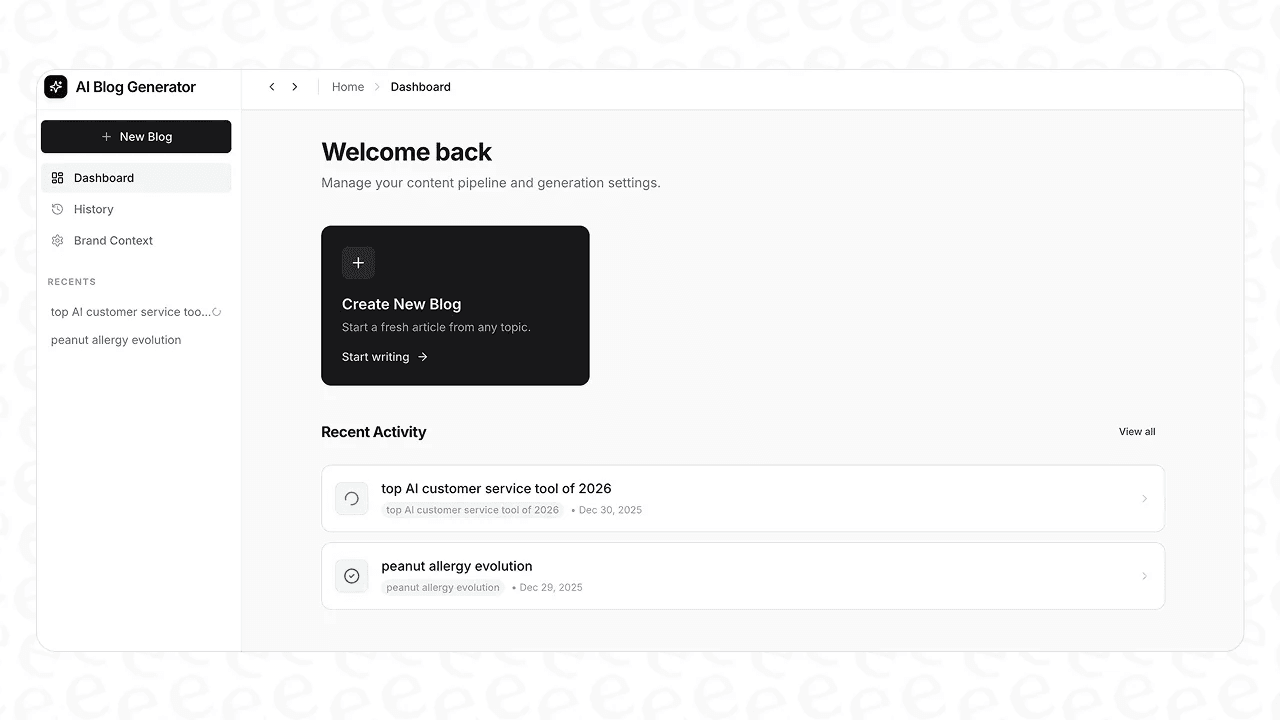
The platform was used to grow our own organic traffic from 700 to 750,000 daily impressions in three months by publishing over 1,000 blogs.
- Complete asset generation: It doesn't just write text. It automatically creates and inserts AI-generated images, infographics, charts, and tables right into the post.
- Built-in media embeds: It finds and embeds relevant YouTube videos and real Reddit quotes, adding authority and a human touch to your content.
- Context-aware research & AEO: It goes beyond basic text generation. It understands search intent to create deeply researched content and is optimized for AI Answer Engines like Google's AI Overviews, which is key for visibility in 2026.
- Human-like tone: The output is designed to be engaging and readable.
The platform is free to try. You can generate your first blog post right now and see the quality for yourself.
To see how these tools perform in real-world scenarios, check out detailed user reviews and tutorials. This video provides a comprehensive look at Anyword's features, offering insights that can help in your decision-making process.
Final verdict: Which should you choose?
So, which tool is the one for you? It really depends on what you're trying to do.
Choose ChatGPT if: You need a flexible, all-purpose AI assistant. It's perfect for brainstorming, getting quick first drafts, helping with code, or tackling a wide variety of text-based tasks where you don't need deep marketing optimization. Your priority is versatility.
Choose Anyword if: You're a marketer whose success is measured in clicks, conversions, and ROI. It's the best choice for writing short-form copy for ads, emails, social media, and landing pages. Your priority is performance and data-driven optimization.
Choose eesel AI blog writer if: Your main goal is to scale your content marketing and drive organic traffic through high-quality blog posts. It’s for teams who want to move from a keyword to a publish-ready article without all the friction. Your priority is efficient, end-to-end blog creation.
Ready to scale your content?
Creating content involves more than just writing text; it includes research, visuals, social proof, and SEO. "eesel AI blog writer" is designed to handle these elements, turning a single keyword into a complete asset.
Move from drafting to publishing content. Try eesel AI blog writer for free and see how fast you can start growing your organic traffic.

Frequently Asked Questions
Share this article

Article by
Stevia Putri
Stevia Putri is a marketing generalist at eesel AI, where she helps turn powerful AI tools into stories that resonate. She’s driven by curiosity, clarity, and the human side of technology.