What is Anyword? A complete overview for marketers in 2026

Kenneth Pangan
Last edited January 5, 2026
The marketing world feels like it's moving at a hundred miles an hour. We're all under pressure to create more content, make it better, and do it faster, all without stretching our teams or budgets too thin. AI tools have popped up, promising to be the solution. One name that keeps coming up is Anyword.
Anyword is an AI copywriting platform built to help marketers write and fine-tune copy that gets results. But with a new AI writer launching what feels like every week, it's hard to figure out which one is actually worth your time.
I’ve compiled and published a detailed review comparing the Top 10 AI Writing Tools of 2026. Each tool has been human-tested for real-world performance , including accuracy, speed, integrations, and pricing.

So, is Anyword the right tool for your team? This guide will give you a straight-up overview. We’ll look at its features, pricing, who it’s really for, and some of its downsides. By the end, you should have a clear idea of whether it fits your marketing goals.
What is Anyword?
At its heart, Anyword is an AI writing assistant that's all about generating performance-driven copy. We're talking about social media ads, email subject lines, landing page headlines, and product descriptions, the short, snappy text that has to grab attention and earn a click.
Interestingly, they've been in the game longer than most. The company actually started as Keywee back in 2013, which means they have a massive amount of data and experience compared to many of the newer tools that have appeared recently.
Their entire approach is built around "closing the feedback loop." Instead of just generating generic text, Anyword uses performance data to predict how well a piece of copy will perform before you publish it. This data-first mindset is what makes it different and has helped it land some big clients. Brands like Red Bull, The New York Times, and National Geographic have used it to sharpen their messaging, which lends it significant credibility.
Key Anyword features explained
Anyword's features aim to remove the guesswork from copywriting. It’s all about predicting what will resonate with your audience so you can spend less time testing and more time getting results.
Predictive performance scores
This is probably Anyword's most famous feature. When you generate copy, the tool gives each version a score from 1 to 100. This number is a prediction of how well it will engage your audience. It’s almost like having a data scientist peeking over your shoulder, pointing out which headline is most likely to work.
For marketers, this can be a significant time-saver. Instead of running a ton of A/B tests to find the winning copy, you can start with the options that already have the highest scores. This can save a lot of time and ad spend, which is always a good thing when you're working with tight budgets.
Copy intelligence and brand voice
The Copy Intelligence platform in Anyword learns from your past wins. It scans your best-performing content from your website, ads, and social media to figure out what clicks with your audience.
From there, the Brand Voice feature lets you create specific guidelines for tone, style, and even words to avoid. This makes sure that every piece of AI-generated text sounds like it came from your brand, keeping everything consistent across your marketing channels.
The data-driven editor
You'll spend most of your time in the main editor. It’s pretty simple, you pick a channel (like a Facebook ad or landing page), and the AI starts generating copy for you.
A neat part of the editor is that you can define specific target audiences. For instance, you can tell the AI to write for "millennial mothers interested in sustainable products" or "small business owners looking for accounting software." This helps you get copy that’s tailored to the exact people you’re trying to reach.
Integrations with other models and apps
Anyword doesn't lock you into its platform. It can work as an optimization layer on top of tools you're probably already using. It connects with platforms like ChatGPT, Notion, and Google Gemini, letting you analyze and score content you’ve created somewhere else. This is great if you're already in a groove with another tool but want to tap into Anyword's predictive insights.
Who is Anyword best for?
Anyword isn't trying to be the perfect tool for everyone. It’s a specialized platform that really delivers for certain kinds of marketing teams.
Demand generation and performance marketing teams
If your day is filled with talk of ROAS (Return On Ad Spend) and CPA (Cost Per Acquisition), Anyword was practically made for you. It is highly effective for creating high-converting ad copy for platforms like Facebook, LinkedIn, and Google.
Being able to predict which ad copy will perform best before you spend a single dollar is a key advantage. It helps teams get their campaigns off to a strong start, which can lead to a much healthier return on investment.
Social media and content managers
For social media managers trying to keep up with multiple platforms, Anyword can be very helpful. It’s great for quickly whipping up engaging captions, post ideas, and blog intros that fit the specific vibe of each platform. The ability to adapt content to different customer personas is especially handy for boosting engagement and making your social feeds feel more relevant.
Email marketing professionals
We’ve all been there, staring at a blank screen trying to write an email subject line that people will actually open. Anyword helps you write compelling subject lines and email body copy that can improve open rates and click-through rates. Its predictive scores help you pick the most effective copy without endless split tests, so you can get your campaigns launched faster.
Anyword pricing plans
Anyword has a 7-day free trial where you get 2,500 word credits to play around with the platform. After the trial, they offer a few paid plans. Keep in mind this information is from their public pricing page, so it’s always smart to check their official site for the most current details. Here’s a visual breakdown of their plans to make it clearer.
| Plan | Price (per month, billed annually) | Key Features |
|---|---|---|
| Starter | $39 | 1 seat, 1 brand voice, basic content generation. |
| Pro | $49 | 1 seat, 3 brand voices, content improver tool. |
| Business | $349 | 3 seats, 5 brand voices, channel integrations. |
| Enterprise | Custom | Custom seats, advanced security, API access. |
The plans are structured pretty clearly. The Starter plan works well for individuals, while the Pro and Business tiers offer more brand voices, seats, and features for teams as they grow.
Limitations to consider
Anyword is a useful tool for its specific purpose, but it does have some limitations. It's good to know what they are before you sign up, especially if you're focused on long-form content and SEO.
The need for human editing
Many users report that while the AI-generated copy is a solid starting point, it often needs a human touch to really nail a specific brand voice.
The output works, but it can sometimes lack the nuance and deeper insights that make content feel truly authentic. For longer pieces like blog posts, the text can come across as a bit generic and may not have the authority needed to rank for competitive keywords.You have clearly prompted an AI to type this paragraph. It offers no unique perspective and contains no example or testimonial... A user could simply prompt an LLM to generate the same type of summary instead of visiting your website. The only value your website currently provides is 'pre-summarizing' information from various AI tools. I'm sure some people might find that useful. But I would define this type of content as 'AI slop' which contains no genuine human touch or information.
Limited support for complete content assets
Anyword's main job is to give you text. It doesn't automatically create a complete, media-rich article. If you're putting together a blog post, you’ll still have to find or create images, look for relevant videos, build infographics, and do all the formatting yourself. It provides the words, but you have to assemble the final experience, which can eat up a lot of time.
Focus on short-form copy generation
Anyword is built for short-form copy. It's fantastic at writing ads, social posts, and email snippets. While you can use it to build a blog post piece by piece, the process may not be as streamlined as tools built specifically for long-form content.
An alternative for end-to-end blog content
For teams focused on scaling SEO with complete, ready-to-publish blog posts, tools specializing in long-form content can be beneficial. For example, the eesel AI blog writer is designed for this purpose.
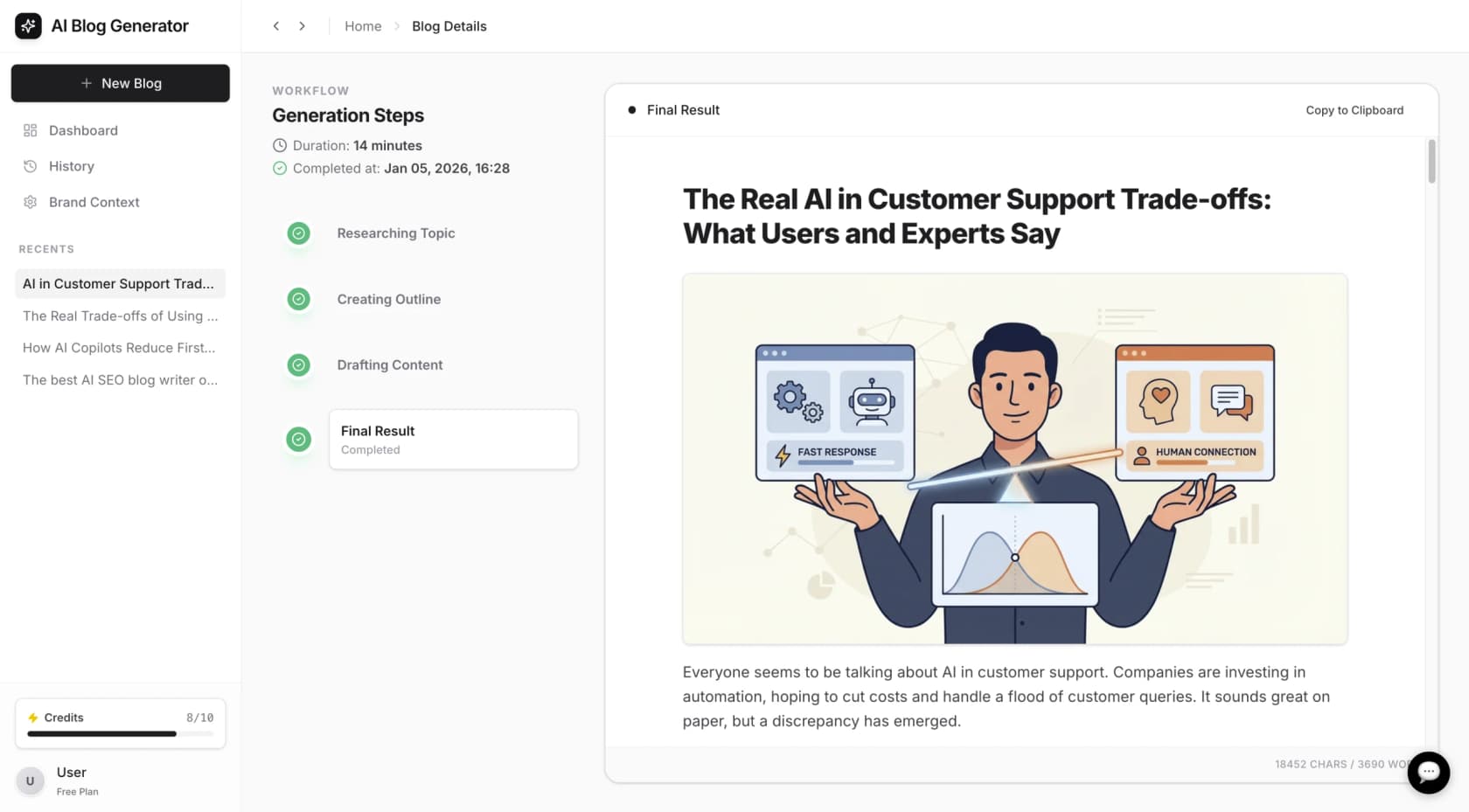
eesel AI is designed to handle the blog creation process from a single keyword. Its features are tailored for creating complete articles.
Here’s what makes it different:
-
End-to-end post creation: It generates a full blog post from a keyword, including a logical flow, headings, and visual assets like AI-generated images, tables, and infographics.
-
Content enrichment: It can embed relevant YouTube videos and find quotes from public forums like Reddit to add context and social proof to the content.
-
Search optimization: The content is structured for Answer Engine Optimization (AEO), which aims to improve visibility in AI Overviews and other answer-based search results.
-
Demonstrated use case: The eesel AI team used the tool to grow their blog from 700 to 750,000 daily impressions in three months.
A free trial is available to generate a blog post and evaluate its features.
To see Anyword in action, this video review provides a detailed walkthrough of its key features and user interface.
Final thoughts on Anyword
Anyword is a data-driven tool well-suited for performance marketers focused on short-form copy for ads, emails, and social media. Its predictive scores can help improve conversion rates and save time on A/B testing.
However, its focus on text-only output and short-form copy means it may require a multi-step workflow for teams creating complete, asset-rich blog posts.
For scaling SEO and content strategy with long-form articles, a specialized tool may be more suitable. While Anyword is effective for copy optimization, a solution like the eesel AI blog writer is designed to manage long-form content from start to finish.

Frequently asked questions
Anyword really shines when it comes to short-form, performance-focused copy. Think social media ads, email subject lines, landing page headlines, and product descriptions that are designed to grab attention and drive conversions.
While you technically *can* use Anyword to generate text for a blog post section by section, it's not its primary strength. The workflow can feel a bit clunky for long-form content, and you'll still need to handle all the formatting, images, and other assets yourself.
The predictive performance score is a unique feature where Anyword analyzes your copy and gives it a score from 1 to 100. This score predicts how well the copy will engage your target audience, helping you choose the most effective version before you even publish it.
Yes, it can be. The Starter plan for Anyword is designed for single users and provides access to the core content generation features. It's a solid option if your main focus is on creating and optimizing ad copy or social media content.
It does. Anyword can act as an optimization layer on top of other tools. You can bring in content generated from platforms like ChatGPT or Google Gemini and use Anyword to analyze it, score its performance, and refine it.
Anyword uses a feature called Copy Intelligence to analyze your existing high-performing content from your website, ads, and social media. From there, you can set up specific Brand Voice guidelines to ensure all AI-generated text stays consistent with your tone and style.
Share this article

Article by
Kenneth Pangan
Writer and marketer for over ten years, Kenneth Pangan splits his time between history, politics, and art with plenty of interruptions from his dogs demanding attention.