A complete guide to blog writing for leads

Amogh Sarda
Last edited January 19, 2026
Do you ever feel like you're blogging into an empty void? A lot of businesses consistently publish content but never see a real impact on their leads or sales. If that sounds familiar, you're not alone. It's a common problem, but the fix is probably simpler than you think.
The issue isn't usually about effort; it's about strategy. Effective blogging isn’t just about hitting "publish." It's about a targeted approach called blog writing for leads, which is all about attracting, engaging, and converting your ideal customers. This guide will break down the strategies you need to turn your blog into a reliable lead generation engine, from figuring out your audience to creating clear paths for them to follow.
What is blog writing for leads?
Blog writing for leads is the practice of creating and sharing blog content with one main goal: attracting potential customers and guiding them into your sales funnel.
This isn't just a nice-to-have; it's a powerful method. Data shows that companies with blogs generate 67% more leads than those that don't. That’s a pretty big difference.
It’s completely different from other types of blogging you might see:
- Company news/updates: This is mostly for people who already know you. It's great for keeping your current audience in the loop, but it rarely pulls in new people who are just starting to look for a solution.
- Thought leadership (without a funnel): This is fantastic for building your brand's authority. But if there’s no clear, actionable next step for the reader, it’s like giving a great speech that ends abruptly with no way for the audience to learn more.
Core components of blogging for leads
To get this right, you need to nail a few foundational elements. Let's break them down.
It’s important to build a good audience. This will be who reads your articles and posts. Watches your content and engages with your messaging. From this audience you will find customers. This is the percentage of your audience willing and able to spend money on your products. Developing content is great but it requires some plan to engage and move prospects through your funnel.

Understanding search intent
Here’s the thing: most of your best leads start their journey on Google. If you want them to find you, your content has to match what they're typing into that search bar. This is called search intent.
- Informational intent: These are people looking for answers or trying to understand a problem. They’re searching for things like, "how to improve team productivity." Your goal here is to be the helpful expert that provides the best answer, building awareness and trust from the start.
- Commercial intent: These folks are a little further down the line. They're comparing solutions and are getting ready to make a decision. Their searches look more like, "best project management software." This is where you can capture high-quality leads by showing them why your solution is the right choice.
Pro tip
A pro tip is to focus on long-tail keywords. These are longer, more specific phrases like 'how to write a blog post for B2B leads.' They might get less traffic, but the people searching for them are usually much more motivated and closer to converting.
Creating value-driven content
This is the golden rule of content marketing: your content has to be genuinely helpful before it can be promotional. You have to earn the right to talk about your product. Focus on your audience's biggest headaches and give them actionable advice, unique insights, and practical solutions they can use right away.
Different formats work well for delivering this value:
- In-depth "how-to" articles and tutorials that walk them through a process step-by-step.
- Comprehensive guides and pillar pages that cover a big topic from top to bottom.
- Case studies that show off real-world results and prove you can deliver.
- Listicles and comparison posts that make it easier for readers to weigh their options.
Designing clear conversion paths with CTAs
A blog post without a call-to-action (CTA) is a dead end. It’s like having a great conversation with someone and then just walking away. You have to guide your reader to the next logical step.
The key is to make your CTAs contextual. The call to action should match the blog post's topic and where the reader is in their journey. For example, a post on "getting started with SEO" could lead to a "Beginner's SEO Checklist" download. A post comparing different software tools should probably link to a free trial or a demo.
Where you put them matters, too. You can place CTAs naturally within the text, at the very end of the post, or use things like hello bars at the top of the page. The goal isn't always a hard sell. A CTA can be as simple as asking them to subscribe to your newsletter, download a useful resource, or register for an upcoming webinar.
Optimizing for on-page SEO and readability
A brilliant blog post can't generate leads if no one can find it or if it's a pain to read.
First, the SEO basics. Make sure your target keyword appears naturally in your title, headings, URL, and meta description. This helps search engines understand what your page is about and show it to the right people.
Second, make it easy to read. Nobody wants to stare at a giant wall of text. Use short paragraphs, bullet points, bolded text, and plenty of subheadings to break things up. This makes your content scannable for busy readers and improves their overall experience, which is something search engines like to see.
Key strategies for turning traffic into leads
Capturing emails with lead magnets
A "lead magnet" is just a term for a valuable, free resource you offer someone in exchange for their contact info, usually their email address. It’s a classic win-win.
Some of the most effective lead magnets include:
- E-books or whitepapers that take a deep dive into a topic your audience cares about.
- Checklists or templates that give them a practical shortcut to getting something done.
- Webinar recordings where they can learn from an expert on their own time.
- Free tools or calculators that solve a very specific problem for them.
You can embed a simple form directly in your blog post or link out to a landing page where they can grab the resource. Just like that, you've captured a lead who is genuinely interested in what you have to say.
Building authority with a smart linking strategy
Your linking strategy is more important than you might think. It can help you build authority, keep people on your site longer, and drive more traffic.
- Internal linking: When you link to your other relevant blog posts, you encourage visitors to stick around and explore more of your content. This is great for them, and it also helps search engines understand your site's structure, which can give your overall SEO a nice boost.
- External linking: Linking out to credible, authoritative sources shows that your content is well-researched and trustworthy. It's a simple way to build credibility with your readers.
- Backlinks: This is the big one. When other websites link back to your content, it’s a huge signal to search engines that your stuff is valuable. High-quality content naturally attracts these backlinks over time. According to a HubSpot study, websites with active blogs get up to 97% more inbound links.
Promoting your content to amplify reach
You can't just "publish and pray." You have to get out there and actively promote your content to make sure it gets in front of the right people.
- Social media: Share your posts on the platforms where your target audience hangs out. LinkedIn is often used for B2B, but Twitter and even Facebook can work wonders.
- Email newsletters: Your email list is one of your most valuable assets. Send your new content to your subscribers to re-engage them and drive repeat traffic back to your site.
- Online communities: Find relevant forums like Reddit or industry-specific Slack groups and share your content there. Just be sure to follow the community rules and be genuinely helpful to avoid coming across as spammy.
How to scale your blogging efforts with AI
Putting all of this into practice is a lot of work. That's where things can get tricky.
IMO opinion, AI is like most tools. Garbage in, garbage out. You can’t throw a Kw at it and expect a week written article. You still need to research proper KWs. You need to study the SERPs. You still need to perfect a great outline. Once all that is done, AI is a crutch, it can assist you.
The challenge of creating high-quality content at scale
Running a successful blog requires a steady stream of high-quality content. For most teams, this is incredibly time-consuming and can drain resources fast. This is often the biggest hurdle. Many marketers know exactly what they need to do, but they just don't have the bandwidth to do it consistently.
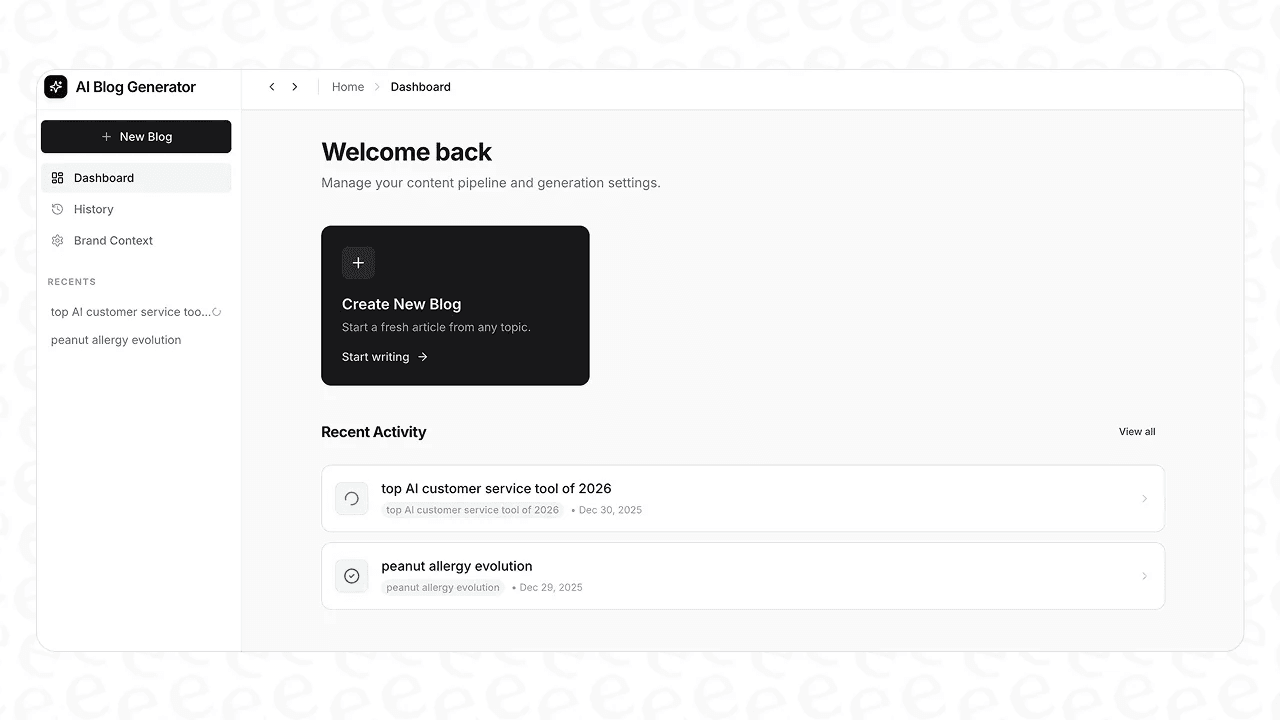
How the eesel AI blog writer automates the workflow
Here’s what makes it different and so effective for lead generation:
- Deep research with citations: It doesn't just skim the surface. The tool performs context-aware research to produce well-analyzed content that builds trust, and it even includes external citations and internal links automatically.
- Automatic assets: It's not just a text generator. It automatically creates and embeds relevant images, infographics, and data tables to make your content more engaging.
- Authentic social proof: The AI finds and integrates real quotes from Reddit and relevant YouTube videos. This adds a layer of human nuance and credibility that other AI tools can't match.
- Proven results: We use this exact tool ourselves at eesel AI. It took our blog from 70k to over 750,000 impressions in just three months because we were able to publish over 1,000 optimized posts.
How specialized AI writers differ
Tools like ChatGPT are powerful for generating text, but they typically require additional steps to create a publish-ready blog post. Users often need to handle tasks like fact-checking, SEO optimization, formatting, sourcing images, and adding social proof. They can serve as a strong starting point, while other platforms are designed to provide a more end-to-end solution.
LLMs are powerful tools, but they'll just make your poor communication skills even more obvious. You can get better at writing *without* letting the AI do it for you. Just ask it for options, work with it, even argue with it. It's a great way to improve your own content.
The eesel AI blog writer is designed to handle the entire workflow. Instead of providing a text document, it delivers a complete, structured, and visually rich article intended to engage readers and build trust to help turn them into leads.
| Feature | Generic AI (ChatGPT, Jasper) | eesel AI blog writer |
|---|---|---|
| Output | Raw, unformatted text draft | Publish-ready post with full structure |
| Research | Requires manual fact-checking | Deep research with automatic citations |
| Visuals | None; requires manual creation | Automatic images and infographics |
| Social Proof | None; requires manual sourcing | Embeds Reddit quotes and YouTube videos |
| Workflow | Multi-step: generate, research, format, find assets | One-click: from keyword to complete post |
| Trial | Varies | Completely free to try |
For a more detailed look at how to apply these strategies in practice, the video below offers some excellent tips for writing blog posts that consistently generate leads.
Turning your blog into a growth engine
So, there you have it. Strategic blog writing for leads is a powerful process that combines understanding your audience, providing a ton of value, optimizing for search, and creating clear paths to conversion.
If there's one thing to take away, it's this: consistency is everything. The more high-quality, targeted content you publish, the more opportunities you create to attract and convert leads. Over time, this builds a sustainable growth engine for your business that, unlike paid ads, actually becomes more valuable the longer it runs.
While the process requires a smart strategy, the payoff is a scalable engine for business growth that works for you around the clock. And with the right tools, it's more achievable than ever before.
Your next step: Generate a lead-focused blog in minutes
Ready to turn your blog into a lead-generation machine without all the manual grind? See for yourself how quickly you can create content that actually attracts and converts.

Frequently Asked Questions
Share this article

Article by
Amogh Sarda
CEO of eesel AI. Amogh Sarda is obsessed with making the ultimate AI for customer service teams. He lives in Sydney, Australia and has previously worked at Atlassian and Intercom. Outside of work he’s usually surfing or on stage doing improv.