The definitive guide to using an AI blog writer for content marketers

Stevia Putri
Last edited January 15, 2026
Being a content marketer in 2026 is a lot. You're expected to churn out high-quality, SEO-optimized content constantly, but there are only so many hours in the day. This pressure to scale up without letting quality slide is a real headache. This is where AI blog writers enter the chat, promising to be the extra pair of hands you've been wishing for. But as you've probably guessed, they're not all the same.
What is an AI blog writer for content marketers?
An AI blog writer is a tool designed specifically for creating blog posts, and it's much more than a general-purpose chatbot. You give it a simple prompt, like a keyword or a topic, and it generates a full, well-structured article that's built to perform well in search engines.
You could ask a generic AI chatbot to write a blog post, and it would give you a big block of text. But then you'd be stuck structuring it, adding headings, hunting down relevant images and videos, checking the SEO, and trying to make it sound like a human wrote it. It’s a start, but it’s still a lot of work.
A dedicated AI blog writer already knows what a good article looks like. It knows how to write a hooky intro, structure headings for both readers and search engines, find relevant media, and even create an FAQ section that targets what people are actually searching for. The goal is to hand you something that's nearly ready to publish, saving you hours on every post.
Key features of an AI blog writer
SEO and AEO features
The old trick of just sprinkling a keyword throughout a post doesn't work anymore. Modern SEO is way smarter than that. A good AI blog writer gets this. It should automatically build a logical heading structure (H2s, H3s), write meta descriptions, and make sure the content is easy to read.
But there's a new player in the game: AEO, or Answer Engine Optimization. With things like Google's AI Overview becoming standard, your content needs to give direct, clear answers. The best AI tools are already built for this, structuring information so that AI-powered search can easily find and feature it.
Automatic asset generation
Finding visuals for a blog post can be a real time-sink. You're either scrolling through stock photo sites, trying to build a chart, or pleading with your design team for an infographic. It’s a pain.
The best AI blog writers handle this for you. They don't just write words; they build a complete post with assets baked in. This means you get AI-generated images, custom infographics, and data tables created on the spot. Some go even further by finding and embedding relevant YouTube videos or pulling real user comments from places like Reddit. This saves you time and adds a layer of credibility that plain text just can't match.
Brand context awareness
The number one complaint about AI content is that it's generic and shallow. It skims the surface of a topic without providing any real value. That's a big problem, because content that doesn't actually help the reader won't rank, and it certainly won't build any trust with your audience.
You cannot fully automate a blog writing and content marketing strategy. Especially Jasper and Surfer, I consider those some of the worst tools for quality content. Any time you want high quality content, you need a real person involved. If you want to create an SEO website with 100s of blog posts that's optimised for LLMs, use AI tools. But I strongly suspect an algorithm update is coming that will destroy all of these sites. It's easy to glance at content and go 'yeah that'll do' because we live in an impatient world now and want to automate things and get results quickly. But if you actually look for substance, AI cannot do it. It just mimics. Proper research will always be needed, real people writing quality will always be needed. I've never seen AI content that is as good as, or better than, paying people to do the job properly. AI is a shortcut.

A smarter AI blog writer fixes this by doing its homework. Instead of just summarizing the top search results, it digs for specifics. For a comparison post, it might find current pricing data. For a product review, it could pull up technical specs. It should also be able to learn from your own website to understand your brand's voice and products. This lets it add natural product mentions and keep a consistent tone, making the content feel like it actually came from your team.
The best AI blog writers: A platform comparison
We’ve spent a lot of time working with these tools. Here’s a no-fluff breakdown of how the most popular options stack up for content teams that need to drive results.
eesel AI blog writer: For publish-ready, traffic-driving content
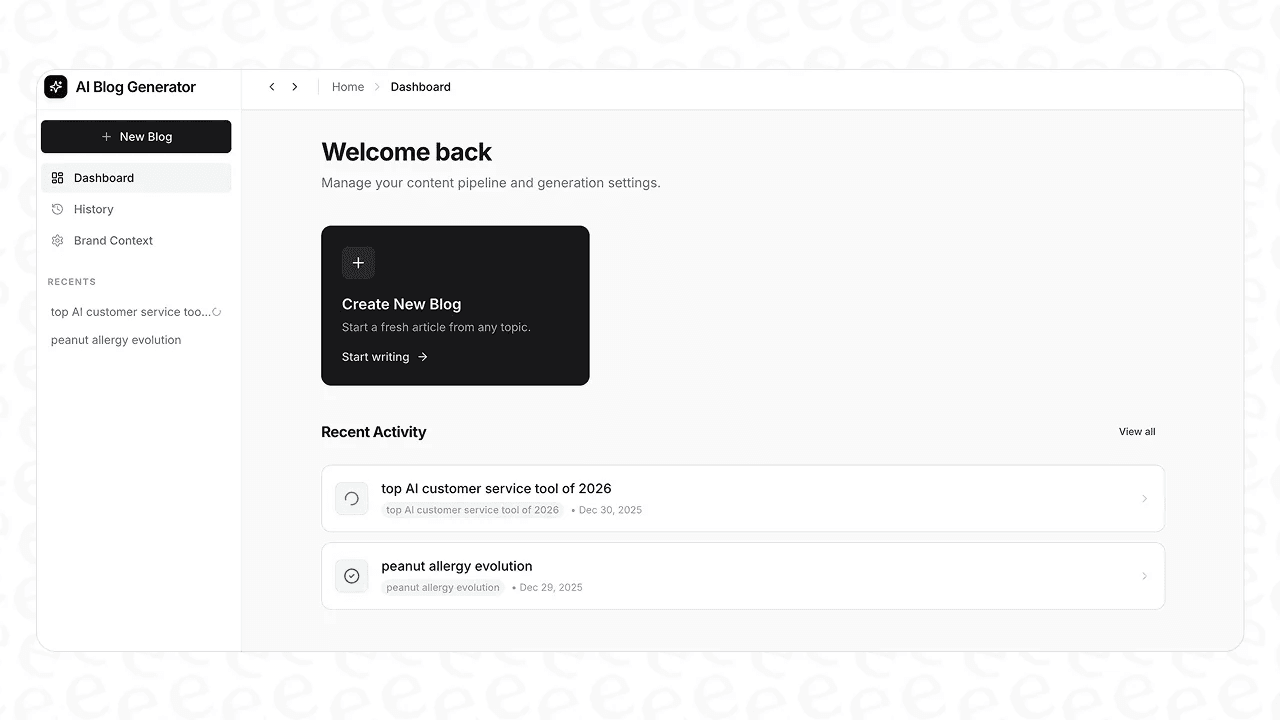
The eesel AI blog writer is the tool we built to fix our own content scaling issues. It’s not about giving you a rough draft; it’s about turning a single keyword into a complete, SEO-optimized, and media-rich blog post that you can publish right away. We built it to take care of all the tedious parts of content creation so marketers can focus on the bigger picture.
Unique Strengths:
- Complete Content Generation: It doesn't just hand you text. You get a fully formed article with AI-generated images, embedded YouTube videos, and even relevant Reddit quotes for social proof.
- Context-Aware Research: The AI automatically finds specific, real-time data for the post. If you're writing a comparison, it will look for pricing. If it's a review, it will find technical specs. You don't have to do the manual research.
- SEO & AEO Ready: Every post is optimized from the start for both traditional search engines and the new AI Answer Engines, giving your content the best shot at ranking.
- Human-Centric Tone: We've spent over a year tweaking our models to create content that sounds natural. It's conversational and avoids that robotic, filler text feel.
Pricing:
- You can generate your first few blogs for free to see the quality for yourself.
- Paid plans are simple: $99 for 50 blog credits, and you can buy more as you need them. No confusing tiers or per-user fees.
Jasper AI: An AI content platform for marketing teams
Jasper is a big name in the AI writing world. It's a versatile AI content platform made to help marketing teams create all sorts of content, from ad copy and social media posts to emails and blogs. It focuses heavily on helping you maintain a consistent brand voice everywhere.
Jasper's "Blog Post" feature gives you a solid first draft, but you will need to manually find and add assets, like videos, infographics, or quotes. It has an AI image generator, but it won't automatically create and place visuals for you. It's great for overcoming writer's block, but it's not a one-click solution for a finished article.
Pricing:
- Pro Plan: Starts at $59 per month, per seat when billed annually.
- Business Plan: Custom pricing is available for teams that need more advanced brand controls and API access.
Copy.ai: A GTM AI platform for sales and marketing automation
Copy.ai has branded itself as a go-to-market (GTM) AI platform. Its main game is helping sales and marketing teams automate workflows like prospecting and managing sales pipelines. Content creation is a feature, but it's not the platform's central purpose.
Since Copy.ai isn't built specifically for long-form SEO content, its blog posts serve as a starting point. Users will likely need to add research, depth, and media to compete in search rankings. It's a better fit for short-form content or as one piece of a larger, automated sales and marketing strategy. Also, its popular free plan is no longer available.
Pricing:
- Chat Plan: Starts at $24 per month (billed annually) for up to 5 users.
- Enterprise Plan: You'll need to contact them for custom pricing if you need API access and other advanced features for your company.
Writer: An enterprise AI platform for agentic work

Writer is an enterprise-level platform for large companies that want to build their own custom AI agents and workflows. It's less of a ready-made tool and more of a powerful sandbox for creating AI solutions that follow strict brand, security, and governance rules.
This is not a simple AI blog writer. Writer is for teams that want to build "Playbooks" and custom AI agents to automate complex internal processes. You could build an agent to help with blog writing, but it's not designed to generate a complete, media-rich article from a single prompt. It's more about helping your existing team's workflow and ensuring everything is compliant, which may be more comprehensive than what some content teams require.
Pricing:
- Starter Plan: They offer a 14-day free trial for teams of up to 5 users.
- Enterprise Plan: Custom pricing is available for large organizations that need the full platform.
How to integrate an AI blog writer into your workflow
Using an AI writer isn't about pushing a button and calling it a day. It's about building a smarter, faster process that blends AI efficiency with your own expertise.
- Step 1: Start with good keyword research. AI is smart, but it can't read your customers' minds. You still need to do the work to understand your audience, what they're searching for, and why.
- Step 2: Use a specialized tool for the first draft. This is the biggest time-saver. Instead of staring at a blank screen, plug your keyword and brand info into a tool like the eesel AI blog writer. In a few minutes, you'll have a complete, structured article with assets already included.
- Step 3: Edit for voice, expertise, and accuracy. This is where you shine. Read through the AI draft. Check any facts or data. Add your own unique insights, stories, or brand-specific examples. Adjust the tone to make sure it sounds exactly like you. The goal is to take the AI's 90% draft and turn it into a 100% polished article.
- Step 4: Optimize and publish. Do one last check of your on-page SEO, add any final touches, and hit publish. Then, keep an eye on the article's performance to see what's working and use that info to make your next post even better.
A workflow infographic showing how to use an AI blog writer for content marketers, from keyword research to publishing.
Why the right AI blog writer leads to growth
AI blog writers are here to stay, and they're changing the content marketing game. But their true value isn't just about speed. It's about finding the right tool that lets you scale up your output without sacrificing quality.
Seeing these tools in action can help clarify which one best fits your team's needs. For a comprehensive overview comparing various AI writing tools, the following video offers a hands-on look at their strengths and weaknesses.
Generalist tools can give you a first draft, but they may leave you with more manual work. Specialized platforms are designed to deliver a more finished product, including the research, structure, and media you need to actually rank and bring in traffic. The best approach is a partnership: let AI handle the speed and scale, while you bring the strategy, creativity, and human touch that no machine can ever replace.
If you're ready to see what a purpose-built AI blog writer can do for your content strategy, try the eesel AI blog writer for free and generate your first publish-ready article today.

Frequently Asked Questions
Share this article

Article by
Stevia Putri
Stevia Putri is a marketing generalist at eesel AI, where she helps turn powerful AI tools into stories that resonate. She’s driven by curiosity, clarity, and the human side of technology.
