A practical guide to blog writing for international SEO

Stevia Putri
Last edited January 20, 2026
Expanding your business across borders isn't just a nice idea anymore; for many, it's the main path to growth. But just being online everywhere doesn't mean you'll actually be found everywhere. If you want to show up when people in Germany, Japan, or Brazil search for what you offer, you need a smart plan.
And that's where international SEO comes in. It's the key to unlocking a stream of organic traffic from all over the world, and your blog is the engine that will drive it. This guide will walk you through the essentials of blog writing for international SEO, covering everything from the big-picture strategy to the nitty-gritty technical details.
Scaling this kind of effort can feel like a lot, but don't worry. We'll also touch on how modern AI tools can help you manage it all, letting you create high-quality content for any market without drowning in spreadsheets and translation docs.
What is blog writing for international SEO?
First things first, let's get clear on what we're actually talking about. It's tempting to think you can just run your content through a translator and call it a day, but that's a surefire way to miss the mark.
It's more than translation, it's localization
International SEO isn't about simply swapping English words for their French or Spanish equivalents. It’s about localization. This means adapting your content to fit a specific region’s language, culture, search habits, and unspoken rules.
Localization covers things like:
- Using the right currency and date formats.
- Choosing images with people and places that look familiar to the local audience.
- Swapping out idioms or pop culture references that won't land.
- Adjusting your tone to match cultural expectations.
It’s about making your content feel like it was written for them, because, in a way, it was.
How blog writing for international SEO differs from local and standard SEO
It's helpful to understand where international SEO fits in with other strategies:
- Standard SEO: This is probably what you're most familiar with. It targets a broad audience using a single language, usually without a specific city or country in mind.
- Local SEO: This is all about targeting customers in a very specific geographic area, like "pizza delivery in Brooklyn."
- International SEO: This is the global version, targeting audiences in different countries and languages. It requires a much more involved approach to both your content and the technical setup of your site.
<quote text="Google has most of the info you need: https://developers.google.com/search/docs/specialty/international/managing-multi-regional-sites
In terms of keyword research and tracking, all the tools separate their databases by country, just like Google. So you'll either need to wait for data to trickle into GSC or purchase a tool you trust tedious research keywords for each country, or both." sourceIcon="https://www.iconpacks.net/icons/2/free-reddit-logo-icon-2436-thumb.png" sourceName="Reddit" sourceLink="https://www.reddit.com/r/SEO/comments/1mfj121/comment/n6jppyd/">
To better illustrate the differences, here's a breakdown of how these strategies compare.
The primary goals of blog writing for international SEO
Ultimately, the goal is simple: grow your business. But more specifically, a solid international SEO strategy for your blog aims to:
- Attract organic traffic from new global markets.
- Build your brand's authority and earn trust with international audiences.
- Give visitors a great, relevant experience, no matter where they're browsing from.
Foundational strategy: Market and keyword research
Before you write a single word, you need to do your homework. This is the most important step, because without the right research, even the most beautifully written blog post will be shouting into the void.
Uncovering opportunities in your existing data
You might already have an international audience without even realizing it. The best place to start is with your own website's data.
Pop open Google Analytics and head to the Audience > Geo > Location report. This will show you which countries are already sending you traffic. Look for interesting signals. For example, if you see a lot of traffic from a non-English-speaking country but the bounce rate is sky-high, that's a huge clue. It means people are interested in what you offer, but they're leaving because of a language barrier. That's a golden opportunity.
The nuances of international keyword research
Here's the biggest mistake people make: directly translating their English keywords and assuming they'll work. They won't.
Search intent and terminology can be completely different. In the US, you search for "sneakers," but in the UK, you'd look for "trainers." The same logic applies across every language and culture. A word-for-word translation often misses the local slang, the cultural context, and what people are actually typing into Google.
Search volume and competition also change dramatically from one country to the next. A keyword that's super competitive in the US might be wide open in Italy. You need tools that can give you country-specific data. Tools like Ahrefs' Keywords Explorer or SEMrush are great for this because they have massive, country-specific databases (SEMrush covers over 140 countries) that let you see what real people are searching for, where they're searching from.
Analyzing the local search landscape
Once you've got a list of promising local keywords, it's time to do some digital reconnaissance. Use a VPN to set your location to your target country and start searching for your keywords.
Look at the pages that rank on the first page.
- What kind of content is it? Are they long-form guides, listicles, or product reviews?
- What's the tone? Is it formal and professional, or casual and friendly?
- Who are your local competitors? What are they doing well?
This manual check gives you an invaluable feel for what works in that specific market. It helps you understand the unspoken rules of the local search landscape before you try to compete in it.
Crafting localized content that connects and converts
Okay, research is done. You know your audience and what they're looking for. Now it's time to actually create the content. This is where you bridge the gap between data and human connection, crafting blog posts that feel native to the reader.
Why machine translation falls short
Using machine translation alone is often insufficient as a complete content strategy. While this technology is improving, it may not fully capture context, cultural nuance, and brand voice. An article that reads as though it were machine-translated can sometimes fail to connect with an audience and may impact your credibility. For effective international content, it's often recommended to work with native-speaking writers or use an AI platform designed for this purpose.
Best example, Pepsi a few years ago. Their slogan is 'Pepsi brings you back to life'. However, they translated it literally to the Chinese market and it became 'Pepsi brings dead ancestors back from the grave' which turned into a good source of memes. What applies to our language does not always apply to others.

Key elements of content localization
True localization goes way beyond the words on the page. Here's a quick checklist of things you need to adapt:
- Imagery: Use photos that feature local people, landmarks, and environments. Stock photos of a generic Western office won't resonate in Tokyo.
- Currency, dates, and units: Make sure prices are in the local currency, dates are in the right format (DD/MM/YYYY vs. MM/DD/YYYY), and units of measurement (like kilograms vs. pounds) are correct.
- Cultural references: Avoid idioms, jokes, or examples that are specific to your home country. They'll just confuse or alienate a global audience.
- Tone and style: Adjust your writing style to match cultural norms. Some cultures appreciate a direct, data-driven tone, while others prefer a more narrative, formal approach.
Having a Short, Concise and Relevant URL is important and from an International SEO standpoint, that means using your target keyword in your URL. Which means using translated versions of your target keywords in your URL. Example: (made it up) https://www.seosubreddit.com/en/international-seo.html https://www.seosubreddit.com/es/seo-internacional.html
How to scale content with eesel AI
Creating unique, high-quality, fully localized blog posts for five, ten, or twenty different markets is an enormous amount of work. It's time-consuming, expensive, and a logistical nightmare to manage.
This is exactly the problem the eesel AI blog writer was built to solve. It's an AI content generation platform designed specifically for the challenge of scaling high-quality content.
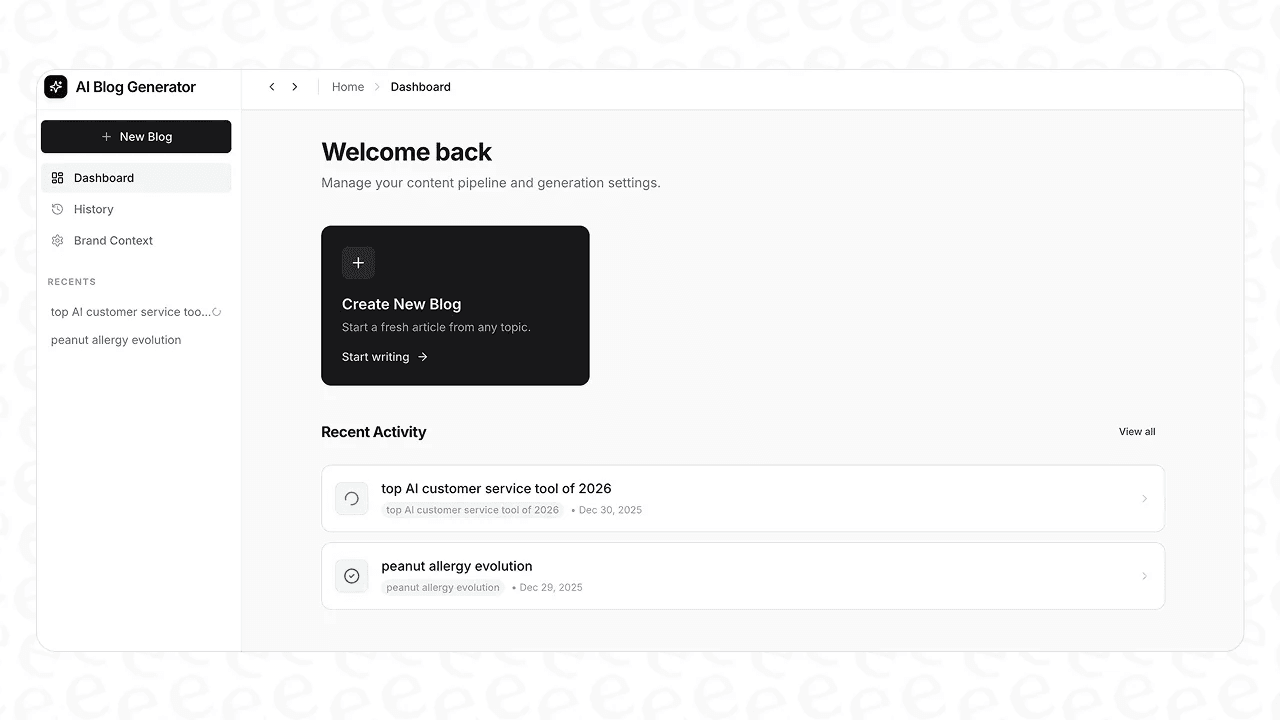
Here’s what makes it different for international SEO:
- It generates a complete, publish-ready blog post. You give it a localized keyword, and it doesn't just give you a rough draft. You get a fully structured article with an intro, headings, a conclusion, FAQs, and everything in between.
- Powerful multilingual capability. It's not just translating; it's generating content natively in almost any language, ensuring the tone, flow, and cultural context feel authentic.
- Context-aware research. The AI understands the search intent behind keywords in different languages. For a German keyword, it pulls relevant German data and sources, not just translated English info.
- Automatic asset generation. It can create localized tables, charts, and AI-generated images that fit the topic and region you're targeting.
- Media embeds. It can even find and embed relevant YouTube videos or quotes from local forums (like Reddit) that resonate with that specific audience, adding a layer of authenticity you can't get anywhere else.
Instead of juggling freelance writers and translators across a dozen time zones, you can generate a high-quality, localized article that’s ready to rank in minutes.
Technical SEO: Ensuring your content gets found
You can create the best content in the world, but if search engines can't figure out who it's for, it will never reach the right people. Getting the technical side of international SEO right is non-negotiable.
Choosing the right international URL structure
You need to decide how you're going to organize the different language versions of your site. Google's guidelines lay out three main options:
For site structure, I almost always recommend subfolders (site.com/en/, site.com/de/) because you keep all domain authority in one, and it's way easier to manage technically. ccTLDs only make sense if you have dedicated local teams and serious market investment, which most don't.
| Structure | Example | Pros | Cons |
|---|---|---|---|
| ccTLD | yoursite.de | Strongest signal to search engines and users that the site is for Germany. | Expensive to buy and manage multiple domains, and some countries have strict requirements for ownership. |
| Subdomain | de.yoursite.com | Fairly easy to set up and allows you to host each version on different servers. | The geo-targeting signal isn't as strong as a ccTLD. |
| Subdirectory | yoursite.com/de/ | Easy to manage, low maintenance, and consolidates all your SEO authority onto one domain. | All site versions are typically hosted on a single server (though a CDN can fix this). |
To help visualize these options, here's a breakdown of how each URL structure works.
For most businesses just starting with international SEO, the subdirectory structure (yoursite.com/de/) is the best bet. It strikes a great balance between SEO benefits and ease of management.
The critical role of hreflang tags
This sounds technical, but the concept is simple. Hreflang tags are little snippets of code you add to your pages to tell search engines, "Hey, I have other versions of this page for different languages and regions."
They are absolutely essential because they solve two big problems:
- They prevent Google from thinking your different language versions are duplicate content.
- They help Google show the correct version of a page to the correct user (e.g., showing the
/fr/page to someone searching in France).
You should also include a special hreflang="x-default" tag, which tells search engines which page to show if a user's language and region don't match any of your specific versions.
Here's what it looks like in code:
<link rel="alternate" hreflang="en-gb" href="https://example.com/uk/page.html" />
<link rel="alternate" hreflang="en-us" href="https://example.com/us/page.html" />
<link rel="alternate" hreflang="de-de" href="https://example.com/de/page.html" />
<link rel="alternate" hreflang="x-default" href="https://example.com/page.html" />
Optimizing for global site speed
Page speed is a huge ranking factor. If your website is hosted on a server in California, it's going to load slowly for a user in Australia.
The solution is a Content Delivery Network (CDN). A CDN is a network of servers spread across the globe. It stores copies of your website in different locations, so when a user visits your site, the content is delivered from the server closest to them. This makes your site load lightning-fast for everyone, everywhere.
Measuring and analyzing international SEO performance
You can't improve what you don't measure. Once your international content is live, you need to keep a close eye on performance so you can refine your strategy.
Essential tools for tracking performance
You don't need a bunch of fancy tools to get started. The two most important ones are free:
- Google Search Console: The Performance report is your best friend. You can filter it by country to see your clicks, impressions, and average rankings for each of your target markets. This tells you if you're actually showing up in search results.
- Google Analytics: Here, you can segment your audience by country to see how visitors are behaving once they're on your site. Are they staying long? Are they converting? This tells you if your content is actually resonating.
For a deeper dive into the practical application of these strategies, the following video offers quality tips on writing for international audiences while keeping SEO in mind.
Final thoughts on international SEO strategy
A successful international SEO strategy boils down to three key things: deep market research, thoughtful content localization, and a precise technical setup. It's a lot to juggle, but getting it right opens your business up to a whole new world of customers.
The biggest hurdle for most companies is simply scaling the creation of high-quality, localized content. It's a massive undertaking. But with a strategic approach and the right tools, you can turn this challenge into your biggest growth opportunity.
Go global with your blog
Scaling a content strategy across borders can be a significant undertaking. The eesel AI blog writer is designed to assist with this process by helping generate SEO-optimized and culturally-aware blog posts. This can reduce the time spent on research and writing for new markets. We used this tool to grow our own impressions from 700 to 750,000 per day in a few months. Try it for free to generate your first international blog post.

Frequently Asked Questions
Share this article

Article by
Stevia Putri
Stevia Putri is a marketing generalist at eesel AI, where she helps turn powerful AI tools into stories that resonate. She’s driven by curiosity, clarity, and the human side of technology.