My complete SEO AI tools analysis: I tried 7 top platforms in 2026

Kenneth Pangan
Last edited January 7, 2026
Finding effective AI tools for content creation can be challenging. This analysis examines 7 popular platforms to evaluate their capabilities in improving Google rankings and citations by AI engines like ChatGPT.
A complete SEO AI tools analysis: Trying 7 top platforms in 2026
SEO has changed. It’s not just about keywords and backlinks anymore. Now, it's about appearing in Google's AI Overviews, getting cited by ChatGPT, and creating content that generative engines favor. This new field is often called Generative Engine Optimization (GEO).
The right AI tools can provide a significant advantage, but the market is filled with options. Many teams are using AI to scale content production. For example, eesel AI used its internal eesel AI blog writer to grow its blog from 700 to 750,000 daily impressions in three months. This review tests several top platforms to compare their features and effectiveness for content strategy in 2026.
What are SEO AI tools?
Before diving in, it's useful to clarify the term. SEO AI tools are platforms that use artificial intelligence to make the search engine optimization process easier and more effective. This goes beyond just finding a few keywords.
Today’s tools can handle a wide range of tasks, including content creation, on-page optimization, technical site audits, and tracking appearances in AI-generated answers, which is the core of Generative Engine Optimization (GEO).
They work by analyzing top-ranking content for a topic, identifying patterns, and providing data-backed suggestions. The goal is to help users create content that satisfies both search engine algorithms and human readers. They can generate outlines, draft articles, suggest internal links, and even provide notifications when a brand is mentioned by AI assistants like Perplexity or Claude. The aim is to reduce manual research and enable the creation of better content more quickly.
How the tools for this analysis were chosen
This review uses a consistent set of criteria to ensure a fair and useful comparison. The evaluation focused on platforms that can make the daily SEO workflow quicker and more impactful.
The evaluation was based on:
-
Content Quality & Human Tone: Does the output sound like it was written by a person, or is it generic AI-generated text?
-
End-to-End Workflow: Can the tool manage the process from a single keyword to a publish-ready article without requiring multiple other subscriptions?
-
SEO vs. GEO Capabilities: Does it focus on traditional Google rankings, or does it also help with citations in AI-generated answers?
-
Ease of Use: Is the platform intuitive for content marketers, or does it require technical expertise?
-
Value for Money: Does the price align with the results it delivers?
A comparison of top SEO AI tools
Here’s a quick overview of the platforms tested.
| Tool | Best For | Key AI Feature | Pricing Model |
|---|---|---|---|
| eesel AI blog writer | Turning a single keyword into a complete, publish-ready blog post with all assets included. | Context-aware research and automatic asset generation (AI images, tables, Reddit quotes, YouTube videos). | Monthly Subscription. |
| Surfer SEO | On-page optimization and auditing existing content against top competitors. | Real-time Content Editor with Content Score and an AI Tracker for brand mentions. | Subscription-based. |
| Frase.io | Researching competitor content and creating content optimized for both SEO and GEO. | Dual SEO + GEO scoring and AI-generated content briefs based on SERP analysis. | Subscription-based. |
| Clearscope | Optimizing human-written content to improve topical relevance and rank faster. | Content reports with term suggestions and AI-tracked topics to monitor visibility. | Subscription-based. |
| Rankscale.ai | Granularly tracking brand visibility and rankings across different AI search engines. | GEO tracking across 10+ AI engines (ChatGPT, Perplexity, Gemini, etc.) and AI-readiness website audits. | Credit-based Subscription. |
| Semrush | All-in-one SEO management with integrated AI visibility tracking. | AI Visibility Toolkit for tracking mentions and "AI Search Health" checks in Site Audit. | Subscription-based. |
| Ahrefs AI Content Helper | Ahrefs users looking to optimize content based on topical coverage and search intent. | Topic coverage scores and the Brand Radar tool for tracking AI mentions. | Included in Ahrefs subscription. |
A detailed analysis of 7 popular platforms
Here’s a closer look at each platform, what it does best, and where it might fit into a content strategy.
1. eesel AI blog writer
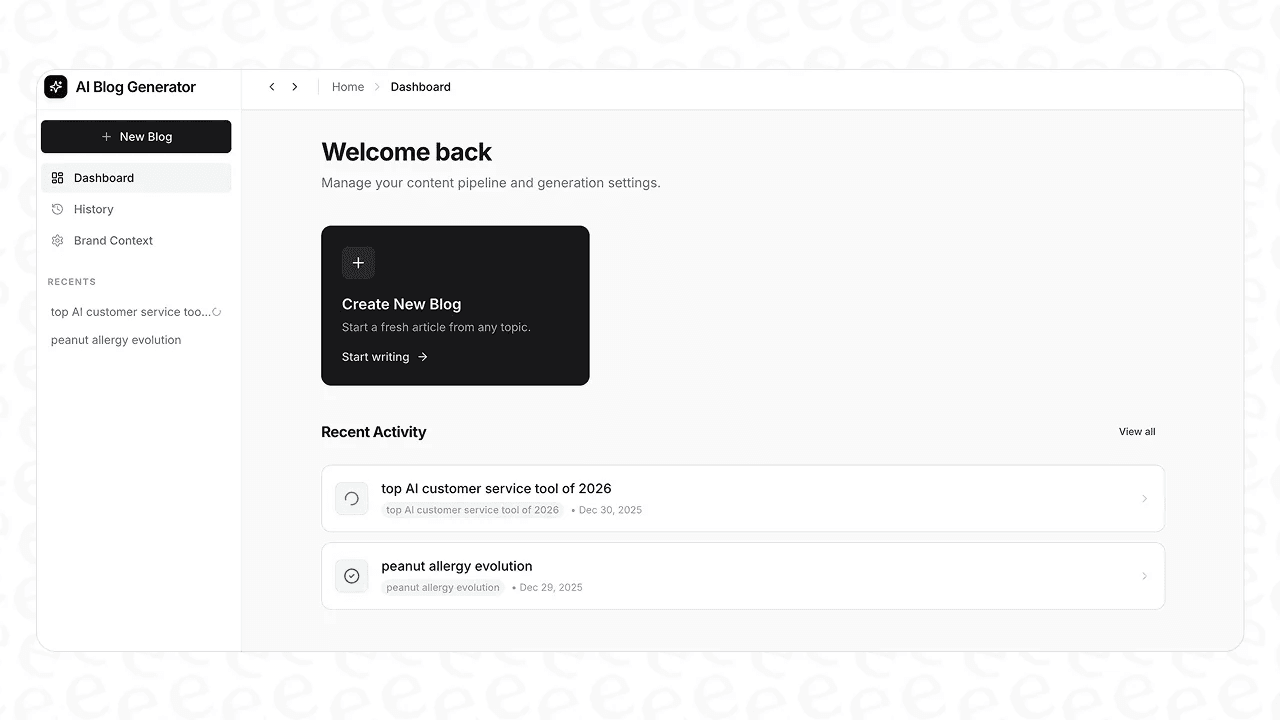
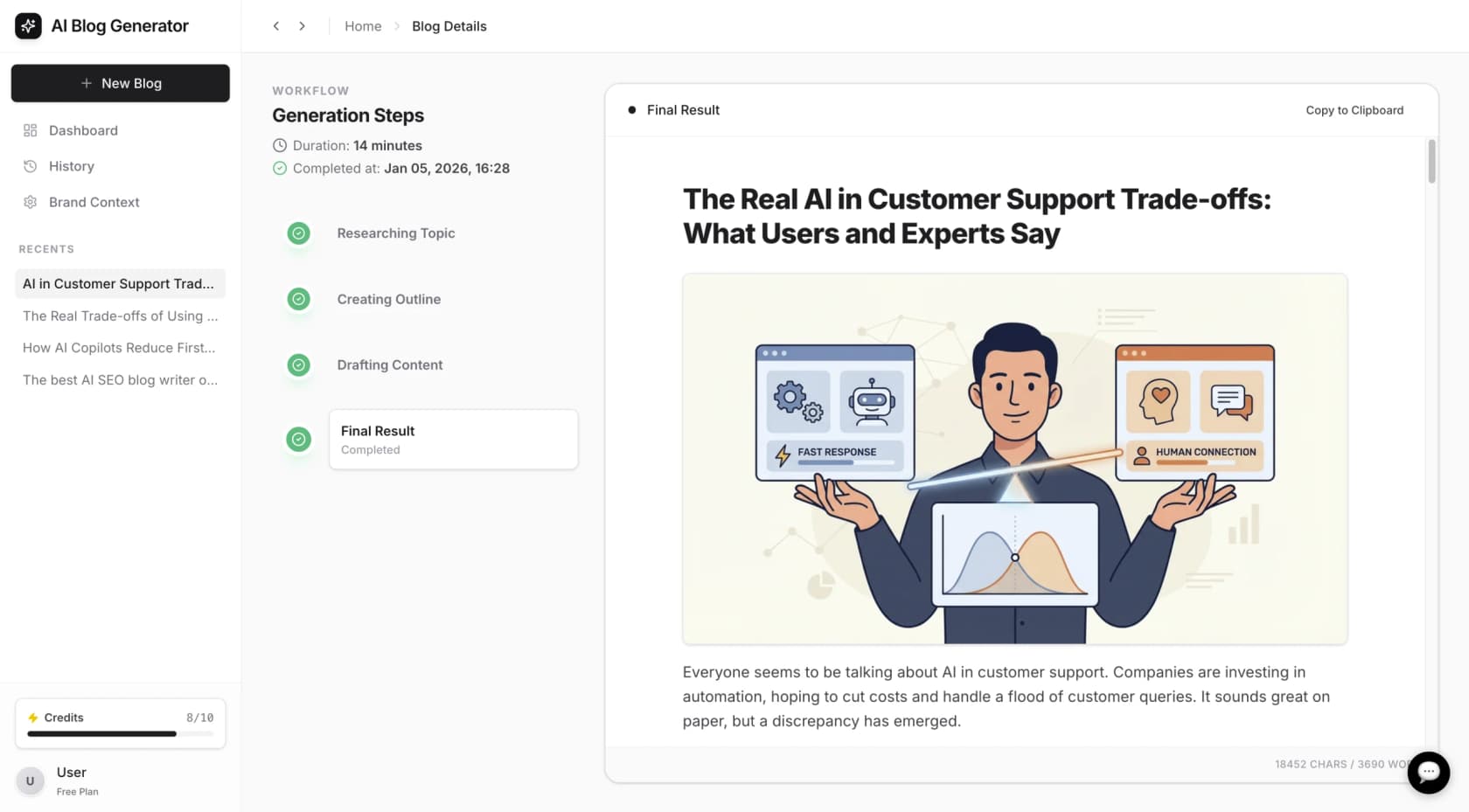
The eesel AI blog writer is designed to generate a complete, media-rich, and SEO-optimized article from a single keyword. Its features include context-aware research and automatic asset generation. The platform can create and insert relevant assets like AI-generated images, data tables, and infographics. To support E-E-A-T signals, it also embeds relevant YouTube videos and quotes from Reddit threads.
A key benefit is the streamlined workflow from idea to published post, as it handles research, writing, asset creation, and optimization for both SEO and GEO. The tool is built specifically for creating blog content, so it does not include broader SEO tools like backlink analysis. It is available with a free trial.
- Pricing: The "Early Bird" plan is $99 per month for 50 blog posts.
2. Surfer SEO
Surfer SEO is a well-known tool for on-page optimization. A standout feature is its Content Editor, which analyzes top-ranking pages for a keyword and provides real-time feedback with a Content Score.
The platform has expanded its AI features with Surfer AI, which can generate entire articles. Its "Coverage Booster" suggests topics that competitors are covering. For teams focused on refining existing content, its AI Humanizer tool can rewrite AI-generated text to sound more natural and bypass AI detectors. A newer feature is the AI Tracker, which monitors brand mentions across ChatGPT, Google AI Overviews, and Perplexity.
Surfers. Obviously now it's one of the best (talking about articles optimization)

One consideration with this tool is its heavy focus on keyword density, which can feel prescriptive. While effective for the optimization phase, the initial content it generates may require human editing to develop a unique voice.
- Pricing: The "Essential" plan starts at $79 per month (paid annually) and includes 30 articles in the Content Editor and 5 AI articles.
3. Frase.io
Frase.io is effective at the research stage. It automates SERP analysis to create intelligent content briefs. In a few minutes, it produces a detailed outline with headings, "People Also Ask" questions, and key topics.
Frase is the best bang for the buck regarding content evaluation and content briefs for writers.
What makes Frase stand out is its dual-optimization approach, focusing on both traditional SEO and Generative Engine Optimization (GEO). It provides separate SEO and GEO scores to help content rank on Google and get cited by AI engines like ChatGPT, Perplexity, Claude, and Gemini. Users can also check a GEO score for free on their site.
While its research capabilities are a key strength, its AI-generated text may sometimes require editing to achieve the natural flow of human-written content. It is a useful tool for creating the structure of an article, which can then be refined by a human writer.
- Pricing: Plans start at $38 per month for the "Starter" plan when billed annually. They also offer a 7-day money-back guarantee.
4. Clearscope
Clearscope is popular with content teams that prioritize human-written articles but want a data-driven way to optimize them. The workflow involves pasting a draft into its editor, which then provides a content grade based on topical relevance and a list of important terms to include.
I've been using ClearScope for the last 6 months or so and it's been amazing. Their team is great and they keep adding onto the software to make it even better.
Its strength is its semantic analysis, which encourages natural and authoritative writing. It also has new features like AI-driven internal linking suggestions and the "Expand" tool, which tracks visibility on Google and citations in AI chatbots. Its integrations with Google Docs and WordPress are also seamless.
The platform is positioned at a higher price point compared to some competitors. It’s also important to note that it is primarily an optimization tool rather than a full AI content generator.
- Pricing: The "Essentials" plan starts at $129 per month for 20 AI Tracked Topics and 20 AI Drafts.
5. Rankscale.ai
While other tools include GEO tracking as a feature, Rankscale.ai focuses on it entirely. This is a dedicated Generative Engine Optimization (GEO) tool that monitors a brand's visibility across a wide range of platforms, including ChatGPT, Perplexity, Claude, Gemini, Microsoft Copilot, and Grok.
Rankscale provides specific data, allowing users to track performance by keyword, region, and even the specific AI model. It can analyze the sentiment of brand mentions and identify the sources cited by AI engines. Its Website Audits are also useful, providing an AI readiness score from 0-100 with actionable tips.
This tool is focused on analytics and is not a content creation platform. For teams that want a detailed view of their AI visibility, it is one of the leading options available.
- Pricing: It uses a credit-based subscription model, with the "Essentials" plan starting at $20 per month for 120 credits.
6. Semrush
Semrush is a large SEO suite that has integrated AI-powered features. Its AI Visibility Toolkit is notable, allowing users to track how their brand appears in AI search results across platforms like Google AI Overviews, ChatGPT, Gemini, and Perplexity.
I recommend SEMrush as the one comprehensive tool. And for content optimization purposes, I think a decent one is Surfer SEO, but in my opinion, it's nothing spectacular. Human eye is still more valuable thing 😁 I would also recommend to get ideas for additional content expansions with People Also Ask queries and related seaeches on Google.
Another feature is the Site Audit's "AI Search Health" report, which analyzes a site's structure and content to assess its readiness for large language models. For teams that want a single platform to manage their entire digital marketing strategy, Semrush offers a breadth of features.
The main benefit of Semrush is its comprehensive nature. However, the platform can feel overwhelming for new users. It also comes with a premium price that reflects its extensive feature set.
- Pricing: The Semrush One "Starter" plan, which includes the AI Visibility Toolkit, starts at $165.17 per month when billed annually.
7. Ahrefs AI Content Helper
Ahrefs has introduced its AI Content Helper to help its user base create content that aligns with search intent. It analyzes top-ranking competitors to provide a "topic coverage" score rather than focusing on keyword density. It also supports content creation in over 173 languages, which is beneficial for international teams.
All its features are built into the Ahrefs ecosystem. The platform has also launched Brand Radar, a tool to track brand mentions across AI chatbots, making it a competitor to dedicated GEO tools like Rankscale.
The main appeal is its deep integration with Ahrefs' data. However, the AI Content Helper is not a standalone product, and its AI writing capabilities function more as an assistant than a full generator. It is better suited for rephrasing and expanding on existing content.
- Pricing: The AI Content Helper is included in Ahrefs subscription plans, which start at $129 per month for the "Lite" plan.
How to choose the right platform from this SEO AI tools analysis
Picking the right tool depends on your main goal and your team's process. No single platform is the best for everyone.
-
If your main goal is to scale high-quality blog production quickly, a tool like the eesel AI blog writer may be suitable because it automates the process from keyword to a finished post, including assets.
-
If you have a team of writers and need to optimize their work, Clearscope or Surfer SEO are excellent choices for providing data-driven feedback and ensuring content is topically relevant.
-
If you want to optimize for both Google and AI engines simultaneously, Frase.io offers an integrated solution with its dual scoring system.
-
If you are an SEO data analyst who needs to monitor performance in AI search, a specialized tool like Rankscale.ai is essential for getting accurate visibility metrics.
-
If you prefer a comprehensive, all-in-one platform, the broad toolkits of Semrush or Ahrefs are strong contenders.
For a different perspective, this video provides a tier list of various AI SEO tools, offering a visual breakdown and ranking of what actually works in the current landscape.
Before committing, consider your biggest bottleneck. Is it research, writing, optimization, or tracking? Answering that question will help point you to the tool that will provide the most value.
Final thoughts on this 2026 SEO AI tools analysis
This analysis of seven platforms shows that AI is a core part of modern content strategy. Effective tools act as assistants, saving time on repetitive tasks so teams can focus on strategy and human insights. The goal is to use these tools to create well-researched, structured, and helpful content that performs well in both traditional search and AI chat responses.
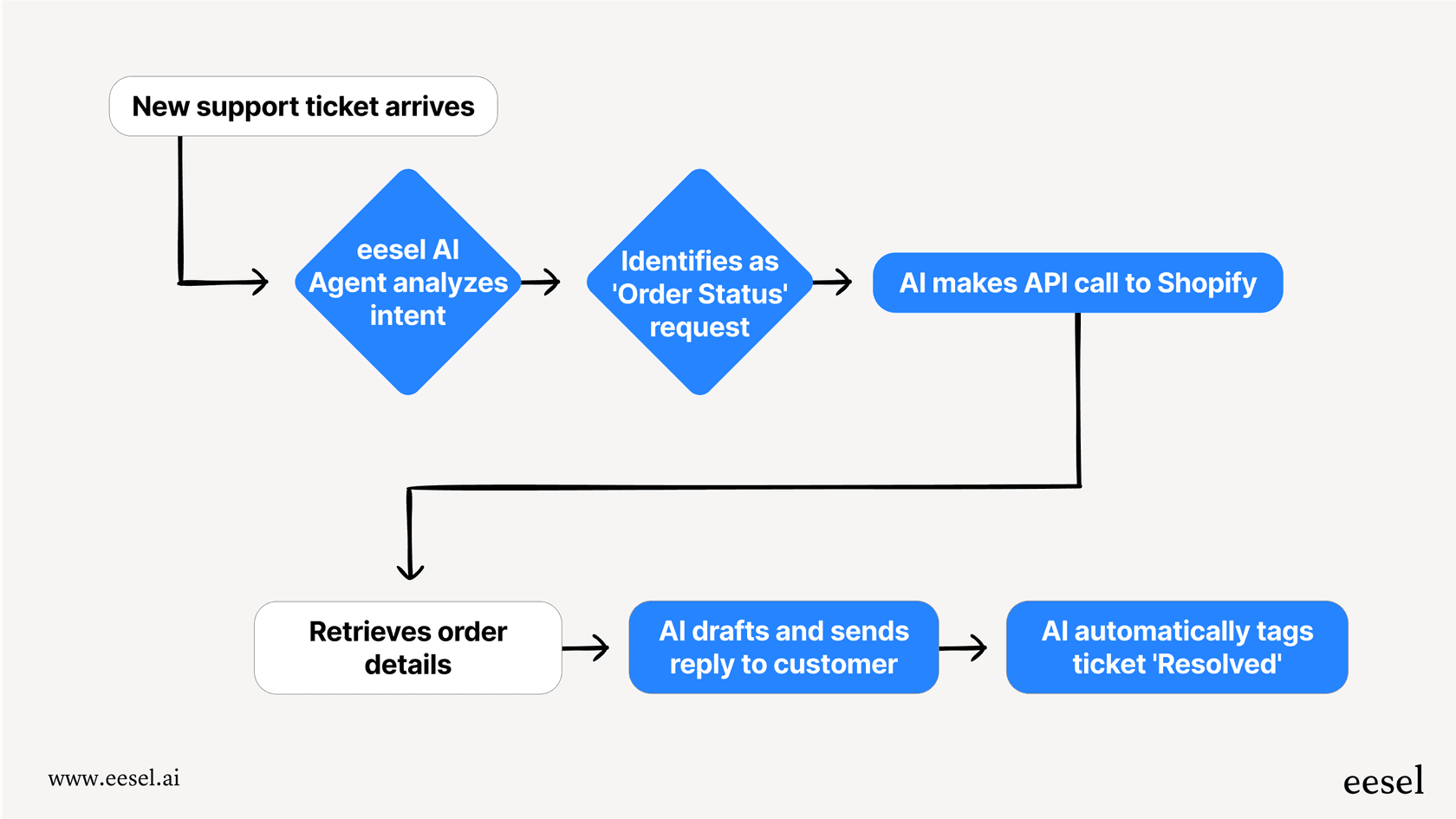
Generic AI content is less likely to be effective. The prevailing strategy is to use these tools to create deeply researched and genuinely helpful content that performs well everywhere, from traditional search results to AI chat responses.
For teams looking to scale blog content efficiently, the eesel AI blog writer is one option to consider. It offers a free trial to generate a first article.

Frequently asked questions
The most important factor depends on your team's biggest bottleneck. If you need to produce content faster, focus on end-to-end writers like eesel AI. If you already have writers and just need to improve their rankings, look at optimizers like Surfer SEO or Clearscope. Your team's specific workflow is the most important factor.
An analysis like this helps a small business find a tool that provides the most leverage. Instead of hiring a large team, a business can use AI to handle research, writing, and optimization, which allows it to compete with larger companies without a comparable budget.
Traditional SEO focuses on ranking in Google's classic blue links. Generative Engine Optimization (GEO) is about getting your content cited in AI-generated answers from platforms like ChatGPT or Google's AI Overviews. A good analysis looks at tools that can handle both.
The AI landscape is changing incredibly fast. A tool that was top-of-the-line last year might be outdated now. Looking at it from a 2026 perspective means focusing on current challenges, like GEO and AI-generated content quality, not just old-school keyword metrics.
Given how quickly things are evolving, it's a good idea to re-evaluate your toolset at least once a year. A yearly check-in ensures you're not falling behind the curve.
Share this article

Article by
Kenneth Pangan
Writer and marketer for over ten years, Kenneth Pangan splits his time between history, politics, and art with plenty of interruptions from his dogs demanding attention.