Remember when SEO was all about chasing that number one spot in the classic ten blue links? Feels like a different era now, doesn't it? Today, we're all trying to figure out conversational search. With Google's AI Mode, ChatGPT, and Perplexity changing the game, getting cited in an AI-generated answer is the new top rank.
But here's the catch: most of us are completely in the dark. We have no idea how our brand, products, or content are appearing in these new AI-powered results. Are we even getting mentioned? What about our competitors? Is the AI saying nice things about us? It feels like a total black box.
That's why I decided to dive in and find the leading AI SEO tools built to give us some clarity. This isn't just another roundup post. It’s a hands-on review of the top six AI mode SEO tracking tools I’ve personally tested to help you find the right one for your needs.
Because tracking your visibility is only the beginning. The real work is creating content that AI models actually want to use as a source. Don't worry, we'll cover that part too.
What are AI mode SEO tracking tools?
So, what exactly are we talking about here? "AI Mode" is that fully conversational search experience you get from models like Google's Gemini. Instead of just a list of links, it pulls info from different places and gives you a straight answer.
AI mode SEO tracking tools are platforms built to see how your brand shows up in those AI-generated answers. You can think of them as the next evolution of rank trackers.
They're a whole different beast compared to something like Google Search Console. GSC is fantastic for tracking your performance on the old-school search results page, but it won't tell you if you were the main source in an AI Overview or if ChatGPT liked a competitor's answer better. These new tools are all about measuring brand mentions, checking the sentiment, and seeing exactly where you were cited in an AI response. To help clarify the distinction, here is a visual breakdown.
This new corner of the marketing world is often called Generative Engine Optimization (GEO). You'll see pioneers in the space like RankScale and Writesonic using the term. It's all about optimizing your content for citations, not just clicks.
Why you need to start using AI mode SEO tracking tools now
I know, I know. Another thing to add to your already overflowing to-do list. But this isn't about chasing a fleeting trend; it's about making sure your organic growth strategy has a future.
Here’s why it’s so important:
-
Win the "first source" battle: The game has changed. It's not just about being number one anymore; it's about being the first source. You want your brand to be the authority that AI models turn to when answering a question. If you're not the source, you're basically invisible.
-
Get the scoop on competitors: These tools are a treasure trove for competitive analysis. You can see exactly which competitors are getting mentioned for your target topics, what sources are backing up their claims, and where you can jump in to fill the content gaps.
-
Measure what actually matters: Your standard analytics can't easily show you where your AI-driven traffic is coming from. These tools provide the hard data you need to understand your performance, justify your GEO efforts, and show tangible results.
Still on the fence? Some reports are floating around that suggest 50% of traditional search traffic could move over to AI-driven answers by 2028. Ignoring this shift is like ignoring mobile SEO ten years ago. It’s a risk you probably don't want to take.
How we chose the tools for this list
To make sure this list was genuinely useful, I didn't just pick names at random. I put each tool through its paces based on a few key criteria.
-
Multi-engine coverage: Does the tool keep an eye on the big players? I was looking for coverage across Google AI Mode, AI Overviews, ChatGPT, and Perplexity. The more, the better.
-
Actionable insights: Just seeing a mention isn't enough. I wanted tools that offered more, like sentiment analysis, competitor benchmarks, and the specific URLs being cited as sources.
-
Accuracy and refresh rate: Can you trust the data? And how often is it updated? Daily updates are great for active campaigns, while weekly might be okay for general monitoring.
-
Ease of use: Is the platform user-friendly? You shouldn't need a Ph.D. in data science to understand the reports. The best tools are easy for both SEO specialists and general marketers to use.
-
Value for money: Does the price make sense for the features offered? I considered how the pricing scales for different teams, from solo operators to large agencies.
Comparison of the top AI mode SEO tracking tools
Here’s a quick table to give you an at-a-glance comparison of the top contenders.
| Tool | Best For | Starting Price | Key Differentiator | LLMs Covered |
|---|---|---|---|---|
| SE Ranking | All-in-one SEO & AI tracking | $95.20/month (Pro Plan) | Integrated SEO suite with daily AI visibility updates | Google AI Overviews, AI Mode, ChatGPT, Gemini, Perplexity (soon) |
| Semrush | Teams invested in the Semrush ecosystem | $165.17/month (Starter Plan) | Combines deep SEO data with AI visibility in one workflow | Google AI Overviews, AI Mode, ChatGPT, Gemini, Perplexity |
| RankScale | Data-driven analysts & budget-conscious teams | $20/month (Essentials) | Flexible, credit-based model with deep analytics and wide LLM coverage | ChatGPT, AI Overviews, Perplexity, Claude, Gemini, DeepSeek, and more |
| Otterly AI | Semrush users and agencies | $27/month | Deep Semrush App Center integration and GEO audits | Google AI Overviews, ChatGPT, Perplexity, Gemini, Copilot, AI Mode |
| Writesonic GEO | Content-heavy teams | $199/month (Professional) | Combines AI visibility tracking with a full content creation suite | Google AI Overviews, ChatGPT, Perplexity (more on higher plans) |
| Peec AI | European and global brands | €89/month | Clean UI with a strong focus on GDPR and multi-language support | Google AI Overviews, ChatGPT, Perplexity (more as add-ons) |
The 6 leading AI mode SEO tracking tools in 2026
Alright, let's get into the nitty-gritty. Here’s a breakdown of each tool, what it does best, and who should use it.
1. SE Ranking
SE Ranking has been a familiar face in the SEO world for a while, and they've smartly woven AI visibility tracking right into their platform. It’s a great all-in-one option for teams that want to manage their traditional SEO and new GEO efforts in one place without juggling multiple subscriptions.
I was super skeptical at first, but SE Ranking turned out to be the only one that didn’t feel like a gimmick. You can actually see what’s triggering and when.

-
Pros and cons: The main benefit here is convenience. Having everything in one spot, with daily data refreshes, makes it easy to connect your AI performance to classic SEO metrics like rankings and backlinks. The only potential downside is that their most powerful AI Search add-on costs extra on top of the base plan.
-
Pricing:
- Pro Plan: Starts at $95.20/month (when billed annually) and includes basic access to their AI Search Toolkit.
- Business Plan: Starts at $207.20/month (billed annually) for those needing higher limits and API access.
2. Semrush
You can't have a conversation about SEO tools without mentioning Semrush, and they've entered the ring with their own AI Visibility Toolkit. If your team already lives inside the Semrush ecosystem for keyword research and site audits, this is an easy choice. They view AI and traditional search as two sides of the same coin.
-
Pros and cons: The seamless integration with Semrush's massive dataset is its biggest strength. You can follow an AI answer all the way back to the web signals that likely influenced it. Plus, the platform is SOC 2 compliant, which is a big plus for enterprise-level security. The main drawback is the price; the AI toolkit is part of their pricier Semrush One plans, making it a hefty investment.
-
Pricing:
- Semrush One Starter: Begins at $165.17/month (when billed annually) and bundles the SEO and AI toolkits.
- Enterprise: You'll have to chat with their sales team for custom pricing if you're a large agency or enterprise.
3. RankScale
RankScale is one of the original players focused purely on GEO, and it really shows. The platform offers deep analytics with a very flexible, credit-based pricing model. This makes it a suitable option for data-focused marketers who want to experiment and dig deep without being tied to a high monthly subscription.
-
Pros and cons: The pay-as-you-go credit system is a key advantage for anyone on a tight budget. You only pay for what you actually use. It also covers the widest range of large language models (LLMs) on this list. On the other hand, it doesn't have an API yet (though one is coming soon), and the interface might take a bit more manual setup than the big all-in-one platforms.
-
Pricing:
- It operates on a credit-based system.
- Essentials Plan: You can get started for just $20/month, which gives you 120 credits.
4. Otterly AI
Otterly AI took a unique approach by integrating directly with the Semrush App Center. It's designed for agencies and marketers who are already deep into Semrush and want to add some powerful GEO features. It provides a slick GEO audit tool and automated brand monitoring that feels like a natural part of your existing workflow.
-
Pros and cons: The deep Semrush integration is its key selling point. If you're a Semrush power user, getting started with Otterly AI is a breeze. The one thing to keep in mind is that its data refresh is currently weekly. For fast-paced campaigns where you need daily updates, that might feel a bit slow.
-
Pricing:
- Semrush App Plan: Starts at $27/month and includes a 7-day free trial.
5. Writesonic GEO
Writesonic GEO is a bit different from the others on this list. It doesn't just track your AI visibility; it pairs it with a full-blown AI content creation platform. The idea is to offer an end-to-end solution: find visibility gaps with the tracker, then use their AI writer to create the optimized content to fill them.
-
Pros and cons: Having your tracking and creation tools in one place is highly efficient, especially for content-heavy teams. The platform is also SOC 2 compliant, making it a solid choice for enterprise users. However, because its main strength is content generation, teams looking for the most detailed tracking analytics might find that other specialized tools offer a bit more depth on the data side.
-
Pricing:
- Professional: Starts at $199/month (billed annually) and includes GEO features.
- Advanced: Jumps to $399/month (billed annually) for higher limits.
6. Peec AI
Hailing from Germany, Peec AI is a fast-growing platform focused on AI search analytics with great multi-language support. Its strong focus on GDPR compliance and European markets makes it a good option for international brands that have to deal with different regulations.
We use peec AI and it’s good for all the main LLMs (ChatGPT, Perplexity, Claude)
-
Pros and cons: The clean interface and daily data refresh are major strengths, letting you make quick, informed strategy changes. I also appreciate its modular pricing, which allows you to add coverage for more LLMs on their enterprise plans. As a newer player, though, it might still be building out some of the deeper features you'd find in more established platforms.
-
Pricing:
- Starter: Begins at €89/month (about $95/month).
- Pro: Starts at €199/month (around $215/month).
- Enterprise: Starts at €499+/month (about $535+/month).
From tracking insights to ranking content with the eesel AI blog writer
Knowing where you stand is half the battle. The other half is actually creating content that AI models want to feature. All the tracking data in the world is useless if your content isn't up to par.
This is where the eesel AI blog writer comes into play. It’s a tool built to help you act on the insights you get from these tracking platforms. It's a content platform designed specifically for AEO (Answer Engine Optimization).
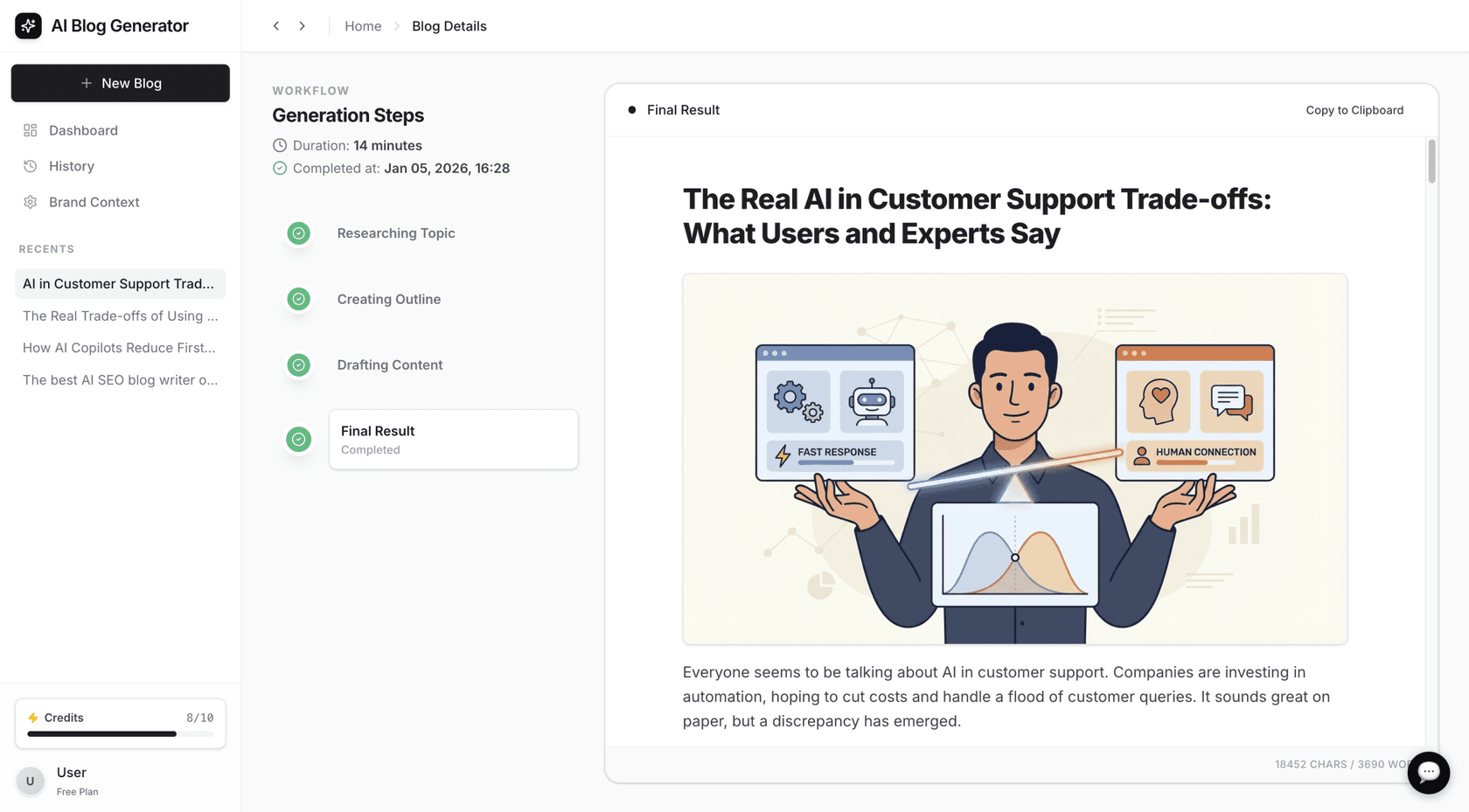
It’s the exact tool we used to grow our own site from 700 to 750,000 impressions per day in just three months. We did it by publishing over 1,000 highly optimized blog posts that are built to be cited.
Its features are designed to help with AEO:
-
Automatic assets: It creates AI-generated images, infographics, and tables that make your content richer and more likely to be used as a source.
-
Social proof integration: To build authority, it pulls in real Reddit quotes and relevant YouTube videos. This adds a human touch that AI models are starting to look for.
-
Context-aware research: The AI understands the topic. If you're writing a comparison post, it finds pricing data. For a product review, it digs up technical specs. This makes sure your content is factual and trustworthy.
-
A focus on natural tone: We've spent over a year tweaking our models to produce content that is readable and engaging, avoiding a robotic feel.
The best part? It's completely free to try. You can generate your first blog post and see the quality for yourself. There’s no reason not to give it a shot.
How to choose the right AI mode SEO tracking tool
Feeling a bit swamped by the options? Here’s a quick guide to help you decide.
-
For large enterprises: Security and in-depth reporting are probably your main concerns. Check out tools with SOC 2 compliance like Semrush or the enterprise plan from Peec AI.
-
For agencies: You need something that can juggle multiple clients and maybe offer white-label reporting. SE Ranking is a good option, as is the flexible credit model from RankScale that lets you scale your usage.
-
For SMBs and solopreneurs: You're likely looking for the most value. All-in-one solutions like Writesonic GEO or tools with a low barrier to entry like RankScale and Otterly AI are excellent starting points.
Pro tip
My final tip: Take advantage of a free trial. Nearly every tool on this list offers one. Plug in 5-10 of your most important keywords and see which platform gives you the clearest, most useful insights.
Final thoughts on AI mode SEO tracking
The rise of AI Mode is shaking up the search world. For any serious SEO strategy in 2026, having one of these dedicated AI mode SEO tracking tools isn't just a nice-to-have anymore, it's essential.
Visibility is a two-part puzzle. You need a great tool to find your opportunities, and you need an even better one to create the kind of high-quality content that can capture them.
Once you’ve picked your tracking tool and have your data, the next move is to start creating content that's built for this new reality. Give the eesel AI blog writer a try for free and start turning those insights into real, sustainable organic traffic.
Frequently asked questions
What is the main purpose of AI mode SEO tracking tools?
Their main job is to show you how your brand, products, and content are being mentioned within AI-generated search answers from platforms like Google AI Mode and ChatGPT. They track your visibility in this new conversational search landscape.
How are AI mode SEO tracking tools different from traditional SEO tools like Google Search Console?
While traditional tools like GSC track your rankings on the standard list of search results, they can't see inside AI-generated answers. AI mode SEO tracking tools are specifically designed to monitor brand mentions, sentiment, and citation placement within those AI responses.
Can small businesses benefit from using AI mode SEO tracking tools?
Absolutely. In fact, they can be a huge advantage. By using AI mode SEO tracking tools, small businesses can find niche opportunities to become the primary source for specific topics, allowing them to compete with larger brands by being more agile and targeted with their content.
How often should I check my data in AI mode SEO tracking tools?
It depends on your goals. If you're running an active campaign, checking daily can provide valuable, immediate feedback. For general brand monitoring, a weekly check-in is usually enough to spot trends and keep an eye on competitors.
Do AI mode SEO tracking tools guarantee my content will be cited by AI?
No, they don't provide a guarantee. These tools are for monitoring and analysis-they give you the data to understand your visibility. The actual work of getting cited comes from creating high-quality, authoritative, and well-structured content that AI models find trustworthy.
What is GEO, and how does it relate to AI mode SEO tracking tools?
GEO stands for Generative Engine Optimization. It's the practice of optimizing your content to be cited by AI language models. AI mode SEO tracking tools are essential for GEO because they provide the data you need to measure the success of your optimization efforts.