
It seems like a new AI writing tool launches every other day. One says it"ll handle your emails, another your social media, and a third claims it can write a whole novel. It"s a lot to track, and it can be tough to know which ones are effective-especially when you don"t want to spend a fortune.
That’s why we decided to test the most popular free options. The goal was straightforward: find the AI writers that produce quality content without a price tag. The landscape has evolved, with specialized tools like the eesel AI blog writer designed to create complete, ready-to-publish articles, not just first drafts.
Here, we'll break down what we found, covering tools for everything from long blog posts to quick social media captions.
What is a free AI writing generator?
At their core, AI writing generators are tools that use large language models (LLMs) to create human-like text. You provide a prompt with instructions, and the tool generates content based on your request.
These tools are not all the same and typically fit into a few categories:
- Text generators: These are what you probably picture first. You give them a topic, like "benefits of remote work," and they generate new content from scratch.
- Writing assistants: These tools act more like a partner. They help you improve text you’ve already written by checking grammar, suggesting better words, or rewriting sentences.
- SEO content tools: This is a specialized group focused on one thing: creating content that is built to rank on search engines like Google. They help with keywords, structure, and other SEO essentials.
People use them for pretty much everything: drafting blog posts, writing emails, coming up with social media captions, creating product descriptions, and just getting past writer's block.
How we selected the top free AI writing generators
To make this list useful, we put each tool through its paces and evaluated them on a few key criteria for a free tool.
Here’s what we looked for:
- A generous free plan: This was a dealbreaker. The tool had to offer a truly useful free version or a trial that didn't ask for my credit card right away. No "free for 5 minutes" tricks.
- Quality of output: The text had to be solid. We were looking for content that was coherent, readable, and didn't sound like a generic robot. If it needed a ton of editing just to be usable, it was out.
- Ease of use: No one has time to spend hours learning a new piece of software. The platform had to be intuitive and easy to figure out, even for a complete beginner.
- Core features: A good free plan is more than just a word count. We looked for tools that gave access to valuable features like different content templates, tone adjustments, or multiple language options.
A comparison of top free AI writing generators in 2026
For a quick look, here's a side-by-side comparison of the tools we tested.
| Tool | Best For | Free Plan Details | Starting Price (Paid) |
|---|---|---|---|
| eesel AI blog writer | Complete, publish-ready blogs | Free to generate your first few posts | $99/month |
| Rytr | All-round text generation | 10,000 characters per month | $9/month |
| Copy.ai | Quick copywriting templates | 2,000 words per month | $29/month |
| ParagraphAI | Simple, multi-platform writing | 5 uses per day | $24.99/month |
| WriteSonic | Affordable copywriting features | Free trial with 25 monthly credits | $16/month |
| Grammarly | Improving existing writing | 100 AI prompts per month | $12/month (billed annually) |
The 6 best free AI writing generators reviewed
Alright, let's get into the nitty-gritty. Here’s our hands-on review of each tool and who we think it's best for.
1. eesel AI blog writer
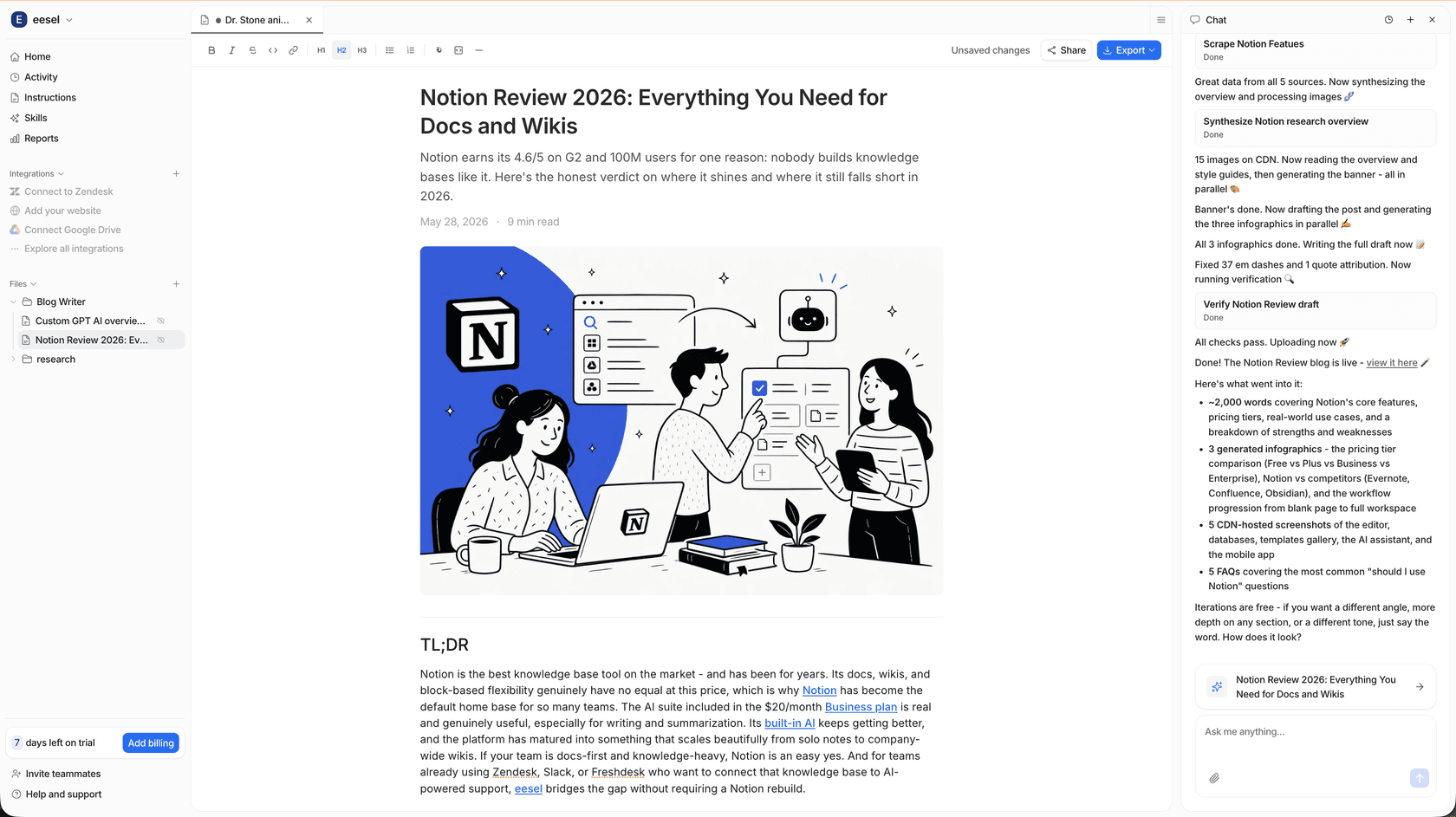
While many AI writers produce a rough draft, the eesel AI blog writer is designed to deliver a more finished article. It’s built to turn a single keyword into a full, SEO-optimized blog post that’s ready to publish.
This tool was used to grow the eesel AI blog, which saw impressive results in three months by publishing high-quality content at scale.
- Pros: It creates a complete content package, automatically adding AI-generated images, charts, and embeds of relevant Reddit quotes and YouTube videos. The writing is context-aware and aims for a human-like tone, which can save a significant amount of time.
- Cons: As a specialist tool for long-form content, it may be more than what is needed for short copy, like tweets or one-line product descriptions. Other tools on this list might be quicker for those tasks.
- Pricing: It's completely free to try and generate your first few posts to see the quality for yourself. After that, the "Early Bird" plan is $99 per month for 50 blog posts.
- Best for: Content marketers, bloggers, and SEO specialists who need to scale the production of high-quality, long-form articles designed to rank in search engines.
2. Rytr
Rytr is a popular and versatile AI writer known for its large library of templates and affordable price. If you need an AI tool that can do a little bit of everything, this is a great place to start.
- Pros: Rytr’s free plan is a fantastic way to get started with AI writing. It supports over 40 languages and has templates for everything from blog outlines to song lyrics, which makes it super flexible. It even has a built-in plagiarism checker, a nice perk for a free tool.
- Cons: The free plan has a monthly character limit of 10,000, which can be restrictive for longer articles. The output may sometimes require tweaking to better match a specific brand"s voice.
- Pricing: There's a free plan with the character limit. Paid plans are very affordable, starting at just $9 per month.
- Best for: Individuals and small teams looking for a budget-friendly, all-purpose AI writer for various short-form content needs.
3. Copy.ai
Copy.ai stands out with its clean, chat-based interface and a library of over 90 templates that make it super easy to get going. It's designed to make creating marketing copy as simple as possible.
- Pros: The free plan gives you 2,000 words per month. Its design is very intuitive, so you can jump right in and start generating ideas for social media posts, ad copy, or product descriptions with almost no learning curve.
- Cons: The 2,000-word limit is suited for short tasks rather than full blog posts. The content may require fact-checking and the addition of more in-depth information.
- Pricing: A free plan is available. Paid plans start at $29 per month, which includes five user seats.
- Best for: Marketing teams who need a fast, simple tool for brainstorming and drafting short-form copy for ads, social media, and websites.
4. ParagraphAI
ParagraphAI takes a different route by making its tool available just about everywhere you write. It comes as a Chrome extension and mobile keyboard, so you can get AI help on the go.
- Pros: The "free forever" plan is a big plus, offering 5 uses per day, which is great for casual users. The mobile keyboard is a neat feature, letting you draft and reply to emails or messages with AI assistance right from your phone.
- Cons: The functionality is more focused on writing assistance rather than full content generation. The daily usage limit on the free plan may not be sufficient for users with consistent, high-volume content needs.
- Pricing: The free plan offers 5 uses per day. The Pro plan starts at $24.99 per month for unlimited use.
- Best for: Students and professionals who need a free, lightweight AI helper for quick writing tasks and email replies across all their devices.
5. WriteSonic
WriteSonic presents itself as a powerful AI writer for marketing and SEO content, and it backs that up with over 100 different templates and tools.
- Pros: The free trial is a great way to test it out, giving you 25 monthly credits to experiment with. It includes some really useful features that other tools charge for, like a built-in SEO optimizer and a plagiarism checker.
- Cons: For long-form content, the output may occasionally lack a cohesive flow. The credit system, where different tasks consume different credit amounts, can take some time to get used to.
- Pricing: A free trial is available. Paid plans are affordable, starting at $16 per month.
- Best for: Freelancers and marketers who want a feature-rich AI writer with a solid free trial to handle a wide range of copywriting tasks.
6. Grammarly
You probably know Grammarly as the world's most popular proofreading tool, but it has evolved. With its suite of AI agents, it now has some impressive text generation features, too.
- Pros: The free version is a must-have for anyone who writes anything at all. It offers top-tier grammar, spelling, and clarity suggestions. The 100 free monthly AI prompts are perfect for things like rephrasing a clunky sentence, brainstorming a few ideas, or getting a little help when you're stuck.
- Cons: Grammarly's generative AI functions as a writing assistant to improve existing text rather than a tool for creating entire articles from scratch. It is also primarily focused on English-language content.
- Pricing: The free plan is excellent and powerful. Pro plans, which offer more advanced features and more prompts, start at $12 per month (when billed annually).
- Best for: Literally everyone who writes. It's an essential tool for proofreading and a great, low-stakes way to start using AI to assist your writing process, not replace it.
Tips for getting the most out of a free AI writing generator
No matter which tool you pick, there are a few things you can do to get better results. An AI tool is fast, but it needs clear instructions.
- Be specific with your prompts: The more context you give the AI, the better the output will be. Don't just say "write about coffee." Instead, try something like, "Write a 500-word blog post for beginners about the differences between arabica and robusta coffee beans, using a friendly and educational tone." Give it a clear mission.
- Fact-check and verify: AI models can sometimes "hallucinate," which is a nice way of saying they make things up. Always, always double-check any stats, facts, or important details before you publish. Trust, but verify.
Overall, it can be an economical option for writing marketing and SEO materials but I would definitely fact-check and proofread before hitting publish.
- Edit for your brand voice: The AI will give you a great starting point, but the final piece needs your human touch. Go through the draft and add your unique perspective, personal stories, and brand personality. This is what separates great content from generic AI filler.
- Use AI as a collaborator, not a replacement: The best way to use these tools is as an assistant. Let them handle the heavy lifting of research, outlining, and getting words down. You, the human, should always be in charge of the strategic and creative direction.

While these tips can help you refine the output of any AI writer, seeing them in action can provide even more clarity. The following video offers a hands-on comparison of several popular tools, demonstrating how different platforms handle similar prompts.
How to choose the right free AI writing generator
The best AI writing generator is the one that fits your specific needs. If you need a versatile tool for various short-form copy, Rytr or WriteSonic are excellent choices. To improve your existing writing, Grammarly is a very effective tool.
For those whose goal is to publish complete, SEO-optimized blog posts designed to drive traffic, a specialized tool like the eesel AI blog writer is worth considering.