
AI that writes for you isn't science fiction anymore. It's a real, everyday tool for anyone who creates content. The problem? There are hundreds of them now, and finding one that actually helps, instead of just creating a huge editing headache, is tough.
They all make the same promises: save time, boost quality, write better than a human. But the reality is, the output can range from helpful to unusable. Trying to find a good one can feel like a full-time job.
This guide aims to cut through the noise, sharing seven of the best AI writing tools that have been personally vetted. We'll break down who each one is for, what it's good at, and where it falls short.
What is an AI tool for writing?
An AI writing tool is software that uses artificial intelligence (like Natural Language Processing, or NLP) to help you write or edit text. These tools learn by analyzing massive amounts of human-written content to get a handle on context, style, grammar, and all the little details.
But they're not all cut from the same cloth. They usually fit into one of three main categories:
-
AI Text Generators: These are the tools that create content from the ground up. You feed them a prompt, like "write a blog post about the benefits of coffee," and they give you a first draft. Jasper and Rytr are good examples here. They do the initial work of getting words on the page.
-
AI Writing Assistants: These act more like a collaborator or an editor looking over your shoulder. They don't write for you, but they do improve your writing. They check for grammar, spelling, clarity, and tone to help your work shine. Grammarly is a well-known tool in this space.
-
AI-Powered SEO Tools: This category is all about creating content that's built to rank on search engines. They analyze the top-ranking pages for a keyword and give you a data-driven recipe for success, telling you what words to use, how long your article should be, and what questions to answer. Surfer is a big name here.
How we picked the best AI tool for writing
This list is based on hands-on usage of these tools. We signed up for accounts, generated a ton of content, played with the features, and scrutinized the final output to see if it was something we'd be proud to publish.
Here’s the criteria we used:
-
Quality of Output: This was everything. Does the content sound like a human wrote it? Is it accurate, interesting, and useful, or is it just generic AI fluff you can spot a mile away?
-
Ease of Use: How fast can a new user get started? We liked tools with simple interfaces that didn't require a degree in prompt engineering to get good results.
-
Key Features & Use Case: Does the tool do one thing exceptionally well? We looked for standouts in different areas, whether that was writing SEO articles, creating marketing copy, or even helping with fiction.
-
Value for Money: Is the price fair? We looked at free plans, trial periods, and what you get for your money with the paid tiers to see if the cost made sense.
The best AI tools for writing at a glance
Here's a quick side-by-side look at the top AI writing tools we'll be diving into. This table should help you see how they stack up at a high level.
| Tool | Best For | Starting Price | Free Plan/Trial |
|---|---|---|---|
| eesel AI | Complete, publish-ready SEO blog posts | $4 per blog post | Free to try |
| Jasper | Business content creation at scale | $59/month (billed yearly) | 7-day free trial |
| Rytr | All-round text generation on a budget | $9/month | Free plan available |
| Copy.ai | Go-to-market (GTM) content automation | $24/month for 5 seats (billed annually) | Not listed |
| Surfer | Data-driven SEO writing support | $49/month (billed annually) | Free trial |
| Grammarly | Improving and correcting your own writing | $12/month (billed annually) | Free version available |
| SudoWrite | Creative writing and storytelling | $10/month | Free to try |
The 7 best AI tools for writing in 2026
After putting dozens of tools through their paces, these are the seven that truly stand out from the crowd. Each one shines in a different way, so the "best" one for you really depends on what you're trying to accomplish.
1. eesel AI
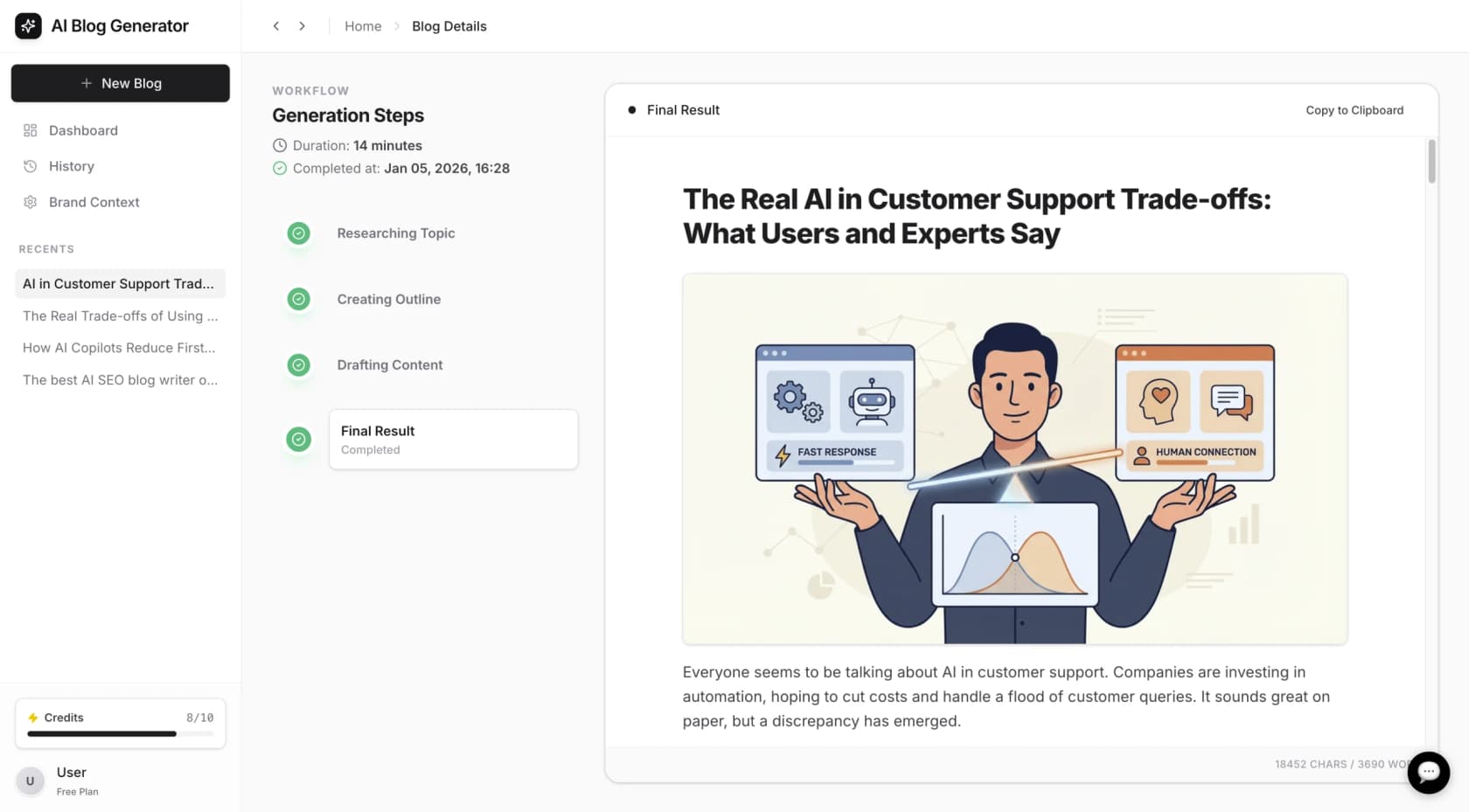
The eesel AI blog writer handles the blog post creation process from start to finish. You give it a topic, and it returns a complete, media-rich, SEO-optimized post that is close to being ready to publish.
-
Key Differentiators & Features:
- Context-aware research: It’s smart enough to know what kind of content it’s creating. For a comparison post, it will automatically pull in pricing data. For a product review, it finds the technical specs.
- Automatic assets: This is a huge time-saver. It doesn't just write text; it pulls in AI-generated images, infographics, and tables. It even finds and embeds relevant YouTube videos and real Reddit quotes to add social proof and make the content more interesting.
- Genuinely human tone: The output is designed to be engaging and readable. It doesn't sound like a robot wrote it, which is the whole point.
-
Limitation: It’s focused on creating blog content. If you need short-form social media copy or punchy ad headlines, this isn't the tool for the job.
-
Pricing: You can try the eesel AI blog writer for free. After that, the blog writer page lists a straightforward $4 per blog post, with no platform fee or monthly minimum.
2. Jasper
Jasper is a comprehensive platform designed for marketing teams that need to produce many different types of content. It calls itself an AI content automation platform, which means it tries to manage everything from planning to publishing.
-
Key Differentiators & Features:
- Jasper IQ: This is Jasper's brain. It combines general marketing knowledge with your specific brand voice, audience info, and product details to create more on-point content.
- Content Pipelines: You can connect your strategy, creation, and distribution into a single automated workflow, which is great for teams.
- AI Agents: Jasper has specialized "agents" for specific tasks like personalization, research, and optimization, which helps streamline common jobs.
- Enterprise-Ready: Jasper is SOC 2 compliant, making it a secure and reliable choice for larger businesses worried about data privacy.
-
Limitation: While it's great at producing first drafts, the content often needs human editing to add a unique perspective and nail search intent. It's also one of the pricier options, especially for solo users.
I like a mix of free Chat GpT and Jasper. Free Chat GPT is actually still better for brainstorming , Jasper doesn’t really always understand the same prompts, the same way. I could ask it to suggest an outline for an ebook blah blah blah and sometimes it takes a lot more correction than chat GPT. But it is helpful for tightening up copy, or rather getting ideas to make it tighter, and things like various classic marketing frameworks.
-
Pricing: Jasper's Pro plan starts at $59 per user per month when billed yearly. They offer a 7-day free trial to test it out.

3. Rytr
If you're a freelancer, a solo business owner, or just need a solid AI writer that won't drain your bank account, Rytr is a great pick. It has over 40 different "use cases," which are just templates for everything from blog outlines and ad copy to video descriptions and song lyrics.
-
Key Differentiators & Features:
- Value for Money: The free plan is surprisingly generous, and the paid plan is one of the most affordable out there. It’s trusted by over 8 million writers, which says a lot.
- Simplicity: The interface is super clean and easy to use. You can start generating content in minutes without needing to watch a bunch of tutorials.
- Language Support: It can write in over 30 languages, making it a solid option if you're creating content for a global audience.
-
Limitation: The output for longer articles can sometimes be generic and might require more editing than what you'd get from a premium tool. The character-based limits on its plans can also be a little confusing to keep track of.
I liked Rytr in pre-chatgpt era. Now I don't use it. And customer support sucks with its 'dark patterns' when it comes to your subscription annual fee. They got my annual subscription fee in advance and when were asked ro a refund THE NEXT day, they just like: 'we don't refund, it's a company's policy... blah-blah-blah-...' Given my previous pre-paid year I didn't use the service almot entirely. Meaning they got 2-year subscription fee almost for nothing...
-
Pricing: Rytr has a free plan that gives you a limited number of characters per month. Paid plans start at just $9 per month (or $7.50/month if you pay for the year).
4. Copy.ai
Copy.ai has evolved quite a bit. It began as a simple copy generator but has now become a full-fledged GTM (go-to-market) AI Platform. It's designed to automate entire sales and marketing workflows, not just spit out bits of text.
-
Key Differentiators & Features:
- Workflow Automation: This is its main selling point. You can build out complex, multi-step processes like processing inbound leads or creating all the assets for an account-based marketing campaign automatically.
- Team-Oriented: The platform is built for collaboration. Even its entry-level paid plan includes multiple user seats, which is great for small teams.
- Integrations: It can connect to over 2,000 applications through Zapier and offers a powerful API for custom setups. It's also SOC 2 Type 2 compliant.
-
Limitation: Its heavy focus on GTM workflows makes it more complex than necessary for individuals or people with simpler content needs. And like any AI tool, the content it generates still needs a human to fact-check and add the final polish.
-
Pricing: Copy.ai's paid "Chat" plan, designed for teams, starts at $24 per month (billed annually, $29 monthly) and includes 5 seats; larger Growth, Expansion, and Scale plans run $1,000 to $3,000 a month.
5. Surfer
Surfer is a little different from the others on this list. It’s a specialized AI tool for SEO content optimization, not a pure text generator. Think of it as your SEO coach. It analyzes the top-ranking pages for your target keyword and gives you a data-driven checklist to follow so you can outrank them.
-
Key Differentiators & Features:
- Content Score: As you write, Surfer gives you a real-time score from 0-100 that measures how well your content aligns with what's already ranking on Google. It's strangely satisfying to watch it go up.
- Data-Driven Insights: It gives you very specific recommendations on what keywords to include, how long your article should be, how many headings to use, and even what images to add, all based on an analysis of over 500 different web signals.
- AI Tracker: This is a neat new feature that helps you see if your brand is showing up in AI search answers from models like ChatGPT and Google's AI Overviews.
-
Limitation: It's a tool designed to help you write, not do the writing for you, and costs climb quickly on the higher tiers. Its AI article generator is a separate add-on, though paid plans now start with a free trial.
-
Pricing: Surfer's Discovery plan starts at $49 per month when you pay annually, with Standard at $99 and Pro at $182.
6. Grammarly
You’ve probably heard of Grammarly. It's the world's most popular AI writing assistant, and for good reason. It’s all about making your writing better. It's an AI-powered proofreader that not only catches embarrassing typos but also offers smart suggestions to improve your text's clarity, engagement, and overall delivery.
-
Key Differentiators & Features:
- Ubiquity: Its browser extensions and app integrations mean it works almost everywhere you write, Gmail, Google Docs, Slack, you name it. It's trusted by over 40 million people for a reason.
- AI Agents: Grammarly has expanded beyond simple proofreading with specialized AI agents like a Paraphraser to reword sentences, a Proofreader for a final check, and even a Citation Finder for academic work.
- Go Assistant: The new 'Go' assistant works in the background to proactively offer help, like summarizing long email threads or drafting quick replies for you.
-
Limitation: It's primarily an editor. While it has some generative AI features, they are more basic compared to dedicated text generators and aren't designed for creating long-form content from scratch.
-
Pricing: Grammarly has a very capable free version that catches most critical errors. Pro plans with advanced features like tone suggestions start at $12 per month per member when billed annually.
7. SudoWrite
While most AI tools are built for marketers, SudoWrite is a love letter to creative writers. It’s designed specifically to help novelists, screenwriters, and hobbyists break through writer's block and bring their stories to life.
-
Key Differentiators & Features:
- Fiction-Focused Tools: You won't find templates for "email marketing" here. Instead, you get creative tools like 'Describe' to add rich sensory details to a scene, 'Story Bible' to organize your characters and plot points, and 'Visualize' to create AI art of your characters.
- Creative Partner: Its 'Write' feature analyzes your characters and tone to suggest the next 300 words of your story in your own voice. Its 'Brainstorm' tool is like having an infinite idea generator on call.
- Privacy: This is a big one for creative work. SudoWrite's privacy policy is clear that they claim no rights over your writing and do not use your stories to train their AI models.
-
Limitation: Its niche focus on fiction makes it unsuitable for business or marketing content. It has no SEO features or marketing frameworks to speak of.
-
Pricing: SudoWrite's Hobby & Student plan starts at a very reasonable $10 per month. You can try it out for free to see if it fits your creative process.
Watching a review can also help you see these tools in action. Here's a helpful overview that explores what makes a good AI writing platform and how beginners can get started.
How to choose the right AI tool for writing
With so many solid options, the "best" tool really just comes down to what you're trying to do. Don't pay for a bunch of features you'll never touch. Here’s a simple way to figure out which one is right for you.
-
If your goal is to publish complete, SEO-optimized blog posts with minimal effort... you need a tool that does more than just write. A solution like the eesel AI blog writer is built for this exact purpose, since it bundles research, asset creation, and optimization into a single step.
-
If your goal is to generate drafts for lots of different content types (ads, social, email)... then an all-in-one platform like Jasper or a budget-friendly and versatile option like Rytr is probably your best bet.
-
If your goal is to automate your entire go-to-market motion... a GTM-focused platform like Copy.ai is specifically designed for your complex needs.
-
If your goal is to improve your existing content's SEO performance... a dedicated optimization tool like Surfer will give you the most detailed, data-driven insights.
-
If your goal is simply to improve your own writing... then a writing assistant like Grammarly is the perfect, always-on writing coach.
Start by figuring out your biggest content bottleneck. Is it coming up with the initial draft? Is it all the research and SEO work? Or is it just the final proofreading and polish? Match the tool to the problem you're actually trying to solve.
Final thoughts
AI writing tools aren't a gimmick anymore. They're genuinely useful assistants that can help you create better content, faster. But they're not a magic button. They can't replace your creativity, your expertise, or your strategy.
The best way to use them is as a co-pilot. Let them handle the repetitive, time-consuming parts of content creation, the initial drafting, the data gathering, the formatting, so you can focus on what really matters: providing unique insights, telling compelling stories, and adding real value for your audience.
The right AI tool can be a powerful asset, streamlining your workflow and helping you produce content more efficiently. To find the best fit, consider your primary use case, whether it's long-form content, ad copy, or SEO optimization, and explore the free trials or plans offered by the tools that align with your goals.
Frequently asked questions
What is the best free AI tool for writing?
Many great tools offer generous free plans. Rytr is a fantastic option if you need versatility on a budget, giving you a set number of characters per month. Grammarly's free version is also a must-have for improving your own writing. For a full blog post, you can try the eesel AI blog writer for free to see how it handles the entire workflow.
Can an AI tool for writing replace a human writer?
Not really. An AI tool for writing is best thought of as a co-pilot or an assistant. It's brilliant at handling the heavy lifting like first drafts, research, and data gathering. But it can't replace human creativity, strategic thinking, or the unique voice you bring to your content. The best results come from combining AI's speed with a human's final touch.
How do I choose the right AI tool for writing for SEO?
For SEO, you want an AI tool for writing that does more than just generate text. Look for tools that incorporate SEO data. Surfer is a great example, as it analyzes top-ranking pages to give you a data-driven checklist. A tool like the eesel AI blog writer is also built for SEO, as it optimizes the content, includes media, and structures the post to rank well from the start.
Is the content from an AI tool for writing plagiarism-free?
Generally, yes. Reputable AI tools generate original content based on patterns they've learned from vast datasets, so the output is unique. However, there's always a small chance of it producing a sentence that's very similar to existing content. It's always a good practice to run the final text through a plagiarism checker like Copyscape, just to be safe.
What are the main limitations of using an AI tool for writing?
The biggest limitation is that an AI tool for writing lacks true understanding and life experience. It can't create genuinely new ideas or provide deep, personal insights. The output can sometimes be generic, factually incorrect, or lack a consistent tone without human guidance and editing. Think of it as a very smart parrot, not a creative genius.
Can I use an AI tool for writing for academic papers?
It's a bit of a gray area. While an AI tool for writing like Grammarly can be incredibly helpful for checking grammar and clarity in academic work, using one to generate the core text is often against university policies on academic integrity. Always check your institution's guidelines before using AI for assignments.